
Click on the image for a detailed view!
Author Archives: Paul
Morrisania (On Everything): On Soccer
_Pollux writes_:
Yesterday, I was listening to “NPR”:http://www.npr.org/templates/story/story.php?storyId=127517884 and heard an interesting factoid: more Americans purchased tickets to see the Soccer World Cup than any other nationality apart from South Africans.
Has America finally fallen in love with soccer? Well, it’s complicated.
As David Wangerin points out in his book _Soccer in a Football World_, the United States may be a soccer-playing nation but we’re not a soccer nation. “Certainly the game has not managed to permeate popular culture,” Wangerin writes, ” – office conversations, school playgrounds, radio phone-ins and so forth – the way the major sports do, and it seems a long way from doing so.”
The United States may go to war for many reasons, but not for soccer. Our archives aren’t filled with blood-soaked, possibly spurious histories about the origins of soccer involving medieval peasants chopping off the heads of Vikings (actual Vikings, not the American football team) and kicking them around (“And thus the game of football was born”).
Timothy Sexton “attributed”:http://www.associatedcontent.com/article/38628/why_americans_hate_soccer_but_not_golf_pg3.html?cat=9 the lack of popularity of soccer in America to the fact that the sport isn’t hand-based. “We still have the memory of our pioneer genesis close to the surface of our society,” Sexton remarks. “This country was literally built from the ground up. We love to do things with our hands. In soccer, you don’t use their hands all that much. It’s a foot-based sport and somewhere deep inside our pioneer psyche, I think we just don’t care for that.”
Why should we care that many of us don’t care about soccer? Does loving soccer finally allow us entry into a Soccer Security Council or a G-5 of Goals? Should we get into fist fights at bars over the merits of the New York Red Bulls versus the Columbus Crew? Should armor-plated policemen charge our soccer fields when riots explode after a terrible 13-0 loss suffered by the New England Revolution?
Why is soccer’s lack of popularity in the United States considered a national defect and a source of wonder and bewilderment? Wind power’s lack of popularity in the United States is more of a problem.
America’s relationship with soccer is like our relationship with Sting’s music: we’re familiar with it, we know that it’s both English and international, that it buys villas in Italy -but who is going to the stadium? Mostly people who grew up listening to Sting’s music.
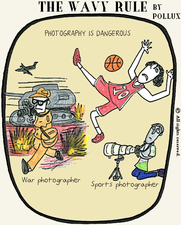
The Wavy Rule, a Daily Comic by Pollux: Photography is Dangerous
Click on the image for a detailed view!
Better Tworld: Beautiful Tweet, Beautiful World
_Pollux writes_:
“I believe we can build a better world! Of course, it’ll take a whole lot of rock, water & dirt. Also, not sure where to put it.”
This tweet, by Canadian Marc MacKenzie, was “crowned”:http://news.bbc.co.uk/2/hi/uk/10250967.stm the most beautiful tweet at England’s Hay Festival.
The judge? The brilliant Stephen Fry, who is a prolific tweeter himself.
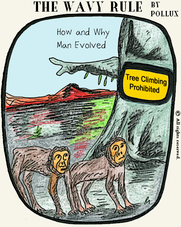
The Wavy Rule, a Daily Comic by Pollux: Evolution
Click on the image for a detailed view!
Sempé Fi: Squared Away
_Pollux writes_:
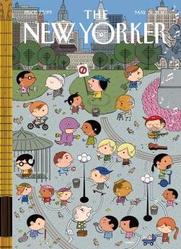
Double issue of _Sempé Fi_ today. Now we’re going to look at Ivan Brunetti’s cover for the May 31, 2010 issue of _The New Yorker_. It’s called “Union Square,” and depicts this New York landmark crowded with Brunetti’s typically diminutive, big-headed figures (Brunetti’s covers are easily recognizable). Even Henry Kirke Brown’s 1856 equestrian statue of George Washington is re-imagined in Brunettian form.
Union Square is usually the focal point for political protests. Brunetti’s Union Square has many people, but only of them can be described as a protestor: she wars a bandanna and holds a sign calling for the ban of something.
The point Brunetti is making is that the call for political action is drowned out by multiple iPods, Bluetooths, and headphones and the steady uproar of daily life. A man strums a guitar, a ponytailed yuppie whizzes by on a Segway, kids play, a man in a purple dinosaur suit hands out ads. As if emphasizing his point, Brunetti’s cover depicts the strings of a large guitar on its left margin. Brunetti’s lone protestor is engulfed by the park and by the skyline.
Who is listening to the protestor? No one. No one is up in arms because everyone’s arms are full with the needs and rhythms of daily life.
The Wavy Rule, a Daily Comic by Pollux: Certified Male

Click on the image for a detailed view!
Sempé Fi: Boomerang

_Pollux writes_:
“Parents groan about the ‘boomerang’ generation,” Gerald Handel and Gail G. Whitchurch write in _The Psychosocial Interior of the Family_, “young adults who return to the nest and stay beyond the time when, in years past, they would have been expected to be independent. Parents send their kids out, but they keep coming back.”
And certainly the parents featured on Daniel Clowes’ cover for the May 24, 2010 issue of _The New Yorker_ look dismayed to see the return of their adult son. Clowes’ cover, called “Boomerang Generation,” refers to a social phenomenon of our time: grown children, often college graduates, who are retying the apron strings.
Clowes depicts an amusing but credible scene: a student, having recently earned his PhD, hanging his diploma alongside past triumphs from his elementary and high school days. The student has returned home; he is surrounded by luggage and boxes. Tim is once again occupying “Tim’s Room.” Parents, keep out (unless you’re there to collect laundry or trash).
His parents look on, saddened and disappointed. Perhaps they had hoped to turn “Tim’s Room” into a gym or a room they could rent out.
What now for Clowes’ newly minted graduate? Will he sit around, getting his laundry done by maternal hands and visiting his old haunts? Will he reflect on how small his bedroom feels compared to the campus dorm he shared with two roommates from Uruguay and Taiwan, respectively? What will he do with his dissertation on Livonian peasant culture?
The trend of a Boomerang Generation, which merits an entry in the _Encyclopedia of Social Problems_ (it comes after “Body Image”), is linked to multiple causes: young adults marrying later, fewer employment opportunities, the high cost of housing.
But for whom is this a problem? The parents or the children? For the children, becoming a boomerang seems less of a social problem and more of a solution. It makes economic sense. Whether the children become psychologically stunted or not, the thought of how much money is being saved cancels out any possible paraphilic infantilism or diaper fetishism.
For the parents, having their children return home may or may not be a cause for strife. As Vincent N. Parrillo writes in his _Encyclopedia of Social Problems_, “the unhappiest parents are those whose children have left and returned on several occasions, returning because of failure in the job market or in pursuit of education.”
We can lump the parents that Clowes depicts into that category of “unhappiest parents.” But they should not despair. Tim is finding his own way, and one day, while driving past his old high school (“Go Wildcats”), an idea or flash of inspiration will strike him, and he will embark on a new life’s journey.
The Wavy Rule, a Daily Comic by Pollux: Antiphallos the Abstinent Satyr

Click on the image for a detailed view!
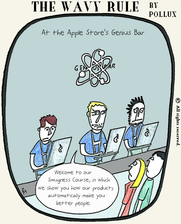
The Wavy Rule, a Daily Comic by Pollux: At the Genius Bar
Click on the image for a detailed view!