

Click on the cartoon to enlarge it!
Read “The Wavy Rule” archive. Look for the sidebar ad to the right of the screen to order your Wavy Rule anthology today!
Monthly Archives: April 2009
President Obama Throws Googly, Is Reading Joseph O’Neill’s “Netherland”
Martin Schneider writes:
At least according to David Leonhardt in the New York Times. A few quick reactions.
1. I’m reading it too! I’m almost done (bet that overachiever Obama beats me to the end, though—I’m savoring). I’m fairly certain it’s the first time that the president and I are reading the same novel at the same time. Did Clinton read Kurt Andersen’s Turn of the Century? I didn’t read any Zane Grey during the Bush years….
2. I admire Obama’s taste. I’ve run into a few people on Twitter and elsewhere calling Netherland overrated, but surely it’s a quality piece of work, even if one feels that it’s been overpraised. I’m not entirely sure how I feel about it yet, but then again, I’m not done yet. Leaning towards thumbs-up, though. What did you make of it?
3. I wonder how much Obama knows about cricket. I know next to nothing.
New Yorker Blog Roundup: 04.30.09
(This content is taken directly from the left nav bar on the magazine’s website.)
Steve Coll wonders if the Times could really be nonprofit.
James Surowiecki loved Obama’s Georgetown speech, even if it wasn’t Churchillian.
Sasha Frere-Jones celebrates Graffiti Kings.
Hendrik Hertzberg on the electoral college and a Fox News stake out.
George Packer discusses George Orwell with the Book Club.
News Desk: What is it with the hundred-days business?
The Front Row: Who still thinks pornography is enlightening?
The Book Bench: Honoring E. L. Doctorow at the PEN Literary Gala.
Evan Osnos provides more details on China’s green-tech space race.
The Cartoon Lounge: Footage from the swing flu of 2006.
Goings On: A Jonas Brothers drug reference?
The Wavy Rule, a Daily Comic by Pollux: High School Abusical
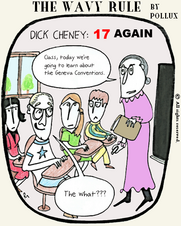
Click on the cartoon to enlarge it!
Read “The Wavy Rule” archive.
It Does Not Matter Where You Write as Long as You Write Responsibly and Well
Emily Gordon quotes:
“The whole blogger versus journalist debate that might have existed around 2004 is dead. Over. Stale. Uninteresting. I couldn’t care less — it’s a meaningless debate to have. What’s more interesting to me is what a blog means now.”
–Sewell Chan, from “So What Do You Do, Sewell Chan, New York Times City Room Bureau Chief?” (MediaBistro)
Spectral Appearances: An Arlen is Haunting The New Yorker
Martin Schneider writes:
In my best stentorian anchorman’s voice, I can honestly write that Senator Arlen Specter “rocked the political world today” when he announced that he would switch his party affiliation from Republican to Democrat, ensuring the Democrat’s a filibuster-proof majority in the Senate once Al Franken is seated sometime in June (it looks like). Specter is truly the man of the president’s 100th day.
When he was district attorney of Philadelphia, Arlen Specter was quoted in The New Yorker in opposition to the new Miranda rule. It was the December 14, 1968, issue. Since then he has appeared in the magazine’s pages many times—and there’ll be plenty more in the near future.
(Note that “Fight on the Right,” by Philip Gourevitch, and “Killing Habeas Corpus,” by Jeffrey Toobin, are actually about Specter, rather than merely mentioning him in passing.)
Here’s the full list:
“The Turning Point,” Richard Harris, December 14, 1968
Comment, Garrison Keillor, August 20, 1990
Comment, Adam Gopnik, October 28, 1991
Comment, Josselyn Simpson, August 3, 1992
“The Ogre’s Tale,” Peter J. Boyer, April 4, 1994
“Flat-Tax Follies,” Warren St. John, June 5, 1995
“The Western Front,” Sidney Blumenthal, June 5, 1995
“Ghost in the Machine,” Sidney Blumenthal, October 2, 1995
“Speaker of the Casino,” Sara Mosle, November 13, 1995
“The Stranger, Mary Anne Weaver, November 13, 1995
“Advice and Dissent,” Jeffrey Toobin, May 26, 2003
“Fight on the Right,” Philip Gourevitch, April 12, 2004
“The Candidate,” William Finnegan, May 31, 2004
“Hollywood Science,” Connie Bruck, October 18, 2004
“Blowing Up the Senate,” Jeffrey Toobin, March 7, 2005
“Ups and Downs,” Hendrik Hertzberg, November 14, 2005
“Unanswered Questions,” Jeffrey Toobin, January 23, 2006
“Hearts and Brains,” Hendrik Hertzberg, November 6, 2006
“The Art of Testifying,” Janet Malcolm, March 13, 2006
“Killing Habeas Corpus,” Jeffrey Toobin, December 4, 2006
“The Spymaster,” Lawrence Wright, January 21, 2008
“State Secrets,” Patrick Radden Keefe, April 28, 2008
“The Dirty Trickster,” Jeffrey Toobin, June 2, 2008
“The Gatekeeper,” Ryan Lizza, March 2, 2009
Fighting the Plague of Our Time: the Ban Comic Sans Movement

_Pollux writes_:
One reads alarming statistics sometimes. The “increase”:http://www.newyorker.com/reporting/2009/04/20/090420fa_fact_bilger in the number of gigantic Burmese pythons in Florida, the growing rate of sea-ice shrinkage, the country’s unemployment rate.
Here’s another statistic that will chill your blood: by approximately 2018, usage of the “Comic Sans font”:http://en.wikipedia.org/wiki/Comic_sans will have surpassed usage of the Helvetica and Times New Roman fonts. By 2030, Comic Sans will be the only remaining font. All other fonts will be extinct and will go the way of grunge and post-grunge lettering.
These are the statistics provided by the “Ban Comic Sans movement”:http://www.bancomicsans.com/about.html, which has sprung up in reaction to the Comic Sans typeface, originally designed by “Vincent Connare.”:http://www.connare.com Connare, as reported in this “_Wall Street Journal_ article”:http://online.wsj.com/article/SB123992364819927171.html by Emily Fleet, is not exactly against the movement against his typographic baby, and is certainly fonder of one of his other creations, the “Magpie font.”:http://www.connare.com/type.htm
Originally designed in 1994, Comic Sans has become the _bête noire_ of the typography world but “sometimes it has been a superhero, as seen in this humorous video,”:http://www.collegehumor.com/video:1823766 and sometimes a “dim-witted creature with a lisp.”:http://www.sheldoncomics.com/archive/070510.html
Holly Sliger and Dave Combs, the husband-and-wife team who started the Ban Comic Sans movement and man the typographic barricades, offer merchandise, font alternatives, and oratory on their website to inspire us all:
“By banding together to eradicate this font from the face of the earth we strive to ensure that future generations will be liberated from this epidemic and never suffer this scourge that is the plague of our time.”
The Wavy Rule, a Daily Comic by Pollux: Horse/Power
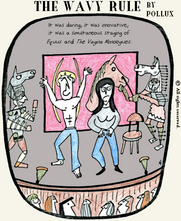
Click on the cartoon to enlarge it!
Read “The Wavy Rule” archive.
Tennis, Anyone? Budge, Cramm, Thurber, and the Nonexistent Mrs. Poos
Martin Schneider writes:
I noticed in Jay Jennings’s review of Marshall Jon Fisher’s A Terrible Splendor: Three Extraordinary Men, a World Poised for War, and the Greatest Tennis Match Ever Played, in the Wall Street Journal, that James Thurber is mentioned as “the tennis-besotted writer for The New Yorker magazine.” I didn’t know Thurber was such a tennis fan; does anyone know if the subject pops up much in the better-known Thurber collections?
The intersection of tennis and The New Yorker cannot but remind me of my father, who was a fan of both things for most of his life (Herbert Warren Wind was a particularly special byline). Furthermore, I remember him telling me about that particular match—Don Budge against Baron Gottfried von Cramm in 1937, a sort of tennis version of the second Joe Louis-Max Schmeling bout, which happened a year later (turns out, both Schmeling and von Cramm were good guys; the story of von Cramm’s life is especially interesting). The setting was Wimbledon, but the match was not a part of the well-known tournament; it was a Davis Cup semifinal.
Knowing a fair amount about the subject but not about the book, I feel confident in recommending it anyway. The book apparently omits an amusing story connected with the match that my dad used to tell. Here it is, quoted from Budge’s memoir (I found it here):
I know I was still in a daze in the locker room. It was as if everyone was trying to outdo each other in congratulating me. Tilden came in, and it was right then that he came over and told me it was the greatest tennis match ever played. Others had about the same thing to say as Tilden did—everyone, that is, except Jack Benny. He came in with Lukas an Sullivan, and while they were raving on at length, Benny just shook my hand and mumbled something like “nice match,” as if I had just won the second round of the mixed doubles at the club. I remember, Jack Benny was the only calm person in the whole locker room. The place was like a madhouse.
[snip]
After I won at First Hills, I went out to Los Angeles to play the Pacific Southwest Tournament. After my first-round match there, which was a rather normal, unexciting one, I looked up from my locker, and who should be coming at me but Jack Benny. He was positively beside himself, hardly pausing to say hello before he launched into a babbling, endless dissertation on how wonderful, how exciting, how fantastic the Cramm match had been. It was like one of those scenes from his show. I would keep trying to interrupt him, unsuccessfully. “But Jack”—I would try to start. And he would go right on.
“Magnificent, Don. It was just marvelous. Why when you—it was incredible. And then you—why, I’ve told everybody about it.” And on he went.
“But Jack,” I kept on, so that at last he stopped long enough to take that pose he is famous for, the palm cupped on his cheek, staring at me curiously. “Jack, I don’t understand,” I began. “At Wimbledon, after the Cramm match, you were the only person I met who was relaxed and calm. Now you carry on like this. The match was two months ago. Then you were unmoved. Now you’re jumping around all excited. What is it?”
“Don,” he said. “The truth is, that the Cramm match was the first tennis I ever saw. Now since then I’ve seen others, but at the time I thought all matches were more or less like that.”
I decided to search Thurber’s New Yorker contributions for tennis references, and found a silly and slight short story called “This Little Kitty Stayed Cool.” I can’t improve on the abstract:
Tells of girl who is an excellent tennis player. Her name is Kitty Carraway. A man by the name of Poos is proposing to her, but she doesn’t like the name Poos and refused. It just doesn’t sound as nice as Kitty Carraway. Argument.
Frankie Manning, Dance Legend, 1914-2009
-thumb-182x136.jpg)
Farewell to a radiant human being, a breathtaking performer, a great teacher, a jazz innovator, and the inspiration to untold numbers of swing and other dancers around the world.
This remarkable photo of Frankie, taken (most likely) last year, is by Holly Van Voast and is used with permission.
Later: That weekend was a long and lindy-hopping celebration of Frankie’s life and exuberant self.