
Martin Schneider writes:
Emdashes is very pleased to feature an events report by a new friend of the site: Ethan de Seife, professor of film at Hofstra University and author of the delightful “Cultographies” book on This is Spinal Tap. He also has a forthcoming book on the director Frank Tashlin.
With no further ado, we turn it over to Ethan:
The big red LED clock at the back of the Times Center auditorium last Wednesday had just blinked precisely 9:00pm as I and the rest of the crowd filed out, having witnessed precisely 90 minutes of “conversation with music,” in which American music icon Emmylou Harris was interviewed by fawning New York Times writer Dana Jennings. This was a tightly run ship.
Given the opportunity, I, too, would likely fawn over Emmylou Harris, whose records have been at or near the center of my collection for a couple decades. Harris’s credentials as a musician and singer are entirely unimpeachable: she is unquestionably one of the most important and sensitive interpreters of American popular song of the last four decades. In the most recent of those decades, give or take, she has turned to songwriting, and she’s quite good at it—not as good as she is at singing, but, then, Emmylou Harris sings better than most people on earth. She is eminently fawnworthy. Still, Jennings’s forced familiarity grated after a while. But we were not there to hear him.
Harris sang a couple of fairly lightweight songs of her own composition, the better of which was a tribute to her friend and inspiration, the recently deceased Kate McGarrigle. The two songs left me craving more, especially since I hadn’t seen her perform since the late 1990s, at the tail end of the Wrecking Ball tour (when she was supported by the remarkable Spyboy band).
The real goal was to get Harris to talk, not sing. And she told some good stories: writing to Pete Seeger when she was a girl; many tales about her beloved dogs; fond remembrances of departed colleagues Hazel Dickens and Charlie Louvin; and the inevitable recollections of Gram Parsons, about whom she was quite frank in her assertion that he did nothing less than change her life, both by “discovering” her and by dying, so very very young, when he and she were lovers.
Ultimately, though, the event did not get much more revelatory than a good, solid magazine interview, and it carried the whiff of something more than a little prefabricated: the second-by-second LED countdown clock; the three camera operators, and so on. So while I would love to have Emmylou Harris over for tea—she seems charming, warm, and good-humored, and I’d love to play for her and sing along with her to, say, my Moe Bandy and Ferlin Husky records—this “TimesTalks” venue did not really play to her many strengths.
Monthly Archives: April 2011
“The Most Trusted Man in America”: Know Your Jon Stewart
Emily Gordon writes:
While ambling around looking for photos of Jon Stewart and Laura Kightlinger together after hearing her be witty (and briefly mention having dated Stewart) on the Marc Maron podcast recently, I happened on this Moment magazine profile of Stewart by Jeremy Gillick and Nonna Gorilovskaya. Read it! It’s smart and thorough, and explores, among other things, Stewart’s Jewishness and relationship to Israel and Jewish history and politics. Here’s a graf I appreciated, followed by one that I know friend-of-Emdashes Ben Bass will either have already noted on his blog or soon will:
After waiting to hear some “constructive criticism” of Israeli policies that “may not be in the best interest of the world,” Stewart rolled clips of silence and went for the kill: “Oh! I forgot! You can’t say anything remotely critical of Israel and still get elected president! Which is funny, because you know where you can criticize Israel? Israel!”
Although the topic doesn’t come up often, it’s also evident where Stewart stands on intermarriage. In 2000, he married Tracey McShane, a veterinary technician and a Catholic. Stewart, who does The New York Times crossword puzzle daily, popped the question with a puzzle of his own. The paper’s “Puzzle Master,” Will Shortz, found Stewart a puzzle creator for the occasion.
I also liked this, toward the end:
Despite his effort to be a fair and balanced mocker, Stewart’s reputation as the “most trusted man in America” should be taken with a grain of salt. Such stature is not unusual for a comedian, says Nicholas Lemann, the dean of the Graduate School of Journalism at Columbia University. “Johnny Carson in his heyday, you could make that statement about.” Lemann warns against generalizing about how far that trust spreads beyond Stewart’s core audience. “I think that’s a kind of a blue-state perspective and youth perspective. To many of my cousins in Louisiana, Rush Limbaugh is the most trusted man in America.”
Anyway, as I said, read it all!
UnderWikied? An Occasional Series
Jonathan Taylor writes:
In this age of the gloriously elaborated Wikipedia page, I’ve lately come across a number of entries that I’m surprised are so scanty. I am going to start taking note of some of them here.
Today’s entry: Jane Bowles.
Shirley MacLaine, “Squirrelly” and Pretty Marvelous
Martin Schneider writes:
When 92Y has a good event, it’s a doozy.
On Monday night Shirley MacLaine consented to be interviewed by WNYC’s own Leonard Lopate (an unexpected surprise—I hadn’t read the event preview carefully enough). I say “consented,” but the truth is, MacLaine’s casino-style show (she mentioned Atlantic City) apparently is mostly an evening of stories and audience Q&A too, and the woman is so ridiculously appealing and entertaining, she could certainly make a living doing just that and not being an incredibly good actress—which she still is, at 76. Also, she appears to cherish being the center of attention and twitting foils like Leonard Lopate for fun.
I could give an account of the event but it was mainly just MacLaine being very charming and telling stories that occasionally involved conversations with people like Nehru (!).
A few highlights: Early during the filming of The Trouble with Harry, her first movie, Alfred Hitchcock walked up to her and the advice he gave her was “genuine chopper.” (Cockney slang for “real axe” = “relax.”)
MacLaine is friends with William Peter Blatty, who wrote The Exorcist in order to “prove” to MacLaine that evil exists in the world. MacLaine was offered the Ellen Burstyn role but her agent convinced her that the script was no good.
Stephen Hawking once told MacLaine that he believes that he is the reincarnation of Sir Isaac Newton. I suspect Hawking was pulling her leg, but who knows?
MacLaine called the recently departed Elizabeth Taylor “my closest friend” and said that her nickname for MacLaine was “Squirrelly.” (I particularly like this.)
In the second half MacLaine spoke at length about her belief in past lives and also UFOs. She also has a lot of silly ideas about 2012 as the end of a 26,000-year cycle or something—I guess we’ll find out next year. I think all of this is poppycock, of course. Alexander Pope said it best: “A little learning is a dangerous thing.” Because what MacLaine is is a highly intelligent woman in the highly intuitive field known as acting, and that means she’s a great actress and not a great analytical thinker. As if that mattered at all.
MacLaine told a story about the filming of Madame Sousatzka that clarified the situation for me a little bit. She said that she made a deal with the movie’s director, “brilliant, cynical” John Schlesinger, that she would play the role by channeling the experiences and emotions of a real woman of the same historical time and place. Obviously she emerged with a very proficient performance, in her mind proving the validity of her belief in past lives.
The key here is that all the business with the past lives is an elaborate, apparently unconscious metaphor for the role of the muse in MacLaine’s life and work. She may believe that this other woman was responsible for that performance, but to me it sounds an awful lot like a tool she used in order to gain the inspiration to give the performance.
In any case, none of this marred the evening a whit. It’s Shirley MacLaine talking about past lives! It’s practically required. And I’ve never seen a 92Y audience quite so delighted. I was with them all the way.
A Study in the Contingency of Journalism: Arendt’s ‘Eichmann’ Typescript at Tablet
Jonathan Taylor writes:
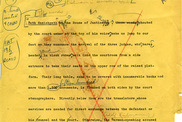
Tablet has some fascinating samples of the typescript of Hannah Arendt’s Eichmann in Jerusalem, marked up with New Yorker editor William Shawn’s editing changes. Allison Hoffman explains, “the text that most people have in mind when they talk about Arendt’s report is not, in fact, the one that appeared in the magazine.” Shawn’s
major cuts and alterations to Arendt’s original are striking in their consistency: Almost all of them involve Arendt’s asides about the contemporary Jewish community and its handling of the trial. Many of the most controversial passages made it into the magazine intact, including her assertion that “if the Jewish people had really been unorganized and leaderless, there would have been chaos and plenty of misery but the total number of victims would hardly have been between five and six million people.” But the final magazine text is in some ways less provocative, more streamlined, and–unsurprisingly, given the precision of The New Yorker‘s legendary copy editor Eleanor Gould–more polished than what’s in the book.
Above all, the manuscript pages, and Hoffman’s backgrounder, give a great sense of the contingency of these things. As Hoffman notes, Arendt wrote her report for The New Yorker because Commentary couldn’t afford to send her to the trial, and “one can only imagine that the final product would have been quite different had Arendt been writing for” Norman Podhoretz.
The Literary Event of 2004 Happens Tomorrow: Peck, Moody, Bernhard
Jonathan Taylor writes:
Tomorrow night at 6:30, Dale Peck and Rick Moody share the stage in a post-grudge match, to discuss Thomas Bernhard’s My Prizes, at the Austrian Cultural Forum in New York City. (Free, but reservation is required.)
Here is Peck’s pretty wonderful Christmas Eve review of My Prizes from the cover of the Times Book Review. I thought it was devilishly perverse that the real payoff—Peck’s explanation of the significance of the texts Bernhard’s prize acceptance speeches themselves—comes only at the end of a relatively long essay that, I imagine, your median Sunday reader may not have gotten as far as.
A more dismissive take on these speeches can be found in Zadie Smith’s review in the March Harper’s, but for registered subscribers only.
Tina Fey, Chick Magnet
Martin Schneider writes:
Last Friday I attended one of the most memorable (not exclusively in good ways) author events I have ever been to. The estimable Tina Fey has a new book out (Bossypants), and she made one author appearance in the New York City area (she will visit only four other cities in the entire tour).
At the event, scheduled for 7pm at the largest retail event space in the city (the Barnes and Noble on Union Square, 4th Floor), Fey would be interviewed by The New Yorker‘s editor in chief, David Remnick; Fey has recently published two sneak excerpts in the magazine.
I harbored a strong suspicion that the event would be very crowded well before the scheduled start. I underestimated just how crowded. You can see the Twitter results for “tina fey noble” for April 8 to get a sense of just how early the massive fourth floor filled up. (Yes, I did get in, and stood many, many yards away. By the time I got there, it seemed silly to leave after already having made my way there.) I’ve never seen that space so crowded, but a friend told me he could remember another such occasion—when Fey’s 30 Rock castmate Tracy Morgan appeared there!
The authorities at B&N kept the interview short, in order to accommodate the many hundreds of people who wanted their books signed (Fey graciously agreed to stay until every person got his or her copy signed, a process that surely took a couple of hours).
In his interview, Remnick hewed closely to the contents of the book, even going so far as to read the wacky faux-blurbs on the back cover (every person in attendance was clutching the book as a requirement for entry, so this seemed a bit pointless).
As expected, Fey was intelligent, forthright, modest, and amusing, even as she was fighting off a cold. All evidence suggests Fey’s core fans are a very intelligent and attractive subset of the female population, and it was great to see so many sharp women come out and worship their hero. I don’t know if Fey is poised to become the next Nora Ephron, but whatever she is or is becoming, I’m all for it.
Sidney Lumet, 1924-2011
Martin Schneider writes:
I’ve always liked Sidney Lumet’s movies, and I’ve always liked the idea of Sidney Lumet’s movies, the elevation of sheer storytelling craft over self-indulgent personal expression. Lumet had plenty to express, all right, but he did it with a minimum of fuss and always with his full attention on entertaining the viewer in an intelligent way.
One of the nice things about a career that is so long and varied and apparently free of auteurist mannerisms is that every fan will have a different collection of favorites. Some champion Network; give me The Morning After instead. You like Equus? I’ll take Murder on the Orient Express. Oh, you want Before the Devil Knows You’re Dead? I’m happy with Prince of the City. And I’ve left out at least ten pieces of compulsively watchable Hollywood product.
He had his turkeys, and he had his hits. He made a lot of movies, and most of them were darn good. I think someone once called him the greatest hack director who ever lived; I think he would have understood the profound compliment implied therein.
PS: For more on Lumet, the comments in this ArtsBeat post are uniformly wonderful.
Literally, Extra: Newspaper Nail Art
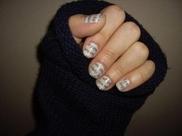 Emily Gordon writes: Thanks to Jennifer Hadley (who also created the original Emdashes logo!) for this: newspaper nail art, courtesy of old media, carefree youths unaware of their own impending obsolescence, rubbing alcohol (“or vodka”), and clear polish. Via, in turn, Je t’aime Morgan and Not Martha. Jennifer thoughtfully follows up with this YouTube video with better instructions. I see this not as a stomp on the corpse of newsprint but as a tribute to its beautiful ordinariness. It’s likely the twentysomethings posting these tips see it as beautifully retro or vintage. I guess that’s OK, too.
A Drinking Game for Any Cocktail Party: When Anyone Says ‘Apparently’
Jonathan Taylor writes:
Someone’s probably written about this already, but, my sometimes ingenious search skills haven’t managed to draw it out.
Tyler Cowen linked to a post by James Somers from about a year ago, about the skillful deployment of the phrase “It turns out….” He says it can have the magical effect of convincing even alert readers, in the absence of evidence, of a proposal “in large part because they come to associate it with that feeling of the author’s own dispassionate surprise.”
This reminded me of an observation—not exactly related and not nearly so incisive—that I’ve long made about the use of the word “apparently,” by people relating information recently gleaned from the news: “Apparently, GE not only paid no taxes last year, the Treasury actually owed it billions of dollars.” (See Felix Salmon for a great overview on the follow-up to that Times story.)
In fact, this usage is touched on in Google’s dictionary definition: “Used by speakers or writers to avoid committing themselves to the truth of what they are saying.” It’s my guess that people use this particularly often in relation to things they read in the New York Times, because it does require some implicit acceptance of the authority of the source. I think even the same people might not say the same thing about something they heard on NPR, but would more likely say, “I heard on NPR that….” Hearing a voice telling you on the radio maybe makes it too clear that the information is second-hand to you, whereas the disembodied authority of one’s most trusted written word is more easily assimilated to one’s own “knowlege.”
However, “apparently” also suggests an openness to acquiring completely new information; I doubt devotees of the Wall Street Journal editorial page introduce their games of telephone with any such qualifier; after all, that information is previously held and immutable belief, not new data.
In any case, use of apparently, overall, is apparently on the decline. If my theory is correct, perhaps the Times paywall will erode it even further.