
_Pollux writes_:
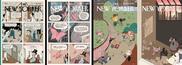
Did you know that if you place the four Anniversary _New Yorker_ covers together, this creates a large composite image of Eustace Tilley? When I “wrote”:http://emdashes.com/2010/02/sempe-fi-7.php about the covers a few days ago, this had escaped my attention.
It wasn’t Dan Brown (or his hero Robert Langdon) who have told me. You can read about this hidden image at the blog “Kempa.com”:http://www.kempa.com/2010/02/09/new-yorker-85th-anniversary-covers-hidden-image/.
Adam Kempa, the blog’s creator, has cleverly, and helpfully, created an overlay of the four covers to reveal the subtle outlines of Tilley.
Monthly Archives: February 2010
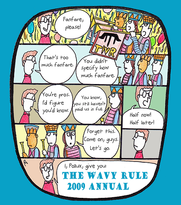
Now Available!: The Wavy Rule 2009 Annual
_Emily Gordon writes_:
It is with great pleasure that we announce the release of _The Wavy Rule: 2009 Annual_, the entire 2009 collection of cartoons by Pollux in one convenient paperback!
“The Wavy Rule” has been running every weekday on Emdashes since June 2008.
We are pleased to offer you the opportunity to get your own copy of the 2009 anthology signed and illustrated by Pollux and shipped right to your door. The 278-page anthology includes all the cartoons that ran in 2009. It’s a bargain for only $8.50 -in honor of the 85th Anniversary of _The New Yorker_.
To order, all you have to do is send payment for $8.50 online through PayPal. You may make a payment there to emdashes [at] gmail [dot] com.
The Wavy Rule, a Daily Comic by Pollux: Rentalympics

Click on the image for a detailed view!
Best of the 03.01.10 Issue: From the Raritan to the Ramapough
Jonathan Taylor writes:
My pick of the March 1 issue is the March 1 issue, just for provoking a Pick of the Issue post. Larissa MacFarquhar’s Profile of Paul Krugman is eye-catching, prima facie, though I’d like to see a piece looking more broadly at the world of economics blogging that Krugman is now engaged with via his Times blog. That could bring us full circle, via Tyler Cowen of George Mason University, to the subject of the issue of Calvin Trillin’s (gated) piece, peripatetic Sichuanese chef Peter Chang: This culinary legend of the U.S. Southeast is a central figure in Cowen’s extenstive Ethnic Dining Guide. (Note to Tyler, put Famous Sichuan on Pell Street, and Grand Sichuan House of Bay Ridge on your New York City to-do list.)
My real pick is Ben McGrath’s “Strangers on the Mountain” (also not free online), the mountain being about 50 miles north of Krugman’s Princeton, in the Ramapo range (which Chang might still try if he really wants to disappear). Just when you think the piece is rather drearily going to be about a conflict between libertarian A.T.V. (and computer) users and the gummint (New Jersey park police), it takes the first in a series of sociological and historical turns that grabbed me over and over. McGrath points out that the so-called Jackson Whites—a.k.a. Ramapo Mountain People, or the Ramapough Lenape Nation—were the subject of some dubious reporting by The New Yorker in 1938, as well as by the Times and others since the 19th century.
Old treatments of the topic by the NAACP magazine The Crisis in 1939, and the Southern Workman, journal of an “industrial school for Negro youth,” in 1911, among others, can be found through Google Books.
Coming Soon: David Remnick’s Biography of Obama
_Pollux writes_:
As “announced”:http://www.nytimes.com/2010/02/23/books/23arts-OBAMABIOGRAP_BRF.html in the _New York Times_, Alfred A. Knopf will be publishing David Remnick’s biography of Barack Obama on April 6, 2010.
The book, entitled _The Bridge: The Life and Rise of Barack Obama_, has been in the works for a while, as Emily “reported”:http://emdashes.com/2008/12/hooray-a-new-david-remnick-boo.php here at Emdashes in 2008.
Sempé Fi: Boing Boing Discusses 1946 Alajalov Cover
_Pollux writes_:
Over at Boing Boing, they’re “discussing”:http://www.boingboing.net/2010/02/25/march-16-1946-cover.html the March 16, 1946 cover for _The New Yorker_, created by artist “Constantin Alajalov.”:http://www.illustration-house.com/bios/alajalov_bio.html
The Wavy Rule, a Daily Comic by Pollux: Dream Jobs
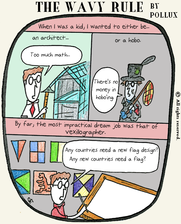
Click on the image for a detailed view!
Sempé Fi: The Butterfly Effect (Four Covers for The Anniversary Issue)
_Pollux writes_:
The February 15 & 22 issue of _The New Yorker_ was The Anniversary Issue of the magazine. To celebrate this occasion, _The New Yorker_ ran a quadruple cover that honored its history, mascot, and sense of humor.
Four artists created various _New Yorker_-tinged realities: in 1925, a struggling male model visits a new publication in order to pose, to his horror, as Eustace Tilley; Eustace’s Butterfly, who also reacts negatively to a vision of Eustace Tilley, performs a poetic monologue; a world of Tilley-like figures record and observe butterflies; Rea Irvin creates the mascot of Eustace Tilley. These visions are both tributes and tongue-in-cheek interpretations of _New Yorker_ history.
Back in 1925, did a male model pose as Eustace Tilley “just the way Mr. Irvin stipulated” for the magazine’s release?
No, but in Adrian Tomine’s “Adaptation,” we are presented with an alternative version of history in which the secret origins of Tilley are revealed. Tomine blurs the line between fantasy and reality, incorporating the magazine’s price tag and date, for example, into the flow of the story. What is real and what is not? Tilley’s Butterfly floats above the male model in the third panel. Tilley’s Butterfly will appear on all four covers, either as an observer or as an observed figure.
In Daniel Clowes’ “Survival of the Fittest,” Tilley’s Butterfly is the cover’s protagonist and main character. A poetic monologue emanates from the butterfly, who reflects on the vanity and destructiveness of mankind.
Tilley’s Butterfly is a scholar, and a hungry scholar at that. He hunts for “elusive nectar,” and finds horror instead, in the form of Eustace Tilley posing in an artist’s studio. Both Tomine and Clowes treat Tilley as a sort of grotesque figure, and in many ways, he is, with his stiff, long neck; large, intimidating suit; top hat; and white gloves.
In Ivan Brunetti’s “Biodiversity,” Tilley is multiplied and transformed into various small figures. Brunetti’s figures retain the size and shape of most of his figures save for the triangular, conceited nose that characterizes Tilley. Brunetti’s hybridized figures, like Tilley, observe butterflies, but do so by different means. They paint the butterfly, create drawings of it on an Etch A Sketch, photograph it, analyze it, and research it. Who needs a monocle when you have an iPhone?
On Ware’s cover, we find the creator of both Tilley and the butterfly: Rea Irvin. In this “piece”:http://www.newyorker.com/online/blogs/tny/2010/02/chris-ware-rea-irvin.html#ixzz0gUsG2sE4 by Chris Ware on the _New Yorker_ site, Ware discusses the difficulties of finding an image of Rea Irvin that he could use as a reference point for his anniversary cover.
As “Emily Gordon”:http://www.printmag.com/Article.aspx?ArticleSlug=Everybody_Loves_Rea_Irvin and I have learned ourselves, Rea Irvin is not an easy historical figure to track down. As Ware writes, “…in this age of find-everything-now, Rea Irvin is nowhere to be found. Do a Google image search and you just get twenty-eight thousand Eustace Tilleys.”
Ware came across the same first image of Irvin that I came across: Irvin sitting cross-legged on a beach in a Buddha-like pose (it is not clear why). In his cover “Natural Selection,” Chris Ware uses this photo as a starting point for his tribute to Irvin. “It occurred to me only afterward,” Ware writes in the same post, “that my efforts at portraiture were essentially ridiculous, since no one today, not even the magazine’s current staff, would know what Irvin looked like.”
Nevertheless, Ware’s cover does what Emdashes has been trying to do: insert Irvin into the popular consciousness so that he does become a recognizable, and recognized, figure in American history.
Rea Irvin is the dominant figure on this cover. Though Tilley’s Butterfly hovers nearest to us, we are drawn to the portly, serious-minded art director who is considering various animal companions for Tilley. Ware’s Irvin believes in research and accuracy: Irvin has a top hat and coat, and has reference books open. Irvin looks keenly at the sketched Tilley figure; something is missing.
Will Tilley’s monocle be focused on a bird, scorpion, primate, bee, wasp, or grasshopper? Which animal will work best?
Irvin has yet to consider the butterfly as the possibility, but we are arriving at the moment of imminent inspiration. Tilley’s Butterfly floats above Irvin in the same way that a flash of inspiration floats above all of us, ready to settle in our brain as soon as we are ready and conditions are right.
Happy Anniversary, _New Yorker_! May there be many more.
The Wavy Rule, a Daily Comic by Pollux: A New Period In My Life
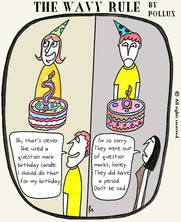
Click on the image for a detailed view!
The Wavy Rule, a Daily Comic by Pollux: The Glazed Tomato
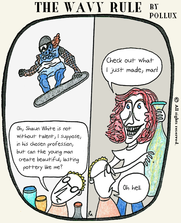
Click on the image for a detailed view!