
Click on the cartoon to enlarge it!
Read “The Wavy Rule” archive.
Monthly Archives: August 2009
Sempé Fi (On Covers): Bridge to Nowhere
_Pollux writes_:
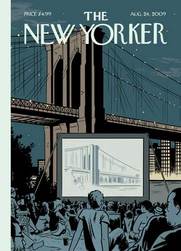
There is a feature playing in an outdoor theatre alongside the Brooklyn Bridge. Tickets are free. All are welcome to come. Flickering on the screen is a shot of the Brooklyn Bridge itself. The audience is entranced. It is a diverse crowd. No one looks at the actual bridge looming behind the improvised cinema.
A movie under the stars makes for a decent Saturday night, maybe a good “second date” or “third date” sort of outing.
Why look up at a marvel of engineering when you can see it on a much smaller screen? No craning of the neck is required; you can see it as you see most of the world: through streaming videos on the CNN website, through newly uploaded Snapfish albums, through the muted flash of Kindle screens.
For the August 24, 2009 cover of _The New Yorker_, “Adrian Tomine”:http://www.adrian-tomine.com/ makes a statement about our world. It is a world in which life and culture seem to be permanently plugged into any device that has a screen: films, iPods, television, and computers. We could spend our whole day viewing, viewing, and viewing some more, and this has become the stuff of life itself. It is life not led but LED, a light-emitting diode existence.
René Magritte created the same sort of imagery and made the same sort of comment in the two paintings called “_The Human Condition_.”:http://www.uh.edu/~englmi/BorgesBaroqueIllusionism/index.html These paintings depicted paintings: in them an easel stands before an open window. The painting on the easel depicts the very same landscape it is concealing. It depicts and conceals it at the same time. Magritte thus toys with reality and our conceptions of it. The painting on the easel is no more and no less real than the landscape behind it.
Tomine’s Magritte-like cover is appropriate to our times. His Brooklyn Bridge is not real; it is simply a depiction of it. Is it any less real than the film that portrays it? Is the film a documentary or a feature film starring the It Girl of the moment?
Our world is a world in which Facebook friendships seem more vigorous and more affectionate than the flesh-and-blood variety. As the ever-waggish Andy Borowitz once “joked”:http://www.youtube.com/watch?v=4cRCHNmoOws, he loves his Facebook friends because they would never betray him as his real friends would.
Are we becoming a world in which reality on the screen is becoming more real than flesh, blood, stone, and brick?
Will battles between nations become transformed into cyber-attacks, in which the websites of embassies are hacked and cities themselves are left untouched and un-bombed? No, that is wishful thinking. It seems that only the good things in life are being transferred to the world of small screens: friendship, architectural works, and concerts.
Tomine’s “last cover”:http://emdashes.com/2009/01/sempe-fi-winter-keeps-us-warm.php for _The New Yorker_, for the January 31, 2009 issue, depicted a different night scene: an ice-cream salesman braving the cold to sell his product, in which light and warmth emanate from the truck that serves as a refuge from the screaming winds.
Tomine’s new cover is equally incongruous, but not obviously so. Tomine makes his point gently and subtly, much like Bruce McCall. Tomine and McCall are the diametric opposites of artists like Blitt, who make their point with hammer blows. _The New Yorker_ needs both types of artists.
We don’t live in an entirely virtual world. The shock of reality always intrudes upon our iWorld of little screens and _Next_ buttons. Perhaps that is just as well. We are alive; what we see on the screen is not.
What’s in This Week’s New Yorker: 09.07.09
Martin Schneider writes:
A new issue of The New Yorker comes out tomorrow. A preview of its contents, adapted from the magazine’s press release:
In “Trial by Fire,” David Grann offers a pathbreaking report, presenting overwhelming evidence that an innocent man was executed by the modern American judicial system—something that has never been proven beyond doubt. Cameron Todd Willingham was put to death by lethal injection on February 17th, 2004, for the murder of his three children by arson, in 1991. But Grann, drawing on court records, government documents, interviews, and even Willingham’s own diaries, shows that the prosecution’s case was flawed in every respect, from the eyewitness testimony to the evidence presented for arson.
In Comment, Nicholas Lemann looks at Senator Ted Kennedy’s legacy of support for universal health care.
Adam Gopnik writes about Michael Ignatieff, the intellectual who may become Canada’s next Prime Minister.
In Shouts & Murmurs, Bruce McCall imagines a health-care newsletter from an unconcerned insurance company.
Jane Kramer looks at Michel de Montaigne’s legacy as the “first truly modern man.”
Hendrik Hertzberg remembers Senator Kennedy, accompanied by a photo of Kennedy from 1962 by John Loengard.
Caleb Crain asks what the pirates of yore can tell us about their modern counterparts.
Joyce Carol Oates reads E. L. Doctorow’s Homer and Langley.
Hilton Als watches the Public Theatre’s production of The Bacchae in Central Park.
David Denby reviews American Casino and The Most Dangerous Man in America.
There is a short story by Orhan Pamuk.
Edward Kennedy, 1932-2009
Martin Schneider writes:
I was hours away from an airplane voyage when news came though of Senator Kennedy’s death. Now, at my destination, I can take the time to accomplish the minimum a post like this should do: direct you to the useful post on The New Yorker‘s website listing the many fine articles that covered Kennedy over the years.
I know I’ll be using it.
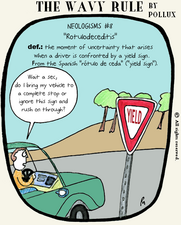
The Wavy Rule, a Daily Comic by Pollux: “Rodulodeceditis”
Click on the cartoon to enlarge it!
Read “The Wavy Rule” archive.
Emdashes Fall Interns: We Want You!
The Emdashes team is looking for bright, New Yorker-phile, syntax-and-punctuation-consumed, creative, and cheerful interns for the fall season. The internship will span from mid-September through December and will be supervised by various members of the staff, all of whom have been interns and will be friendly and supportive mentors in literary-media-political-illustration-design-niche blogging.
It will involve whatever you are best at doing from this list: editing, writing, idea-generating, organizing, tagging, coding, linking, doing multimedia tasks to be determined, reporting local events (not just in New York but wherever you happen to be), reading, reviewing, collecting, scanning, sleuthing, event planning, and/or obsessing. Actually, obsessing is the only absolute requirement. Attention to detail and horror at factual, typographical, and orthographical errors are key.
Benefits include free stuff (books, tickets to events, and the like), plenty of positive reinforcement and honest advice from professional editors and writers, web publication experience, writing clips, and a ticket to the hottest party in town: the Emdashes 5th Anniversary Extravaganza, near New Year’s of this year.
Please send a short email explaining why you are the perfect Emdashes intern to emily at emdashes dot com, and attach your CV and a writing sample or two. We’re looking forward to meeting you!
Best Single Line of Mad Men Commentary I’ve Read So Far
…and I’ve read a lot of it! This made me laugh, given that I’ve been describing the show to those who don’t get the appeal as hat-and-typewriter porn:
James Wolcott writes:
(Note to self: Focus on foreground.)
Read the rest. Could he liveblog everything? That would make my life instantly better.
The Wavy Rule, a Daily Comic by Pollux: Electric Cars on Mars
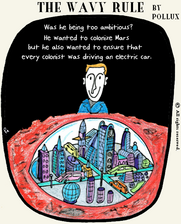
Read Tad Friend’s “profile”:http://www.newyorker.com/reporting/2009/08/24/090824fa_fact_friend on Elon Musk in the August 24, 2009 issue of _The New Yorker_.
Click on the cartoon to enlarge it!
Read “The Wavy Rule” archive.
Rea Irvin’s Birthday Today
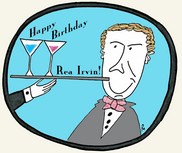
_Pollux writes_:
On this day, a hundred and twenty-eight years ago, Rea Irvin was born in a Californian town named San Francisco. A hundred and three years ago, Irvin traveled to the East Coast to assist in a birth that occurred eighty-four years ago–the founding of _The New Yorker_.
Thomas Edison invented the Kinetoscope as well as the lightbulb, and Rea Irvin did more than simply create the Eustace Tilley cover portrait.
Irvin lent his good taste and good sense towards the creation of _The New Yorker_’s page design, headings, spot illustrations, as well as the archetype of the typical _New Yorker_ single-panel cartoon.
As Emily writes in her important and much-needed “article”:http://www.printmag.com/Article.aspx?ArticleSlug=Everybody_Loves_Rea_Irvin on him, “it was Irvin’s own intimacy with classic form and craft, and his genial willingness to share that expertise, that allowed him to create a complete device: a design, a typeface, a style, and a mood that would be instantly recognizable, and eminently effective, almost a century later.”
Emily and I have worked to pull Rea Irvin out of the shadows that seem to enshroud his life and his work. I wrote the initial Wikipedia article on him, and, in the true spirit of Wikipedia, others have contributed to it, the latest contribution being a series of Irvin “drawings.”:http://commons.wikimedia.org/wiki/Category:Rea_Irvin
Rea Irvin is one of our heroes, and one of the patron saints of this publication that we love so much.
In his honor, we declare August 26 to be **Rea Irvin Day**. Celebrate accordingly.
The Wavy Rule, a Daily Comic by Pollux: Dressed for the Part
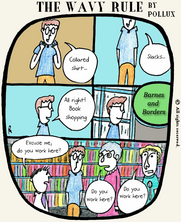
Click on the cartoon to enlarge it!
Read “The Wavy Rule” archive, and “order your Wavy Rule 2008 Anthology today!”:http://emdashes.com/2009/03/the-wavy-rule-anthology-now-fo.php