
In today’s “Wavy Rule,” Paul addresses the question: What does a James Frey novel smell like? Click to enlarge!

More by Paul Morris: Our very own upside-down question-mark naming contest! Plus, “The Wavy Rule” archive; a very funny webcomic, “Arnjuice“; a motley Flickr page; various beautifully off-kilter cartoon collections for sale and free download at Lulu.
Monthly Archives: July 2008
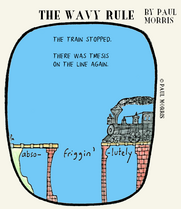
The Wavy Rule, a Daily Comic by Paul Morris: Tmesis Junction, What’s Your Function?
Paul writes about today’s “Wavy Rule”:
What’s tmesis exactly? Well, as one definition goes, “a tmesis is the separation of a word into two, for the purpose of inserting another word between the separated parts…” (John Carey, Latin Prosody Made Easy, 1808, p. 195). The word “tmesis” comes from a Greek word meaning “to cut,” and the figure of speech is found in ancient Greek and Roman poetry. But as a linguistic phenomenon, its use has continued, finding its way in Ned Flanders’ “Wel-diddly-elcome” and the “La-dee-freakin’-da” of Chris Farley’s Matt Foley character. Both examples were provided by the Wiki-freakin’-pedia article on the subject, found here.
More by Paul Morris: Our very own upside-down question-mark naming contest! Plus, “The Wavy Rule” archive; a very funny webcomic, “Arnjuice“; a motley Flickr page; various beautifully off-kilter cartoon collections for sale and free download at Lulu.
Unique New York, Unique New Yorker
At/on/in/with/from/for Radar online, Choire Sicha compares this week’s New York and New Yorker.
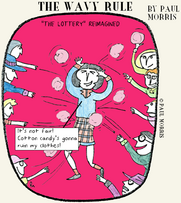
The Wavy Rule, a Daily Comic by Paul Morris: Get Me Rewrite!
Paul explains today’s “Wavy Rule”:
Last week, Benjamin Chambers posted here on the anniversary of the publication of Shirley Jackson’s 1948 story “The Lottery,” which caused an outcry and controversy across America, for reasons you should remember from English class. What if Jackson had been asked to do a rewrite? Click to enlarge!
More by Paul Morris: Our very own upside-down question-mark naming contest! Plus, “The Wavy Rule” archive; a very funny webcomic, “Arnjuice“; a motley Flickr page; various beautifully off-kilter cartoon collections for sale and free download at Lulu.
Holt’s New Book: Not About “Shy, Bald Buddhist”
Martin Schneider writes:
You can divide the world into people who understand that headline and people who don’t.
Yes, yet another book whose origins can be traced to the pages of The New Yorker. Jim Holt has expanded his April 19, 2004, book review into a laughable, if not risible (wait, those are pejorative), in any case highly amusing volume about the nature of the joke. It’s called Stop Me If You’ve Heard This, and Norton is the publisher (no, not Ed, nor Jim neither).
If Amazon had any wit, they’d pair it with James Wood’s How Fiction Works.

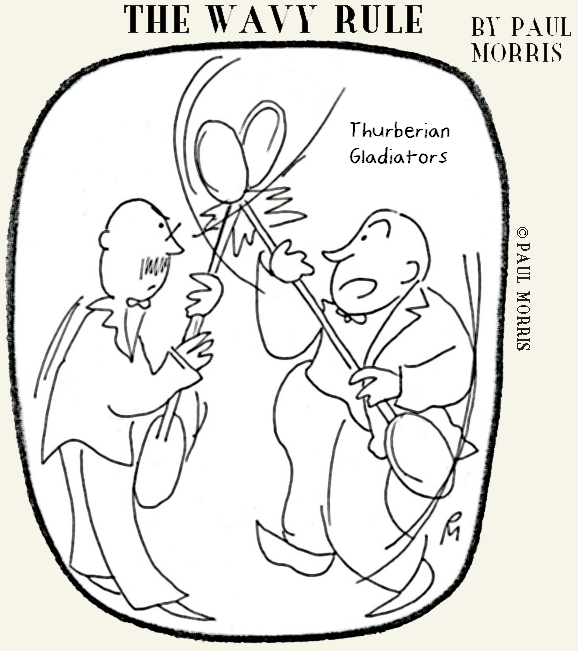
The Wavy Rule, a Daily Comic by Paul Morris: Mitty and Bodwell Smackdown
Paul explains today’s inspired “Wavy Rule” (click to enlarge):
They’ve remade that jewel in the crown of our American heritage: American Gladiators, a show that fed the minds and muscles of countless kids from 1989 to 1996. I’m not sure what the point of that show was–maybe how to educate children on the proper use of skybikes and atlaspheres, or how to play Breakthrough & Conquer, a combination of football and freestyle wrestling. A veritable blast.
Here’s my own remake of the show, with James Thurber-like characters. Instead of Turbo and Nitro, I say we pit Walter Mitty and Bodwell (a character in Thurber’s story “The Night the Ghost Got In”) against one another. Thurber humor and Super Powerballs–who can say no to that?
More by Paul Morris: Our very own upside-down question-mark naming contest! Plus, “The Wavy Rule” archive; a very funny webcomic, “Arnjuice“; a motley Flickr page; various beautifully off-kilter cartoon collections for sale and free download at Lulu.
“The 405” and “the B.Q.E.” Both Mean “40-Minute Delay”
At the Washington Monthly website, Kevin Drum once raised the question of the (relatively) recent New York discovery of the taco (here is our contribution); now he is investigating a regional linguistic quirk: why is it that Angelenos are the only American city dwellers (save those living in Toronto/Buffalo, apparently) who habitually refer to local thoroughfares as “the 5,” “the 405,” “the 10”? Here in New York, you take “95” to get to Connecticut and “87” to get upstate and “287” to get across Westchester and so on.
(A friend of mine may have cracked the case, by the way. In Drum’s third post on the subject, he asks why the prevailing academic explanation—scale of traffic system—does not also obtain in New York City, which also has a high number of highways. Answer: in New York, if you say “the 1” or “the 3,” you’re probably referring to a subway.)
I called up my trusty Complete New Yorker, with the sneaky hope that some prescient gem about the “prepended the” would be contained therein. I found nothing about this definite article business. But I found gems nonetheless.
For some reason they are concentrated in the year 1966. That year, in the October 1 issue, the magazine ran “The Ultimate City,” a Profile on Los Angeles by Christopher Rand. Let’s start with that beguiling Steinberg art, a clear precursor to the famous “View of the World from Ninth Avenue” cover, only from the Los Angeles perspective—and ten years earlier. I zoom out to present the page layout (click to enlarge):

Dedicated as the Profile is to the futuricity of the city, many of the statements therein lend themselves to hindsight evaluation, and the recent spike in gas prices make 2008 an especially good year to excavate it. In dogged, unfussy, even mundane fashion, Rand hits on the main infrastructural features/challenges/problems of Los Angeles you would expect a typical educated representative from the east coast to notice: cars, water, earthquakes, brush fires, freeways, smog. He gets them all.
Rand mentions that the fashionable term for suburbs in the area is “slurbs” (60). Did this term stick? Does anyone say this? Does anyone remember people saying this? Much later (104), Rand writes two sentences that are suggestive from the vantage point of the energy-drained present day. “One wonders what would happen if gas and tire rationing struck L.A. now, as they did at the time of Pearl Harbor.” Indeed, one does wonder. And then: “As for mass transit, it is now talked of as if the city were serious about it.” Surely the skepticism in that sentence is built-in. But having never visited Los Angeles, I leave it to natives to debate whether 1966 was or was not the year the city finally got serious about the subway and bus system.
On page 109 the article mentions “sigalerts,” which term I had only first seen in one of the Washington Monthly posts. I had not realized that the term was so entrenched. In any case, it dates from no later than 1966. For anyone interested in the development of Los Angeles, Rand’s article is a fascinating and essential snapshot.
A few months earlier, in the June 11 issue, The New Yorker ran a cartoon, by Whitney Darrow Jr., with only glancing resonance to Drum’s “Highway Linguistics” series. Here it is (again, clicking makes big):

Staten Island Yankees Catch Irvin Fever
Martin Schneider writes:
Yesterday I went to see the Staten Island Yankees host their crosstown rivals, the Brooklyn Cyclones, at beautiful Richmond County Bank Ballpark at St. George. (The Yankees won, 4-1.)
I couldn’t help but notice that all visitors are greeted with a big blue blast of Irvin type (or something close). I asked my friend Seth Davis to snap a few shots for evidence; they are presented below.




Friday Roundup: Our Interns Bring Us the Best of Newyorker.com
Each Friday, the Emdashes summer interns bring us the news from the ultimate Rossosphere: the blogs and “podcasts”:http://www.newyorker.com/online/podcasts/podcasts at newyorker.com. Here’s this week’s report.
Sarah Arkebauer:
I was pleased to get the scoop on the making of Radiohead’s new music video for the song “House of Cards” in the July 18 Goings On. The video, in the experimental style so typical of Radiohead, was filmed without any lights or cameras. Both the music video and the making-of video are fascinating, and worth a look. Then, in a continuation of what I took to be “Multimedia Day,” the blog also posted a clip from Neil Young’s new documentary, CSNY: Déjà Vu. Ever multifaceted, Neil Young’s clip and the accompanying article do not disappoint.
On July 21st, the Book Bench shared poetic gems from Muhammad Ali; the original copy of one of his poems has just sold for $25,000. The Manhattan Children’s Museum right now has a display of Golden Books for children, which looks interesting. As a current student at Penn and lover of poetry, I was thrilled to see Jenna Krajeski’s July 22 post reference to PennSound, the Penn-hosted audio-archive of poets reading their poetry. Also worth noting: John McCain’s favorite author is Ernest Hemingway.
I am still laughing out loud at the Cartoon Lounge. This week’s blog posts included an interview with Dubai, and a portrait of Paul Giamatti as television’s John Adams, done by the perpetually funny Zachary Kanin.
In the archives of the New Yorker Fiction Podcast is Louise Erdrich reading Lorrie Moore’s wonderful “Dance in America.” First published in the magazine in 1993, and podcast on April 9 of this year, the story is at once poignant and hilarious. Erdrich explains, “[Moore’s] dialogue captures so much of the edginess and yet the kind of wacko quality of conversations between people.” Both the story and the podcast discussion are worth looking into.
Taylor House:
Steve Brodner bemoans the death of the modern newspaper over at Person of the Day. More ads, less news, and maniacal cost cutting have all contributed to their (untimely?) demise. He suggests nothing different, “except to repeat, again, the following: the loss of daily newspapers is a significant threat to the future of our democracy. It is far too important to be left in the hands of a bunch of clueless media moguls and their ‘chief innovation officers.'” Well, okay.
Mick Stevens draws from the euphoric afterglow of a great vacation and writes a lovely post on the nature of leisure. Sharks, lugnuts, and old hippies abound. Ends on a sad note–like most great vacations.
My other blogs have been radio silent this week, so here’s a weeks-old giggle from Dana Goodyear at Postcard from Los Angeles: comedian Zach Galifianakis lip-synching Fiona Apple’s “Not About Love.” Great song, great man, great synching.
Adam Shoemaker:
“It’s not always about us,” writes George Packer in his latest post on
Interesting Times. He’s talking about Prime Minister Maliki’s much-publicized endorsement of Barack Obama’s timetable for withdrawal of American troops, and Packer’s long experience with the insuperability of the Sunni/Shiite divide leads him to suspect that the statement is more a product of Shiite opportunism than of Democratic sympathies. He makes a convincing case that Maliki is staking out a position that would enable him to finish the “ethnic cleansing” of Sunnis from Baghdad while at the same time outflanking Moqtada al-Sadr’s Shiite faction. Grim. He also reports good news this week, in the promotion of (now) General H. R. McMaster, “a humanist, with a doctorate in history, who is allergic to the military’s culture of PowerPoint presentations.” McMaster, whose successful counterinsurgency strategy formed the basis of the 2007 Petraeus campaign in Iraq, is also an advocate of reality in the Pentagon. I know at least one other Ph.D. who will be buoyed by the news.
Notes on Politics, mostly stays true to its name this week as Hendrik Hertzberg continues his valiant fight to expose misconceptions about the National Popular Vote movement. The counter-arguments this time are of a better sort than those investigated a few weeks ago. Hertzberg gives small credence to idea that states’ individual characters should matter in the general election, and this Hoosier would certainly hail the end of “battleground states.” Even so, it at first seemed a little strong to imply that the 3/5 Atrocity continues to haunt us in the form of the Electoral College. Then I remembered that other close election.
Hertzberg also offers his own defense of New Yorker Irony, as incarnated on last week’s cover. He’s not worried, he reports, about that small section of America who might not get it. His concern is that it may have led to the perception that Barack Obama can’t take a joke.
Sasha Frere-Jones writes about what must be considered a great leap forward in the history of music reviews: LOLdogz. The marriage of icanhascheezburger with Pitchfork is surely an unholy one, yet I can’t help but cheer. In other news, the auction of James Brown’s personal belongings brought $857,688 into Christie’s this week, which seemed cute until I read that someone paid twenty-six grand for his diabetic bracelet.
In this week’s New Yorker Out Loud podcast, David Samuels talks about his article on the medicinal marijuana industry in California. I learned a lot…for instance, that 15-20 marijuana plants can pay for a mortgage. There are more than two hundred thousand licensed pot users in the state, a number that now includes Samuels (he assures us his is for reportorial duties only). This kind of legal consumer base and the dispensaries it allows have produced customers as discriminating as those at Whole Foods and connoisseurs as finicky as oenophiles. It’s a great listen, even if Samuels may not be quite as entertaining a guide as Nancy Botwin.
Finally, Andy Borowitz breaks the news we’ve all been waiting to hear—John McCain has at last visited the internet. He may still struggle with the mouse, but we can rest assured our potential commander-in-chief will now have the word of the people at his fingertips—via Yahoo! Answers, that is. All of which inevitably leads to this devoted Wikipedian to dream—Wales ’16?
Previous intern roundups: the July 18 report; the July 11 report.
Exciting Emdashes Contest! ¿What Should We Call the Upside-Down Question Mark?



Above: A haunting dramatization of the dilemma in question. Click to enlarge.
The other day, Pollux, our “Wavy Rule” staff cartoonist, and I were questioning some punctuation: namely, the upside-down, Spanish-style question mark. After consulting friend and lettering expert Paul Shaw–who reports that “Bringhurst just calls it an inverted question mark, no special name”–we decided it was a real scandal that this character dare not speak its name. (Parenthetically, I wonder when the nameless mark will become a standard part of the computer keyboard, especially in America, where Spanish is rápidamente becoming our dual language?) So we decided to sponsor a contest. Paul wrote everything from here on–and, of course, drew the searing cartoon above.
You’ve seen it before. It stands on the west end of elegant Castilian questions: ¿Adónde vas? ¿Cuando llegarás? ¿Quien eres tú?
Ah, the upside-down question mark! Its limited range lends this punctuation mark a certain romantic air, its elegant curve bent and shaped by the same winds that propelled caravels and galleons on treasure runs across the ocean sea, its use first legislated in 1754 by a second edition of the volume OrtografÃa, issued by Spain’s Royal Academy.
You can make one yourself: hold your Alt key down, hit the number-lock key, and then type the numbers “168.” [On a Mac, just type option + shift + ?. –Ed.] There, you see it? It stands nobly, and a little sadly, on your computer screen–like a single tear on the face of a father who’s walking his daughter down the aisle of a church, or like a grandee who has been reduced to complete penury but who still points to his ancient coat of arms on the wall.
A noble punctuation mark, to be sure, but deficient in one regard: it lacks a name. “Upside-down question mark” is purely descriptive. Its Spanish name is equally lacking in punch: “signo de apertura de interrogación invertido.”
Now’s your chance to make history. Name this punctuation mark. Give it a name both euphonious and appropriate. Earn everlasting glory. Win a prize–dinner for two at the Spanish, Mexican, Ecuadorian, Dominican, &c., restaurant of your choice, or, if you prefer, a beautiful copy of Pablo Neruda’s immortal The Book of Questions. Emdashes wants to hear your best ideas, so post them in the comments or, if you’re shy (as so many of you are, we know and sympathize), just email us. All entries are due by August 25, no question about it. We are very much looking forward to your submissions. At TypeCon last week, I got two impressive entries from genuine maniac typophiles; I’ll post them in the comments as soon as things get rolling. The very best of luck to you, and andale!
And if you’d like to see more drawings by Pollux, check out “The Wavy Rule” archive.