
As well they should, really. Occasionally people ask me if I’m a “media watchdog.” In this context, no–I gave at the office. Maybe more like a watch Golden Retriever, or possibly Norton Juster’s Tock. Anyway, Google’s new wikiblogthing, Knol, gives users a way to legally use New Yorker cartoons in posts (“authors are allowed to use one cartoon from The New Yorker magazine per article”), and its inventor, Udi Manber, is a major fan of the cartoons in The New Yorker. What’s more, one of the new iPhone ads features the magazine’s website, showing off how nice it looks in that shiny, happy, my-birthday-is-September-12 device. I saw another iPhone demo recently in which March of the Pengins played a prominent role, and how perfect are those penguins and their ice for the iPhone screen? We will ignore, for the time being, the fact that both birds and habitat are likely doomed, because we (meaning I, in this case) were Appleized from too early an age to ever rethink different, so there.
Thanks to everyone who’s written to me about these news items today! By all means, keep sending us any relevant tips you come across; we can’t read our Google Alerts all day, because there are just too freaking many of them, and besides, the wisdom of crowds!
Monthly Archives: July 2008

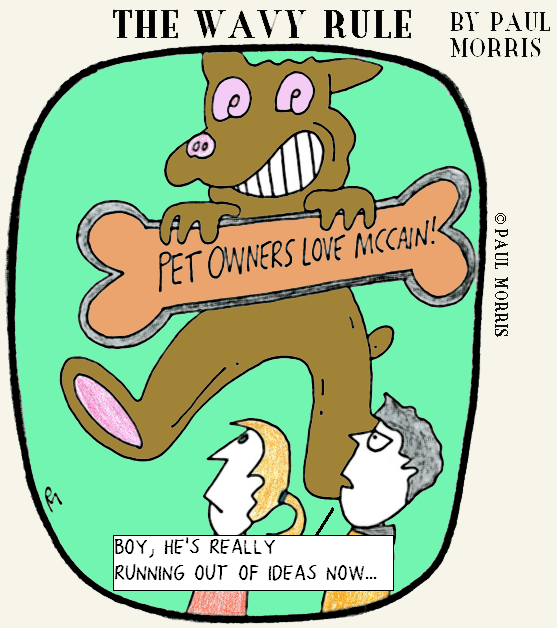
The Wavy Rule, a Daily Comic by Paul Morris: Throw McCain a Bone?
The only thing I like about the McCain campaign is that it rhymes. In today’s “Wavy Rule,” Paul looks at the canine angle of an increasingly panicky political strategy. Click to enlarge!
More by Paul Morris: “The Wavy Rule” archive; a very funny webcomic, “Arnjuice“; a motley Flickr page; various beautifully off-kilter cartoon collections for sale and free download at Lulu.
Save Newspaper Book Reviews From the Doomsday Machine
Scott McLemee makes a fiercely elegant argument for giving book review sections the vote of confidence they deserve.
Happy Belated 60th Anniversary of Shirley Jackson’s “The Lottery”
From Benjamin Chambers:
Yep, it’s been a little over 60 years since the publication of Shirley Jackon’s classic story, The Lottery, which first appeared in the June 26, 1948 issue of The New Yorker.
In Jackson’s honor, the well-known sci-fi editor Ellen Datlow will be hosting a reading of Jackson’s work tonight—that’s July 23rd—from 7pm- 9pm at KGB Bar in New York City (85 East 4th Street, just off 2nd Ave, upstairs). Because the event is a fundraiser for “The Shirley Jackson Awards”:http://www.shirleyjacksonawards.org/, there will be a $5 cover charge. A list of authors who will be reading can be found “here “:http://ellen-datlow.livejournal.com/94546.html.
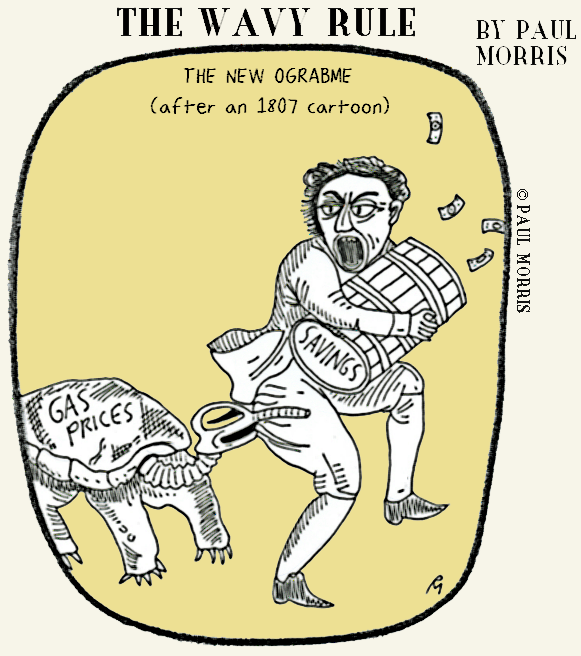
The Wavy Rule, a Daily Comic by Paul Morris: Ograbme!
I’ll let Paul introduce this. I think it’s absolutely great. “The original Ograbme cartoon, visible here, protested the Embargo Act of 1807 (O-grab-me is “embargo” spelled backward). The ograbme was depicted as a snapping turtle detaining an American merchant by the seat of his pants. And now gas prices are doing their damage to both American consumers and businesses.”
More by Paul Morris: “The Wavy Rule” archive; a very funny webcomic, “Arnjuice“; a motley Flickr page; various beautifully off-kilter cartoon collections for sale and free download at Lulu.

Cartoonist Liza Donnelly: “An Insider’s Perspective on the ‘New Yorker’ Cover”
Read Donnelly’s post on wowOwow about the much-discussed cover.
The Wavy Rule, a Daily Comic by Paul Morris: His Gossip Girl Friday
Of this drawing, Paul adds, “I’m worried that this may actually be true.” 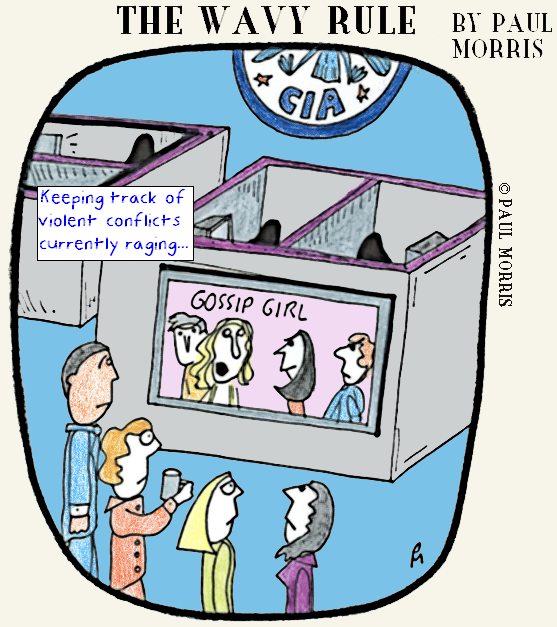
More by Paul Morris: “The Wavy Rule” archive; a very funny webcomic, “Arnjuice“; a motley Flickr page; various beautifully off-kilter cartoon collections for sale and free download at Lulu.
The Wavy Rule, a Daily Comic by Paul Morris: Indiana Jones & a Reverse Turing Test
Today, Paul captures an ancient captcha in hieroglyphic captivity. Are you human? No need to prove it–just click to enlarge.

More Paul Morris: “The Wavy Rule” archive; a very funny webcomic, “Arnjuice,” a motley Flickr page, and various beautifully off-kilter (and freely downloadable) cartoon collections at Lulu.
Ballyhoo at the Return of “The Campaign Trail” (For Me, Anyway)
Hooray, the Campaign Trail podcast is back! For some reason, the July 11 podcast never loaaed into my iTunes until yesterday, when I also downloaded the July 18 edition, which means that I’d been waiting since June 26 for more of Dorothy Wickenden and the gang. For my money, The Campaign Trail and the Washington Week audio feed are the only two weekly-ish political podcasts worth the trouble. The (belated) double dip was welcome indeed.
So after a week in which we heard way too much about the cover of the magazine, let us now praise The New Yorker‘s indefatigable, entertaining, and, at this stage, well-nigh overlooked political team, including but not limited to Hendrik Hertzberg, John Cassidy, George Packer, Jeffrey Toobin, Elizabeth Kolbert, and, of course, Ryan Lizza, who only wrote (in the very same issue!) that great article on Barack Obama that the whole political blogosphere recognized as outstanding.
I wrote way back in 2007 that “one of the rewards of election years is the certainty of … Lemann-esque articles” in The New Yorker, and Lizza’s was just the kind of thing I meant. (Nicholas Lemann wrote terrific articles on Al Gore and George W. Bush during the 2000 campaign.)
Which reminds me: I got to see Lizza interview Rahm Emanuel at the New Yorker Conference. I didn’t document it at the time, alas, but his reportorial chops were very in evidence that day. Lizza had the only interview of the conference that was newsworthy, and he knew it. He treated it as an opportunity to elicit new information, and he kept the pressure on Emanuel, and—what do you know, he committed news. By all means watch the video—you can see him trying to squeeze the most out of his allotted twenty minutes, doggedly refusing to let Emanuel off the hook. And remaining affable throughout.

Interns’ Friday Roundup: This Week in New Yorker Podcasts and Blogs
Each Friday, the Emdashes summer interns bring us the news from the ultimate Rossosphere: the blogs and “podcasts”:http://www.newyorker.com/online/podcasts/podcasts at newyorker.com. Here’s this week’s report.
Sarah Arkebauer:
This week’s Book Bench features a conversation with the new United States Poet Laureate, Kay Ryan, in which she shares her thoughts on clichés–listing some malapropisms that would impress even Honey Bunch Morton. Jenna Krajeski’s post in that same blog has given me a fascinating new way to spend time online—reading up on old issues of Poetry magazine.
I began following the Cartoon Lounge this week, and it’s all sorts of amusing. Its variation—thanks to multiple contributors—keeps it smart and fresh. In particular, Zachary Kanin contributed several humorous posts, including a laugh-out-loud set of instructions for what to do when hiring him. Also excellent is the blog’s recurring Crazy Caption Contest, the wackiness of which is all one could desire.
Alex Ross, of The Rest Is Noise fame, went on hiatus yesterday, but posted a playlist that looks promising. Congratulations are also in order for Mr. Ross: his blog was nominated for the BBC Four Samuel Johnson Prize.
Although Andrea Thompson’s post in Goings On about scientific manipulations to decrease the fattiness of beef left me skeptical and more than a little worried, I got a kick out of her inclusion of a 1966 Talk of the Town article discussing the possibilities of other such modifications.
I enjoyed the July 9th New Yorker Fiction Podcast, in which “Aleksandar Hemon read”:http://www.newyorker.com/online/2008/07/21/080721on_audio_hemon?xrail Bernard Malamud’s short story “A Summer’s Reading.” Hemon’s comments were interesting and insightful—he pointed out that the protagonist’s surname indicates he’s Slavic, not Jewish—but I was particularly haunted by Malamud’s description of Mr. Cattanzara, who reads the entire New York Times every night by the light from a shoe store.
Taylor House:
Steve Brodner has his say about the Obama cover controversy by encouraging his readers to want more. Controversy is healthy, he says, and a pile of angry letters on the editor’s desk shouldn’t scare him into toning it down. Click through and help Brodner support strong graphics in media.
The Campaign Trail podcast poses the question: is Obama’s apolitical image just a front? How much of his campaign is manufactured, and how much is sincere? Can a presidential candidate be a successful politician and remain true to himself? (Yes, all, none, no. But it makes for a lively debate.)
Dana Goodyear of Postcard from Los Angeles looks for an iPhone in all the wrong places. But she does find Rick Caruso, a bigtime LA developer with an eye on the mayor’s seat.
Adam Shoemaker:
This week, George Packer writes in Interesting Times about an Iraqi friend’s ordeal in customs at J.F.K. airport, and wonders about the effects of Homeland Security’s senseless indifference to America’s visitors. He contrasts the beauty of one scene, the disembarkation of the world’s “gorgeous mosaic” into the capital of immigration, with the bitterness of another, those held behind for hours for no apparent reason. “This is the Iraqi style,” protests his friend. “Not the American style.” It is one thing, concludes Packer, to balance immigration protocols against the threat of terrorism. It is another, quite indefensible thing to breed animosity among our guests for no better reason than the uncaring incompetence of a few D.H.S. officers.
Sasha Frere-Jones relates the story of a rare interview with Tupac from the early nineties. The rapper’s instinct for performance and his attempt to reconcile fame and authenticity were both on display in the interview, which also included a sober prediction of his own death. Trish Deitch ends the account with a potent example of the complications of Tupac’s self-definition as it was set against rising stardom. Earlier in the week Frere-Jones also reported on the recent sale of Death Row Records and the rights to Shakur’s unreleased material—the mining of which is hardly unprecedented.
The Borowitz Report lends some much-needed aid to America’s comedians by reporting that Barack Obama has released an approved list of jokes about himself. As might be expected, these revolve around foreign oil, foreclosure, and health insurance. Sadly, the kangaroo and horse do little to save them. Then satire it is, I suppose.
On the New Yorker Out Loud podcast, Matt Dellinger speaks with Jill Lepore about her piece on E.B. White’s decidedly unmousy classic Stuart Little. Roger Angell, E.B. White’s stepson, also joins in the conversation. Lepore talks about her fascination with the piece—and the lengths to which that drove her research. The real story, says the author, is not the battle between E.B. White and the celebrated librarian Ann Carroll Moore, but rather the sometimes noble, sometimes cosseted vision of children’s literature the Victorian Moore tried—ultimately, unsuccessfully—to impose on America’s young readers.
Previously: the July 11 report.