
Founder and frequently meddling publisher Emily Gordon writes:
In blog years, we’re very mature: Emdashes turns four today. I began it in a red-floored Chelsea loft as a labor of love, an antidepressant, and a scratch for my irrepressible itch to sample new technology. Happily, these days, Emdashes reflects the hard work and enthusiasm of many others besides me. Since my first post (about Donald Antrim’s monumental essay “I Bought a Bed”) on December 31, 2004, Emdashes has grown and progressed in innumerable ways. The site looks the way it does because of my collaboration with House of Pretty, about whose whip-smart and big-hearted proprietors, Patric King and Su, I can’t say enough. Every week, you also see the elegant creations of Inkleaf Studio’s Jesse Ewing, chic cartoonist Carolita Johnson, our own Pollux, and my best pal, designer Jennifer Hadley, who adapted a 1943 Dorothy Gray ad into the Emdashes logo you see there above (referred to in-house as “pencil girl”).
What’s more, we now have a genuine staff of editors and regular contributors—including, though not limited to, current editor and total mensch Martin Schneider, ace literary columnist Benjamin Chambers, my scholarly old friend Jonathan Taylor, and my humblingly humble, multitalented new friend Paul Morris, a.k.a. Pollux (whom you can credit for the drawing of me as a prehistoric proto-blogger at right).
I’ve loved editing, and getting to know, the kind, witty, and meticulous New Yorker librarians, Jon Michaud and Erin Overbey, who write the indispensable column “Ask the Librarians.” (Look forward to a fresh installment soon!) The virtual and real-life conversations that the blog has inspired have enhanced my life immeasurably. I’ve soaked up more of the New Yorker Festival and New Yorker Conference, and more readings, lectures, gallery shows, conversations, softball games, histories, anthologies, and other things New Yorker, than I’d ever imagined experiencing (even in my previously acute state of preoccupation). Last year, the site won the coveted distinction of being a Webby Awards official honoree. Four years later, my personal affinity for The New Yorker, and the sometimes cryptic ways in which I try to express it, is only a part of the picture.
This isn’t a blog that had any model, particularly. It’s driven by the collective bees in our bonnets, who are erratic drivers. We write about pigeons. (A lot.) We do whatever we can to make Rea Irvin a household name. I’ve banned a number of words and phrases and pontificated on punctuation. We were entertained and pleased by a large number of submissions to our rename the upside-down question mark contest. We explore the “Best American” series like there’s no tomorrow. We’ve had crazy spikes we couldn’t have predicted—at one time, this site has been the #1 world resource on both the Ricky Gervais cult sensation “I Could Eat a Knob at Night” dance remix and iPod security, not to mention a surprising magnet of commentary on Knocked Up, tacos, and Brandenn Bremmer—while equally spirited analyses are met with baffled silence. We don’t mind a bit. We’ve had fascinating comments from friends and relatives of departed New Yorker writers and artists, all of whom we try to recognize when they pass away.
And we’ve had so much fun. Here’s to the next year—is that five or ten in blog years?—whatever it may bring! Happy new year, dear readers. And to Jasmin Chua and Ashby Jones, you were there when the twinkle met the eye. Thank you.
Monthly Archives: December 2008
The Wavy Rule, a Daily Comic by Pollux: The Curious Case of 2009
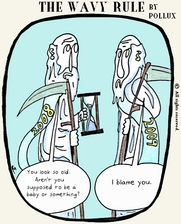
And that wraps up The Wavy Rule for 2008. Have a Happy New Year, gentle readers! Click on the cartoon to enlarge it!
Read “The Wavy Rule” archive.
The Wavy Rule, a Daily Comic by Pollux: Tales of Despereaux

Click on the cartoon to enlarge it!
Read “The Wavy Rule” archive.
Random Profiler: Liebling on Chicago, 1952
About a year ago I toyed with the idea of reading every single Profile that ever appeared in _The New Yorker,_ a project surely to be measured in decades rather than years. I didn’t get very far with that one. (I did read a few of the very first Profiles, mainly because they’re super short.)
As 2008 wanes and 2009 commences, I’ve downsized to a more manageable project. With the aid of a “random number generator,”:http://www.random.org/ I intend to read a randomly selected Profile every now and then. There are few undertakings that can’t be improved by the I Ching, I reckon, not that I’ve ever had occasion to use it.
I took the system out for a test drive last night, and it worked like a charm. The random number generator steered me to “1952” (represented by year “28” out of 84) and then to the number “1” Profile of that year (out of 19), which happens to be a three-parter by A. J. Liebling, dated January 5 to 19, on the immensely promising subject of Chicago.
It’s a complete disgrace.
I’m not familiar with the city at all, but a few times in my life I’ve encountered the trademark Chicago Boast, which I find only mildly irritating and mostly charming. Liebling seems to find in that tic an occasion for an all-out attack on the city. New York has its rivalries, with Chicago, with Boston, with Washington, with Los Angeles…. but frankly, this does not seem an outgrowth of any such dynamic, it seems purely personal—to wit, Liebling himself just powerfully disliked Chicago (where he lived for a year or so before writing the Profile).
Liebling relies strongly on the injudicious use of personal anecdote, most of which are chosen to point up the provincialism, insularity, paranoia, corruption etc. etc. that he finds so typical of the city. Liebling writes well, and he keeps it moving, but the articles feel like piling on. Right from the very first page, the exercise feels lazy.
A comparison with Christopher Rand’s 1966 “Profile”:http://emdashes.com/2008/07/the-405-and-the-bqe-both-mean.php of Los Angeles, published a mere fourteen years later, would, I think, serve as an object lesson of the maturity of the magazine during these years, primarily attributable, I would imagine, to the magazine’s editor starting in 1952, William Shawn. (Of course, it’s possible that the culture at large was maturing in certain ways as well.) On the other hand, Harold Ross had died in December; perhaps the issues that appeared over the next few weeks aren’t the best measure of anyone’s abilities.
So far, so good. We’ll see what randomness brings us next time.
The Wavy Rule, a Daily Comic by Pollux: Repeat the Sounding Joy

Click on the cartoon to enlarge it!
Read “The Wavy Rule” archive.
A No-Soglow Zone? Unpacking a Pearl Harbor Puzzle
Benjamin Chambers writes:
Regular readers of Emdashes are no doubt aware of Emily’s abiding attachment to the artwork of Otto Soglow. His “tiny, unsigned” illustrations, according to his 1975 obituary in The New Yorker, graced the Notes and Comment section for 49 years; and the TNY Librarians say that the magazine has consistently reused his drawings since his death.
Austin Kleon, a Soglow fan, goes so far as to write that Soglow “drew every one of the small drawings that appeared at the beginning of each Talk of the Town article” (emphasis mine). But if you’re familiar with Soglow’s gentle drawings, it’s hard to believe that he was responsible for the drawing that appeared in 1941’s December 13 issue—the issue that came out right after the bombing of Pearl Harbor.
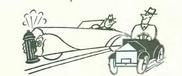
To give you some perspective, here’s a drawing from the December 6, 1941 issue, which strikes me as quintessential Soglow (click to enlarge):
Next, here’s the drawing that appeared at the bottom of Wolcott Gibbs’s Comment on December 13, 1941:

Looks nothing like Soglow’s work, does it? It also appears to be signed (in the middle, at the bottom). But the December 20 issue marks a return to the usual Soglow style, though the drawing is also signed, and uncharacteristically crammed with detail:

Good artists, of course, can work in multiple styles, which they draw upon to fit the occasion. But how remarkable the December 13 drawing is, if one places it beside so many decades of Soglow’s sweet, graceful art.
So here’s my question: are all three of these drawings Soglow’s? Am I naive to be so struck by the contrast?
The Wavy Rule, a Daily Comic by Pollux: The Nutcracker Packing Heat
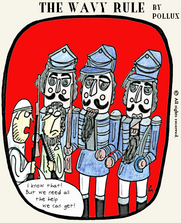
Click on the cartoon to enlarge it!
Read “The Wavy Rule” archive.
The Wavy Rule, a Daily Comic by Pollux: Holiday Jeers

Yes, this is the same family (let’s call them the “Irvins”) that appears “here.”:http://emdashes.com/2008/12/the-wavy-rule-a-daily-comic-by-100.php Click on the cartoon to enlarge it!
Read “The Wavy Rule” archive.
Winter Fiction Issue: What to Read
This holiday, I have very good news: I don’t think you can go wrong with any of the fiction in the December 22 & 29, 2008 double-issue of The New Yorker. Even for our beloved TNY, that’s some feat.
I have caveats, of course. (Spoiler warning! Below, I reveal key details of several stories.) For example, Donald Antrim’s “Another Manhattan,” though sad and graceful toward the end, is shrill and artificial for most of its length.
Jim and Kate are married, and involved in a love quadrangle with another couple, Elliot and Susan. Most of the narrative involves Jim’s nearly doomed attempt to get a bouquet of flowers for his wife—his motives mysterious, calculating, and mixed up in his attraction to the florist helping him. Meanwhile, Kate is attempting to end her affair with Elliot.
Miscommunication is rife—most conversations take place on cell phones, in a farcical, four-sided dance that feels too obviously symbolic to be fully effective. As for the rest, Jim’s tortured assessments of what behavior or choices might be appropriate (either to hide his now-ended affair with Susan, or to balance his desire to surprise his wife with a bouquet with his desire for the florist) are a hallmark. In the end, Jim finally does arrive at the restaurant with the enormous, wind-battered bouquet, his face bleeding from rose thorns.
And though even that image seems intended to be Significant, it’s right about there that the story turns from a tale of unreal, unlikeable people into something else entirely. Jim arrives; Kate bursts into tears when she sees the flowers and his bleeding face.
“I’m here,” he said, and his own tears started. He wanted to tell her that everything would be better, that he would be better, that one day soon he would work again, and start paying some bills, and take the burden off her shoulders; that they would be able, at last, to leave the little apartment with the busted plumbing. He wanted to tell her how much he needed her.
But he could see, out of the corner of his eye, his horrid reflection in the mirror behind the bar. He looked down at Kate’s hands, the blood smeared across her palms. And he saw the restaurant-goers and the waiters and waitresses and busboys, who, not knowing what to make of the bleeding and the crying and the broken lilies arcing over Jim and Kate’s heads like some insane wedding canopy, had come from the kitchen or the bar to stand mutely around them. The pain in his body grew, and the words that spilled out of him were not words of love. Or they were. He spoke to his wife, as he spoke to the people gathered.
He tells her that he must go back to the mental hospital, that he doesn’t belong anywhere else. The rest of the story is a melancholy slide, all of the story’s earlier tension burned away, as the narrative follows the four of them to the emergency room, where it’s just Kate and Jim; and then into the locked ward, where it’s just Jim, in “a room of his own.” Taken as a whole, it’s quite lovely, really.
Alice Munro, of course, is so steadily reliable a writer that it’s hard to go wrong with her work, which is why I was particularly disappointed with “Face,” which appeared in the September 8, 2008 issue. “Face” contained no drama at all except at its end, when it promptly veered into melodrama: a little girl slices up her face to approximate the narrator’s birthmark; they never see each other again, not really, though years later she visits him in the hospital after he’s been temporarily blinded. She doesn’t identify herself directly, but quotes lines from Walter de la Mare before leaving forever…Puh-leeez!
But this month’s “Some Women” felt like a return to form. The narrator looks back on an incident that happened during or after the second World War, when she was thirteen, and temporarily employed to look after a former fighter pilot, Bruce, dying of leukemia. She does this two days a week, when his wife Sylvia is teaching classes at the college.
Bruce’s stepmother, referred to in town as Old Mrs. Crozier, crustily dominates the household; all she “really cares about”, the narrator says, is “her flower garden.” So it’s a bit of a surprise when it turns out she has a masseuse, Roxanne, who visits her in the home. (Which struck me as anachronistic, but I’m probably wrong.) Roxanne is brassy and teasing, and forces an introduction to Bruce, whom she flirts with and makes a show of coddling. Seeing him becomes part of her weekly routine.
She was never at a loss. Sometimes she came equipped with riddles. Or jokes. Some of the jokes were what my mother would have called smutty and would not have allowed around our house, except when they came from certain of my father’s relatives, who had practically no other kind of conversation …
“Isn’t that awful?” she always said at the finish. She said she wouldn’t know this stuff if her husband didn’t bring it home from the garage.
The fact that Old Mrs. Crozier snickered disturbed me as much as the jokes themselves. I wondered if she didn’t actually get the jokes but simply enjoyed listening to whatever Roxanne said.
Mr. Crozier doesn’t laugh at these jokes, exactly, but doesn’t object, either.
I tried to tell myself that this was just good manners, or gratitude for her efforts, whatever they might be.
I myself made sure to laugh so that Roxanne would not put me down as an innocent prig.
Even so, the narrator doesn’t like Roxanne:
I began to understand that there were certain talkers—certain girls—whom people liked to listen to, not because of what they, the girls, had to say but because of the delight they took in saying it. A delight in themselves, a shine on their faces, a conviction that whatever they were telling was remarkable and that they themselves could not help but give pleasure. There might be other people—people like me—who didn’t concede this, but that was their loss. And people like me would never be the audience these girls were after, anyway.
The question, of course, is why Mrs. Crozier—so staid and ungiving normally—puts up with Roxanne; the narrator even wonders if Mrs. Crozier is paying her to flirt with Bruce, for it becomes clear that she doesn’t care for Bruce’s wife, Sylvia. In fact, it seems that Mrs. Crozier feels hemmed in by Sylvia: “No chance of having anything special with her around,” she complains to Roxanne.
But on Sylvia’s last day of teaching, Bruce locks himself in his room so that Roxanne and Old Mrs. Crozier can’t get in. The narrator helps him, and, acting on his instructions, gives the key to his room to Sylvia when she gets home from the college. This turns out to be decisive.
I understood pretty well the winning and losing that had taken place between Sylvia and Roxanne, but it was strange to think of the almost obliterated prize, Mr. Crozier—and to think that he could have had the will to make a decision, even to deprive himself, so late in his life. The carnality at death’s door—or the true love, for that matter—was something I wanted to shake off back then, just as I would shake caterpillars off my sleeve.
Munro’s subtlety ensures that it’s only here, in the story’s penultimate section, that the nature of the struggle at its heart is fully revealed, a quiet detonation. Still, it’s not quite the right note to end on, and she indulges in a summary coda, wrapping up loose ends with efficient terseness. The final line: “I grew up, and old,” is both great—many a great novel could be summarized in this way—and rushed, underscoring the narrator’s ultimate irrelevance to the story, except as a vessel for its telling. All in all, however, this is the strongest story of the issue.
I’m new to Roberto Bolaño, having read only the unimpressive “Clara,” a story of his that appeared in the August 4, 2008 issue. But I’ve heard very good things about his novels, The Savage Detectives and 2666, and so I’m well-disposed to like his work. Consequently, my heart sank when I began “Meeting with Enrique Lihn,” because right away it was obvious the narrator was a writer, and he was about to relate a dream.
Why does it matter if the main character is a writer? If one had to list the profession that fiction writers most often choose for their characters, it would be that of author: it’s as if they cannot imagine anything else. But it can be done well, and in this case, the fact that the narrator is a writer is integral to the story’s theme, but not obtrusive.
Dreams, for their part, allow the writer what Stanley Elkin used to call “a terrible freedom,” by which he meant the freedom to be arbitrary, to ignore on a whim the emotional and practical physics of human existence, and the freedom to create objects and situations overdetermined with Meaning. With this in mind, Bolaño is guilty on all counts; and yet, the dream he writes about is remarkably absorbing.
The main character dreams that he meets another, more famous writer, the “Enrique Lihn” of the title. At one point, Lihn reveals to the narrator that he has to take a pill every three hours:
Lihn began to break it up with a spoon, and I realized that the pill looked like an onion with countless layers. I leaned forward and peered into the glass. For a moment I was quite sure that it was an infinite pill. The curved glass had a magnifying effect, like a lens: inside, the pale-pink pill was disintegrating as if giving birth to a galaxy or the universe. But galaxies are born or die (I forget which) suddenly, and what I could see through the curved side of that glass was unfolding in slow motion, each incomprehensible stage, every retraction and shudder drawn out as I watched. Then, feeling exhausted, I sat back, and my gaze detached from the medicine, rose to meet Lihn’s, which seemed to be saying, No comment, it’s bad enough having to swallow this concoction every three hours, don’t go looking for symbolic meaning—the water, the onion, the slow march of the stars.
Of course, the pill is symbolic, or at least evocative, of the universes contained in passing time. Other images in the story are nearly as dense; all point to existential themes: Lihn, despite his fame and skill as a writer, is dead, in and outside of the dream; the narrator, once one of a set of promising poets, has not lived up to his promise, and neither have his compatriots. In essence, the story is about what life does to one’s ambitions; and how death levels us all.
So, even though the story ultimately feels minor—precisely the sort of work that good authors produce on an off day and publish posthumously (for Bolaño, like Lihn, is now dead)—it’s actually quite enjoyable.
Curiously enough, the fragmentary nature of Bolaño’s story is analogous to the baggy-monster feeling of Colson Whitehead’s “The Gangsters“, for neither piece reads as though it’s meant to be a short story. Bolaño’s is unsatisfyingly short, whereas Whitehead’s is so leisurely and random that it feels like a random section from a novel. And as it turns out, this is exactly what it is, as a Q&A with Whitehead confirms.
“The Gangsters” describes a few incidents in the lives of a group of young black teenagers who summer with their families in Sag Harbor, New York during the 1980s. Part bildungsroman, part exploration of the evolution of black culture, and part evocation of a period, the story meanders through a series of incidents in which the narrator, his brother, and their friends and acquaintances take up guns—BB guns—and it’s all fun and games until someone (nearly) puts out an eye.
I have a huge amount of respect for Whitehead (though I vastly prefer his first novel, The Intuitionist to his subsequent work, such as the clever-but-arid Apex Hides the Hurt), and I’m going to want to read this novel when it does come out. It’s just that, cut down to story-size, so much of it is unsatisfying. For example, these lines:
The trick of those early-morning jaunts was to wake up just enough to haul a bag of clothes down to the car, nestle in, and then retreat back into sleep. My brother and I did a zombie march, slow and mute, to the back seat, where we turned into our separate nooks, sniffing the upholstery, butt to butt, looking more or less like a Rorschach test. What do you see in this picture? Two brothers going off in different directions.
You would think, with a lead-in like that, the story would be centrally concerned with the brothers’ relationship, but in fact it’s peripheral, despite a third-act rapprochement of sorts between the brothers.
Or, for example, when the narrator nearly does put out his eye with a BB, he and his brother spend a lot of time trying to hide the evidence and think up a cover story so that their parents won’t ground them for life. Here’s how this is resolved: “But they got home and never noticed. This big thing almost in my eye.” Kind of lets the air out of the tires, doesn’t it?
When Whitehead is asked in the Q&A how he differs from his main character, he observes sardonically, “I tend not to do things that lend themselves to dramatic unity, aesthetic harmony, and narrative discharge.” Which is funny and dead-on, as far as it goes, but the trouble with “The Gangsters”, finally, is that it doesn’t display much dramatic structure, either.
That might be why Whitehead is hard-pressed to convince Deborah Treisman, fiction editor for TNY, that his story isn’t autobiographical. I believe him when he says it’s not; but it sure reads like memoir, and oddly enough, so does the Bolaño piece, despite the fact that it consists of the retelling of a dream, and the Munro story (though this is an effect she seems either unconcerned by, or wishes to encourage). Regardless, as long as you don’t go looking for dramatic unity, meandering through “The Gangsters” will yield up a number of pleasures.
As I said, you can’t go wrong with this issue. But the most quotable moment in the issue doesn’t occur in one of the stories. You’ll find it when fiction writer Zadie Smith quotes fiction writer Martin Amis in her memoir, “Dead Man Laughing“:
In birth, two people go into a room and three come out. In death, one person goes in and none come out.
The Wavy Rule, a Daily Comic by Pollux: Coal Energy
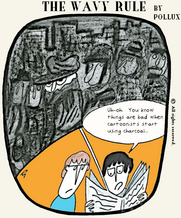
Click on the cartoon to enlarge it!
Read “The Wavy Rule” archive.