
You may be here seeking my sentences. I’ve started a writing portfolio for my copywriting and journalism. My Twitter (and Instagram) handle is @emdashes, and I compile the Tumblrs The Beautiful Sentence and Obscure Controversies. Here’s my LinkedIn profile. These days, I’m a scholarly publicist and editor at the Yale School of Management and am working on a book about cavemen. Will I ever blog about The New Yorker again? Probably not. Will I start blogging about something else? It’s not impossible. In the meantime, I’m getting ready to refresh this site so it’s a little easier to find things, so if you’re here, thanks and check back again in a few months!
Author Archives: Emdashes
The Way We Live Now
Fourteen! If this blog were a child, it’d be a smart-mouthed teenager. I founded it in 2004, dedicating it to the superb writer Donald Antrim. So what is Emdashes? It’s either a pair of long dashes in a sentence–like these–or a culture blog whose original tagline was “The New Yorker Between the Lines.” In its active days, it was a _New Yorker_ magazine fanblog. More on all of that here.
Here’s a long-winded description of me if you’re here for the first time: I’m a writer, editor, and digital strategist; my keenest interests are books and culture, politics and social issues, technology and design. I was a staff theater critic for Time Out Chicago; here are those reviews. As a book critic and feature writer, I’ve interviewed Edward Gorey, Aisha Tyler, J. K. Rowling, Lewis Lapham, Ayaan Hirsi Ali, Nick Hornby, Cathleen Schine, Françoise Mouly, Paul Auster, and gifted young designers, among many others. I’ve also written about poetry–and am myself a poet.
Online archives being what they are, much of my journalism lives in the Lexis-Nexis Federal Penitentiary or in the twilight of the Wayback Machine. I’ve started migrating pieces to my portfolio; in the meantime, some are reprinted here in posts tagged “Clips.” A few more samples at hand: features and interviews about graphic design, including a deep dive into the career of founding New Yorker art director Rea Irvin, for Print magazine; liveblogging for a hyperlocal-business summit; book reviews for Salon. For NYCgo.com, I celebrated the life of dance legend Frankie Manning, whom I’d previously interviewed for Newsday.
On the advertising and digital marketing side, as managing editor of Ogilvy & Mather’s brand newsroom, I edited, art-directed, and co-wrote hundreds of pieces of content for IBM–blog posts, landing-page copy, infographics, and social media assets. You can get a taste of the work I oversaw from this SlideShare recap of our team’s live coverage of Mobile World Congress.
For arts and public-policy nonprofits, I’ve written and/or edited site copy, reports, and press releases. While helping build the Rockefeller Foundation’s content strategy for its “100 Resilient Cities” launch, I interviewed architecture critics about resilient buildings. I’ve written a lot of e-commerce and email-marketing material, including editorial and marketing e-blasts for the art-collecting site 20×200. As a Groupon copywriter in the site’s salad days, I wrote droll profiles in its giddy house style. I’ve also ghostwritten blog posts for B2B companies and features for business magazines.
Personal stuff: My photos are here on Instagram. I work as a DJ and sound improviser for the Dirty Little Secrets improv show, which plays monthly at Niagara in NYC. Aside from my often not-serious “serious” poetry, I serve as an occasional occasional poet. Yes, I’m the author of that corduroy sestina. A clerihew I composed appeared on The New Yorker‘s own blog, bringing it all full circle.
David Ogilvy Is My New Boss
Not in the literal sense. But certainly in a spiritual sense. I’m happy to say I began work this week at Oglivy & Mather as its Newsroom Editor. As for here, I don’t know how Emdashes will evolve in the future, in this, its tenth year. To judge from my radio silence, I’ve been drawn to other magnetic things, among them the Tumblrs The Beautiful Sentence and Obscure Controversies, as well as Peekskill Rocks, a city site I founded with the punk-rock developer Joe Sepi. But I would never, ever let go of my dearest place online.
So, I’ll return, tweed-clad and pipe in hand, and tend to this overgrown plot when I can. (I see, for instance, that there’s some messed-up code up there on the right rail. And I know, how minuscule is that type in the header and footer? What are we, tarsiers?) If you’re reading this, hi! Thanks for reading. Thanks for everything. This blog has opened so many incredible doors and continues to do so. The explanation “It originally started as a meta-superfanblog about The New Yorker” makes sprockets spring out of some people’s ears. But luckily, enough people have shared my obsessions that it made obsessing all the more delightful.
Interview: Frankie Manning, Lindy Hop Legend (Newsday)
He Put the Hop in the Lindy | Frankie Manning, the Last King of Swing
By Emily Gordon and Robert L. Fouch
Imagine this scene: In a packed ballroom, hundreds of women edge closer to the dance floor, angling for a chance with that handsome fellow with the brilliant smile, the one who moves with such power and grace. Never mind that the man is 85 years old. This is the legend of lindy, the king of Harlem’s Savoy Ballroom in its heyday, who danced for royalty and has sidestepped old age as he would another couple on the floor. This is Frankie Manning, and as the song begins to swing, the women clamor to be one of his 85 partners–one for each of Manning’s remarkable years.
Swing dancers, musicians and jazz and dance lovers from all over the world will descend upon Roseland Ballroom tomorrow night to celebrate the man who helped create the lindy hop–the dance Life magazine once pronounced “this country’s only native and original dance form,” which has hooked a new generation on partner dancing.
Manning, as any young swing fanatic can tell you, was a member of Whitey’s Lindy Hoppers, a celebrated ’30s swing performance troupe that performed at Radio City, the Moulin Rouge, the Royal Albert Hall. Manning also choreographed movies of the era, including jaw-dropping scenes in “Hellzapoppin'” and the Marx Brothers’ “A Day at the Races.”
Perhaps Manning’s most famous legacy, though, is the invention of the air step–or, as it’s now called, the aerial. “You have to remember that those were the beginning days of lindy hop, that everything that was created was ours, was new,” he says. “So a person could never say, ‘That’s wrong.'” When he told Frieda Washington, his partner, “Get on my back, roll over, come down in front of me,” what was her reply? “Just think of this,” he says now, “something you’ve never seen, don’t know how to do it, your partner don’t know how to do it–and she said, ‘Yeah, OK.’ Brave girl, very brave.”
The Savoy in the ’30s was the place to dance. It was New York’s only integrated club–unlike, for instance, Roseland, where Manning and some friends were once turned away at the door. At the Savoy, “They didn’t care what color you were. All they wanted to know is, ‘Can you dance?’ … Clark Gable walked into the place and somebody’d say, ‘Hey, Clark Gable’s in the house!’ ‘Oh yeah, can he dance?'” Manning knew the legends–Duke Ellington, Count Basie, Dizzy Gillespie. He played point guard for Cab Calloway’s basketball team.
Today’s swing dancers speak with awe about Manning’s career. “Frankie’s stuff is so out there,” says Janice Wilson, who teaches lindy and won the 1999 Dancesport International lindy hop championship with her partner, Paolo Lanna. “When you see the old films, all of [Whitey’s Lindy Hoppers] were phenomenal dancers, but you have a really hard time looking at anyone else.” But those days would soon end. Manning was drafted, and spent five years fighting in the South Pacific. When he came home to New York, they were playing bebop, and the lindy hop was passé.
So Manning took a job at the post office, where he stayed 30 years. He still danced–“If I wasn’t dancing, I don’t think I would be here”–and when they played rock and roll, “I learned how to do those dances, too.” It seemed that Manning, and the lindy, had had their day. But not quite. In the ’80s, rockabilly and swing bands grew out of a retro subculture. Erin Stevens, co-owner of the Pasadena Ballroom Dance Association, and her dance partner, Steven Mitchell, set out to track down the finer points and pioneers of lindy hop. They had the old films but, Stevens says, “we didn’t have any names”–African-American dancers and choreographers at the time often weren’t credited.
Finally, they came across Manning’s name, and found him in Corona, Queens. He eventually agreed to teach them, and thus, says Stevens, “we learned the heart, the soul, the feeling, the basics, from Frankie Manning.” It wasn’t long before Manning was coaxed out of his living room and into the studios. For Manning, swing is as much about socializing as it is about dancing, and now, he says, “People want to get back together again, they want to be friends, they want to talk to each other.” And that’s what Manning preaches: affection and respect. “A lot of times if I get a class of beginners … I say, ‘OK, now you’re going to have to put your arms around the lady.’ For some ungodly reason, they are very reluctant. I say, ‘Fellows, touch the girl, she doesn’t mind. Do you mind, ladies? No. See there?'” He always tells them: “Make sure you treat her as if she’s the queen, and you’re just a jester in her court.”
Given that their teacher has 71 years of dancing experience, his students tend to listen. Manu Smith, webmaster of yehoodi.com, New York’s central swing website, says, “You look at Frankie and you think to yourself, OK, you’re teaching us this step. You might have invented it. When you look at Frankie, he is lindy hop … You feel honored to be corrected on a step by Frankie.” Manning seems to breathe the dance, as another student, Katherine Lewis, puts it. “Instead of counting out the steps the way other teachers do, he just scats. ‘Be-dop-a-oody-ah-be-doby-yonk-ah!’–and you’re like, oh, that’s it! All of a sudden, you feel it in your body.”
For his part, as is obvious from Manning’s gigantic grin when he watches his students, the swing revival has given as much to him as he has given to it. “I see some of these young kids get out on the floor, and sometimes they don’t even know what they’re doing, but I see something that I say, ‘Oh, wow. Yeah, I can do something with that.’ … They’re creating also, just like when I was young.” Some of modern lindy hop’s best will be performing at tomorrow’s birthday bash–dancers from Sweden, London, Singapore, California and New York. Manning chose the bands: Grover Mitchell’s Count Basie Orchestra and George Gee and His Make-Believe Ballroom Orchestra–“That’s one of the swingingest bands in the land,” Manning says. His old friend Buster Brown will tap dance. More than 100 couples will dance the Lindy Chorus, a routine Manning choreographed.
Lindy-hop teacher Laura Jeffers is counting on being in the lucky 85. “He has this dance in him. You can watch him and listen to him talk about it, but you can get so much of the dance from just being near him. He is the most goodwilled person I have ever met in my entire life, about people and the world–aside from everything else. It’s like a gift.”
–Published in Newsday: May 25, 1999
Writing About Poetry
Reviews:
Poetry Without Pain: National Poetry Month roundup (Newsday)
How to Read a Poem: And Fall in Love With Poetry, by Edward Hirsch
How to Read a Poem…And Start a Poetry Circle, by Molly Peacock
A Grain of Poetry: How to Read Contemporary Poems and Make Them Part of Your Life, by Herbert Kohl
Poetry Anthologies After September 11 (Newsday)
Poetry After 9/11: An Anthology of New York Poets, ed. Dennis Loy Johnson and Valerie Merians
110 Stories: New York Writes After September 11, ed. Ulrich Baer
Poems of New York, ed. Elizabeth Schmidt
Speaking From Memory (Newsday)
Handwriting: Poems, by Michael Ondaatje
Above an Abyss (The Nation)
Meadowlands, by Louise Glück
Otherwise: New and Selected Poems, by Jane Kenyon
Pollitt, Poet (The Nation)
The Mind-Body Problem: Poems, by Katha Pollitt
Obituaries:
Ted Hughes (Newsday)
Iris Murdoch (Newsday)
Review: Poetry Without Pain (Newsday)
Poetry Without Pain | Averse to verse? Good! For National Poetry Month, here are three books to stir the stanza lover in you.
By Emily Gordon
HOW TO READ A POEM: And Fall in Love With Poetry, by Edward Hirsch. Harcourt Brace, 352 pp., $23.
HOW TO READ A POEM…And Start a Poetry Circle, by Molly Peacock. Riverhead, 209 pp., $22.95.
A GRAIN OF POETRY: How to Read Contemporary Poems and Make Them Part of Your Life, by Herbert Kohl. HarperCollins, 175 pp., $23.
Otherwise sensible people are always going around saying they don’t like poetry. Not “Emily Dickinson perplexes me” or “haikus give me the heebie-jeebies”; nope, they tried it, and it didn’t agree with them. “It’s just not my thing,” they say with inexplicable pride, as though staking a claim for verbal democracy. Often, these are folks who savor words and delight in the pleasures of reading. Yet somehow they can justify dismissing a whole genre of literature, which spans thousands of years and countless phases of human creativity, out of hand. You don’t hear anyone declaring that they’ve never really seen the point of paintings, or “This Gustav Mahler–why doesn’t he just come out and say what he means?” So why is poetry so scary?
For one thing, it’s being taught that way. A generation or two ago, poets were literary figures who would be on the final exam; learning poems, often by heart, was a standard feature of public education all through school. While this hardly guaranteed appreciation, hearing poetry and speaking it aloud repeatedly meant that, for many students of those eras, the words could and would come back to them at unexpected–sometimes desperate or rapturous–moments or even decades later. Accustomed to poems, people worked them into their heads, and because the words themselves were musical and had meaning, the poems stuck there.
These days, on the other hand, the dread Poetry Unit tends to be administered during a few weeks of high school English as a painful but necessary dose, like a vaccination, or presented as an awesomely intricate equation to be broken down with stern, deadly precision. When poetry is snipped from the fabric of basic learning and, hence, daily life, what gets lost is not only the passion of the person who created the thing, but the idea that it can produce passion (or pensive reflection, or sudden epiphany, or sharpened observation) in the reader, too.
Nevertheless, among the cute cameos of public-transportation verse, Shoebox doggerel and, of course, Jewel, there’s the poetry that considerable numbers of people write in private and, in some cases, even publish. The annual “Poet’s Market” adds scores of entries for poetry journals to each new edition; graduate poetry-writing programs are multiplying; spoken-word poetry had a big commercial revival after years of urban-fringe momentum; Dylan (Bob), Morrison and Cobain are in lots of people’s canon; current poet laureate Robert Pinsky–a frequent charismatic presence on radio and quoted even more frequently than Joyce Carol Oates–is something of a rock star himself.
And yet poetry largely remains a public embarrassment, a disagreeable chore, for even the most avid literary enthusiasts–as everything from the threadbare state of most poetry organizations to dwindling NEA grants for poets to the dearth of poems in major magazines vividly attest. Not to mention that assorted cranks make a biennial announcement of the Death of Poetry, to wit: MFA programs are the work of Satan, and the Only Authentic Voices Are Out There on The Mean Streets Outside the Ivory Tower, Man. No wonder, then, that in this last National Poetry Month of the 1900s, writers are attempting to reconcile the steadfast poetic impulse in the human spirit and the icky, panicked feeling it seems to produce in so many.
Toward that end, two poets, Edward Hirsch and Molly Peacock, have published books titled “How to Read a Poem.” Peacock–author of four books of poetry and a memoir–takes the hand-holding route; her aim, as stated in her subtitle, “…and Start a Poetry Circle,” is to coax readers toward feeling comfortable, and then release them into the world. She takes 12 poems by both classic (Gerard Manley Hopkins, Li Ch’ing-chao) and contemporary writers (herself included)–each on a different theme–and discusses them in turn, examining everything from the poet’s likely state of mind to the poem’s formal makeup.
Hirsch’s book, with the less imperative subtitle “And Fall in Love With Poetry,” nonetheless has similar goals; the essays that make up the book are, like Peacock’s, organized around larger ideas: initiations, Polish poets, desolation, form. Instead of addressing one or two poems per chapter, though, Hirsch (who also has four poetry books to his credit) uses numerous excerpts to explain each point, which makes for a denser, more meditative and considerably longer narrative.
Hirsch’s mission reflects that of the poets he most admires, to whom he defers with exuberant conviction: “I am completely taken by the way that Whitman always addresses the reader as an equal, as one who has the same strange throb of life he has, the same pulsing emotions.” Or, quoting Paul Valéry: “A poet’s function–do not be startled by this remark–is not to experience the poetic state: that is a private affair. His function is to create it in others.” Throughout Hirsh’s tour of the rhythms, layers, contradictions, history and personalities of the poetry available to us in English, he turns “the poetic state” inside out, offering it to us carefully and considerately. His critical views are assured and emphatic–he remarks that Christopher Smart “was the least jaded of poets…. I believe he believed everything he said. He would not be dissuaded from saying it, either, though his testimony imperiled him and put him on the far margins of society”–yet he also leads us deliberately enough through them, line by line, that we stay with him all the way to their conclusion.
In short, reading Hirsh’s “How to Read a Poem” is like a very long evening with a learned and perceptive friend who keeps leaping up to his bookshelf for more and better illustrations, and finding ever more connections and revelations. Whereas–to return to the other guidebook of the same name–Peacock’s chumminess comes across as forced. Comparing two poems about fathers, one by Yusef Komunyakaa, the other by Michael Ondaatje, Peacock writes:
“But why am I assuming that these writers are writing about their own fathers? Couldn’t it all be fiction? I make the assumption because of the pure electricity of the currents of emotions in the poems and because poets (even fiction writers who are poets) write poetry because they are pointing to emotional or spiritual or intellectual truths through language–through letters–and not through plot or character development or the course of ongoing prose. Perhaps I am hopelessly over-identified with these poems because of my own father. I feel free to be openly subjective at the same time as I spy the grammatical and musical structures that underpin–or overthrow–my whirligigs of interpretation.”
Twelve such indulgent whirligigs end up being more exhausting than Hirsh’s much lengthier reflections. Still, as a first introduction to the impulses and architecture of poetry, Peacock’s “How to Read a Poem” could be illuminating for fledgling poetry circles, particularly if they use her last chapter (which plugs the National Network of Poetry Circles) as a handbook.
Finally, Herbert Kohl’s “A Grain of Poetry”–which puts the how-to part second–demonstrates brilliantly that it doesn’t always take a poet to teach poetry. Kohl, a “teacher-educator,” writes in a direct style that, while simpler, is no less lyrical than Hirsch’s. “Expectations of what poetry has to sound like or talk about come from old school memories of rhyme and meter,” he writes. “It is easy to avoid or resist freshness in language because it can be so disorienting.” Kohl has an unusual, and affecting, way of stepping around a poem to look at it from every angle; he overturns it for inspection, then picks it up and puts it down next to another one, which then completely changes the look of the first.
He also has a remarkable field of vision. Here’s a sequence of excerpted poets, in a few pages of a single flowing point: George Herbert, Ron Padgett, Robert Creeley, Czeslaw Milosz, Jane Hirshfield, Victor Hernandez Cruz, Juan Delgado, Martin Espada, Sherman Alexie, Charles Simic. There’s nothing faux-inclusive about this lineup; every poem or piece of a poem clicks satisfyingly into the next, and as he reminds us, “It is a mistake to put poets in boxes and cut yourself off from poetic voices that might come from different perspectives and cultures than your own. A poet is not a preacher or a politician.” And Kohl isn’t holding any of these poems at arm’s length–he reaches right in and rearranges them, highlighting words in bold type or shuffling line breaks so that what he’s explaining will be unmistakable.
Kohl also lets poets speak for themselves, including their thoughts on their own work at some length. If Hirsch is entreating us to walk alongside him through endlessly rewarding terrain, Kohl is holding his breath: “Read it, silently at first, then out loud,” he suggests before a poem by Janice Mirikitani. “I’ll save my comments until after you have a chance to enter into the poem.” And elsewhere, he writes: “Poets have the power to merge opposites, imagine the unimaginable, break all of the usual rules of language in the service of their sentiments and dreams, and rethink the ordinary ways in which language serves us.” As Keats used to say, that’s all ye need to know.
–Published in Newsday, April 25, 1999
Willkommen, Bienvenue, Welcome (Back)! And a Note on Bravery.
It’s spring in Emdashes’ tenth (!) year. These days, I’m working on grants and web content at The Center for Jewish History, right next door to the Margaret Sanger Clinic House. Sanger was a friend of my great-grandmother Dorothy Gordon, and I wish I’d known both of them and could have joined even one of their conversations. Here’s Dorothy (known as Ooma) on her ’50s and ’60s TV show, The New York Times Youth Forums, where a multicultural panel of brainy youth debated serious subjects of the day along with a distinguished guest.
Dorothy herself had a great sense of humor, I’m told, and had been a singer of folk songs on the radio and an opera singer before that. She put herself forward when host positions were scarce for women, to say the least, and refused to weave those cheesy ads into her shows (“Friends, do you have tired blood?”) because, she said, children can’t distinguish between the show and the advertising.
I don’t normally write about myself, and I don’t think I’ve ever written about any member of my family. But I have chutzpah and bravery on the brain as I work on grants with meaningful purpose; finish a book proposal; think about the new documentary about Vivian Maier, who never showed her city-capturing photographs; rewatch the classic (as far as I’m concerned) 1985 movie Desperately Seeking Susan.
No one can be Madonna except Madonna. Nobody can be Aidan Quinn except Aidan Quinn, either. (Those searching, uncertain blue eyes.) And most of all, no one can be Susan Seidelman, who directed a movie so celebratory, suspenseful, subtly feminist, and generally badass that it instantly, completely, dare I say desperately, made me decide to move to New York as soon as possible. And I did. And the movie is still wonderful. And Rosanna Arquette’s character has the courage not to be Madonna/Susan, but to make her own goofy way that’s just as cool. If not cooler. I’m certain Ooma would’ve liked her.
Revolution Number Nine
Happy ninth anniversary to Emdashes! I could go on, but there’s so much to attend to in these waning hours of the year that I’ll just refer you to this five-year-anniversary hurrah, which pretty much says it all. Plus, may I recommend this punctuation-themed post with a headline dear to our hearts? Yes, it’s “The Singular Beauty of the Em-Dash,” with a plum quote from our scholarly pal Ben Yagoda.
Thank you, dear people, for being here–especially since other projects have kept the Emdashers from posting often. We’re also working behind the scenes to freshen things up, so if you see a bug or two, our trusty back-end compatriot is on it. (Block that metaphor!)
A very happy new year to you all, and we have lots of new plans for the big ten. Not the football Big Ten. Our very own.
Dumb Quotes Are the Cold Tears of a Stick Figure
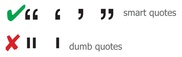 There are smart cookies and dumb bunnies. (The latter term can apply to men and women alike, as far as I’m concerned.) There are smart moves and dumbfounding decisions. And, as every discerning typophile, copy cat, and design devotee knows, there are smart quotes and dumb quotes. The image to the right is a succinct visual summary. The Society of Publication Designers feels so (justly) strongly about it that they made smart versus dumb quotes lesson number one in their essential-vocabulary series.
Most recently, John Brownlee at Fast Company’s Co.Design defines the problem and provides the solution:
If you think about it, almost everyone is aware that quotation marks are not, in fact, vertical, but curled or diagonal. It’s how we write quotation marks on paper. So why do we type quotation marks on our keyboard this way?
Blame the advent of the typewriter. As [designer Jason] Santa Maria rightly points out, “Dumb quotes, or straight quotes, are a vestigial constraint from typewriters when using one key for two different marks helped save space on a keyboard. Unfortunately, many improper marks make their way onto websites because of dumb defaults in applications and CMSs.
The fix is blessedly simple. Refer to any of the links above, but especially bookmark Santa Maria’s firm and simple guide, Smart Quotes for Smart People. He knows what he’s talking about. Don’t be a dummkopf. Get smart!
Image credit: Radar Collective, “Cleaning up Bad Typography–10 Rules at a Time.”
Interview: Nick Hornby (Newsday)
**A Fan’s Notes**
By Emily Gordon
“For the first, but certainly not the last, time, I began to believe that Arsenal’s moods and fortunes somehow reflected my own,” wrote Nick Hornby in “Fever Pitch,” a memoir of his obsession with his local English soccer team. At the time, this proved to be a faulty theory, but today it seems perfectly apt. Just as Arsenal captures the soccer grail – winning the league championship and the FA Cup in the same season (“an event that’s happened only six times this century,” he reports) – Hornby is scoring writerly goals with his new novel, “About a Boy” (Riverhead, $22.95). On a tour wedged into the off-season, ending just before the World Cup, Hornby stopped to talk at lunch in New York.
“About a Boy” follows Hornby’s first novel, “High Fidelity” – starring Rob, record-store owner, dumpee and maker of lists – which has become a cult favorite in both Britain and America. The new book, too, is about a 30-something guy in London; Will, though, is single and comfortably unemployed, living off the royalties from an excruciatingly well-covered Christmas jingle composed by his father in 1938.
Surely something can alleviate the dullness of an existence consisting of soccer matches on TV, movies, shopping and a top-notch stereo: “It’s a little short on soul,” as Hornby observes. Will’s got the answer: attractive single mothers, to whom he will look great after the accursed ex. Inevitably, both moms and kids soon fill Will’s life – in particular one irony-impaired man in the body of a 12-year-old boy. His name is Marcus, he’s never heard of Kurt Cobain and, once the child-phobic Will has (reluctantly) let him infiltrate his ordered world, nothing can, of course, be the same.
Much like “High Fidelity’s” Rob, Will is winsomely familiar. (As a friend of mine put it of Rob, “I don’t know if I am him or I’ve dated him.”) This is no doubt why fans feel they know, in turn, Nick Hornby. “I get letters addressed `Dear Nick,’ ” he says, riffing on the likelihood of other novelists’ receiving similar greetings (“Dear Don”? “Dear Norman”?). In person, his demeanor does little to formalize matters; with an Englishman’s healthy lack of reverence for the press, he leans forward on his elbows, simultaneously casual and intent, with bright blue eyes focused in a thoughtful, impish gaze.
Easily as amusing as his characters, Hornby also comes off as kinder and more circumspect. Since the success of “Fever Pitch,” though, he has, like Will, been able to make his own schedule. “Some of Will’s TV routines correspond very neatly to the routines of a writer,” he says, grinning. “I live a charmed life. I have a little apartment around the corner from where I live where I try to go from 10 to 6. Of course, I don’t actually write from 10 to 6.”
When he gets distracted, he walks around Highbury, his North London neighborhood, which is full of “perfect writing material” (not to mention the Arsenal grounds). “When I can’t write I go to the record shop; I’ve made friends with the guy who works there. He told me he wanted to put the jacket for “High Fidelity” up against the register with a sign: `Yes, I’ve read it!’ He used to give me a 10 percent discount, but when the news that I sold my first film rights came out, he rescinded it.” (These days, Hornby likes pop bands from Ben Folds Five to Radiohead.)
Though Hornby’s life does overlap with Will’s, 12-year-old boys are not a regular feature (his own son is 4 1/2). He recalls that some of the inspiration for “About a Boy” came from being invited one day to “hang out with guys of all different ages, just spending the day doing whatever they would normally do.” The boy he spent time with was 11, and the two of them spent the day “playing Gameboy, playing football in the street, going out for chips.” Unlike Marcus when he first meets Will, Hornby’s companion wasn’t suspicious. “The funniest thing he said was when we were talking about marriage. He said he couldn’t wait to go on honeymoon, and I was startled because we hadn’t talked about sex or anything. But he said, `Yes, because you get to go to places like Hawaii and Cornwall.’ ”
Hornby has taught high school, which was exhilarating at times, but also draining. “What kind of bad day could a writer have compared with the worst day a teacher could have?” Now, he often gets called into schools to read to students. “They think since my first book is about football, I’ll be the magic route into literature, and before you know it, they’ll be reading `Great Expectations.’ After all, `Fever Pitch’ is kind of a book. But afterward the kids usually come up and ask me who looks good for Arsenal this year, or who has the best haircut.”
Hornby will soon have a new wave of admirers, since both his novels are being made into films (“High Fidelity” stars John Cusack as Rob) set in America. “People from North London ask me how the films can be set anywhere but North London, as though all I’ve done is set down a list of street names.” He’s not worried about how the movies will turn out. “If it’s a decent book, it has a life far beyond the film,” he says. “Does anyone ever say about Joseph Heller, `Why did he have to sell the film rights to `Catch-22?’ ” He’s now working on his own screenplay, about an American musician who defects to England after his sister dies.
Hornby’s work, like that of Lorrie Moore, whose writing he loves, is deceptively fun to read. Some critics have mistaken his light tone as unserious: “If you put a joke in your book, you’re doomed,” he says without concern. He’s also not afraid to put references to current culture in his books. A lot of contemporary writers, he muses, are “interested in posterity – they don’t want to put anything in that will date it. I don’t think anyone will be able to read `High Fidelity’ in 40 years.”
Doubtful, since his characters – churlish, wistful, morally vague – are so resonant. In Will, Hornby says, “I tried to make a character with no redeeming qualities. I saw `As Good as It Gets’ on the plane, and it’s a similar situation: Both Will and the Jack Nicholson character are forced into a situation where they have to break out of their routine.” As Will discovers, kids can do that to you, a fact Hornby knows well: “You don’t notice your life is changing.”
So has literary success changed his life on a grand scale? He cocks his head. “The particularly strange thing for me is that my first book is about being a fan, and now I have fans, I think.”
–Published in _Newsday_, June 21, 1998