
On Mother’s Day, friend of Emdashes Caledonia Kearns writes:
For years I thought my father was the story, though I knew nothing of his day to day. I just knew that his life was more cinematic than mine and my mother’s–for one thing, he was dealing his way through the grit and graffiti of 1970s and ’80s Manhattan. A surviving beatnik, he went from burning his draft card and feeding the poor on the Bowery at the Catholic Worker, to selling marijuana in a loft with special built-in bins for the various varieties he sold.
When I was three, he left our limestone apartment in Crown Heights and moved to a SoHo that still smelled like industry and garbage. It was bohemian existence. The loft wasn’t fancy, but the bathtub was made out of a whisky barrel, the antiquated elevator had a steel gate like an accordion, and Joey Ramone occasionally appeared in the elevator. My father met John Lennon at the Corner Bistro, knew that Kerouac’s preferred drink was Jack Daniels on the rocks because he’d sat with him at the bar. Once, when he was selling the Catholic Worker newspaper on the corner of 8th Street and 6th Avenue, he said that Allen Ginsberg’s boyfriend tried to pick him up.
So many stories we tell are about men known by their last names: Kerouac, Ramone, Lennon, Ginsberg. This is what tripped me up for so long. My father had a New York life that intersected with those of New York men and I thought I must be interesting by association. But my childhood story is that of a single woman raising her child alone in an unglamorous Northern city–my mother and I left New York City for Boston when I was four. My father looks like the Monopoly man, and growing up he was like the game’s top hat to me, a metal piece I moved from east to west, uptown and downtown across the map of Manhattan in my mind. My mother was my home.
When they were first separated, the year I turned three, I saw my father every weekend. Once we moved, he visited three times: my 8th birthday, a ballet recital when I was 12 and my high school graduation. He was getting arrested, on and off probation, visiting Mexico and Puerto Rico on business and to lie low, while my mother was a Montessori teacher, a waitress, a worker in the mailroom of Boston’s public television station, a graduate student, a Head Start teacher, a graduate student again, a waitress/adjunct professor, then finally a professor of adult students going back to college to get their undergraduate degrees. She did not get that job until I was a senior in high school. If we hadn’t had family friends with three daughters who fed me dinner at least twice a week, and opened their home to me whenever necessary, I don’t know what would have happened to me.
I was always clear, however, that my mother and I were better off alone. My father was not just a dealer, he is an addict, and there was never any way to divorce the two. He called occasionally and except for annual reunions, initiated by my mother at his mother’s house in New Jersey, he knew nothing of harsh New England winters or how the salt air wafts into Dorchester off of the Atlantic. My father once told me he got me a good mother as if he were some kind of god with the power to grant maternal favor, but there is some truth to this. He had a child with a woman whom he knew was more than capable of raising that child alone. He knew he could trust my mother to work like a dog and support me in a way he never could. And, he did, indeed, know that she had that indefinable something extra–she was a good mother.
But my mother is not unique. She is a member of a tribe of single women who work hard to support their children and do it well. Common as bread. Throughout my childhood, I thought I could avoid her fate. I told my grandfather not to worry, that I wouldn’t end up like her. When I was ten and my mother was raging yet again about how little money there was and how my absent father never contributed to my support, I vowed I would do better. Not in terms of career, I knew my mother was doing her best while fulfilling her intellectual gifts, and I never begrudged her making the choice to get her doctorate, but I promised myself I would find a partner I could depend on, a partner who would take care of me. And I did, but I didn’t marry him. My first love is one of the most steadfast men I have known, but we were too young. Years later I married an artist obsessed with painting. We separated when our daughter was four.
I didn’t escape the sins of my father. I thought my ex-husband would change after the baby was born. Instead I found myself in an enormous building alone. When he left he said his leaving would be okay, our daughter would be fine, as I had been, but he never connected my fatherlessness to what it was about me he had to leave–the fatherless child pretends not to need. He knew no matter what he did I would take care of our daughter as my mother had done for me.
For so many years, I worried I’d become my mother. To escape her fate, I trolled for love on OkCupid, dated all the unavailable fortysomething men in Brooklyn, then blamed my own unavailability on them. I understand as the years go by that I have inherited my father’s restlessness. And while our circumstances echo: single woman, urban apartment, cat, daughter, I now say I’m a single mother who was raised by a single mother without flinching. You’d be surprised how freely people comment on my situation. A lover who thoughtlessly asks, “Do you ever worry you’re just like your mother?” Worse is the unspoken judgment. The unsaid, “Poor you.”
My mother worked hard every day of my childhood. She wrote in the morning, ran hundreds of miles, served hundreds of people at one restaurant or another, went to school either as a student or a teacher. No one ever told her it was going to be okay. And we were lucky, my grandfather was a liquor salesman who paid for my sneakers and braces and bought me a cornflower blue Marimekko comforter and matching sheets for my 12th birthday. He left enough money when he died so that my mother’s cashing in her pension each time she switched jobs did not screw her financially in retirement. She lives carefully, but has a car, a small house, a horse and a cat.
Ultimately, there is no “leaning in” when you are raising kids alone, nor is there any leaning on. Being a single mother means constantly treading water to stay afloat, while holding your head up in the process. Maybe this is why there are so few single mothers who write about work. I have wanted to contribute article after article to the ongoing debate about working mothers, but finding time to write when you have a full-time job and are running a household, while possible and achieved by many, has been challenging for me. This is, in part, why I write poetry. A poem is jewel-like in its compression. It can be entered into and revised intermittently and on the fly.
It has always been ironic to me that that while society offers no real support for the single mama, there is, in concert with the pity, loads of condescending admiration. Friends and colleagues wonder how I do it alone. I never answer, “I don’t know how you do it and stay married.” I say that sharing my daughter with her father offers me time to myself, that while I miss her when she is with him, we have been doing this for nearly a decade. It has taken nearly that long to shed my skin, not to be afraid that I am living my mother’s life. We may not be models of partnership and interdependence, but no one can have it all. I am a second-generation single mother proud of my mother’s legacy of hard work and creativity. This is not such a bad inheritance.
Elsewhere, Caledonia Kearns in the Awl: “Louie” in Divorceland, Where a Fun Schlub is a Super-Stud.
Category Archives: The Catbird Seat: Friends & Guests
Guest Review: Alan Rickman’s Trenchant “Seminar”
![96241_Seminar_Image505x250_FINAL[1] (1).jpg](http://emdashes.com/96241_Seminar_Image505x250_FINAL%5B1%5D%20%281%29.jpg)
Lee Alexander writes:
It’s hard not to think of Alan Rickman as Severus Snape, curl-lipped and leering behind a smoking cauldron as Harry Potter’s ambiguously evil Defense Against the Dark Arts instructor. In Thersea Rebeck’s new comedy, Seminar (which opened on Sunday at the Golden Theatre), Rickman is once again in command of the classroom, abandoning his robe and wand for a somewhat more mundane task: instructing four twentysomethings on the craft of writing a novel.
Though Rickman’s character, the famous writer Leonard, snidely remarks that “the novel has fallen on hard times,” the audience is secure in the knowledge that the play has not. During the show–which gives us a sense of what highbrow reality television would be like if it existed–we watch with delight as the four hopefuls are eviscerated, one by one, under the cutting critiques of their fiercely disparaging instructor.
_Seminar_ isn’t just a play about writing; it’s also a play about power. Director Sam Gold has a firm grasp on its subtleties in his staging and highlighting of the shifting power dynamics of this highly contentious and incestuous writing circle.
This is ensemble acting at its best, though there are two actors whose performances rise to Rickman’s star power. Kate (played skillfully by the talented Lily Rabe), an affluent young woman whose beautifully designed Upper West Side apartment serves as the group’s meeting spot, is dismissed by Leonard as a rich-girl feminist with an Emily Dickson complex (he dismisses Dickinson’s poetry as “words like lumps of shit”). Rabe has an expert sense of comedic timing, and is a joy to watch as she proves the ultimate literary cliché: Never judge a book–or, in this case, character–by its cover.
As Martin, Hamish Linklater perfectly captures the intensity and undeniable charm of a character whose self-doubt and lack of confidence make him a natural underdog in this cadre of big personalities and oversized egos.
Not everyone in the audience will share the dream of writing the great American novel, but we all face criticism in the pursuit of our own endeavors. Often, of course, the critical figure in the way of our dreams is not a dismissive authority but our own insecurity. After all the vicious insults and all the bruised egos, _Seminar_ reminds us, it’s how we respond to criticism that informs our success. As Leonard warns: “If it gets in, you’re doomed.”
Lee Alexander has an MA in Text and Performance Studies from King’s College/RADA and currently lives in Brooklyn.
Late But Not Without Love: Our Punctuation Contest Winner!
Some time ago, we sponsored a contest–write a letter to a punctuation mark, and get a chance to win a signed copy of Ben Greenman’s book What He’s Poised to Do–whose results diverted and delighted us. They also distracted us, so much so that it’s taken us, collectively, quite a while to pick a winner. The Emdashes staff selected an absurdly long but heartfelt of finalists, and now Ben has picked his winner. Here is the glad announcement, and with it, our collective apology that we can be awfully slow. Punctuation makes us dizzy and loony. Sometimes blogging does, too. Thank you so much to all the clever writers and true punctuation lovers who entered the contest. And now: Ben Greenman! –Emily Gordon
To say that I agonized over this contest would be an understatement. I have spent weeks staring at these semifinalists, trying to decide how to elevate one and let the others fall away. Who should win? Who will win? When we started this competition months ago, we had no idea that so many people would write such passionate, funny, and insightful letters to pieces of punctuation. We should have guessed. The relationship between a reader and his or her punctuation starts early, and it doesn’t operate as a type of infatuation or opportunism, as the relationship between readers and words sometimes does. The love of (or love for) a piece of punctuation grows slowly, over time, until it is undeniable: a reader looks and wonders until there’s no option left but saying what is felt.
In the end, after weighing them all, I selected Letter #2, Nicole Rushin’s letter to the tilde, in part because she couldn’t remember its name (she’s flustered by love) and in part because she has perfectly identified the seam between passion and fashion. Ten years ago, no one cared about the tilde except for Spanish teachers. Ten years from now, it will have passed into oblivion again. But today, in the waning days of the strange http era, it is a kind of little king. The last four sentences of Nicole’s letter are especially poignant, and especially true. Congratulations to our winner and all our entrants.
–Ben Greenman
Nicole Rushin‘s winning entry, for which she will receive a signed and personally punctuated copy of Ben’s book:
Dear ~,
I am embarrassed to say that I have forgotten your name. You came into my life one torrid night while talking to the abrupt, but helpful customer service rep from Blue Host. I remember it clearly. I hope this letter reaches you. Is it too forward to say how I love the way you look after my name? Please write back. I am sending this out in a bottle, posting it in the classified ads. We would could be so happy together, crashing the shores of our meaning against each other, forever. I know nothing about you, I don’t know what you do? Why do you exist? I just want to know you.
Nicole ~
Juicy New Yorker Cartoon Revelations From the Chicago Humanities Festival
Emdashes exclusive: A dispatch by our friend Ben Bass from the recent Chicago Humanities Festival–in particular, an event in which New Yorker cartoonists told fascinating stories and Bob Mankoff made cogent observations about modern youth (and encouraged more people to submit). Bass is a theater critic, culture watcher, devoted attendee of the New Yorker Festival, puzzler, and writer (not to mention tool maker, stacker of wheat, player with railroads and the nation’s freight handler in the city of the big shoulders) who would have to be considerably windier before we tired of reading him. Here’s his engaging report.
Chicagoans who make an annual pilgrimage to the New Yorker Festival are getting a local cherry on top of their recent Manhattan sundae. Now underway within Windy City limits is the Chicago Humanities Festival, a yearly cultureklatsch that recently retained New Yorker staff writer Lawrence “Ren” Weschler as its spiritual leader. As a result, this year’s CHF has more representation than ever on the Eustace Tilley front.
Simon Schama, for example, joined Weschler onstage to tell Jewish jokes to a capacity crowd at the Spertus Museum of Judaica. The fast-talking two-man vaudeville show was punctuated by sound effects from beatbox artist Yuri Lane. Artist Chris Ware, whose ghostly Halloween cover and four-page cartoon spread graced last week’s issue, appeared with Matt Groening, Lynda Barry, Jules Feiffer, and Michael Miner for a discussion on the dire state of alternative comics.
And Saturday morning, a panel of New Yorker cartoonists assembled at Thorne Auditorium in the Northwestern University School of Law. The popular Illinois attorney general Lisa Madigan introduced them; I imagine she’s no stranger to making appearances at elite law schools, but even more relevantly for this purpose, she’s married to the New Yorker cartoonist Pat Byrnes. The other panelists: Roz Chast, Ed Koren, and moderator Robert “Bob” Mankoff.
Mankoff, the magazine’s cartoon editor, kicked things off with a joke: “We’re running late, so please hold your laughter until the end.” Before turning things over to Koren, he discussed the recent history of humor and The New Yorker‘s cartoon selection process. The audience got a delightful peek at the latter during a screening of the short film Being Bob, in which Mankoff roundly rejects everything from piles of cartoons (“No… no… nah… too funny… normally I would but I’m in a pissy mood”) to a selection of sandwiches to passing taxicabs.
Koren’s dapper appearance was a surprise to some of those who follow his work, in which every person, place, and object looks like a large, shaggy dog. He emphasized the importance of drawing in a personal style, showing a 1966 submission that the magazine rejected. It looked a lot like a William Steig cartoon, and represented Koren’s attempt to capture what he thought The New Yorker wanted. When he eventually stopped trying to please an audience and started drawing for himself, he found to his surprise that the audience liked his work, too. That began his long, distinguished, and ongoing New Yorker tenure.
The cartoonists spoke in turn over a projected series of their New Yorker cartoons, expounding on certain drawings and placing referential material in cultural context. Koren mentioned Dorothy Parker and James Thurber as in-house inspirations and repeated an old definition of cartooning as “angry generosity.” Summarizing his life’s work, he quoted Lily Tomlin: “No matter how cynical I get, I can never keep up.”
Next up was Pat Byrnes, whose sweetly childlike drawings belie a stinging sense of humor. In one, a lawyer says to another on the courthouse steps, “Remember, we can only afford to do all this pro bono because of how much anti bono pays.” A father tells his baseball mitt-toting six-year-old, “Just remember, son, it doesn’t matter whether you win or lose–unless you want Daddy’s love.”
An audience member asked Byrnes whether he ever runs out of ideas. He replied, “You don’t run out of ideas, you run into them. They’re all around you. Do you run out of ideas for waking up in the morning?” Cartooning, he argued, is not something you do, it’s something you are.
Roz Chast took the podium to a rousing ovation. Proving Koren’s point about the importance of a personal approach, Chast has become perhaps the most popular New Yorker cartoonist by illustrating her own neuroses. She also documents the silliness inherent in raising teenagers in suburban Ridgewood, New Jersey. Chast’s idiosyncratic foibles are highly specific yet easy to relate to–there’s a certain empathetic release in seeing them laid bare on the page. They’re also extremely funny.
Chast told how she hit the ground running at The New Yorker when then-cartoon editor Lee Lorenz bought a quirky drawing entitled “Little Things” from among her very first batch of submissions. (Long-suffering Mankoff, sitting to her left, had over two thousand drawings rejected by the magazine before it finally bought one.) These days Chast submits six or seven cartoons a week (“it used to be more”), and usually sells one, sometimes two. Still, like Ted Williams at the plate, even the most successful cartoonist must contend with constant failure. Chast says her stack of rejects could fill two file cabinets.
She showed some of her best-loved cartoons from over the years. Her drawing “In a Just World” shows a boy sitting in the corner of his classroom wearing a conical cap reading DUNCE, supervised by an angry old schoolmarm whose conical cap reads BITCH. Her well-known Venn diagram–in which the intersection of Fun and Boring circles contains a guy named Bob–got a big laugh, then a wave of follow-up laughs at the idea that the Bob in question might be Mankoff. Chast explained that she simply needed a short name.
Mankoff, meanwhile, expressed concern that so many of today’s children have been effusively praised and coddled from a young age–“kvelled over” to excess. He thinks this makes them incapable of handling life’s rude shocks, including editorial rejection, as they enter the real world. It’s become commonplace for recent graduates of top schools to present cartoon submissions to The New Yorker, he said, and when their entries aren’t accepted, the talented twentysomethings give up and are never heard from again. “I was lucky,” Mankoff cracked. “My parents didn’t even know I was there.”
Since Mankoff is the public face of the New Yorker cartoon editorial staff, his contact with laypeople fits into some familiar patterns. “My cardiologist told me he had an idea for a cartoon,” he said. “I told him I had an idea for a bypass.” He also chuckled ruefully about a genus of super-idealists who draw ten cartoon submissions over 40 years, then submit the batch when they retire and expect the magazine to run them.
Mankoff prefers more regular contact, and stresses perseverance above all. “Submit a hundred,” he said. “A thousand!” And he took care to emphasize that the New Yorker cartooning circle is not closed to new members. Anyone may submit work for consideration and talent will out. New Yorker cartoon space is “open like the New York Yankees,” he said. “Just hit it into the stands.”
Related on Emdashes: Bass critiques the redesigned Cartoon Bank and writes up the 2009 and 2008 and 2007 New Yorker Festivals; Pollux has an Ouija Board session with Chris Ware’s Halloween cover; our April Fool’s homage to James Thurber, which alarmed some suggestible lawyers; Emily interviews Roz Chast.

A Report: Nixon, Oppenheimer, Faust, and John Adams at Yale
In October we were very pleased to present Jenny Blair’s account of Platon’s New Yorker Festival event. Today Blair has volunteered to bring us a detailed report of a fascinating lecture by the composer John Adams in New Haven, which occurred last week.—Martin Schneider
Jenny Blair writes:
The composer John Adams visited Yale University last week to give the prestigious Tanner Lectures on Human Values.*Â This writer attended the second of the two lectures, held at the Whitney Humanities Center on October 29. (In the first, the composer discussed Thomas Mann’s fictional composer in the novel Dr. Faustus.)
A fine-featured and slender man with arching sprouts of white hair and a gracious manner, Adams spoke to a near-capacity crowd about the way that myth informs his operas. Though he is famed in part for having dramatized Nixon’s visit to China and, more recently, for the 2005 opera Doctor Atomic, which dramatizes the hours before the first atomic bomb was detonated, Adams is annoyed when he hears himself referred to as a “political composer” or his operas called “docu-operas.” Such appellations would seem to miss the point, which is that he seeks out universal themes within the famous particular. Events in history, he said, can rise to a mythic level, and these myths are a proper hunting ground for his music. “The themes I choose,” he said, “are not simply mere news, but rather human events that have become mythology. . . . [They are] a symbolic expression of collective experience.”
“Biography, history, and science have come to constitute our own myths,” he said, naming as examples Gandhi, Babe Ruth, 9/11, and the moon landing. “Andy Warhol understood the grip that iconic images have on us, . . . [such as] Elvis with a six-shooter, the electric chair, Marilyn Monroe.”
An indispensable element of myth is the supernatural, Adams said, and there is something about the media’s incessant repetition and manipulation of images and events that supernaturalizes those events. “When they saturate public consciousness, they become totemic. . . . [Some] rise to the status of myth.” Whether we know it or not, he said, we of the electronic age are saturated in myth.
9/11 is a classic case in point. Even with the same number of deaths, he said, “had it been a one-story warehouse somewhere in New Jersey, I don’t think that totemic power would have invaded public consciousness.” The endlessly replayed video clip of the Twin Towers’ collapse, he said, was a ritualistic reenactment.
It was Peter Sellars, director of the first, highly acclaimed production of Doctor Atomic, who suggested that Adams write an opera about Nixon’s iconic visit to China. At the time, Adams had been composing music about Carl Jung, and had even made a pilgrimage to the psychiatrist’s home in Switzerland. But he recognized the story of Nixon’s trip as “full to the brim with myths.” Capitalist meets Communist. Presidential vanitas. The narratives and personae created by people in power—this story had it all. “Both Mao and Nixon had made themselves into grandiose cartoons.”
Adams read aloud a portion of Alice Goodman’s Nixon in China libretto, in which Nixon is speaking. (One suspects he held back a rip-roaring mimicry.) Then he parsed it like a poem, noting references to 1930s ballads, Chekhov, and Apollo 11. A recording of the same passage as sung by original cast member James Maddalena was then played, and Adams, as he listened, made muted conductor-like waves of his bowed head.
To critics who charge that subjects like the atomic bomb or terrorism (a subject he treated in The Death of Klinghoffer, his 1991 opera based on the hijacking of the Achille Lauro) are events too serious to be appropriate for theater, Adams replies that such things are the stuff of myth. Moreover, terrorism, with its suicide bombers and innocent victims, is already a kind of theater. And as for Trinity, “there is no more emphatic image to [sum up] the human predicament than the atomic bomb. . . . That day, science and human invention sprang instantaneously to mythic levels.” Initially, Adams said, he had wanted to draw a parallel between J. Robert Oppenheimer and the soul-selling Faust of Goethe’s drama. But he eventually came to decide that inaction during the war would have required complete pacifism and an acceptance of “a long dark night of the soul,” whereas the Los Alamos scientists were devoted to winning a war against tyranny.
Yet once they built the bomb, said Adams, “the relationship between the human species and the planet irrevocably changed. It was a seismic event in human consciousness. . . . [Humankind now had the ability] to destroy its own nest.” Indeed, the physicist Edward Teller, in a letter Adams read aloud, wrote, “I have no hope of clearing my conscience. . . . No amount of fiddling . . . will save our souls.”
The libretto of Doctor Atomic was greeted by a torrent of criticism in the press for its unusual use of both natural language (as lifted from primary sources, like letters and biographies) and poetry, as well as a perceived lack of “verismo” in some of the arias. But Adams pointed out that not all operas are like Strauss or Wagner. The arias of Monteverdi and Mozart were written purely for poetic effect and stepped out of narrative time—as did Adams’s.
The composer ended his lecture with a few words about the first act’s final aria and a video of its performance by “my wonderful, wonderful” baritone, Gerald Finley. This aria takes place the night before the Trinity test, after an electrical storm has threatened the test. The music before this had flirted with atonality, Adams said, but the aria itself is in D minor, which conveys the “noble gravitas” of the poem. The storm blows over at last, and Oppenheimer is left alone with his thoughts. He sings a lightly adapted Donne sonnet, “Batter my heart, three-person’d God.” The choice of this poem reinforces Adams’s decision not to compare Oppenheimer to Faust, for in it the narrator longs to reunite with God:
Batter my heart, three person’d God; For you
As yet but knock, breathe, knock, breathe, knock, breathe
Shine, and seek to mend;
Batter my heart, three person’d God;
That I may rise, and stand, o’erthrow me, and bend
Your force, to break, blow, break, blow, break, blow
burn and make me new.I, like an usurpt town, to another due,
Labor to admit you, but Oh, to no end,
Reason your viceroy in me, me should defend,
But is captiv’d, and proves weak or untrue,
Yet dearly I love you, and would be lov’d fain,
But am betroth’d unto your enemy,
Divorce me, untie, or break that knot again,
Take me to you, imprison me, for I
Except you enthrall me, never shall be free,
Nor ever chaste, except you ravish me.
After thunderous applause—the kind that tempts you to stand up and start an ovation—audience members stepped up to the microphones to ask questions. Highlights, lightly paraphrased:
Q: “Please give me water—my child is thirsty” were spoken as the last words of the opera. Why?
A: I realized I needed to hear the other side. Those words came from John Hersey’s Hiroshima. The woman who did the recording was a California university student, Japanese, and had a lot of piercings and tattoos.
Q: There are things in your opera that are fictional. For example, Kitty Oppenheimer is portrayed as the embodiment of the feminine principle, but Kitty was not like that at all. She was not a good mother; she left Oppenheimer; she ferociously wanted the project to succeed.
A: The real Nixon is to the operatic Nixon as the real Julius Caesar was to Shakespeare’s version. We’re working in the poetic realm. Moreover, I don’t agree with you about Kitty Oppenheimer. According to American Prometheus [Kai Bird and Martin J. Sherwin’s biography of Robert Oppenheimer], she was incredibly unhappy at Los Alamos. She was a scientist relegated to faculty-wife status. Anyway, I don’t see why a person who has character flaws can’t have profound human and moral feelings about war.
Q: The Kitty material is presented too densely for my taste.
A: I, too, have some difficulties with Muriel Rukeyser [the poet whose words appeared in the libretto during Kitty’s parts]. Poetry is unknowable—each of us brings to it our own personal experience. As for density, check out Othello. Works of art can be dense. It could be that over time people find that density to be something they can really chew on.
Q: Why did you repeat text in the sonnet? It’s not a sonnet anymore.
A: Your ear is tuned to prosody, mine to harmonic necessity. Even the Beatles say “She loves you, yeah, yeah, yeah.” The “yeah, yeah, yeah” there is to confirm the phrase. What I don’t like to do is melisma. It’s a great tradition in opera; it just doesn’t suit me as an American.
Q: Is there any subject you feel is prohibited in opera? What student idea would make you feel compelled to say, “This wouldn’t work”? What would you feel profoundly uncomfortable treating operatically?
A: If I say nothing, I’m immoral. If I say something, then I’m stuck. Next question!
Q: What are your bulwarks?
A: Sterility is the greatest danger. The theme of Mann’s novel Doctor Faustus is sterility. Popular culture is a bulwark against that sterility. Rap. Stravinsky’s imagined primitive dance forms. Bartok’s hummus of Hungarian sounds. . . . There is raw, uncooked life force in popular culture.
* [There doesn’t have to be a connection to The New Yorker for us to run a report of this quality, but for those who crave one, Adams wrote of his early days as a composer in avant-garde Berkeley and San Francisco for the August 28, 2008, issue, and Doctor Atomic was reviewed by Alex Ross on October 27, 2008. —MCS]
New Yorker Festival: Platon
Emdashes is thrilled to extend its impressive list of august Festival reporters. Trained as a doctor, Jenny Blair has twice been recognized by the National Headliner Awards for Special Column on One Subject for “First Opinion,” a column in the Hartford Courant describing her experiences in medicine. This is her first piece of writing for Emdashes—and, we hope, not her last.—Martin Schneider
Jenny Blair writes:
Any artist who lies awake wondering if his labors make any difference in the world ought to talk to Platon, the London-born portrait photographer. In his photography master class on the Festival’s last day, there was little technical talk.* Instead, in a series of fascinating anecdotes, the master revealed how he builds rapport with his subjects, then elicits portraits so powerful that one of them may have changed the course of a presidential election.
Platon’s technique is to disarm. A short man with a cheerful accent and goofy smile, he wore a bowler hat and stripy shirt and said right away that he finds New Yorker staffers intimidatingly brilliant. He lost few opportunities to denigrate his own intelligence and education. Yet by the end of the lecture it was clear that his lack of pretense is key to his mastery.
Take, for example, his reaction to the convolutions required to meet Vladimir Putin in person. (Platon caught the icy-eyed Putin for the cover of Time‘s 2007 Person of the Year issue.) The photographer waited for days to be summoned, then, upon getting out of the car at the dacha, saw his own chest bespeckled with laser sights from gunmen. He narrowly avoided unplugging the nuke phone in Putin’s office while setting up his equipment. Yet he gave the startled dictator a near-suicidal hug in a room full of bodyguards upon learning that Putin, too, adored the Beatles.
Christopher Walken required some indulgence. He arrived at the studio and proceeded to rummage aimlessly through cupboards, then posed with his back turned and insisted on being called to before each shot. “Chris!” Platon would say obligingly, whereupon Walken would whirl to face the camera. This game went on for take after take.
Such disingenuous interactions are Platon’s stock in trade. “Mr. So-and-So,” he likes to say, “you’re so successful and have been working/singing/writing for so long. Do you have any advice?” (Neil Young: “If you follow your heart as an artist, you’re never wrong.” Karl Rove: “If you’re photographing me, you’ve already made it.”) He described crouching to move beneath his subjects’ level when necessary. It all works: They unfold their arms and legs; they lean forward. Intuition like that is its own form of intelligence.
But he failed, Platon said, with Heath Ledger. No amount of cajoling could put Ledger at ease, and the photographer went home frustrated. Looking now at a portrait from that session, taken a year before Ledger’s death, Platon said, “You can see the confusion in his eyes.”
A photo in his New Yorker series of service personnel gave rise to his best story. A tender portrait of a mother at the grave of her son, an American serviceman and Purple Heart honoree killed in action, stood out because the soldier had been Muslim. A Koran leaned against the headstone, which carried a crescent and an Arabic name. Platon told the audience that Colin Powell, enraged by false accusations about Obama’s religion and the implied insult to Islam–a religion espoused by some soldiers who die for our country–cited that photo as a reason for his endorsement of Obama, just days before the election. There may not be a better reason to take a picture.
* Though he did reveal his preference for film cameras (medium-format Hasselblad and 35 mm Leica). “Digital,” he opined, “is shit.”
Emdashes Fall Interns: We Want You!
The Emdashes team is looking for bright, New Yorker-phile, syntax-and-punctuation-consumed, creative, and cheerful interns for the fall season. The internship will span from mid-September through December and will be supervised by various members of the staff, all of whom have been interns and will be friendly and supportive mentors in literary-media-political-illustration-design-niche blogging.
It will involve whatever you are best at doing from this list: editing, writing, idea-generating, organizing, tagging, coding, linking, doing multimedia tasks to be determined, reporting local events (not just in New York but wherever you happen to be), reading, reviewing, collecting, scanning, sleuthing, event planning, and/or obsessing. Actually, obsessing is the only absolute requirement. Attention to detail and horror at factual, typographical, and orthographical errors are key.
Benefits include free stuff (books, tickets to events, and the like), plenty of positive reinforcement and honest advice from professional editors and writers, web publication experience, writing clips, and a ticket to the hottest party in town: the Emdashes 5th Anniversary Extravaganza, near New Year’s of this year.
Please send a short email explaining why you are the perfect Emdashes intern to emily at emdashes dot com, and attach your CV and a writing sample or two. We’re looking forward to meeting you!
Palin’s Speech, the Founding Dads, and Hertzberg’s Hilarity
Emily Gordon writes:
So, my dad sent me this very funny–funny for nerds, which is us–link to the corrections to Sarah Palin’s speech by the Vanity Fair literary editor and the magazine’s copy and research departments. (Martin’s already noted it, because he’s quick on the draw that way.)
I sent it on to my dear friends and former employers at The Nation‘s copy department, as I am wont to do, and my fleet former boss, Roane Carey, now the magazine’s managing editor, wrote back with this quotable observation, which, with his permission, I quoth:
I can’t wait to read this, but I also thought parts of Hertzberg’s leader in the latest New Yorker were hilarious–comparing, in sober, reflective language, Palin’s resignation speech with that of the Founders: “And, indeed, her speech had echoes of the document signed in Philadelphia two hundred and thirty-three years and one day earlier.” Hertzberg cites Jefferson on political change, then quotes Palin (unintelligible, of course) on same. More fun than a barrel of monkeys.
I agree. And while I’m sure Hertzberg is as big a Dylanophile as anyone, I wonder if the Talk’s inspired epigraph originated with his boss, since I’ve heard he’s a low-key, Sunday sort of fan o’ Bob.
Pnin & Semicolons: Zadie Smith & Jonathan Safran Foer at NYU
Kirsten Andersen writes:
Zadie Smith and Jonathan Safran Foer sat down on April 30 at New York University for a ninety-minute discussion that began with a list—originally drafted by Smith in an email to Foer—of topics the two writers covered in a recent (and one assumes more private) conversation.
That list included foreskin, farting, and a nation’s romantic love for its president, and it served as the springboard to a milder discussion moderated by Foer, during which Smith addressed the Internet’s effect on writing (“an absolute disaster for writers”); writing about family (“writers come to destroy their families; there’s no doubt about it”); and her insistence on writing in the third person, despite the fact that “it looks antique now.”
The stage at Vanderbilt Hall remained unlit as the sun set in the windows along MacDougal Street, and it became difficult to see the faces of Smith and Foer from my seat in the middle of the auditorium. Still, I could easily make out Smith’s red head wrap, peacock blue mini-dress, and yellow stack heels. She was, as Foer might say, luminous, and when the conversation was opened to the audience for questions, a group of adoring men in front of me smiled at each other and shook their deferent heads.
Asked about her definition of failed writing, Smith scratched her arm and rubbed her neck. “Indulgence, making a fool of one’s self, caricature, overplotting, bad confused endings, too many semicolons,” she said. She smoothed her dress and crossed her legs as she dismissed femininity as a code for “passivity and delicacy”; she cited Pnin as one of her favorite novels.
“I’m constantly feeling like I’m on the back foot,” insisted the 2005 Orange Prize winner. Smith said that her forthcoming book, Changing my Mind: Occasional Essays, was an extended exercise in self-education. Citing her less than desirable primary school experience, Smith said she feels she is constantly learning “on the hoof.” A few heads pulled back and the brilliant writer nodded in earnest. All things considered, it seemed unlikely. Still, I took her elegant, artful word for it.
Kirsten Andersen is a poet, writer, and editor.
The Wavy Rule, a Daily Comic by Pollux: Tales of Despereaux
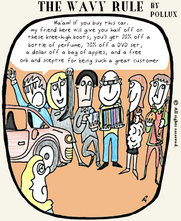
Click on the cartoon to enlarge it!
Read “The Wavy Rule” archive.