
_Pollux writes_:
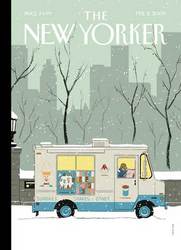
A cold wind blows across an empty urban landscape, agitating the slender trees that stand tenuously in the moss green and greenish-gray city. In “Adrian Tomine’s”:http://www.adrian-tomine.com/ cover for the February 2, 2009 issue of _The New Yorker_, the only source of warmth, ironically enough, comes from the inside of an ice-cream truck. The urge to launch into the worst in “dark and stormy night” writing has been suppressed: Light bathes the lone ice-cream salesman, who sits contentedly in his truck reading a rose-colored newspaper. He’s not calling it a day, and the winter has not erased the smile off the kiddie-cup face of the Ice-Cream Man gracing the side of the truck. “We got sundaes, shakes, and cones; we got sundaes, shakes, and cones…”
Tomine’s delicate linework and subtle coloring lend themselves well to the inherent incongruousness of selling ice-cream on a wintry day. It isn’t a clichéd form of comedy with a sad-sack salesman staring and shivering gloomily into the darkness. Tomine’s salesman waits for business, but not impatiently so. He’s snug in his earflap hat, scarf, and jacket. Besides the inherent incongruousness of this scene, there is also the innate optimism of such a commercial enterprise. If people, perhaps motivated by hunger or by childhood nostalgia, want ice-cream, they’ll buy ice-cream. But they’ll have to brave the snow to get it. When my grandmother, a native of much warmer climes, visited Hornsea, England in 1979, it was in the middle of a hard Yorkshire winter. The town was battered by bone-chilling North Sea winds. It didn’t matter. My father bought her a “99 Flake”:http://en.wikipedia.org/wiki/99_Flake ice-cream crowned with two half-size Cadbury chocolate bars. It was so good that she felt she deserved punishment or time in a mental asylum. “They should beat me with sticks,” she said.
It doesn’t matter if it is an odd thing to eat ice-cream in winter. Let’s all venture out into the snow and treat ourselves to a selection of sundaes, shakes, or cones. Happy times may be here again.
Monthly Archives: January 2009
New Yorker Blog Roundup: 01.30.09
Martin Schneider writes:
On this quiet, chilly Friday, just a few percolating thrums over at newyorker.com before Super Bowl weekend (in which, as far as I can tell, nobody is interested):
* The remarkable “Remembering Updike” blog continues with Tobias Wolff. The sentiments of so many celebrated writers, in genuine thrall to Updike—it leaves me awestruck.
* Evan Osnos argues that Obama had better get his keister to China, stat.
* Inspired by a new book of photographs, Eliza Honey becomes a “trash detective.”
Meanwhile, on the new (!) politics podcast, rechristened “The Political Scene,” Dorothy Wickenden, James Surowiecki, and Steve Coll discuss the stimulus package, the bank bailout, and the deteriorating situation in Pakistan and Afghanistan.
The Wavy Rule, a Daily Comic by Pollux: Hot Type, Baby (2)
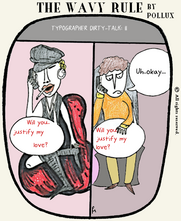
Haven’t I done this before? “Oh yes”:http://emdashes.com/2008/07/the-wavy-rule-hot-type-baby.php. Click on the cartoon to enlarge it!
Read “The Wavy Rule” archive.
Adam Gopnik: I Am ‘SherbrookeW’
Jonathan Taylor writes:
On the Times‘s books blog, Paper Cuts: “Stray Questions” for Adam Gopnik, who reveals his hockey message-board screen name. Also, the word “acedia” has appeared at least twice in The New Yorker: once in a poem by Derek Walcott (“Miasma, acedia, the enervation of damp…”), once in a Donald Barthelme story.
Gabba Gabba Hey! Are the New Yorker Archives Full-Text Searchable?
Martin Schneider writes:
I just noticed something weird: You can get hits from old New Yorker articles on Google.
It may not be immediately apparent how significant this is. Since The New Yorker began steadily—aggressively, even—increasing its electronic profile in 2000, one of the natural consequences has been that you can access the materials by searching on them.
But there have always been arbitrary constraints: Anything since 2000 is likelier to be searchable because the magazine was putting a lot of its content on its website—logical. Before that, and you might be out of luck. The Complete New Yorker DVD set came out in 2005, which vastly increased the user’s ability to search on The New Yorker‘s past. But the search was a keyword search that also (I think; I’ve never quite gotten a handle on this) folded in The New Yorker‘s own internal abstracts and possibly some other text—but never full-text searches or anything close to it. The Digital Edition, unveiled a mere three months ago, also doesn’t incorporate full text. (The Digital Edition lives at http://archives.newyorker.com/, which will become relevant shortly.)
So here’s what happened. You know the “site:” tag in Google? You use it if you want to limit a search to a single website. I was fiddling around, searching for the term “Ramones” on newyorker.com—and I realized that my hits weren’t limited to www.newyorker.com; you also get stuff from archives.newyorker.com. Here are the results from that search:
Google’s gotten subtle and variable enough that different people might get slightly different results, but on my machine, it returns 198 hits. Scrolling down, the first (counting….) twenty-six hits are from www.newyorker.com, and just about all of them appear to be recent, that is, since 2000. That material was posted to the magazine’s website.
But the twenty-seventh hit is not from www.newyorker.com. It’s from archives.newyorker.com. And it dates from 1991. The title reads, “The New Yorker Digital Reader : Jan 07, 1991.” I don’t know for sure, but it looks like every hit after that might be from archives.newyorker.com. (I guess this is a good moment to observe that you have to be a subscriber of the magazine to benefit from this quirk. In case you don’t know, I’ll reiterate that any print subscriber automatically receives free access of all old issues on the Digital Reader.)
And yes, if you’re wondering, these results are completely different from the hits you would get from the other New Yorker resources. On the CNY DVD set, a search for “Ramones” returns 6 results (I only have one update installed on my version, FYI.) On the website, the same search returns 162 hits, but a great many of them are for “Ramon” and have nothing to do with our beloved Forest Hills punk gods.
Most of these hits for the Ramones seem to be listings, which makes some sense. Readers tend to forget the sheer volume of verbiage that each week’s listings section represents. Those would provide a huge amount of content that is nowhere else accessible. Now you can document Jerry Orbach’s storied career as a Broadway crooner! Among other things.
I don’t actually think these results are coming from a proper full-text archive. I think these are OCR (optical character recognition) results. I worked extensively with OCR in the late 1990s, so I kind of know it when I see it. One of the hits in Google provides the following preview:
he Ramones-who are, after Patti Smith, per haps the most successful act to pass through these … \\rho have all taken Ramone clS their stage name,
“\\rho” is obviously “who,” and “clS” is obviously “as.” That’s OCR output, right there. So I guess the results will be imperfect. Good, but imperfect. (It stands to reason that if The New Yorker had their archives OCR’d, then it would capture advertisement content as well. Basically the nature of magazine layout would make this very hairy—but you’d stlll get some decent results, as the Ramones search shows.)
You can search on those archives hits exclusively by doing this:
Okay, that’s enough on this subject for now. Please do write in if you discover anything interesting about this!
A New Alice Tully Hall: Paul Goldberger’s Tour

_Pollux writes_:
If you’re interested in buildings or New York City or music, this is the post for you. Paul Goldberger, the architecture critic for _The New Yorker_, takes a tour of the newly renovated Alice Tully Hall, part of the Lincoln Center for the Performing Arts in New York City. We got the “skinny from Unbeige”:http://www.mediabistro.com/unbeige/architecture/the_new_yorkers_paul_goldberger_takes_a_walk_around_the_new_alice_tully_hall_106914.asp, and I’m digging the building’s new prow-like lobby that juts out like a bocal on a bassoon. Apparently, the new Tully’s sounds will be richer and more alive than they used to be. But what will New York City pigeons think of the new building? Only time will tell.
The Wavy Rule, a Daily Comic by Pollux: A Dashing and Dotting Hero

Click on the cartoon to enlarge it!
Read “The Wavy Rule” archive.
The Wavy Rule, a Daily Comic by Pollux: Stellar Performance Issues
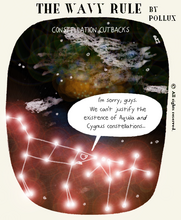
Click on the cartoon to enlarge it!
Read “The Wavy Rule” archive.
John Updike at Rest
Benjamin Chambers writes:
I’ve been on vacation, and so missed the momentous news, yesterday, of John Updike’s passing. His fiction was never my cup of tea, but I mourn his loss just the same. Universally admired for the smooth, sparkling facility of his sentences, he was what most writers wish they could be: able to laugh at himself, but deadly serious about his work; supernaturally and steadily productive in multiple genres; critically admired and at the same time a household name; a thoughtful and perceptive critic who read widely; and (though he has never been given much credit for this by readers of his fiction) omnivorous in his interests.
If that list is a bit jumbled, it merely reflects the breadth of Updike’s wide range. And for those with fixed ideas of Updike, based perhaps on his recent stories, I urge them to go back and read “Friends from Philadelphia,” the first story he published in The New Yorker, back in 1954. I read it for the first time last year; though I didn’t comment on this at the time, I was pleasantly surprised by its multiple subtexts, and a piquancy that age has not dimmed.
Years ago, a friend of mine, a New Yorker, passed on a quote she swore was from Updike, something to do with “… the secret sense that anyone not from New York had to be, in some sense, kidding.” Nonetheless, that was how I felt when I heard the news about his death: that someone, somewhere, has got to be kidding. I feel it still.
Making Our Lives Suck Less: 2/25 Event With Avenue Q and [Title of Show] Stars
Here’s a press release we can believe in: what promises to be a scintillating and hilarious conversation with some of the creators of Emily’s favorite show, Avenue Q, and the acclaimed and wittily titled [Title of Show]. Here are the details:
**P.S. 107 Continues 5th Annual “Readings on the 4th Floor” Series With Focus on “Broadway Unbound”: The creators of Avenue Q and Title of Show along with the artistic director of the Vineyard Theatre talk about redefining the Broadway musical**
Brooklyn, January 26, 2009 – How do you convince a producer that a show featuring puppets for an adult audience and one about writing a Broadway musical will ever succeed in a theater world focused on risk aversion? On **Wednesday, February 25 at 7:30 p.m. on the 4th Floor of PS 107 in Park Slope, Brooklyn**, **Framji Minwalla**, visiting professor of drama at Fordham University, will moderate a panel that includes some of the most successful off-off Broadway talents to ever make it to The Great White Way.
**Jeff Bowen** and **Hunter Bell**, creators and stars in the Obie-award winning musical Title of Show, will be joined by their female lead, **Susan Blackwell**. **Jeff Whitty**, Tony Award-winning playwright (Best Musical 2004) of Avenue Q and Tales of the City will be joined by **Bobby Lopez**, Tony-award winning composer and lyricist for Avenue Q. **Doug Aibel**, artistic director of the Vineyard Theater, which took both of these shows to Broadway, will round out the panel. Anecdotes, spontaneous song and the trials and tribulations of creating musical theater that goes beyond the norm will be center stage in this evening of theatrical insight.
Broadway Unbound will be held on the 4th Floor of PS 107, which is located at 13th Street and 8th Avenue in Park Slope, Brooklyn. Tickets are $15 online at www.ps107.org or at the door.
This esteemed topical literary series continues to raise funds for the newly renovated fourth floor library/art/performance space of P.S. 107. It has featured everyone from Pulitzer prize-winning author Jumpha Lahiri, Interpreter of Maladies, to leading journalists including George Packer of The New Yorker.