
…about the future of the printed word, working with Seymour Hersh, Beppe Grillo, the scope of the magazine, and, of course, Dylan. Read it!
Monthly Archives: November 2009
The Wavy Rule, a Daily Comic by Pollux: Saving California
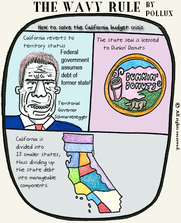
Click on the image for a detailed view!
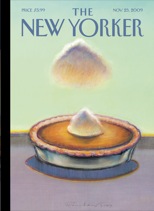
Sempé Fi: Pie and the Sky
_Pollux writes_:
We can’t expect clear skies in late November, but nevertheless we hope to avoid the special kind of rain cloud that hovers over our pumpkin pies. The November 23, 2009 issue of _The New Yorker_, which is “The Food Issue,” features a little cloud hovering above the normally cheery sight of a newly-baked pumpkin pie.
“Wayne Thiebaud’s”:http://en.wikipedia.org/wiki/Wayne_Thiebaud “Pumpkin Cloud” is heavy with rain. Perhaps cheery optimists will hope that the “Pumpkin Cloud” will sprinkle extra whipped cream on the pie, in a sort of Big Rock Candy Mountain kind of fantasy, but I see nothing cheery about the image. Thiebaud’s painting reminds me that we’re never entirely free from worries.
Can we still dig into a pumpkin pie in a carefree manner as we once did? As Phil Gallo “points out”:http://www.zesterdaily.com/media-a-entertainment/281-danger-in-the-kitchen, the November 23 issue of _The New Yorker_ is “likely weighted by the recession — stories about gourmet hamburgers, thousand-dollar meals and Ferran Adria wannabes are certainly gauche these days — but have we reached the point where the joy of eating is gone?”
Depression runs rampant during the holidays. Thiebaud’s cloud is of the emotional kind, a kind of meteorological Sword of Damocles that reminds us that family strife often accompanies Thanksgiving dinners; that political strife still racks the country; that Thanksgiving is followed by the blood-spurting good fun of Black Friday, a frenetic rush for flat-screen TVs and other electronics.
This year, many consumers have foregone the traditional Thanksgiving dinner in order to wait in line outside the department stores and get into the store before anyone else the next morning. And so the pumpkin pie goes cold and uneaten, to be replaced by lifeless electronics and maxed out credit cards.
Thiebaud’s pie is present but where are those who will eat it? Does the pie sit on the edge of a table or of a horizon? This is of course not the first Thiebaud has painted food. Thiebaud gained fame creating still-lifes of all-American foods: pies, cakes, candy, ice creams, hamburgers, hotdogs, and club sandwiches.
Thiebaud’s work “sells well.”:http://oneartworld.com/artists/W/Wayne+Thiebaud.html At his website _Daily Sun Times_, the artist and writer William Theodore Van Doren, who “describes”:http://www.dailysuntimes.net/home/2009/11/22/sunset-sunday-22-november-2009.html Thiebaud’s image as a “luminous and shadowed cream-like cloud hovering over a mound of whipped cream in the middle of a pumpkin pie,” gives a conservative estimate for the value of the original of “Pumpkin Cloud”: $75,000.
Thiebaud’s foods represent nostalgia for a simpler time, when no one worried about calories, cholesterol, and Chinese economic dominance. But what do his paintings mean? What do we make of his rows of gumball machines or lollipops?
I should be careful. As this “article”:http://www.artchive.com/artchive/T/thiebaud.html states:
Thiebaud himself has warned against reading too much into their symbolism. “The symbolic aspect of my work is always confusing to me – it’s never been clear in my mind…. I tend to view the subject matter without trying to be too opaque with respect to its symbolic reference, mostly from the standpoint of problematic attractions – what certain aspects of form offer.”
We should, then, focus on the aspects of form in “Pumpkin Cloud”: the symmetry of cloud and cream, the texture of crust and surface, the horizon and shadow. But that scowl of a cloud isn’t going away.
For the Next Style Issue
Benjamin Chambers writes:
With a few exceptions, The New Yorker has never gone in much for featuring tidbits from its past issues, but here’s one from a short Talk piece by Ian Frazier from the October 10, 1977 issue that should be highlighted in the next Style issue.
Attending a Parsons-New School lecture called “Fashion for the Consumer,” Frazier found “the most interesting part” was the slides shown by Dorothy Waxman of fashions seen on the street. Here’s the punchline:
One of the slides was of a woman stepping off a curb holding a little girl by the hand. “‘Look at this beautiful woman!’ said Dorothy Waxman. ‘Look at the stunning neutral palette of colors she has chosen—the hat just a slightly brighter shade than the jacket. The colors aren’t flashy, but they really come alive. And look at that beautiful little blond girl. What a wonderful accessory!'”
The Wavy Rule, a Daily Comic by Pollux: Obama’s Breakfast
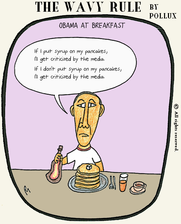
Click on the image for a detailed view!
The Wavy Rule, a Daily Comic by Pollux: Green Bean Casserole, 1623
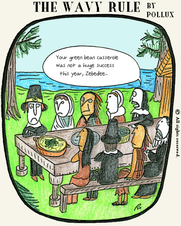
Happy Thanksgiving, Emdashes readers! Click on the image for a detailed view!
The Wavy Rule, a Daily Comic by Pollux: Heaven
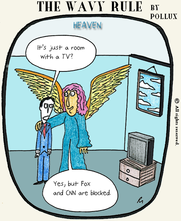
Click on the image for a detailed view!
In Absentia? Gay-Themed Cartoons in The New Yorker
_Pollux writes_:
At his blog “Streetlaughter”:http://ukjarry.blogspot.com/, British writer Matthew Davis takes an interesting “look”:http://ukjarry.blogspot.com/2009/11/314-days-of-future-past.html at the absence of gay-themed subject matter in _The New Yorker_’s cartoon section until the early 1990s.
As Davis points out (with visual examples),
Bear in mind that “Private Eye” and “Playboy” had been publishing gay cartoons since the beginning of the ’60s, and even “Punch” and “Mad”, with their particular audiences, had followed suit by the end of the ’60s, while “National Lampoon” had started in 1970 and never blanched at any gay gag…. The gay cartoonist William Haefeli, who has since produced a significant percentage of “The New Yorker”‘s gay gags, with a career of twenty years in almost every major magazine, didn’t begin appearing in “The New Yorker” until 1998 with the appointment of a new cartoons editor, Bob Mankoff.
He asks an important and relevant question: Why were gay themes seemingly “comedically unprintable” in _The New Yorker_’s cartoon section until just over fifteen years ago? Unless you know of other examples; if you do, let us know.
In Search of New Humor: David Remnick Explains
_Pollux writes_:
How hard is it to find new cartoonists for _The New Yorker_? It’s tough, David Remnick explains, in this “video”:http://bigthink.com/davidremnick/whats-the-deal-with-new-yorker-cartoons posted at BigThink.com. “It’s easier for me to get somebody to go sleep on the ground in Sudan and dodge bullets in Afghanistan than it is to get something authentically funny,” Remnick says.
Remnick mentions in the video that he shared his thoughts with _New Yorker_ writer and fiction editor “Roger Angell”:http://en.wikipedia.org/wiki/Roger_Angell on this difficulty of finding new humor. Angell replied that Remnick was the fifth editor of _The New Yorker_ to make this observation, beginning with Harold Ross.
Remnick remarks that he works closely with cartoon editor Bob Mankoff to review the new batches of incoming cartoons. Finding of the humor of the highest order is exceedingly difficult. Making a living as a cartoonist is even more so.
The Wavy Rule, a Daily Comic by Pollux: Waterworld
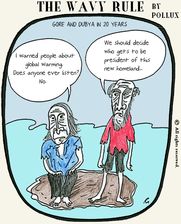
Click on the image for a detailed view!