

Click on the image for a detailed view!
Monthly Archives: October 2009
UCLA’s Royce Hall: Robert Crumb and Françoise Mouly
_Pollux writes_:
Last night I had the opportunity to attend “An Evening with Robert Crumb” at UCLA’s Royce Hall, in which the renowned cartoonist sat down for a discussion with Françoise Mouly, art editor of _The New Yorker_.
It was a rare public appearance for Crumb. The cartoonist joked that he would need recovery time at an Austrian health spa after the night was over. “I’m never doing it again,” he said, with a chuckle, before the discussion had even begun. Crumb prefers the privacy of pen and paper.
The evening started with a discussion on his “self-pitying youth,” which is by now quite familiar to Crumb fans and to anyone who has seen Terry Zwigoff’s 1994 film _Crumb_: Crumb’s domineering father; his obsessive brother Charles, who got him to start drawing comics in the first place; his brother Maxon who went from sitting on the street in a lotus position with a beggar bowl to being an artist whose intense work is much in demand. “Self-esteem helps people a lot,” Crumb said.
A photograph of Crumb as a nerdy 13-year-old was displayed on the screen. The audience laughed as Crumb pointed to certain aspects of himself as a young man: the shirt buttoned all the way to the top and a gap in his front teeth.
Crumb said the origin of gap in his teeth was explained in a story of his called “Don’t Tempt Fate.” A kid in the neighborhood used to throw pieces of cinderblock over a fence. Crumb had thought someone could get hurt; he walked around the fence, and that person ended up being him.
“Do you recognize yourself?” Mouly asked Crumb, in reference to Zwigoff’s film. “Excruciatingly so,” Crumb said, and said that Zwigoff had depicted Crumb’s natural self. Crumb said he had expected the film to be shown at a few art houses and then die a natural death. It didn’t turn out that way: the film became a huge success and his mother ended up feeling very hurt by Crumb’s comments in the film about his family.
Crumb said that his family was angry at him for about a decade, but that he recently attended a family reunion of “hundreds of Crumbs”. Crumb talked about his “skinny ectomorph” of a cousin, Scott, who looks exactly like him and is living what seems like an alternate life in a trailer in northern Minnesota.
Mouly pulled up an old photo from Crumb’s childhood, which depicted a wall plastered with _New Yorker_ covers. Mouly asked him if he had dreams as a young man of drawing for _The New Yorker_. Crumb said he could scarcely imagine it, since drawing for _The New Yorker_ had seemed so unattainable. Crumb, of course, succeeding in doing so. “I only got my chance after Arno and all the others had died off,” he said.
Mouly and Crumb talked about the Crumb “cover”:http://archives.newyorker.com/?i=1994-02-21 from February 21, 1994. Mouly said that Tina Brown, editor of _The New Yorker_, had initially not realized the image was a take-off on Eustace Tilley. Crumb loved that a sacred taboo had been broken in his depiction of Tilley as a grungy young man reading a flier for an adult video store. Crumb loved that it caused “fussy old grumps” to write angry letters and cancel their subscriptions in protest.
Crumb talked about his career at a greeting card company. A man at an employment agency man got Crumb the job after letting the greeting card company know that the young man he had in his employment office was a fantastic artist. The man at the employment had never seen of his work since Crumb had not thought to bring a portfolio of his artwork.
Crumb hadn’t thought a job in the art field was possible, and his first job at the greeting card company was working at the tedious and laborious process of color separation. Eventually, he was moved to card design after his superiors spotted doodles dotting the walls of his desk. First, they needed to teach him how to “draw cute,” which entailed creating characters with big heads and short bodies. “People love cute,” Crumb said.
Mouly asked Crumb about his life in France. “You live in France but not because you love France,” she said. Crumb said this was true; living in France was all his wife Aline’s idea. Crumb had worried that he would lose in touch with America, but said that his _Book of Genesis_ would now make those fears unfounded.
Crumb said that his wife Aline now practically runs the French village they live in, organizing aerobic classes there, for example. She makes her husband design the fliers for the aerobics studio every season. Crumb said that his wife Aline pushed her aerobics class to scream and yell and really stretch instead of mincing around; she now has a loyal group of “fifteen French Amazons.”
Crumb talked about his wife’s interests in imagery, both Catholic and pagan, depicting goddess figures. He spoke admiringly of her and said that she was hard-nosed and street-wise but also “intuitively mystical.” Crumb talked about his love for big-legged, big-breasted women and his Catholic schoolgirl fantasies. He remarked that Serena Williams had a butt to die for, and that he would be a puddle if he were in her presence.
Mouly pulled up a drawing of a street from the French village. The locals liked the drawing, but hated the fact that Crumb had drawn a trash-bin as well. Crumb said that he was just drawing the reality of the street. Someone later asked him if he would use Nicolas Sarkozy as subject matter in his comics. “No, I don’t mess with politicians,” Crumb said. “It’s a waste of time.” The audience clapped.
Crumb and Mouly then talked about his illustrated “_Book of Genesis_”:http://www.printmag.com/Article/R_Crumb_and_the_Bible, which represents four years of hard work. Crumb dedicated the work to his wife, in honor of her encouragement and her idea to set him up in a hut in the mountains where he could live and work as a hermit without interruption. “I’m too famous,” Crumb said.
The genesis of Genesis was a satirical comic Crumb had previously done on Adam and Eve. Crumb said that he later realized that he didn’t have to present a satirical or mocking view of the Old Testament. If he followed the text literally, he could show how bizarre the Bible actually was.
Mouly asked if Crumb grew up reading the Bible. Crumb said he was raised Catholic but said that Catholicism involved a lot of reading of texts other than the Bible, such as the catechism. When he did hear from the Bible, it was mostly from the New Testament.
Crumb read part of an angry letter sent by a “Jewish Lesbian” to _The New Yorker_, which ran an excerpt of the work in the June 8, 2009 issue. Crumb chuckled as he read it; he loves angry letters. The letter held that Crumb’s work reinforced conceptions of God as a patriarchal, dominating figure.
Crumb said that he drew God as a man because the text says “He” and “Him,” but he admitted to using the familiar image of God as an angry bearded white man. But God is angry in a lot of these stories, Crumb said. The best compliment Crumb has received, he said, was that someone told him that his Genesis project made the reader want to know what happens next.
Crumb found some stories from Genesis to be incomprehensible and he took some liberties. On the whole, he was completely faithful to the text, and drew, for example, all of the “begats” as individual portraits.
He never consulted with Biblical scholars but did seek the advice of a Hebrew scholar he knew. For the props and details of everyday life, Crumb said he referred to stills from old Cecil DeMille and D.W. Griffith films, since information from the era in which Old Testament figures are said to have lived suffers from a paucity of historical information.
For his Isaac, Crumb used as his model an old Moroccan Jewish man who lives in the same French village. Otherwise, for his cast of characters, he generally referred to images taken from books. Crumb was later asked about how he intuited the emotions of female figures from the Old Testament, which Crumb said he was forced to speculate on, as the Bible makes little comment on Sarah’s emotions, for example.
Crumb said he was sick of the Bible and wanted to go back to “porn.” He was later asked if the project had made him more spiritual. Crumb replied that he had no reverence for the text and that he did not think that the Old Testament was the word of God, and emphasized that the Old Testament represents an oral tradition passed from generation to generation.
The Q & A session was disconcertingly chaotic. David Sefton, Executive and Artistic Director of UCLA Live, had said at the beginning of the evening that microphones would not be made available to audience members who had questions. This was intended, he said, to prevent audience members from plugging their websites, comics, screenplays –but this is what happened anyway.
The first question that Crumb received was more a statement than a question. “Mr. Crumb, I like big legs too,” a man in the audience said. “Oh, good,” Crumb replied. And then the man began to plug his website, which apparently was devoted to women with big legs. The audience roared in disapproval.
Since there was no usher handing a microphone to people who had questions, the audience simply yelled out questions, often simultaneously. Crumb took it in stride, joking at one point that he had heard a woman’s voice, and could he hear her question, please?
Questions ranged from “What’s your hat size?” and “Do you have carpal tunnel syndrome?” to “What finally pushed your brother Charles over the edge?” (a question that also elicited, understandably, grumbles of disapproval).
Some members of the audience became rather frenzied. “Talk about Fritz the Cat! Talk about Fritz the Cat!” a young man kept on yelling. Another asked a question in regards to a fellow questioner: “How many questions is this guy going to ask?” This was in reference to a man who stood at the balcony and called out one question after another.
UCLA’s total lack of control over the disorderly Q & A session reflected badly on the university as a whole. At times, Mr. Crumb was interrupted by people asking new questions before he could have a chance to finish answering a question that he was already asked. It could not have been an entirely happy experience for the cartoonist.
The man who had plugged his porno site kept on yelling comments and questions from his balcony seat. Whenever he made a statement the audience roared in disapproval.
I couldn’t help thinking that this is precisely why Crumb hates public appearances. He seemed relieved to get off the stage as soon as the evening had ended.
The best questions posed to Crumb involved his methods. He was asked if he would ever “go digital.” Crumb responded with a categorical “No.” His daughter Sophie has tried to get him to use PhotoShop but he found it laborious and he hated telling her (and the image editing program) what colors he wanted to use. He does not like using technology; in high school he had taken typing classes and had received F’s.
For coloring, he pastes a Xerox of his drawing onto a hard piece of board and then uses watercolor. But for his _Book of Genesis_ he used no color, since it would have taken too long. Crumb uses a crow quill pen rather than a rapidograph.
With some exceptions, he generally required three days to do one page for his Genesis project. Crumb said he felt like he was “laying track for the Trans-Siberian Railroad or climbing Mount Everest” and had times doubted the value of the project. Mouly assured him that his work had great value, and had gotten people interested in the Bible, not so much for religious reasons but as a piece of historical text.
Crumb seemed relieved. “That’s good to hear, after all that fuckin’ work.”
The Wavy Rule, a Daily Comic by Pollux: Prince Valiant at a Deli
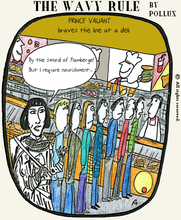
Click on the image for a detailed view!
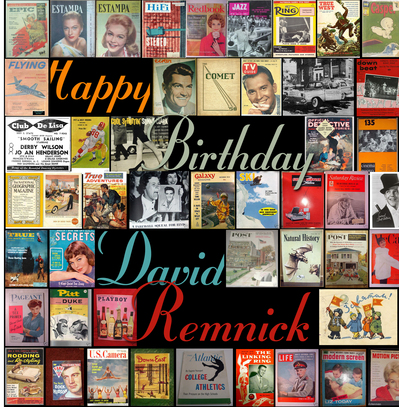
Happy Birthday, David Remnick!
Emily Gordon writes:
We’re running this nifty photo collage, which our designer friend Jennifer Hadley (creator of the original Emdashes logo) created last year for a significant milestone, to wish The New Yorker‘s editor many happy returns of the day. The image is made up of magazine covers and other images (including a Russian postcard) from Remnick’s birth year, part of the environment of word and image that formed an editor perfectly suited to both a righteous tradition and a challenging new age.
Who could have predicted how the picture of print media would change? Thankfully, we still have great magazines to celebrate, and as always but especially today, the one whose host we toast is The New Yorker.
The Wavy Rule, a Daily Comic by Pollux: We Know Drama, My Dear Watson
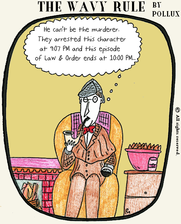
Click on the image for a detailed view!
The Wavy Rule, a Daily Comic by Pollux: Groovy Typography
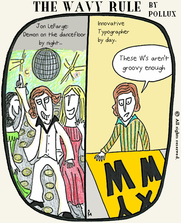
Click on the image for a detailed view!
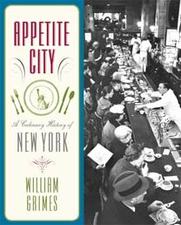
Tables for Eight Million: William Grimes’s ‘Appetite City’—An Emdashes Review Essay
Jonathan Taylor writes:
New York is food crazy right now, even more than usual. It’s also experiencing a renaissance of interest in local history, as new populations sweep into neigborhoods across the boroughs, and some, at least, take an interest in the surroundings they are the latest to reshape. So it’s hardly a surprise to see the publication this month of William Grimes’s history of New York restaurants, Appetite City (North Point, $30). What may be perplexing is that so little of this history was already widely known. The book helps us understand why it wasn’t. [Grimes will be discussing Appetite City with Ruth Reichl and others at the New York Public Library on Thursday Nov. 5, at 7:00 p.m. Info and tickets here.]
New York is sufficiently impressed with its own importance, but it has long been too busy occupied with what is happening now, and what’s the next big thing, to pay attention to the history that makes it important. Cities whose glory days are over do that. I’ve lived in New York for 15 years, and I know off the top of my head that the oldest existing restaurants in Boston are Union Oyster House, Durgin-Park and Locke-Ober; and that the oldest in New Orleans is Antoine’s.
But what is the oldest restaurant in New York? I had hardly given it a thought. It turns out it’s not that clear, and whatever the answer is, it’s of limited interest, and cannot illuminate New York’s past in the way that these others do for their cities. The history of New York’s restaurants, as in other fields, is one of constant change, creative destruction, and nimble assimilation of other places’ traditions and talents. The only thing capable of embodying the essence of New York’s history is its present—the notable absence of so much of its history is a result of the way that history unfolded.
Grimes’s opening chapter describes a New York difficult to imagine: “A City Without a Restaurant.” The early history of eating out in New York is the history of the notion of eating outside the home at all. For the Dutch-descended Knickerbocker society of the early 19th century, dining was done in private, and in any case, they regarded the food generally served in public—at chophouses—as “foreign,” because it was English. Those chophouses, and lesser coffeehouses and pie counters, served what Grimes says was the American city where it first became customary not to return home to consume lunch.
In the busy city, eating out was thus first a matter of necessity. But the idea of going out to eat as a pleasurable activity in itself was a slightly later import. Abram Dayton, in his 1897 memoir Last Days of Knickerbocker Life in New York, recalled the “foreign element” that distinguished Delmonico’s, opened in 1827 by Swiss brothers as a French café. Delmonico’s introduced the phenomenon that defines one aspect of New York as a restaurant city: aspirational dining. Fed by its own farm in the village of Williamsburgh on Long Island (now Brooklyn’s Williamsburg), it offered above all the latest in Parisian trends, but also skimmed the world’s cuisines, offering, according to New York bon vivant Sam Ward, everything from “the caviare of Archangel, to the ‘polenta’ of Naples, the ‘allia podrida’ of Madrid, the Bouillabaise of Marseilles, the ‘Casuela’ of Santiago Chili, and the Buffalo hump of Fort Laramie [sic throughout].”
Over the course of the 19th century, Delmonico’s became New York’s most renowned restaurant, or rather restaurants: Its expansion illustrates another reason New York’s dining history isn’t well preserved—it kept moving. Their second location at 76 Broad St., opened in 1834, became the main restaurant after a fire destroyed the original 23 William St. site the next year. Lorenzo Delmonico, keeping his eye on the city’s growth uptown, moved the “flagship” Delmonico’s to a series of locations opened successively at William and Beaver in 1837; Chambers and Broadway in 1856; Fifth Ave. and 14th St. in 1862, relocated in 1876 to Fifth Ave. and 26th St. by Madison Square; and finally to Fifth and 44th, the last location, which closed in 1923.
In Grimes’s chapters focusing on Madison Square, we see New York’s emerging economic preeminence in the second half of the 1800s, as manifested in the city’s first fully realized nocturnal entertainment and social mecca. Lavish hotels, like Hoffman House and the Brunswick, boasted restaurants matching the Delmonico’s standard (and poaching its cooks), and racily decorated bars that poured the first wave of Martinis and Manhattans. The Madison Square scene functioned both as stage for the high-society likes of Edith Wharton, who gathered at the Café Martin (opened in the Delmonico’s space when that moved to Midtown), and auditorium for a mass audience of gawkers: the area was the pre-Times Square theater district, the site of a Barnum Hippodrome and, of course, the original Madison Square Garden.
While the upper crust migrated determinedly from downtown (Bleecker St. was “the Park Avenue of its day” before 1850) to Union Square to Madison Square to Midtown, Appetite City gives glimpses of the surprising pasts of the neighborhoods in its shadows. Park Row, the 19th-century home of New York’s newspaper industry, was lined with cheap spots that served journalists around the clock, like so-called “beef and” restaurants. (Journalists, in return, fancifully embellished on the kitchen argot that waiters supposedly used to shout orders to the kitchen. The symbiotic relationship between the news media and restaurants is a constant theme in the book.)
And who knew that what we now call SoHo was once settled by French emigres who patronized grubby cuisine grand-mere eating houses along Wooster Street? Nearby, the stretch of Houston just east of Broadway was once a notorious den of gambling and theivery, concentrated around the oyster saloon Florence’s and the concert hall Harry Hill’s. (It’s just barely possible to feel that the block’s raucous late-night history survives a bit in old-time dive bar Milano’s and Botanica, a.k.a. the former Knitting Factory.)
Throughout New York’s relatively short history, composed mostly of the arrival of waves of newcomers, what’s “authentically” New York has always been fiercely, and pointlessly, contested. At the turn of the 20th century, vast “lobster-palaces”—Rector’s at 44th and Broadway, Churchill’s at 49th, Jack’s at 42nd and Sixth—fed thousands of pleasure-seekers in a district that redefined the image of New York high life, Times Square, and prompted a now-familiar kind of discourse about what defined a “real New Yorker”:
There was disagreement about who belonged to lobster-palace society. The more jaded journalists dismissed the whole tribe as nothing more than out-of-towners desperate to spend money and woop it up. Convinced that they were seated amidst real New Yorkers and the cream of the theatrical crop, the rubes stared agog at their fellow visitors from Rapid City and Kalamazoo, and endured the close company of big-spending loudmouths….
What could be more “authentically” New York than the visitors’ quest to show up and be in the middle of it, and the entrepreneur’s readiness to furnish a ready-made spectacle. In any case, the original lobster palace, Rector’s, was an import: Chicago restaurateur Charles Rector simply transplanted the restaurant model that had already earned him his fortune in the Loop.
And while today, as the plans for a T.G.I. Friday’s in Union Square understandably prompt bemoaning of the dilution of the city’s character by national chains, it’s worth noting that at the turn of the 20th century, restaurant chains were the rage in New York. The city was the birthplace of the Childs restaurants, which from 1889 to 1928 grew to 112 restaurants in 33 cities in North America (including one in Union Square). At each stage of the city’s rapid development, an ever-shifting, self-centered sense of “history” is repeatedly generated. In 1921, Collier’s magazine lamented that Broadway around Times Square, “once famous for ‘gilded’ restaurants,” was now lined with “dairy restaurants, pastry shops, rotisseries, cafeterias, and ‘automats'”—the last of which are now themselves objects of nostalgia of “old New York.”
Today, New York is taken with a food culture hungry for the brand of authenticity preached by Michael Pollan and Alice Waters. But this city, although a gastronomic capital, is not the custodian of a traditional local cuisine or a terroir. To a degree, it resembles Paris in this way, since Paris is famous not because of the cuisine of the ÃŽle de France, but as magnet and stage for the entire country’s products and cuisines. But in Paris, the fanciful use of those products at high-end restaurants became itself a fully developed culinary tradition. In contrast, Grimes notes, “New York’s hallmark as a dining city is not the excellence of its best restaurants, it’s the uncommon diversity of ‘national cooking styles’ in one place.” And, like the entertainment industry they’re so connected to, the “best” restaurants also depend on talent and trends from the sticks gravitating to the New York City stage, be it Chicago’s Charlie Rector or Waters’s Californian farm-to-table movement.
The one kind of eatery that historically is as authentically local to New York as a bouchon is to Lyon is the oyster saloon—and that’s one that, typically enough, is extinct, due to overharvesting of the once seemingly limitless oyster supplies of regional waters. Mark Kurlansky, of course, explained the pervasiveness of this shellfish in New York’s economic, cultural and natural life in his book The Big Oyster. But Grimes shows vividly how oysters were, in the 19th century, the city’s “great leveler.” They were an omnipresent cheap snack food, whether a half-dozen (seven) for a dime, a hot chunk of oyster pie, or pickled oysters. (Grimes rightly finds the disappearance of the latter puzzling—with luck, maybe they’ll be revived by an artisanal fishmonger analogue of the Marlow & Daughters-style butcher shop.) At the same time, some oyster saloons functioned as the era’s “power restaurants,” whether the sumptuous Downing’s on Pell St., or the ostentatiously severe Dorlon’s at Fulton Market. The Oyster Bar in Grand Central Terminal was founded before the final end of the oyster era and is, in Grimes’s estimation, a good “approximation” of this old-time New York institution.
But cheap oysters as the quintessential food of the city’s daily life are a thing of the past, just as it’s difficult to imagine Broadway between Madison Square Park and 34th St. as “ablaze with the electric light” illuminating thronging crowds of night-owls. Yet even as so much of New York’s restaurant past has vanished, much of it is simply reincarnated, since many of the city’s eating requirements stay the same. Once you’ve read Appetite City, almost any kind of restaurant reveals itself as merely the latest avatar of a New York archetype.
“My theory about a restaurant is that to be the right sort of an eating place it must be closely related to its source of supplies,” wrote the man behind a meticulously conceptualized restaurant that was supplied by its own farm outside the city; “We feel that certain ideals of cooking and furnishings should be expressed in connection with a restaurant.” The restaurateur in question is not Dan Barber, but Arts and Crafts furniture designer Gustav Stickley, whose Craftsman Restaurant on East 39th St. lasted tantalizingly briefly, from 1913 to 1914. Graydon Carter’s Waverly Inn has as predecessor in the Pfaff’s of the 1850s, at Broadway and Bleecker, where Saturday Press magazine editor Henry Clapp “cracked the whip” over a hand-picked circus of “self-proclaimed geniuses—most of them future footnote material.” A craze for tamale carts made a notable appearance a century before the Red Hook soccer fields—”chicken” tamales sold by Irish vendors and actually made with veal, then a cheaper meat than chicken!
And the pizza slice can be said to play the same role for the city that the oyster once did: the cheapest meal available on every street, but an object of appreciation up and down the social scale. Apart from a mention of the origins of pizza’s presence in New York, though, there is scant mention in Appetite City of this ubiquitous food, and food culture, of the city. It’s almost impossible to make a fair criticism of what has to be left out, after everything that Grimes has managed to put into this book. But here’s my only real quibble. Until the early 20th century, Grimes vividly conjures the scope of popular food practices alongside the heights scaled by the likes of Delmonico’s. But the in latter part of the book focuses more narrowly on fine dining trends—telling that story as a former Times restaurant critic can—but also at the expense of the true vernacular dining of the city’s millions.
This makes the more recent history weaker for at least two reasons. It neglects to carry historical threads the book has traced for so long all the way to their fascinating manifestations in the present day. I was disappointed, after the extensive genealogy of greasy spoons—the “coffee and cake” restaurants, “beef and…” joints and “hash houses”—not to see exactly how these led to what today’s New Yorkers know as diners.
Secondly, it loses sight of Grimes’s own maxim that it’s the “diversity of national cooking styles,” not only the “best” restaurants, that define this “restaurant city.” And thus it can’t account for what is already shaping up as the next chapter in New York’s culinary history: the fact that the city’s foodies are now as fixated on seeking out the best taco cart or Hunan hot noodle hideaway as on getting the impossible Momofuku reservation—if not more.
But that’s just to say of Grimes’s achievement, “More like this, please.” As the current quest for authenticity mandates attention to (sometimes imaginary) tradition and heritage, and restaurants continue to both cause and symptom of the changing geography of the city—functioning as chicken and egg in the familiar cycle of neighborhood gentrification—Appetite City is required reading for understanding more than just how we eat in this city.
P.S.: Appetite City has some New Yorker angles too, with a number of its articles serving as key sources, including:
“Romance, Incorporated,” a February 4, 1928, profile by Margaret Leech of Alice Foote MacDougall, “the Martha Stewart of the 1920s” in Grimes’s words, and creator of cozily middlebrow chain of restaurants intended for working women to repair to.
Margaret Case Harriman’s two-part profile of the headwaiters of Upper East Side society restaurant The Colony, from June 1 and June 8, 1935.
“The Ambassador in the Sanctuary,” Joseph Wechsberg’s 1953 profile of Le Pavillon proprietor Henri Soulé.
Geoffrey Hellman’s 1964 profile of Joseph Baum’s Restaurant Associates, “Directed to the Product.” (As told by Grimes, the tale of Restaurant Associates’ impeccably researched artificiality is a key chapter in the history of the kind of “fine-dining business” now exemplified by the McNally, Danny Meyer and other restaurant “groups.”)
Grimes also notes two early New Yorker writers who authored guides to the city’s restaurants: George S. Chappell (The Restaurants of New York, 1925) and Walter R. Brooks (New York: An Intimate Guide, 1931).
Festival Link: Rumpus Chronicler Must Know Shorthand
Martin Schneider writes:
It’s not easy to out-Festival Emdashes—I always thought that I took the most exhaustive notes of anybody bar Rachel Sklar—but dang if Rozalia Jovanovic of The Rumpus didn’t display as much enthusiasm, interest, and wit as a pack of Emdashers.
Her exquisitely detailed account of five New Yorker Festival events is a must-read for anyone who wants to relive or vicariously soak in the events of that wonderful weekend. Her use of full names at every conceivable juncture is mesmerizing and hilarious.
The papercut illos by Sybille Schenker are a perfect supplement to the text.
The Cartoon Kit: New Yorker Contest
_Pollux writes_:
Robert Mankoff, cartoon editor of _The New Yorker_, talked about this upcoming feature at his class on cartooning during the New Yorker Festival–and now it’s here!
This is the “Cartoon Kit!”:http://www.newyorker.com/online/photocontests/cartoonkit It’s an advanced form of the Caption Contest: for this contest you’ll be creating your own _New Yorker_ cartoon with pre-drawn props and characters drawn by artist and writer Alex Gregory.
Caption your customized cartoon and submit your entry by **November 22, 2009**!
Fans of _New Yorker_ cartoons will love the props they can play around with, which range from cats, cavemen, dogs, martini glasses to aliens, the Grim Reaper, a fishbowl, and a sad clown.
You can drag and drop from the gallery of more than forty images, and resize and duplicate them. Let your imagination run wild!
The Cartoon Kit will be releasing a new theme with new drawings each month.
This month the site is also running a sweepstakes, in which _The New Yorker_ will be giving away a signed copy of _On The Money: The Economy in Cartoons, 1925-2009_, edited by Mankoff.
Grand prize is a trip for two to New York City. This trip will include a meeting with Mankoff and a tour of the _New Yorker_ offices.
The Wavy Rule, a Daily Comic by Pollux: Northwest by 150 Miles Northwest
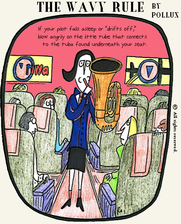
Click on the image for a detailed view!