
Martin Schneider writes:
Seeing Larry David and the cast members of his show Curb Your Enthusiasm (Susie Essman, Cheryl Hines, and Jeff Garlin) as well as a sneak preview of the first episode of Season 8 (it airs on HBO this Sunday) at 92Y of all possible places felt a bit like seeing— the mind gropes for comparisons. The Pope in Rome? Prince in Paisley Park? Oprah in Oprahland?
In other words, the adoration from the audience was total. Indeed, the whole thing was even better because (no spoilers) the episode has a lot to do with Judaism, and this highly Jewish audience (I didn’t say “self-loathing”) lustily ate it up.
The surprise MC was Brian Williams, and he couldn’t have been more perfect or more mock-awkward. His first words were, “Welcome to ‘Let’s Find a Catholic to Moderate This Event,'” which very much conveyed his sporting humor for the evening. As it turned out, he and Jeff Garlin parried so much and so well that Garlin suggested jettisoning Larry David from Curb and making it a Williams-Garlin joint. Garlin also went into a loud, funny tirade about how Williams is the only entity in “media” with any class. And he certainly seemed to mean it. (Nobody seemed to disagree, either.)
It’s pretty useless to summarize this long, probing, hilarious, and joyful event, so I’ll throw out a few choice quotations and we’ll call it a day.
Garlin: “The Orthodox are known for their great sense of humor.”
Williams: “I’m not William F. Buckley. I’m as dumb as this table top.”
Essman: “People will come up to me and say, ‘My wife is just like Susie.’ And I’ll think, ‘You poor motherfucker!'”
David: “If the character [i.e., Larry on the show] is a narcissist, then I’m a narcissist.”
Garlin [to Williams]: “You are America’s most trusted news source! No opinions! These are the facts! I am Brian Williams!”
David, on losing a lot of potential script ideas when his Blackberry died: “A person could die, and I wouldn’t be as unhappy.”
Williams: “I wasn’t going to say ‘narcissistic’….”
Williams: “If you’re in a cab, will you talk to the cabbie?”
David: “Sometimes….”
Williams: “If you’re at Yankee Stadium, will you talk to the guy next to you?”
David [after a hesitation]: “A cab ride lasts ten minutes….”
Garlin: “I don’t think the show is brilliant. Pixar movies are brilliant, because the stupidest person and the smartest person can watch it and get something out of it. Our show—you have to be smart to get it!”
David: “When I hurt someone’s feelings, I am tortured by it.”
Garlin [chiming in]: “More than anyone I know, actually.”
Garlin [to Williams]: “You love the word ‘Judaica.'”
Williams: “Yes, we’ve vacationed there….”
Thanks to 92Y for a remarkable evening with five remarkable entertainers (yes, Williams too).
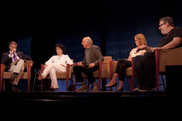 Photo credit: Joyce Culver for 92nd Street Y
Author Archives: Martin
Ryan Lizza on Liposuction; Louis Menand on Charlie Sheen….
Martin Schneider writes:
Slate‘s Tom Scocca is on to something here with some reassignment suggestions for the New Yorker editors. I also enjoyed his description of the magazine as “America’s leading crypto-newsweekly,” which is simultaneously complimentary and deliciously suggestive of a subtle publishing conspiracy.
“My Perestroika” Movie May as Well Be “Russian People 101”
Martin Schneider writes:
Last night the IFC Center in New York had a special event for the tremendous new documentary My Perestroika in which director Robin Hessman and the Meyerson family, three of the movie’s subjects, fielded questions from the (it turned out) largely Russian-fluent audience.
My Perestroika retrospectively tracks a handful of Moscow elementary school chums from the 1970s to today. Hessman’s subjects are, for lack of a better word, “ordinary” Russian citizens, which fact must present a hell of a challenge for a documentarian. These people are noteworthy for not having gaudy and obviously narratizable biographical details: The aforementioned Meyersons today are schoolteachers with a winsome young son. One fellow is a former rock musician, another manages the retail presence of a French shirt designer; one woman makes a living managing the pool tables in an unspecified number of Moscow bars. The day-to-day details of the lives of these people and their uniformly sensible comments about the political upheavals of the past and present form the beating heart of this engrossing and observant movie.
For those who can remember the Cold War as a distant “adult” drama that never yielded much in the way of detail, My Perestroika has a few surprises in store. A key one is that the USSR of the 1970s wasn’t such a bad place for middle-class Muscovites to grow up. The struggle against the belligerent, materialist West was a fine cause for idealistic children to sink their teeth into (we see them designing handmade posters for media-ready protests). Halfway through the movie, the viewer is likely to marvel at the seemingly stark differences between the Russia of “closed” 1975 and that of “open” 2006. By the time the movie is over, that take will seem more than a little naïve. Vladimir Putin may have overseen a country with access to the capitalist West and the Internet, but his role ended up being uncomfortably similar to that of Brezhnev or Andropov.
To Hessman’s credit, My Perestroika is as interested in the lives of its subjects as the political lessons to be drawn from them, although both elements are important to the movie’s power. The people we meet are unremarkable, yet oddly likeable; the viewer never tires of them, I think. If such footage had been widely available to Americans several decades ago, perhaps the Cold War would have been shorter or less scary. The unavoidable irony is that the movie could only have been made and distributed after it was no longer necessary in that way.
My Perestroika‘s run at the IFC Center has been extended beyond its initial week-long commitment, so do check it out.
Emmylou Harris: A Conversation with Music at the Times Center
Martin Schneider writes:
Emdashes is very pleased to feature an events report by a new friend of the site: Ethan de Seife, professor of film at Hofstra University and author of the delightful “Cultographies” book on This is Spinal Tap. He also has a forthcoming book on the director Frank Tashlin.
With no further ado, we turn it over to Ethan:
The big red LED clock at the back of the Times Center auditorium last Wednesday had just blinked precisely 9:00pm as I and the rest of the crowd filed out, having witnessed precisely 90 minutes of “conversation with music,” in which American music icon Emmylou Harris was interviewed by fawning New York Times writer Dana Jennings. This was a tightly run ship.
Given the opportunity, I, too, would likely fawn over Emmylou Harris, whose records have been at or near the center of my collection for a couple decades. Harris’s credentials as a musician and singer are entirely unimpeachable: she is unquestionably one of the most important and sensitive interpreters of American popular song of the last four decades. In the most recent of those decades, give or take, she has turned to songwriting, and she’s quite good at it—not as good as she is at singing, but, then, Emmylou Harris sings better than most people on earth. She is eminently fawnworthy. Still, Jennings’s forced familiarity grated after a while. But we were not there to hear him.
Harris sang a couple of fairly lightweight songs of her own composition, the better of which was a tribute to her friend and inspiration, the recently deceased Kate McGarrigle. The two songs left me craving more, especially since I hadn’t seen her perform since the late 1990s, at the tail end of the Wrecking Ball tour (when she was supported by the remarkable Spyboy band).
The real goal was to get Harris to talk, not sing. And she told some good stories: writing to Pete Seeger when she was a girl; many tales about her beloved dogs; fond remembrances of departed colleagues Hazel Dickens and Charlie Louvin; and the inevitable recollections of Gram Parsons, about whom she was quite frank in her assertion that he did nothing less than change her life, both by “discovering” her and by dying, so very very young, when he and she were lovers.
Ultimately, though, the event did not get much more revelatory than a good, solid magazine interview, and it carried the whiff of something more than a little prefabricated: the second-by-second LED countdown clock; the three camera operators, and so on. So while I would love to have Emmylou Harris over for tea—she seems charming, warm, and good-humored, and I’d love to play for her and sing along with her to, say, my Moe Bandy and Ferlin Husky records—this “TimesTalks” venue did not really play to her many strengths.
Shirley MacLaine, “Squirrelly” and Pretty Marvelous
Martin Schneider writes:
When 92Y has a good event, it’s a doozy.
On Monday night Shirley MacLaine consented to be interviewed by WNYC’s own Leonard Lopate (an unexpected surprise—I hadn’t read the event preview carefully enough). I say “consented,” but the truth is, MacLaine’s casino-style show (she mentioned Atlantic City) apparently is mostly an evening of stories and audience Q&A too, and the woman is so ridiculously appealing and entertaining, she could certainly make a living doing just that and not being an incredibly good actress—which she still is, at 76. Also, she appears to cherish being the center of attention and twitting foils like Leonard Lopate for fun.
I could give an account of the event but it was mainly just MacLaine being very charming and telling stories that occasionally involved conversations with people like Nehru (!).
A few highlights: Early during the filming of The Trouble with Harry, her first movie, Alfred Hitchcock walked up to her and the advice he gave her was “genuine chopper.” (Cockney slang for “real axe” = “relax.”)
MacLaine is friends with William Peter Blatty, who wrote The Exorcist in order to “prove” to MacLaine that evil exists in the world. MacLaine was offered the Ellen Burstyn role but her agent convinced her that the script was no good.
Stephen Hawking once told MacLaine that he believes that he is the reincarnation of Sir Isaac Newton. I suspect Hawking was pulling her leg, but who knows?
MacLaine called the recently departed Elizabeth Taylor “my closest friend” and said that her nickname for MacLaine was “Squirrelly.” (I particularly like this.)
In the second half MacLaine spoke at length about her belief in past lives and also UFOs. She also has a lot of silly ideas about 2012 as the end of a 26,000-year cycle or something—I guess we’ll find out next year. I think all of this is poppycock, of course. Alexander Pope said it best: “A little learning is a dangerous thing.” Because what MacLaine is is a highly intelligent woman in the highly intuitive field known as acting, and that means she’s a great actress and not a great analytical thinker. As if that mattered at all.
MacLaine told a story about the filming of Madame Sousatzka that clarified the situation for me a little bit. She said that she made a deal with the movie’s director, “brilliant, cynical” John Schlesinger, that she would play the role by channeling the experiences and emotions of a real woman of the same historical time and place. Obviously she emerged with a very proficient performance, in her mind proving the validity of her belief in past lives.
The key here is that all the business with the past lives is an elaborate, apparently unconscious metaphor for the role of the muse in MacLaine’s life and work. She may believe that this other woman was responsible for that performance, but to me it sounds an awful lot like a tool she used in order to gain the inspiration to give the performance.
In any case, none of this marred the evening a whit. It’s Shirley MacLaine talking about past lives! It’s practically required. And I’ve never seen a 92Y audience quite so delighted. I was with them all the way.
Tina Fey, Chick Magnet
Martin Schneider writes:
Last Friday I attended one of the most memorable (not exclusively in good ways) author events I have ever been to. The estimable Tina Fey has a new book out (Bossypants), and she made one author appearance in the New York City area (she will visit only four other cities in the entire tour).
At the event, scheduled for 7pm at the largest retail event space in the city (the Barnes and Noble on Union Square, 4th Floor), Fey would be interviewed by The New Yorker‘s editor in chief, David Remnick; Fey has recently published two sneak excerpts in the magazine.
I harbored a strong suspicion that the event would be very crowded well before the scheduled start. I underestimated just how crowded. You can see the Twitter results for “tina fey noble” for April 8 to get a sense of just how early the massive fourth floor filled up. (Yes, I did get in, and stood many, many yards away. By the time I got there, it seemed silly to leave after already having made my way there.) I’ve never seen that space so crowded, but a friend told me he could remember another such occasion—when Fey’s 30 Rock castmate Tracy Morgan appeared there!
The authorities at B&N kept the interview short, in order to accommodate the many hundreds of people who wanted their books signed (Fey graciously agreed to stay until every person got his or her copy signed, a process that surely took a couple of hours).
In his interview, Remnick hewed closely to the contents of the book, even going so far as to read the wacky faux-blurbs on the back cover (every person in attendance was clutching the book as a requirement for entry, so this seemed a bit pointless).
As expected, Fey was intelligent, forthright, modest, and amusing, even as she was fighting off a cold. All evidence suggests Fey’s core fans are a very intelligent and attractive subset of the female population, and it was great to see so many sharp women come out and worship their hero. I don’t know if Fey is poised to become the next Nora Ephron, but whatever she is or is becoming, I’m all for it.
Sidney Lumet, 1924-2011
Martin Schneider writes:
I’ve always liked Sidney Lumet’s movies, and I’ve always liked the idea of Sidney Lumet’s movies, the elevation of sheer storytelling craft over self-indulgent personal expression. Lumet had plenty to express, all right, but he did it with a minimum of fuss and always with his full attention on entertaining the viewer in an intelligent way.
One of the nice things about a career that is so long and varied and apparently free of auteurist mannerisms is that every fan will have a different collection of favorites. Some champion Network; give me The Morning After instead. You like Equus? I’ll take Murder on the Orient Express. Oh, you want Before the Devil Knows You’re Dead? I’m happy with Prince of the City. And I’ve left out at least ten pieces of compulsively watchable Hollywood product.
He had his turkeys, and he had his hits. He made a lot of movies, and most of them were darn good. I think someone once called him the greatest hack director who ever lived; I think he would have understood the profound compliment implied therein.
PS: For more on Lumet, the comments in this ArtsBeat post are uniformly wonderful.
TV Talkers Jeff Greenfield and Charlie Rose Talked at 92Y
Martin Schneider writes:
Last Sunday 92Y perpetrated a switcheroo. Longtime TV analyst Jeff Greenfield has hosted a recurring series of interviews at 92Y for (if I heard the intro right) something like 30 years, a forum he has used to interview people like Newt Gingrich and presumably also people whose opinion is worth a damn. (Although, to be fair, Greenfield referred to that interview in a way that made it sound worth watching.)
At the moment Greenfield has a new book to flog, Then Everything Changed, an entertaining exercise in alternate history from the sound of it. So for this one night, Greenfield was the subject of the interview, and 92Y enlisted longtime friend Charlie Rose to host the proceedings.
In short, the event featured two of America’s best and smartest professional talkers, although perhaps not the most exciting two people in the world. Not surprisingly, Rose and Greenfield are such fluent talkers/thinkers and also such political junkies that the event was highly amusing and entertaining.
Rose, whose affable drone has occupied the 11pm slot on PBS for a generation now, was remarkably amusing and fluid as the host on this night. Greenfield spoke at length about two former bosses, Robert F. Kennedy and John Lindsay, both of which feature in the book to some extent. It was fun to hear Greenfiled explore the possibilities of an RFK presidency (and therefore no Nixon presidency, no Watergate) and similar scenarios.
Late in the session, Greenfield made some quite critical remarks about President Obama for not making the urgency of the economic crisis of 2008-09 (and ongoing) the central theme of his presidency. Greenfield ventured that he “may have been overtaken by events.” He also noted the political wisdom of “acknowledging the elephant in the room,” a move that voters appreciate and that Obama has not done sufficiently.
I was a little surprised that Greenfield had swallowed the conventional wisdom about the election of 2010 to that extent, but then again, he works for a major news network — as smart as he is, it’s not his role to push a big alternate version of events (given his book, ironic) in which most of what Obama did worked fairly well and so forth. But I’m picking nits. It was a good time!
New Yorkers: Excellent & Free French Festival Starts Today!
Martin Schneider writes:
There’s a very intriguing festival starting today and running through Saturday in New York City for those who can attend. (I expect to attend multiple events myself. If you spot me, by all means say hello!)
It’s the Festival of New French Writing at NYU’s Hemmerdinger Hall on Washington Square. All events are free of charge, all events will interestingly pair a prominent French intellectual or writer with an American counterpart, and all in attendance will receive a free Renault Wind Gordini. (One of these facts is not true, but I’m not telling which.)
My knowledge of recent French writing is pretty paltry (starts with Houellebecq and ends with Carrère, neither of whom will attend), but if the French luminaries are as prominent as the Americans (all of whose names should be familiar to the typical Emdashes reader), the festival should be wall-to-wall terrific.
I am excited to see the brilliant and bewitching cartoonist David B., and I’m told that the events with Philippe Claudel and Pascal Bruckner should be especially good.
I haven’t yet fulfulled the blogger’s imperative to stick in some cute French phrase, so …. Zut alors!
Lewis and Glass: Parsing the Crooks and the Fools
Martin Schneider writes:
A rash assertion: Ira Glass and Michael Lewis are the two best people in the world at discussing the recent financial collapse in front of a lay audience.
Glass is host and producer of This American Life and works often with (and helped found) the “Planet Money” podcast. Lewis’s first book, Liar’s Poker, was about the bond market and Salomon Brothers, and his most recent bestseller, The Big Short, is about the dysfunctional real estate market of the George W. Bush years. These men have both spent countless hours figuring out just the right way to express to regular, informed non-experts what went so catastrophically wrong on Wall Street a few years back.
On February 3 they appeared together at 92Y.
The event was not boring. Actually, it was fairly riveting.
Glass was interviewing Lewis on this night, and he assumed the role of the people’s staunch advocate. He frequently expressed a desire to “get” those responsible for the crisis; Lewis was a bit more cagey about embracing that populism. This divide tells us, I think, a lot about the two men’s styles in general.
Glass is a middle-class constructive aspirer, and his work and personality reflect that in a more or less uncomplicated way. Lewis, for his part, may have hobnobbed with too many wealthy people in his life to be fully in sync with Glass on a number of issues, but it’s precisely that protean quality of his charm that may lie at the root of Lewis’s greatness as a reporter. Lewis worked as a bond salesman for several years, remember, and knows a lot more billionaires than the average muckraker. He’s not your typical left-wing slacker genius—but that slacker genius also could not have written Lewis’s books.
The dialogue at 92Y was primarily about two things, Lewis’s approach to reporting, and who was responsible for the financial collapse. Lewis was modest to a fault, calling himself “lazy” and indeed, elevating a certain kind of laziness as a key to his success: “I’m lazy…. I don’t want to spend time with people I don’t like.”
Glass quizzed Lewis about the problem of making a story like The Big Short readable. The formal problem of writing The Big Short is that the heroes of the book made billions of dollars on the collapse of the U.S. financial system, not normally a quality that endears a person to readers. (Lewis: “They bought fire insurance on your house and then watched it burn down.”) Glass asked if Lewis had “tricked” his readers into liking characters like Michael Burry and Steve Eisman, the two most memorable “shorters” in the book (Eisman was in the audience at 92Y). Lewis demurred: “Well, that’s the point—I really like them!”
Lewis addressed a dichotomy that comes up in the books, that of the difference between the “fools” and the “crooks.” In effect, per Lewis, the financial collapse was the result of a toxic combination of obliviousness and venality, and it’s not clear which of those is worse: “Wall Street can withstand the charge that they are behaving in societally unproductive ways. They can’t withstand the charge that they are actually stupid, bad with money.”
The longish session had too much to quote from, so I’ll stop now. It was a terrific event, and I was very happy to be in attendance. And also, I do recommend The Big Short (and This American Life too, duh).