
Click on the image for a detailed view!
Monthly Archives: April 2010
Sempé Fi: The Green Fields
_Pollux writes_:
The massive oil spill makes landfall today in the Gulf of Mexico, oozing towards the marshlands of Louisiana that threaten bird breeding areas, oyster beds, otter playgrounds, tuna spawning grounds, and President Obama’s plan for expanded offshore drilling.
The oil rig explosion and ensuing spillage remind us that despite our awareness that the earth is a fragile planet, we are still very careless with it, like an 8-year-old playing and then breaking his father’s expensive watch.
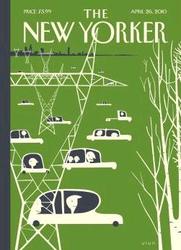
“Frank Viva’s”:http://www.francisaviva.com/ cover, “Earth Day,” for the April 26, 2010 issue of _The New Yorker_, reveals a planet that is busy and humming with activity. Oil is not spilling and exhaust fumes are not being discharged from Viva’s oddly-shaped cars.
Nonetheless, we are all aware of the damage that our inventions can cause. Despite the stylized shapes and smiling faces, Viva has created a cover filled with very timely significance and meaning.
His cover is dominated by power line towers. They crowd out and outnumber his trees. The power line towers extend confidently and aggressively across the landscape and skyline. In the distance, the horizon consists of a long cityscape. Cars whiz across the cover, moving almost as if in formation towards the east, where a few trees bereft of leaves can be found.
Viva’s cover is dominated by the color green, but it is a green that is reduced and lacerated by white shapes and lines that symbolize the intrusion of technology over nature.
Frantic efforts to contain the Gulf of Mexico spill to prevent an ecological and financial crisis cannot erase the initial carelessness that caused it. Like the figures on Viva’s _New Yorker_ cover, we put up towers and drive our cars but don’t stop to think about how much less green our world is, despite the coming and going of “Earth Day.”
The Wavy Rule, a Daily Comic by Pollux: Goldman Sacks
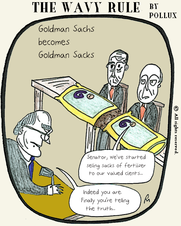
Click on the image for a detailed view!
The Wavy Rule, a Daily Comic by Pollux: The Notebook
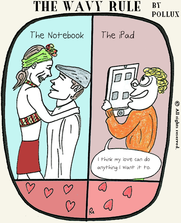
Click on the image for a detailed view!
The Wavy Rule, a Daily Comic by Pollux: J.Lo is a Knockout
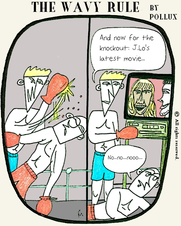
Click on the image for a detailed view!
The Wavy Rule, a Daily Comic by Pollux: Eyjafjallajökull

Click on the image for a detailed view!
Flash Drive: Mark Fiore’s Pulitzer for Online Video Cartooning
_Pollux writes_:
Editorial cartoonists have been winning “Pulitzers”:http://www.pulitzer.org/bycat/Editorial+Cartooning since 1922 (the first ever winner was Rollin Kirby), but 2010 marks the year in which an online video cartoonist has won the prize.
The winner? Mark Fiore of SFGate.com, the website for the _San Francisco Chronicle_.
Fiore uses Flash animation and biting satire to do what editorial cartoonists always hope to do: point a magnifying glass onto our times, make us laugh, and scorch the villains of each respective era.
Fiore’s animated cartoons can be seen “here.”:http://www.markfiore.com/pulitzer/
DFW’s Vocab List: “Tennis,” Anyone?
Martin Schneider writes:
A few weeks ago it was reported that the Harry Ransom Center in Austin, Texas, had purchased the letters and ephemera of David Foster Wallace. One item of note was his dictionary, which contained various markings. It’s difficult to think of another writer for whom the personal dictionary would be of such special interest, but no popular writer ever used such pointedly obscure words so frequently and so winningly.
Now Slate has cleverly provided a list of words circled by Wallace. The words on the list couldn’t be better, they are almost all quite obscure; I think many highly literate people will be unfamiliar with a great many of them. They are also quite Wallacean, and in certain cases the close reader of Wallace will be able to remember specific words and the exact context in which they appear in Wallace’s works. (For example, I think “espadrille” makes an appearance in the opening pages of Infinite Jest.)
The least difficult word on the list may be “tennis,” which pursuit had a particular importance to Wallace. It’s remarkable to see that word, of all words, nestled between “tenesmus” and “tepefy.”
Although the list is difficult, it also provides hope. For the implicit meaning of a word circled in the dictionary is that the word was a new acquaintance to the encircler. So in considering a writer of so vast a vocabulary as Wallace, even he had to do the ignoble legwork of tracking down these words, much the same way a foreign student of the language might have to circle “shoulder” or “carrot.”
Learning about language is an inherently democratic pastime—and also one that never comes to an end.
The Wavy Rule, a Daily Comic by Pollux: Scorpio Man
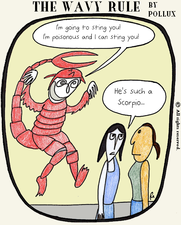
Click on the image for a detailed view!
Some Quick Hits on a Recent Issue
Martin Schneider writes:
I’m finding the April 26 issue of The New Yorker (green cover) kind of delightful. In no particular order:
1. Hendrik Hertzberg’s Comment is excellent and also clarifies a subject that I’d pretty much missed, President Obama’s recent successes on the nuclear proliferation front. If you think you might have missed it too, do check it out.
1a. Hertzberg quotes Obama’s “Dmitri, we agreed” comment to Medvedev that apparently sealed the deal in the end.
The line possesses … an odd echo* of some of the most delicious dialogue in Dr. Strangelove, which movie Hertzberg cites in the beginning of the Comment, when President Merkin Muffley, played by Peter Sellers, is on the phone to the Russian premier to tell him that the United States is about to destroy the USSR for no good reason:
Well let me finish, Dimitri. Let me finish, Dimitri. Well, listen, how do you think I feel about it? Can you imagine how I feel about it, Dimitri? Why do you think I’m calling you? Just to say hello? Of course I like to speak to you. Of course I like to say hello. Not now, but any time, Dimitri. I’m just calling up to tell you something terrible has happened. It’s a friendly call. Of course it’s a friendly call. Listen, if it wasn’t friendly, … you probably wouldn’t have even got it.
So, so good.
The other thing that struck me about “Dmitri, we agreed” is that it may be the most quintessentially Obamanian statement of any importance he has ever uttered as president. That statement is wholly consistent with the person I supported as early as 2007, voted for in 2008, and haven’t seen quite enough of since.
2. Dana Goodyear’s article on the restaurant Animal in Los Angeles (not available online) is a sheer delight, and towards the end takes on an almost fictive quality. A great subject, and she did the most with it.
3. The letter Saul Bellow wrote to Philip Roth on January 7, 1984 (not available online), is pretty fantastic, even if his appellation for the poor journo who crossed him, “crooked little slut,” is a bit unfortunate.
4. Billy Kimball’s list of rarely heard complaints about the iPad is very funny.
===
* Update: Somehow I missed that Hertzberg quoted a different part of Muffley’s telephone monologue to start off his Comment. Kudos to Hertzberg for spotting this echo long before I did.