
Martin Schneider writes:
Here’s a curious Flickr group dedicated to author photos of New Yorker people. If you’ve always wondered what John McPhee or Dana Goodyear look like (I didn’t know), this is worth a look.
Note: Loyal reader ZP of I Hate the New Yorker (who recently wrote about all the mentions of Roy Cohn, in prose and cartoons, through the years of The New Yorker) told us about this ages ago, but we lost track of it somehow.
Monthly Archives: June 2008
The Wavy Rule, a Daily Comic by Paul Morris: Michelin Man
Last week, we introduced Paul Morris’s new daily comic for Emdashes, “The Wavy Rule,” named for Rea Irvin’s signature wiggly line for The New Yorker.
Today’s edition–which will recall Bill Buford’s sizzling story about hot-headed chef Gordon Ramsay–is below. Click to enlarge!

The New Yorker Earns a White Whine
In a typically petulant, amusingly frivolous bleat, a White Whiner complains on the tongue-in-cheek Tumblr log that some New Yorker articles are online before the printed magazine arrives, making him feel “penalized.” Another of the satirical squadron of the privileged carps about an address label right in the middle of some trenchant cover satire.
I found both through a simple yet vexing Google search. Why can’t Tumblr have its own internal search function? Now there’s a whine nearly worthy of the site.
We’re Upgrading, and You May See Some Strangeness
Emdashes is upgrading to a new version of Movable Type–hurrah!–and that means that for the next day or so, you may witness some weirdness on the site, and commenting may be temporarily unavailable. Don’t worry! I suggest Sleepytime Tea, with a little brown sugar and milk. Yes, you can use soy milk. No, the bear is just dozing off naturally.

The Wavy Rule, a Daily Comic by Paul Morris: Foodie Revolution
This past week, we introduced Paul Morris’s new daily comic for Emdashes, “The Wavy Rule.” Today’s edition is below–click to enlarge.

Readers Agree: Elizabeth Kolbert is “Unputdownable”
Martin Schneider writes:
Hats off to the reader who said of Elizabeth Kolbert’s Field Notes from a Catastrophe that “it kept him up all night”—skip to about 10 minutes in. I love the idea! (The adjective above comes from a pullquote emblazoned on a paperback copy of David Halberstam’s The Powers That Be that I once owned.)
The Wavy Rule, a Daily Comic by Paul Morris: So I Married a Butterfly Spotter
This week, we published the first and second of Paul Morris’s new daily comic for Emdashes, “The Wavy Rule.” Today’s edition is below–click to enlarge.

And, Vaster, Some Realms I Owned
Last night, I kissed Restaurant Florent goodbye–really kissed it, with my mouth, and salted my veggie burger and champagne with a Liechtenstein-sized tear. It’s inconceivable that the restaurant, which houses many memories for those who spent time in the West Village before All This, won’t exist after this Sunday, but it’s so. Get there while you can; the atmosphere, as well as the legendary menu board, is festive-tragic. Go. Didn’t Malcolm Gladwell say that when something you’d come to count on in New York suddenly disappears, whether you’ve been here a month or a year, you become a true New Yorker? That happened a long time ago for many, but maybe this weekend will produce many a mussel-colored hash mark for loyal service rendered, especially, of course, by Florent Morellet himself.
Who will report Florent’s last day for The New Yorker, I wonder? I’d be glad to read a Talk of the Town by Ben McGrath, Lauren Collins, Rebecca Mead, or Michael Schulman on the ultimate order, but if there’s a longtime contributor who loves the place (say, Lillian Ross, although I can’t quite picture it), or a chronicler of New York who wants to make a special visit (Pete Hamill comes to mind), I would love to read his or her account. Gladwell is a neighbor of the place, and Leo Carey could also do a lyrical restaurant-review-final-day mashup.
I asked Martin to see if there were any references to Florent in the Complete New Yorker, and here’s what he found. From a January 19, 2004 Talk by Lauren MacIntyre, about housing in the West Village:
One person’s avant-garde, though, is another’s antique. One of the meatpacking district’s better-known businessmen, Florent Morellet, the owner of Florent, the sleek Gansevoort Street diner that is popular with both cross-dressers and corporate financiers, began to speak out in support of the house. Alarmed by the brushfire development around the Gansevoort Market, Morellet helped push to have the area designated a historic district (a proposal that just passed), yet he also praised the plans for 829 Greenwich Street, calling the use of steel building materials “authentic” to the history of the neighborhood. Last spring, when Baird and his team presented their design to the Landmarks Commission, the board voted unanimously in favor of it, and last February the old place was finally demolished.
To celebrate the groundbreaking, Baird threw a party at Florent just before the new year. Baird and the woman who owns the house (her husband was out of town) strolled amiably among the guests. Hanging in the restaurant’s entryway was a large computerized rendering of the house. People commented on the huge steel façade, which, if it is trucked into the city, will necessitate a temporary shutdown of the George Washington Bridge.
“It weighs seventeen tons,” a man said.
And from a Tables for Two restaurant review of “Pre:Post” in the July 3, 2006 issue, by Nick Paumgarten:
“Even before the meatpacking district became hell, there was a respite from it, at Florent, the regenerative twenty-four-hour bistro. Not so in West Chelsea, the night-club vortex up the avenue, where the right kind of late-night chow has long been scarce as silence. Such, anyway, is the theory, or one of the theories, behind Pre:Post, a new dusk-to-dawn restaurant where the slick kids are encouraged to gather and dine before and after their submersion into the clubs down the block.”
Finally, something I happened on recently, also in the Complete New Yorker jewel box, brought Florent to mind. It’s a Talk from June 6, 1925, and as with a number of those early number, the author is unknown:
Note on a Passing
Joel’s has closed; perhaps the last of the older order of restaurants, whose hosts were individuals, not corporations. It was never a gaudy, nor a gilt-edged establishment; that one on Forty-first street, with its green-tinted door; and its heydays were ten, or even fifteen years behind when it surrendered to the inevitable.
But it did know heydays, such as would lead a profitable procession of American tourists to visit it still if Joel’s were in Paris, or London, instead of a few doors west of the second-hand clothing marts of Seventh avenue; and how picturesque, by the way, these would be in, for instance, Vienna.
There was in Joel’s on the night it clossed, the table at which Sidney Porter used to sit, back to the window, looking on life. And another that knew the young Booth Tarkington many a long night years ago. The older Mark Twain looked in occasionally. Alfred Vanderbilt was a patron in those times when it was the thing to stay up all night on the eve of a Vanderbilt Cup race and drive through the greying dawn to the Jericho turnpike to look on the daring of Barney Oldfield and the like.
George Luks was seen there often, and Alan Dale when his caustic comments were feared far more than the ponderous pronouncements of the venerable William Winter, another patron of Joel’s. It was, too, a favorite resort for earnest Mexican revolutionists before that nation substituted the ballot for the bullet in presidential elections. This last, probably, because Joel Rinaldo served admirable chili con carne when that dish was almost unknown elsewhere in New York.
Fare thee well, all things Florent.
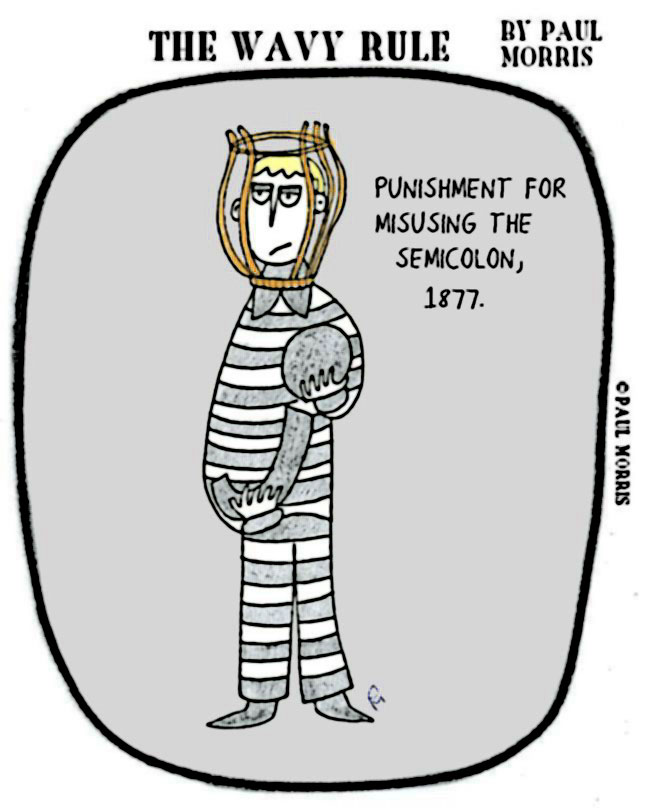
The Wavy Rule, a Daily Comic by Paul Morris: Punctuational Punishment
This week, we introduced Paul Morris’s new daily comic for Emdashes, “The Wavy Rule.” Today’s installment is below–click to enlarge.
Translations from the British (Harry Potter Edition)
Back in April, I posted about The New Yorker’s (TNY) recent propensity for publishing British fiction that (sometimes) requires translation, at least for those of us who grew up talking ’merican instead of the Queen’s English.
Little did I know at the time that the pleasure of doping out the lingo of our cousins across the pond had been systematically stolen from oodles of American readers of Harry Potter. That’s right: the U.S. editions of the Potter books (pre-2000, anyhow) were, um, bowdlerized (albeit unevenly) with the cooperation of the author, as Daniel Radosh reported in the September 20, 1999 issue of TNY.
Unfortunately, the complete version of Radosh’s “Talk of the Town” piece isn’t available online, so I urge those of you with the Complete New Yorker to check it out in its entirety. For the rest of you, here’s a taste:
In the American edition, “wonky” becomes “crooked”; “bobbles” turn into “puff balls”; and “barking mad” translates to “complete lunatic.” “Git,” “ickle,” and “nutters,” however, are left as they are. Why does Father Christmas become Santa Claus, and “bogey” become “booger,” but “budge up” not become “move over”?
Ah, well. Hard enough on the editors as it was, making sure they switched all the single quotation marks for double quotation marks, and vice versa.