Monthly Archives: October 2010

Department of Factual Verification Dept.

From Wikipedia, which, as Jesse Sheidlower could surely tell us, is also a verb, as in “Wiki that shit before you go around spouting nonsense!”:

Experience of the K-hole may include distortions in bodily awareness, such as the feeling that one’s body is being tugged, or is gliding on silk, flying, or has grown very large or distended.[citation needed] Users have reported the sensation of their soul leaving their human body.[citation needed] Users have also often reported feeling more skeletal or becoming more aware of their bones – the shape of their hands is also often of interest.[citation needed] Users may experience worlds or dimensions that are ineffable, all the while being completely unaware of their individual identities or the external world. Users have reported intense hallucinations including visual hallucinations, perceptions of falling, fast and gradual movement and flying, ‘seeing god’, feeling connected to other users, objects and the cosmos, experiencing psychic connections, and shared hallucinations and thoughts with adjacent users.[citation needed]

Yes, primary sources, people!

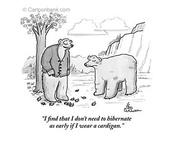
Leo Cullum, 1942-2010

cullum bears.jpg
Emily Gordon writes:
We were very sad to hear the news of the death of New Yorker cartoonist and veteran airline pilot Leo Cullum. (Click his name to see the full archive of his wonderful cartoons for the magazine.) From the New York Times obituary:

Mr. Cullum, a TWA pilot for more than 30 years, was a classic gag cartoonist whose visual absurdities were underlined, in most cases, by a caption reeled in from deep left field. “I love the convenience, but the roaming charges are killing me,” a buffalo says, holding a cellphone up to its ear. “Your red and white blood cells are normal,” a doctor tells his patient. “I’m worried about your rosé cells.”

Mr. Cullum seemed to have a particular affinity for the animal kingdom. His comic sympathies extended well beyond dogs, cats and mice to embrace birds — “When I first met your mother, she was bathed in moonlight,” a father owl tells his children — and even extended to the humbler representatives of the fish family. “Some will love you, son, and some will hate you,” an anchovy tells his child. “It’s always been that way with anchovies.”

“There are many ways for a cartoon to be great, not the least of which is to be funny, and Leo was one of the most consistently funny cartoonists we ever had,” said Robert Mankoff, the cartoon editor of The New Yorker. “He was certainly one of the most popular — some of his cartoons were reprinted thousands of times.”

Here’s the full obituary, and we’ll add other stories throughout the week.

Our condolences to Mr. Cullum’s family and friends, including the many New Yorker cartoonists who knew and loved him. Here’s the post reporting the news at the magazine’s own Cartoon Bank.

Later: Here’s the Comics Reporter on Cullum and his career.

Feisal Abdul Rauf to Appear at 92Y Debate

Martin Schneider writes:
On Sunday, December 5, at 4:30pm, 92Y is hosting a discussion titled, “Can We Understand Each Other? An Interfaith Dialogue.” Tickets are available to purchase—act quickly, because this event should sell out soon.
Participants will include Rev. Dr. Joan Brown Campbell, director of religion at Chautauqua Institution; Sister Joan Chittister, OSB, author of more than 27 books on issues involving women in church and society, human rights, peace and justice; Imam Feisal Abdul Rauf, founder and CEO of the American Society for Muslim Advancement and architect of the Cordoba Initiative, an interreligious blueprint for improving relations between the Muslim world and the United States; and Rabbi Joseph Telushkin, associate of the National Jewish Center for Learning and Leadership.
Feisal Abdul Rauf is best known, of course, as the man behind the so-called “9-11 Mosque,” otherwise known as Park51, which has garnered an enormous amount of controversy in recent months.
For a taste of what this event might be like, check out This Week‘s debate from this past weekend, “Should Americans Fear Islam?” which included Rauf’s eloquent wife, Daisy Khan, and a host of other lively personalities.
Rauf has not made many public appearances during this controversy, making this event all the more exceptional.
It’s worth pointing out that the event is taking place on the Upper East Side, which is a Tea Party-approved distance from Ground Zero, according to many prominent Republican and conservatives who have objected to the Park51 plan.

Mad Men Recap Ritual Reading: This Week’s High Point

_Emily writes:_
Of the assorted Mad Men recaps I read every week, New York magazine’s are often my favorite. I interrupt myself to say, though, that the first one I read each week, and very nearly hyperventilate while waiting for, is Mark Lisanti’s matchless, dirty Mad Men Power Rankings, which are less recaps than they are manic fanfic, or meta-dystopias, or thought balloons kidnapped from the dank shadows of the writers’ room.
Then, throughout the week, I savor the Slate TV Club dialogues, which I love; letter-writing and -answering is still such a civilized form, and the correspondents’ sign-offs always make me laugh. Plus, the Slate trio (Michael Agger, John Swansburg, and Julia Turner) often cite reader comments and research, which is classy. You’d be a fool to miss James Wolcott’s (and others’) recaps at Vanity Fair, which include a playful plaint on the weary burden of recapping that is, as a friend of mine says, “the stuff of an S. J. Perelman Greatest Hits.” In the same column, Wolcott writes, elegiacally, of Sally:

I hate seeing Sally cry; there’s something so pure and defenseless about her plight. She’s either going to evolve into a saint forged in suffering or develop telekinetic powers and turn their next residence into a house of flying daggers, converting her mother into a lovely order of shish kabob. Either way, we’re pulling for you, Sally! Your tears shall not spill in vain!

I also enjoy the Lemondrop recaps, which have an appealing carefree zest but are sometimes a little sloppy. I can wait a few episodes to catch up with the Movieline recaps and Entertainment Weekly‘s “Mad Men Central,” though I relished EW‘s “‘Mad Men’: Unpacking ‘The Suitcase.'” Correct me if I’m wrong, but is EW a couple of episodes behind? Think of the people, like me and Duck Phillips, prone to the shakes!

Anyway, back to the always expertly composed and deeply considered writing on the show from New York. I thought this was an especially elegant, and relevant–see the Observer‘s recent instant classic “So Sorry To Do This! Flakiness Epidemic Sweeps Digital New York”–graf from Logan Hill this week:

This season, the show has become more critical of the actual conditions of Madison Avenue. Abe was the first character to really embody a hard-left critique of the ad world (only Midge’s bohemian critique came close) with his “Nuremberg on Madison Avenue” jeremiad. There are a whole lot of historians and sociologists, like David Montgomery (or Christopher Lasch, whose Haven in a Heartless World: The Family Besieged seems especially pertinent to this episode) who might be frustrated by the way a lot of the period arguments we fans have had about Mad Men — in terms of women in the office and work-life balance, and gender roles and so forth — tend to occlude the macro-level changes in the ways Americans work. We talk about how Betty’s a bad parent, and Don’s a bad parent, but rarely about how the way work — and, particularly, this kind of obsessive Manhattan work world — is eclipsing all other sorts of power and order, requiring and overtaking more and more of people’s values and lives. When, at a funeral, there’s more talk of money than religion, more talk of work trips than the journey to the afterlife, the show’s making a point.

Read the rest. This is rewarding, satisfying television criticism. That’s not an implied slight to anyone else’s (I hate the blog idiom sometimes–it’s so binary), but here’s to Logan Hill for doing this so well. Meanwhile, can someone pay Mark Lisanti to blog all day? I’m sure he has better things to do, but it would make a major contribution to my quality of life.

See also: 5 Other Necessary Mad Men Tumblrs, from Movieline.

In the Urologist’s Office: A New Yorker Issue

_Pollux writes:_
While waiting for the arrival of a female urologist, George Christopher (played by Ted Danson) flips through an issue of _The New Yorker_ in the latest episode of HBO’s _Bored to Death_, “Make it Quick, Fitzgerald.”
Danson’s character is a magazine editor (of the fictitious _Edition_), and thumbs through the issue of _The New Yorker_ with apparent relish.
We see a fairly convincing _New Yorker_ cover, featuring what appears to a cyclist rendered in strong shapes and bold colors. If this is an actual issue, my apologies, Emdashes readers. If it is, it isn’t a recent issue. Doctors never keep their piles of magazines up-to-date.

What You Missed (or Didn’t) at the New Yorker Festival

Martin Schneider writes:
Another New Yorker Festival has come and gone, and it must be said it was a good one. We posted last week about the existence of Fora.tv’s pay-per-view videos of a good number of the events. After the jump we post some tasty snippets to whet your appetite.
Lorrie Moore:

E. Annie Proulx:

Dave Eggers:

Joyce Carol Oates:

Michael Chabon and Zadie Smith:

Paul Krugman:

Ken Auletta:

Stephen King:

Fashion Forward:

James Surowiecki:

Cynthia Nixon on Gay Marriage:

Calvin Trillin:

Malcolm Gladwell:

Ian Frazier:

Jonah Lehrer: