
_Pollux writes:_
While waiting for the arrival of a female urologist, George Christopher (played by Ted Danson) flips through an issue of _The New Yorker_ in the latest episode of HBO’s _Bored to Death_, “Make it Quick, Fitzgerald.”
Danson’s character is a magazine editor (of the fictitious _Edition_), and thumbs through the issue of _The New Yorker_ with apparent relish.
We see a fairly convincing _New Yorker_ cover, featuring what appears to a cyclist rendered in strong shapes and bold colors. If this is an actual issue, my apologies, Emdashes readers. If it is, it isn’t a recent issue. Doctors never keep their piles of magazines up-to-date.
Category Archives: X-Rea: Irvin Type Watch
The Irvin Type: Down to a T
_Pollux writes_:
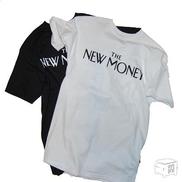
Sharp-eyed designer and art director “Lindsay Ballant”:http://www.lindsayballant.com has spotted the use of Irvin type on “streetwear”:http://www.krudmart.com/mens/t-shirts/york-st.html for the hip and cool.
The Rocksmith York St. T-Shirt (available in black or white) features Irvin’s lettering, allowing its wearers to swagger in style. “The New Money”? Perhaps. A classic font? Absolutely.
Cold Souls: A Convincing Issue
_Pollux writes_:
I saw _Cold Souls_ on Pay-Per-View tonight. It stars Paul Giamatti as Paul Giamatti, a man who literally unburdens his soul in a Soul Storage company run by Dr. Flintstein (David Strathairn). How does Giamatti hear of the Soul Storage company? A friend calls him and tells him to the read the latest issue of _The New Yorker_.
Unable to sleep, Giamatti trudges into his living room and picks up the “latest issue” of _The New Yorker_. The issue that Giamatti picks up features Barry Blitt’s actual “cover”:http://www.newyorker.com/magazine/toc/2007/05/28/toc_20070521 for the May 28, 2007 issue, called “Half-Staff.”
But the article inside is entirely fictional. Nevertheless, in terms of layout, type, and tone, it is entirely convincing as a _New Yorker_ article. It is written by a (fictional) writer named Sarah Shruber. The article features the same headline and subtitle format, with the name of the article, “Soul Storage,” underneath the headline of “Unburdening made easy.” Its subtitle is: “Are New Yorkers tired of carrying their souls?”
The movie itself was “reviewed”:http://www.newyorker.com/talk/2009/07/20/090720ta_talk_friend in the _New Yorker_ by Tad Friend, and a “piece”:http://www.newyorker.com/arts/critics/cinema/2009/08/10/090810crci_cinema_lane#ixzz0fUYg4rvK was also written on the film by Anthony Lane. “Paul learns about soul storage from an article in this magazine,” Lane writes, “and I seriously considered checking the archives.”
No matter what your opinion of the film is, if you see it, you’ll have to admit that they created a convincing facsimile of a _New Yorker_ article, and used, thankfully, the Irvin type.
The Invisible Man: Finding Rea Irvin
_Pollux writes_:
What does Rea Irvin look like?
In this “post”:http://www.newyorker.com/online/blogs/tny/2010/02/chris-ware-rea-irvin.html on the New Yorker site, Chris Ware explores the difficulties of finding a photograph of the _New Yorker’s_ first art director.
Although Irvin’s legacy remains clear and apparent, Irvin the man remains a shadowy, elusive figure. Any student of Irviniana will share the same gratification that Ware experienced when he found a mysterious photograph of Irvin on the beach, in a meditative pose. Irvin turns out to be “an affable, rotund chap, with an unruly swoop of hair.”
With the benefit of finally knowing what he looks like, Ware depicts Irvin on an upcoming anniversary “cover.”:http://www.newyorker.com/online/2010/02/15/slideshow_100215_anniversarycovers#slide=3
What does Rea Irvin look like? Now we know.
Rea Irvin’s Birthday Today
_Pollux writes_:
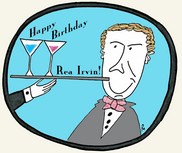
On this day, a hundred and twenty-eight years ago, Rea Irvin was born in a Californian town named San Francisco. A hundred and three years ago, Irvin traveled to the East Coast to assist in a birth that occurred eighty-four years ago–the founding of _The New Yorker_.
Thomas Edison invented the Kinetoscope as well as the lightbulb, and Rea Irvin did more than simply create the Eustace Tilley cover portrait.
Irvin lent his good taste and good sense towards the creation of _The New Yorker_’s page design, headings, spot illustrations, as well as the archetype of the typical _New Yorker_ single-panel cartoon.
As Emily writes in her important and much-needed “article”:http://www.printmag.com/Article.aspx?ArticleSlug=Everybody_Loves_Rea_Irvin on him, “it was Irvin’s own intimacy with classic form and craft, and his genial willingness to share that expertise, that allowed him to create a complete device: a design, a typeface, a style, and a mood that would be instantly recognizable, and eminently effective, almost a century later.”
Emily and I have worked to pull Rea Irvin out of the shadows that seem to enshroud his life and his work. I wrote the initial Wikipedia article on him, and, in the true spirit of Wikipedia, others have contributed to it, the latest contribution being a series of Irvin “drawings.”:http://commons.wikimedia.org/wiki/Category:Rea_Irvin
Rea Irvin is one of our heroes, and one of the patron saints of this publication that we love so much.
In his honor, we declare August 26 to be **Rea Irvin Day**. Celebrate accordingly.
Cocktail Contriver: Rea Irvin’s Illustrations for Crosby Gaige’s Cocktail Guide and Ladies’ Companion
“Beer drinkers lead a dreary and gaseous life … Whiskey enthusiasts are … confined to a three-lane highway – straight, soda, or just plain water. But the cocktail contriver … has the whole world of nature at command…” So declares _Crosby Gaige’s Cocktail Guide and Ladies’ Companion_, published in 1941.
Crosby Gaige (1882-1949), a book publisher and book collector, had help from fellow travelers in the world of potent potables: “Lucius Beebe”:http://en.wikipedia.org/wiki/Lucius_Beebe provided a foreword; “Alexander Lawton Mackall”:http://en.wikipedia.org/wiki/Alexander_Lawton_Mackall an afterword or “final insult.”
And, lucky for Emdashes, the center for all things Irvinian, Gaige employed the talents of Rea Irvin, who “richly embellished” the book “with drawings almost from life.” Check out Lady Brett’s “post”:http://ladybrettashley.wordpress.com/2009/05/22/femme-guide-to-butch-drinks-part-3/ on her copy of the book.
Irvin on a See-Saw: Two Rea Irvin Magazine Covers
Everybody loves “Rea Irvin”:http://en.wikipedia.org/wiki/Rea_Irvin. It’s true. “Liza Cowan”:http://www.lizacowan.com/, lucky enough to own two original Rea Irvin magazine covers at her shop, writes about Irvin at “her blog”:http://seesaw.typepad.com/blog/2009/05/rea-irvin.html. And if you haven’t read it yet, “Emily’s article on Irvin”:http://www.printmag.com/Article.aspx?ArticleSlug=Everybody_Loves_Rea_Irvin is required reading for anyone interested in Irvinian Studies. You can minor in it here at Emdashes.
Staten Island Yankees Catch Irvin Fever
Martin Schneider writes:
Yesterday I went to see the Staten Island Yankees host their crosstown rivals, the Brooklyn Cyclones, at beautiful Richmond County Bank Ballpark at St. George. (The Yankees won, 4-1.)
I couldn’t help but notice that all visitors are greeted with a big blue blast of Irvin type (or something close). I asked my friend Seth Davis to snap a few shots for evidence; they are presented below.




The Wavy Rule, a Daily Comic by Paul Morris: Tilley Meets His Maker
As you might expect, since I just spent a number of months collecting material for a piece about Rea Irvin for PRINT, I am in love with all things Irvin. Paul–whom I thank in the piece because he’s shared numerous invaluable resources and insights with me about Irvin’s aesthetic–is as keen on the early years’ co-genius as I am. About this cartoon, he writes: “Inspired by the photograph of Irvin in Lee Lorenz’s wonderful The Art of The New Yorker. A must read.” I agree. Sweet Knopf: Please bring it back into print! Click to enlarge.
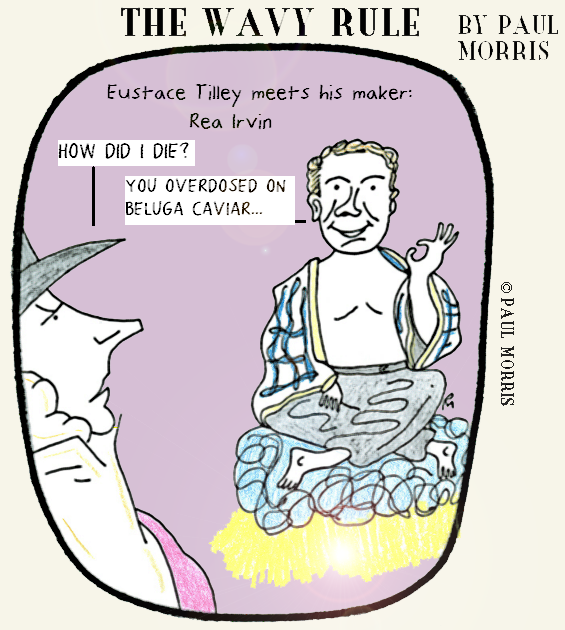
More Paul Morris: “The Wavy Rule” archive; his very funny webcomic, “Arnjuice,” a motley Flickr page, and beautifully off-kilter (and freely downloadable) cartoon collections at Lulu.
Everybody Loves Rea Irvin
That’s the headline for a story by me in the hot-off-the-presses Print magazine, in a special issue on type. Ever wonder who was behind Eustace Tilley–and hundreds more iconic images and visual features (including the famed “Irvin type”)–in the first decades of The New Yorker? There’s so much more to say about this spectacular moment in graphic history, and particularly about what came before it, but this is a start. And it was incredibly fun to write. Since I had limited space to acknowledge the many people who provided documents and contacts for the story, I’ll give three grateful cheers here to cartoonist Liza Donnelly and to Dorothy Parker Society sagamore Kevin Fitzpatrick. They have both been incredibly generous with their resources and thoughts.
Very soon, we’ll run the contest I mentioned the other day. It’s a doozy! And I’ll tell you what our interns will be up to this summer, too. And if you haven’t heard about this, here’s some welcome news about two new Joseph Mitchell reissues, one of which has a new introduction by David Remnick. I can’t agree that Mitchell “is perhaps most remembered not for his writing, but for not writing,” but there’s never anything wrong with new readers for this peerless writer of New York’s proud populations, human, aqueous, and otherwise.