
Category Archives: Ask the Librarians

Ask the Librarians (VII)

This will be the final column in a series we have been enchanted by since Jon Michaud and Erin Overbey, The New Yorker‘s head librarians, agreed to answer readers’ questions about the magazine’s past and present. Their daily investigations into the magazine’s mysteries, and their preservation of its treasures, take all their time; that they so generously gave more of it to us, and that our association developed into a friendship over time, has been one of the most rewarding results of the Emdashes experiment.
Like parents at a graduation, we’re a bit choked up and very proud to announce that Ask the Librarians will soon move to
The New Yorker‘s own Back Issues blog. As its debut post explains, “Look out for new features that will offer additional paths into The New Yorker‘s archives–all without paper cuts or dust-induced sneezes.” Gesundheit, godspeed, and we gaily say goodbye. We look forward to the next installment at its new (and wonderfully traditional) home! There’s a new e-mail address for submitting burning research questions, as you’d expect, and it’s tny.archive at gmail dot com. The Ask the Librarians illustration is by Lara Tomlin, whom we also thank for her warm and graceful contribution.
Q. Who have The New Yorker‘s chief fiction editors been, and what were their years of tenure?
Jon writes: For much of its history, The New Yorker frowned on the use of formal titles among its staff. As a result, there have been long periods of time when there was no designated chief fiction editor. Perhaps the best way to answer this question is simply to identify the staff members who have played a significant role in selecting and editing the fiction published by the magazine.
In this sense, The New Yorker‘s first fiction editor was Harold Ross. Ross’s founding concept of the magazine as a “comic paper” included short, often satirical pieces of fiction by the likes of Robert Benchley, Dorothy Parker, and Frank Sullivan. (For many decades thereafter, the fiction department handled the magazine’s humor writers, including James Thurber, E. B. White, Woody Allen, George W. S. Trow, and Garrison Keillor.)
In the late twenties, The New Yorker also began to cultivate and publish more serious literary fiction. A great deal of the credit for this goes to Katharine S. White, who, with Ross’s blessing, solicited work from Kay Boyle, Sally Benson, and others. Later, she would oversee the publication of stories by John Cheever, Vladimir Nabokov, and many other writers now associated with The New Yorker. White had come to the magazine in August of 1925 as a part-time manuscript reader (she was Katharine Sergeant Angell then), but was rapidly given greater responsibilities, and arguably did more than anyone but Ross to shape The New Yorker‘s editorial identity. During the thirties, Wolcott Gibbs and, later, William Maxwell, worked with Mrs. White in the fiction department.
In 1938, Katharine and E. B. White moved to Maine, reducing their contributions to the magazine. A year later, Gibbs became the magazine’s theatre critic. Gustave (Gus) Lobrano, who had been at Town & Country, was hired to fill the vacancy and stayed at the magazine until his death, in 1956. Maxwell left The New Yorker for a time to focus on his writing. When the Whites moved back to New York in 1943, Mrs. White returned to full-time editorial work and continued to exert an enormous influence on the magazine until her retirement in 1957.
William Shawn did not name a new chief fiction editor upon White’s retirement, though Maxwell, who had resumed full-time editing duties in the fifties, was seen as the department’s leading member. Katharine White’s son, Roger Angell, who had been contributing pieces to The New Yorker since the forties, was hired as a fiction editor. Other editors who were prominent during this period were Robert Henderson and Rachel MacKenzie. Writers published in this era included John O’Hara, John Updike, Frank O’Connor, J. D. Salinger, Harold Brodkey, and Mavis Gallant.
Maxwell retired in 1975, by which time he had helped to hire Charles McGrath and Daniel Menaker. Through the late seventies and early eighties, Roger Angell managed the department, which also included Frances Kiernan and Veronica Geng among its editors. McGrath was promoted to co-managing editor for fiction and then to deputy editor before leaving, in 1995, to become editor of The New York Times Book Review. Raymond Carver, Mary Robison, Ann Beattie, Alice Munro, V. S. Pritchett, Jamaica Kincaid, and Bobbie Ann Mason were regularly published during this period.
In 1995, Tina Brown hired Bill Buford to be fiction and literary editor. Buford had edited the English literary magazine Granta since 1978, transforming it from a mimeographed and stapled college journal into an important literary periodical. Menaker went on to become editor of Random House books and continued to contribute pieces to the magazine; Angell stayed at the magazine and, in time, reduced his editing responsibilities in order to do more writing. Fiction writers who made their New Yorker débuts during Buford’s watch include Donald Antrim, A. M. Homes, Martin Amis, Jhumpa Lahiri, and Junot Diaz.
The magazine’s current fiction editor, Deborah Treisman, succeeded Buford in 2002. Treisman first came to The New Yorker from Grand Street in 1997, where she had been managing editor. She was Buford’s deputy for five years before becoming fiction editor. Cressida Leyshon is the current deputy fiction editor. Aleksandar Hemon, Haruki Murakami, Louise Erdrich, George Saunders, Annie Proulx, and Edwidge Danticat have all been regular contributors of fiction to the magazine during Treisman’s tenure.
Q. What’s the history of Shouts & Murmurs? Has it always been written by a different person every week?
Erin writes: Shouts & Murmurs was originated by Alexander Woollcott, in 1929, as an essay column, filled with his musings on literary and theatrical happenings, as well as on the humorous miscellany and scandals of the day. Woollcott was a New York Times drama critic and Stars and Stripes colleague of Harold Ross’s before he joined The New Yorker in 1925. From 1925 to 1939, he also wrote a series of profiles on cultural celebrities, including Harpo Marx, Noel Coward, George S. Kaufman, and Frank Lloyd Wright.
Woolcott’s writing is notable for its ornate style, which was typically at odds with that of his contemporaries at the magazine. Brendan Gill, in his 1975 memoir Here at The New Yorker, said of Woollcott that he “combined a foul mouth with a sentimentality so extreme that he was sometimes referred to even by friends as ‘Louisa May Woollcott.’ ” Here is an excerpt from a Shouts & Murmurs published on August 5, 1933:

I must now break down and admit that, despite all my labors in this vineyard, the Wee Wee Cleaners & Dryers are doing business in Woodside, Long Island; that a drugstore sign in Watertown, Conn., advertises “Little Bibs for Little Spinach Spillers”; and that cards from the Westmoreland Club in Wilkes-Barre, Pa., announce “Club Night and Beer ‘Ception for New Members.” It is now my private ambition to attend a ‘ception at the ‘Quaintance Club out in Forest Hills. It will make me feel socially ‘portant. At such evidence that the Helpy-Selfy-Bekus-Puddy tide rolls on despite all the earnest jeers from this department, you might expect your correspondent, in his discouragement, to throw up his hands as well as his breakfast. But something has just happened to renew this fainting spirit, to revive this drooping head. Incorrigible readers of this page may recall that this campaign was originally inspired by the sight of a roadside eating place north of Pittsfield, in Massachusetts, which, as I noted with a cry nicely blended of incredulity and pain, was called the No Namie. Well, friends, no one can say now that this department his lived in vain. For the sign has come down at last and this summer the No Namie is called The Spot.

Shouts & Murmurs was written solely by Woollcott, and it ran from February 16, 1929 to December 29, 1934. He borrowed the title of the column from his 1922 book of theatre reviews. Woollcott suffered a heart attack during an appearance on the CBS radio show The People’s Platform on January 23, 1943, and he died later that day. He was fifty-six.

Shouts & Murmurs was reborn, as a humor column, in editor Tina Brown’s first issue, October 5, 1992. It replaced the longstanding humor “casuals,” which ran in the magazine for more than sixty years. This time, the Shouts column relied on a variety of contributors, including some of the leading writers and humorists of the last few decades. Those who wrote for Shouts in the nineties and early 2000s include Jay McInerney, John Guare, Martin Amis, Garry Trudeau, Wendy Wasserstein, David Sedaris, Joyce Carol Oates, Steve Martin, Nick Hornby, Salman Rushdie, Elaine May, Jon Stewart, Rick Moody, Noah Baumbach, Paul Rudnick, George Saunders, Woody Allen, and Nora Ephron.

Shouts moved from the back page to the front of the book in 1998. A number of Shouts pieces were collected in Fierce Pajamas, a New Yorker humor anthology co-edited by David Remnick and Henry Finder and published by Random House in 2002. A second New Yorker humor anthology, Disquiet, Please (also co-edited by Remnick and Finder), was released last year.

Q. I have been reading Sloan Wilson’s The Man in the Gray Flannel Suit. I understand that Wilson published some stories in The New Yorker. Can you tell me more about his contributions to the magazine?

Jon writes: Sloan Wilson (1920–2003) published twenty-four stories and two poems in The New Yorker between January, 1945, and October, 1953. The Man in the Gray Flannel Suit, which appeared two years after his last publication in the magazine, was a best-seller and was adapted into a movie starring Gregory Peck in 1956. The novel, which chronicled the domestic and working life of Tom Rath, a Second World War veteran living in suburban Connecticut with his wife in three children, was favorably reviewed in the “Briefly Noted” section of The New Yorker: “Mr. Wilson creates a realistic, perceptive picture of a tiny, frightened life being lived as largely as possible.”

Wilson’s first piece for The New Yorker was a poem, “The Soldiers Who Sit.” Its opening line articulates the goal of many of Wilson’s later stories and novels: “I would like to write a poem about the soldiers in this war.” Wilson served in the Coast Guard and aboard military transport ships in the Pacific. Like “The Man in the Gray Flannel Suit,” Wilson’s stories often deal with the difficulties faced by veterans returning to civilian life.

In fact, it is possible to read a many of his stories as warm-ups for the novel. The characters and the themes are already in place, and he merely needed a larger canvas. In “The Reunion,” an assistant sales manager helps a former shipmate get a better job in part so that he will not have to see him and be reminded of the war. In “Bygones,” a married veteran gets a letter from a woman in Germany with whom he had an affair. In “The Regatta,” a man traveling to the Harvard-Yale regatta aboard a sailboat sees a periscope and is reminded of his service on a submarine during the war.

Malcolm Gladwell used The Man in the Gray Flannel Suit to discuss changing ideas about the way people cope with trauma in the November 8, 2004 issue of The New Yorker. Gladwell contrasted Tom Rath, the protagonist of Wilson’s novel, with John Wade, the Vietnam veteran in Tim O’Brien’s In the Lake of the Woods. Gladwell writes that Tom Rath comes out of Wilson’s novel “stronger, his marriage renewed,” while Wade falls apart and is destroyed by his past.

Reading The Man in the Gray Flannel Suit I found myself thinking of Richard Yates’s Revolutionary Road, a more ferocious novel with a nearly identical subject and setting, published in 1961. (It was also the March selection of The New Yorker‘s online book club). Yates, who was born in 1926, served in Europe immediately after the war. The similarities between Yates and Wilson don’t end there. Yates’s only publication in The New Yorker, “The Canal,” was about two veterans discussing a Second World War battle during a cocktail party. Wilson’s “The Housewarming” tells the story of three men at a party discussing the war and the likelihood of another. In both stories’ closing scenes, a veteran is alone with his wife after the party where they have just been talking about the war. In Wilson’s story, the husband is unable to console his weeping wife: “he couldn’t think of anything at all to say to comfort her.” In “The Canal,” meanwhile, the more vitriolic Yates has his protagonists say to his spouse, “Will you please for God’s sake shut up?”

Q. Janet Flanner and A. J. Liebling famously covered France for The New Yorker. Have there been any other significant international beats, and who covered them?
Erin writes: The magazine has published thousands of foreign letters, from nearly a hundred countries, in its eighty-four-year history. The most famous, of course, is Janet Flanner’s Letter from Paris column, which she wrote under the pen name Genêt. Her Letter from Paris ran from October 10, 1925 (originally as Paris Letter) through September 23, 1939, right at the beginning of the Second World War. Flanner’s column started up again on December 23, 1944, and ran until September 29, 1975. (A. J. Liebling wrote the Letter from Paris column during the Second World War, from October 28, 1939, through November 4, 1944.)
There are other significant foreign letters columns published by the magazine that are less well-known. Mollie Panter-Downes’s Letter from London ran from September 9, 1939, until March 26, 1984. Panter-Downes was an English novelist who published her first novel, The Shoreless Sea, at the age of sixteen. In 1939, St. Clair McKelway sent a telegram to Panter-Downes, asking her to write a column for the magazine about “human rather than political events” in London.
She went on to document both in her column, covering the cultural, domestic, and political scene in London from the Second World War through the nineteen-eighties. In all, she published more than four hundred and seventy Letters from London. The following is an excerpt from a Letter published September 21, 1940, during the London bombings:

For Londoners, there are no longer such things as good nights; there are only bad nights, worse nights, and better nights. Hardly anyone has slept at all in the past week. The sirens go off at approximately the same time every evening, and in the poorer districts, queues of people carrying blankets, thermos flasks, and babies begin to form quite early outside the air-raid shelters. The Blitzkrieg continues to be directed against such military objectives as the tired shopgirl, the red-eyed clerk, and the thousands of dazed and weary families patiently trundling their few belongings in perambulators away from the wreckage of their homes…. The Nazi attack bore down heaviest on the badly nourished, poorly clothed people–the worst equipped of any to stand the appalling physical strain, if it were not for the stoutness of their cockney hearts. Relief workers sorted them out in schools and other centres to be fed, rested, and provided with billets. Subsequent raids killed many of the homeless as they waited. The bombers, however, made no distinction between the lowest and the highest homes in the city. The Queen was photographed against much the same sort of tangle of splintered wreckage that faced hundreds of humbler, anonymous housewives in this week’s bitter dawns…. The “diversion” in Regent Street, where a bomb fell just outside the Café Royal and did not explode for hours, cut off the surrounding streets and made the neighborhood as quiet as a hamlet…. The scene next morning was quite extraordinarily eerie. The great sweep of Regent Street, deserted by everyone except police and salvage workers, stared gauntly like a thoroughfare in a dead city. It would have been no surprise to see grass growing up out of the pavements, which were covered instead with a fine, frosty glitter of powdered glass…. Scenes like this are new enough to seem both shocking and unreal; to come across a wrecked filling station with a couple of riddled cars standing dejectedly by its smashed pumps makes one feel that one must have strayed onto a Hollywood set, and it’s good to get back to normality among the still snug houses in the next street.

Panter-Downes’s first year of London letters was published in 1940 by the Atlantic Monthly Press as the collection Letter from England. She died on January 22, 1997, at the age of ninety. Good Evening Mrs. Craven: The Wartime Stories of Mollie Panter-Downes, a collection of twenty-one of her short stories for The New Yorker, was reprinted by Persephone Books in 2008.

The magazine also ran a series of in-depth foreign letters during the Vietnam War by Robert Shaplen: Letter from Saigon (December 14, 1963–October 6, 1975), Letter from South Vietnam (April 24, 1965–November 13, 1978), and Letter from Vietnam (November 13, 1971–February 24, 1973). Shaplen wrote for Newsweek, Fortune, and Collier’s before joining the staff of The New Yorker in 1952. His pieces during and after the Vietnam War were less reflective of a particular ideological stance than of a persistent and abiding interest in the region and its people. He wrote comprehensively on the political and military strategies of both sides during the war, but always with an eye on the cultural landscape in which they were playing out.

Eventually, he became a harsh critic of America’s participation in the war. Here is an excerpt from a Letter from Saigon, which ran April 21, 1975:

This capital of a lost cause, fatalistically awaiting the climactic hour of the thirty-year Indo-China war, can, at best, become a hostage for peace on predominantly Communist terms if the inept and unpopular Thieu regime is replaced by one that is prepared to negotiate and avoid further carnage. It is generally agreed here that the sooner this happens the better. The mood of the besieged city, now one of benumbed resignation, could easily give way to the panic and hysteria that marked the collapse of Danang and other cities in the past month if the Communists choose the option of outright capture–or simply if, as seems even more likely here than it ever did elsewhere, angry and despairing soldiers and citizens, with nowhere to flee, turn into rioting mobs and vent their spleen on each other and on the six thousand Americans nervously anticipating evacuation…. Politically, American policy here is bankrupt. Too late–far too late–the more realistic American officials have come to admit that Thieu must go…. Whatever merit there is in [Thieu’s] case against the Americans, he seems determined to hang on as long as he can… The net effect of this, in both the Embassy and the Presidential palace, is catatonic. But in recent years, and especially the past year or two, I have increasingly come to feel that everything that happens in Vietnam is phantasmagoric, and that it has all happened before–all, that is, except the vast human tragedy now unfolding. And even this, of course, has been going on for a long time, at a different tempo, but now, at the moment of abject defeat, the futility of everything that has taken place here is being driven home more sharply by the frantic flights for survival, the pell-mell surges of huge numbers of refugees in every direction, the hasty dispatch of orphans abroad–climaxed by the awful air crash outside the Saigon airport–and, in general, the separation and destruction of whole families of innocent city folk and country folk as anger and bitterness have suddenly boiled over…. Perhaps the strangest thing is that, until one really looks beneath the surface, daily life in Saigon continues much as before…. The restaurants are fuller than they have been for several years, because of the influx of foreign correspondents. The flower stalls are still open, though the flowers are less plentiful and seem to fade more quickly. The city responds to a crisis–as it always has–with hidden reflexes, and then lapses back into its ordinary pace.

Shaplen was the author of more than ten books and nearly one hundred and sixty articles for the magazine before his death in 1988. He was among the many who fled Saigon by helicopter on April 29, 1979, as North Vietnamese troops were about to seize the city. In the introduction to his 1986 book, Bitter Victory, he wrote of the war that America “had never properly defined our original commitment, had become overinvolved militarily, had misconstrued our political aims, and then had angrily fought a bootless and cruel war ineffectually.”

One of the longer-running current foreign letters has been Jane Kramer’s Letter from Europe, which began in 1981. Kramer wrote for The Village Voice before joining the staff of The New Yorker, in 1964, and she has written more than one hundred and seventy pieces for the magazine. Her Letter from Europe has covered such varied topics as the election of Francois Mitterand, the Klaus Barbie trial, the coal miners’ strike in Britain, Salman Rushdie’s The Satanic Verses, the rise of Italy’s Silvio Berlusconi, and Pope Benedict XVI’s view on Islam. She is also the author of nine books and the first woman to win the Prix Européen de l’Essai “Charles Veillon,” Europe’s most prestigious award for nonfiction.

More recently, writers Adam Gopnik and Julian Barnes have covered the Paris and London beats for the magazine. Gopnik wrote a Paris Journal column from 1995 to 2005, and Barnes wrote a Letter from London from 1990 to 1994. Gopnik’s column was the seed for his best-selling book, Paris to the Moon (Random House, 2000), and in 1995, Vintage compiled and published Barnes’s London columns as Letters from London.

Addressed elsewhere in Ask the Librarians: VII: Who were the fiction editors?, Shouts & Murmurs history, Sloan Wilson, international beats; VI: Letters to the editor, On and Off the Avenue, is the cartoon editor the same as the cover editor and the art editor?, audio versions of the magazine, Lois Long and Tables for Two, the cover strap; V: E. B. White’s newsbreaks, Garrison Keillor and the Grand Ole Opry, Harold Ross remembrances, whimsical pseudonyms, the classic boardroom cartoon; IV: Terrence Malick, Pierre Le-Tan, TV criticism, the magazine’s indexes, tiny drawings, Fantasticks follies; III: Early editors, short-story rankings, Audax Minor, Talk’s political stance; II: Robert Day cartoons, where New Yorker readers are, obscure departments, The Complete New Yorker, the birth of the TOC, the Second World War “pony edition”; I: A. J. Liebling, Spots, office typewriters, Trillin on food, the magazine’s first movie review, cartoon fact checking.

Ask the Librarians (VI)

A column in which Jon Michaud and Erin Overbey, The New Yorker’s head librarians, answer your questions about the magazine’s past and present. E-mail your own questions for Jon and Erin; the column has now moved to The New Yorker‘s Back Issues blog. Illustration for Emdashes by Lara Tomlin; other images are courtesy of The New Yorker.

Q. When did The New Yorker start publishing letters to the editor? Did it publish letters in any form before that?

Erin writes: The Letters to the Editor department has had several incarnations at the magazine. In the twenties and thirties, the magazine published occasional letters to the editor, but no consistent weekly column from readers. These early letters were usually quite brief and appeared under headings like “The Amateur Reporter” or “Our Captious Readers.” Some of them were actually parodies written by New Yorker staffers under pseudonyms; a typical example is this excerpt from a letter, written by “Rye Face,” in the March 13, 1926, issue:

That smart New Yorkers read your confounded paper may be true. But why imply that decent people would become smart if they read it? Dammit, I read it. And I am a bootlegger. And practically all bootleggers and others with a sense of humor read it. Accept my sincerest expressions of disgust. THE NEW YORKER is not smart. Please have the decency to cease from accusing the honest people who support your senseless waggery with their good cash of vices they don’t possess. We may not be perfect but God knows we aren’t smart.

From the forties through the early nineties, letters to the editor would occasionally appear in the back of the magazine, usually identified as Departments of Amplification. Those who wrote letters to the magazine during this period include Eudora Welty, John McNulty, George S. Kaufman, and Thomas Mann. The following is excerpted from a letter written by Eudora Welty and published as a Department of Amplification in the January 1, 1949, issue. Welty is responding to Edmund Wilson’s review of William Faulkner’s Intruder in the Dust (1948):

How well Illinois or South Dakota or Vermont has fared in The New Yorker book-review column lately, I haven’t noticed, but Mississippi was pushed under three times in two weeks…. Such critical irrelevance, favorable or unfavorable, the South has long been used to, but now Mr. Wilson fancies it up and it will resound a bit louder. Mr. Faulkner all the while continues to be capable of passion, of love, of wisdom, perhaps of prophecy, toward his material. Isn’t that enough? Such qualities can identify themselves anywhere in the world and in any century without furnishing an address or references…. Mr. Wilson has to account for the superior work of Mr. Faulkner, of course he has to, and to show why the novelist writes his transcendent descriptions, he offers the explanation that the Southern man-made world is different looking, hence its impact is different, and those adjectives come out. (Different looking–to whom?) Could the simple, though superfluous, explanation not be that the recipient of the impact, Mr. Faulkner, is the different component here, possessing the brain as he does, and that the superiority of the work done lies in that brain?

In October of 1992, with Tina Brown’s first issue, the magazine began occasionally publishing single letters under the heading “Mailbox.” The first stand-alone Letters to the Editor column, titled “In the Mail,” ran in the October 4, 1993, issue. The weekly column was renamed “The Mail” in the January 20, 1997, issue. Today, the magazine receives about one hundred letters to the editor per issue, and every letter is read by someone on the editorial staff. Usually, the letters editor selects three or four for the weekly column. The criteria for choosing a letter vary, but typically the editor is looking for something that furthers or clarifies a point in the piece or is an interesting addendum. Some of the people who have written letters to the magazine in the past fifteen years include Norman Mailer, Erica Jong, Colin Powell, Stephen Sondheim, Gore Vidal, Arthur Schlesinger, Jr., and Dick Cavett.

Q. Did The New Yorker always publish a pre-holiday “On and Off the Avenue”?

Jon writes: Each year, for most of its history, The New Yorker has published holiday shopping guides under the “On and Off the Avenue” rubric. Until the early nineties, these gift guides appeared annually over several issues in November and December, broken up into such categories as gifts for children, gifts for the house, holiday food, and wrappings and trimmings. During the Second World War, the magazine ran, earlier in the year, a guide to gifts for men and women in the armed forces. The pre-Christmas gift guides were written by the regular Avenue correspondents: Lois Long, Sheila Hibben, Marion Miller, Barbara Blake, Cecil Webb, and Kennedy Fraser. In the nineteen-eighties, Lynn Yaeger, Cynthia Zarin, Andy Logan, and Mary D. Kierstead contributed. Since the mid-nineties, the column has run occasionally; Patricia Marx has published gift guides the last two Decembers.

The style of these columns has been consistently direct and pragmatic. “Paging Mr. Claus,” a pre-Christmas guide from the December 7, 1929, issue, warns readers, “Please don’t phone us for information, and if it’s peace you want, shop early in the morning.” The column sums up Hammacher Schlemmer like this: “Labor-saving devices a specialty. Innumerable electrical tricks; all kinds of hardware; anything for kitchens.” When it comes to buying beauty products for wives, the column writer suggests, “If you know her preferences, you need read no further.”

The writer of a 1944 column on gifts for servicemen and -women notes: “Women on tropical stations must have cotton lingerie, such as Lord & Taylor slips ($3.95)…. For girls in cold climates, Macy has two-piece pajama suits, knit like balbriggan and cut like ski pants; $3…. Navy nurses, poor things, must wear black cotton or rayon stockings. Saks has them.” The writer goes on to suggest gifts for soldiers in hospitals. “Sleight-of-hand paraphernalia delights both men who are bedridden and those able to get around. You can easily assemble a bag of tricks yourself.” Six months later, Lieutenant Alton Kastner wrote a letter to the magazine from the South Pacific critiquing some of the suggestions: “Fruitcake is ‘surefire,’ you say. One mammoth fruitcake we got was sadly massacred by our industrious little insect friends…. Only ten per cent of the hundreds of fruitcakes arrived in edible condition.”

In later decades, the columns were less list-like and more discursive. Andy Logan’s “Under the Children’s Christmas Tree,” from December 9, 1985, considers the new fad of including documentation such as “birth” certificates with dolls, ascribing the trend to the pervasive influence of Cabbage Patch Kids. Later, commenting on a “Peanuts” anthology, she quotes Umberto Eco, who said of Charlie Brown and friends, “They are the monstrous, infantile reductions of all the neuroses of a modern citizen of the industrial civilization.”

In her recent columns, Patricia Marx has brought back something of the lighter touch of the gift guides’ earliest years. In her 2005 guide to holiday gifts for women, Marx puts forward the following theory:

Everything costs so much these days that everything starts to seem cheap. Speaking as a pretend economist, I must explain that this is because the rate of real inflation cannot keep up with the rate of inflation in one’s head. And so when a person hears of a brownstone going for twelve million, even a person who happens to gulp at the monthly mortgage on her puny one-bedroom, she finds herself thinking, What a bargain! Maybe I should buy that!

Q. Who have all the cartoon editors been over the years? Are they all cartoonists themselves? Is the cartoon editor the same as the cover editor and the art editor?

Erin writes: The New Yorker‘s first art editor was Rea Irvin, the illustrator and cartoonist who created Eustace Tilley–the monocled dandy who appears on the magazine’s cover each February–and was the driving force behind the magazine’s graphic identity and early artistic innovations. Irvin, along with a few other staffers, met with editor Harold Ross every Tuesday afternoon, from 1925 to 1951, to peruse the weekly submissions of covers, cartoons, illustrations, and so on. In 1939, James (Jim) Geraghty, a cartoon-gag writer at the magazine, was hired as art editor, and Irvin was from that point on known as the art director. Irvin continued to sit in on art meetings throughout the forties, but he left the magazine after Ross’s death in 1951. From the fifties until his retirement in 1972, Geraghty oversaw all art in The New Yorker and acted as the liaison between the cartoonists and the magazine. Some of the artists he nurtured during that period include Peter De Vries, Charles Addams, Saul Steinberg, George Booth, William Steig, Ed Koren, and Charles Barsotti.

In 1972, William Shawn hired the cartoonist Lee Lorenz, who had worked for Geraghty since 1958, as art editor, and Lorenz retained that position until 1993, when he became cartoon editor. During his tenure, which ended with his retirement in 1998, Lorenz cultivated such artists as Jack Ziegler, Roz Chast, Jean-Jacques Sempé, Bruce Eric Kaplan, and Michael Crawford. Bob Mankoff, Lorenz’s successor as cartoon editor, has been a cartoonist at the magazine since 1977. Mankoff also runs The Cartoon Bank, the leading searchable database of cartoon humor on the web. In his nine years as cartoon editor, Mankoff has fostered cartoonists like William Haefeli, Carolita Johnson, Drew Dernavich, Alex Gregory, Matthew Diffee, and David Sipress.

Caroline Mailhot, the current art director, joined the magazine in 1992, and, with the design consultant Wynn Dan, adapted the magazine’s design to incorporate photography and a wider use of illustration. She continues to be responsible for the overall design of the magazine and of each issue. Françoise Mouly assumed responsibility for covers when she was named art editor in 1993. Elisabeth Biondi, the visuals editor, oversees photography, and Christine Curry, the illustration editor, oversees the assignment of illustrations.

Q. Is The New Yorker available on audio?

Jon writes: There are several ways to access content from The New Yorker on audio. A weekly audio edition, with a selection of pieces from the week’s issue of the magazine, is available online from Audible.com. Listeners may buy individual issues or an annual subscription. A typical week’s content might include the Comment, two Talk stories, a Shouts & Murmurs, two feature stories, and a movie review. Audible also offers packages of recordings from The New Yorker Festival.

Under the “Online Only” tab on The New Yorker‘s web site, browsers will find a list of recent Q. & A.s with New Yorker writers as well as Audio Slide Shows and the Fiction podcast, a monthly feature in which a current New Yorker fiction writer selects and discusses a story from the magazine’s archive.

Podcasts of The New Yorker‘s audio content are also available for free through the Apple iTunes store and other podcast sites (and via RSS readers). In addition to the monthly Fiction podcast mentioned above, the magazine produces two weekly podcasts. The New Yorker Out Loud features the Q. & A.s and other audio content from the web site. The Comment Podcast contains a reading of the week’s commentary column from the magazine (produced by Audible). Readers can also subscribe to these podcasts via The New Yorker‘s RSS page.

Associated Services for the Blind produces recordings of articles from newspapers and magazines, including The New Yorker. A recent visit to the ASB web site revealed that The New Yorker was among the top ten best-selling items in their Braille and Audio Resource Center. Like Audible, the ASB records selections from the magazine, rather than the contents of an entire issue.

Perhaps best of all, each year you can hear New Yorker writers read their work in person at The New Yorker Festival, whose 2007 program can be found here.

Q. I know that Lois Long created Tables for Two. When was that, and what were some of the restaurants she reviewed? Who started writing it after her, and when did the tradition start of different staffers (or freelance writers) doing weekly reviews?

Erin writes: The magazine’s Tables for Two department was originally called When Nights Are Bold, and it included reviews of nightclubs and speakeasies as well as restaurants. Charles Baskerville wrote the column, under the pseudonym Tophat, until July 18, 1925, when Lois Long took over, writing under the pen name Lipstick. The column was renamed Tables for Two in the September 12, 1925, issue. Long, a former Vanity Fair reporter, brought a lively and effervescent tone to the column, which typically ran to two or three pages. That tone is reflected in this excerpt from a review she wrote about Harlem’s Cotton Club in the May 4, 1929, issue:

Another thing that your most high-hat friends have recently discovered in a body is the Cotton Club in Harlem, which has a perfectly elegant revue that goes on at twelve-thirty and again around two o’clock. I fondly think that this revue…is the reason for their presence there–I cannot believe that most of them realize that they are listening to probably the greatest jazz orchestra of all time, which is Duke Ellington’s–I’ll fight anyone who says different. It is barbaric and rhythmic and brassy as jazz ought to be; it is mellow as music ought to be. There are throbbing moans and wah-wahs and outbreaks on the part of the brasses, and it is all too much for an impressionable girl.

In addition to the Cotton Club, Long reviewed most of the upscale hot spots of the Jazz Age, including the Stork Club, the Four Seasons, Tavern on the Green, the Rainbow Room, and the Algonquin. Her last Tables for Two review ran in the May 28, 1938, issue. After that, the column was written by other New Yorker staffers, including David Lardner and the prolific R. E. M. Whitaker, until February of 1963.

The magazine also published a separate Restaurants column, written by Sheila Hibben and Katherine Blow, which began in 1935. That department reviewed restaurants as varied as Grand Central’s Oyster Bar, “21,” Pete’s Tavern, and the Russian Tea Room. The Restaurants column ran for just seven years, but Tables for Two reemerged, as an occasional department, in the Goings On About Town section, beginning in May of 1995. It expanded to a weekly department, still in GOAT, in the spring of 2000. Today, the column is written by a rotating group of five or six staffers.

Q. What is the origin of the vertical band of solid color that appears on the left side of every cover of The New Yorker?

Jon writes: That vertical band is known as the cover strap. The strap was included in Rea Irvin’s design for the first cover in 1925, and it has appeared on every New Yorker cover since. Usually the strap is rendered as a solid column of color, but over the years a number of artists have used it as a way of ornamenting or enhancing their illustrations. Some notable uses of the strap include the August 6, 1927 cover by Ilonka Karasz depicting a concert at the Central Park bandshell. The strap contains passages from a musical score.

1927_coverstrap.jpg


More recently, for his January 8, 2007 cover “On Thin Ice,” Ivan Brunetti accentuated his drawing of a young girl skating on a shrinking ice floe with smaller visions of global warming in the strap, including a polar bear sipping a drink in front of a fan and an igloo with a melted roof.

brunetti_coverstrap.jpg


Addressed elsewhere in Ask the Librarians: VII: Who were the fiction editors?, Shouts & Murmurs history, Sloan Wilson, international beats; VI: Letters to the editor, On and Off the Avenue, is the cartoon editor the same as the cover editor and the art editor?, audio versions of the magazine, Lois Long and Tables for Two, the cover strap; V: E. B. White’s newsbreaks, Garrison Keillor and the Grand Ole Opry, Harold Ross remembrances, whimsical pseudonyms, the classic boardroom cartoon; IV: Terrence Malick, Pierre Le-Tan, TV criticism, the magazine’s indexes, tiny drawings, Fantasticks follies; III: Early editors, short-story rankings, Audax Minor, Talk’s political stance; II: Robert Day cartoons, where New Yorker readers are, obscure departments, The Complete New Yorker, the birth of the TOC, the Second World War “pony edition”; I: A. J. Liebling, Spots, office typewriters, Trillin on food, the magazine’s first movie review, cartoon fact checking.

Ask the Librarians (V)

A column in which Jon Michaud and Erin Overbey, The New Yorker’s head librarians, answer your questions about the magazine’s past and present. E-mail your own questions for Jon and Erin; the column has now moved to The New Yorker‘s Back Issues blog. Illustration for Emdashes by Lara Tomlin; other images are courtesy of The New Yorker.
Q. How does The New Yorker collect the newspaper clippings with the funny typos and malapropisms?
Jon writes: The clippings, which have been appearing in the magazine since its first year of publication, are called newsbreaks. They are submitted to The New Yorker by its readers and also gathered by members of the magazine’s staff. They were originally used to fill up leftover column inches at the end of stories, but quickly became a popular department in their own right. By the early 1930s, readers were sending in as many as a thousand newsbreaks a week; at that time, the magazine also employed staff members whose duties included scanning the daily newspapers for potential breaks.
The writer most closely associated with newsbreaks is E.B. White. Harold Ross gave White a batch of newsbreaks as a test before hiring him, and was pleased enough with the results to make newsbreaks one of White’s first assignments at The New Yorker. (At that time, the newsbreaks department was considered the lowliest position on staff.) White quickly made them his own, generating witty taglines (the tagline was known in-house as the “snapper”) and creating many of the now-familiar headings, such as Neatest Trick of the Week and Constabulary Notes from All Over. In the foreword to Ho Hum: Newsbreaks from “The New Yorker” (1931), White noted, “There is a secret joy in discovering a blunder in the public prints. Almost every person has a little of the proofreader in him.”
White continued working on newsbreaks well into the 1970s, long after he and his wife Katharine had quit New York for Maine. Writing to Ross in 1943, he said, “My breaks are raised right in the home from hardy vigorous stock.”
Since White stopped doing them, newsbreaks have been handled by a number of editors. These days, the magazine receives far fewer clippings than in earlier decades, and no one on staff is now employed to scan newspapers and other publications for potential breaks. Even so, most of the newsbreaks printed in The New Yorker still come from the magazine’s readers.
Q. What did Garrison Keillor write for the magazine?
Erin writes: Garrison Keillor, the popular Prairie Home Companion host who is also a writer and satirist, began writing for The New Yorker in the early 1970s, around the same time he began his radio career in Minnesota. His first piece for the magazine was a short casual (now called Shouts and Murmurs) titled “Local Family Keeps Son Happy,” which ran in the issue of September 19, 1970. It’s a humorous account of a suburban family that hires a prostitute as a live-in companion for their unhappy teenage son. According to Ben Yagoda’s About Town: The New Yorker and the World It Made, when editor Roger Angell first read Keillor’s piece, he walked the corridors of the office, waving the manuscript and shouting, “This is great!”
In his twenty-two-year career at The New Yorker, which spanned 1970 to 1992, Keillor contributed a total of one hundred and three pieces. He primarily wrote humor casuals, short stories, and Comments, but he also contributed two features to the magazine: an Onward and Upward with the Arts on the Grand Ole Opry (May 6, 1974) and a Reporter at Large about country musicians and golf (July 30, 1984). It was while researching his piece on the Grand Ole Opry that Keillor conceived the idea of A Prairie Home Companion, which debuted two months after his article appeared in the magazine. The following is an excerpt from that piece:

The Grand Ole Opry is the oldest continuous radio show in America today…. You listen to the Opry and pretty soon you have a place in mind—a stage where Uncle Dave [Macon] sang and told jokes and swung the banjo, where the Great [Roy] Acuff wept and sang “The Great Speckled Bird,” where Hank Williams made his Opry debut with “Lovesick Blues”…and the crowd wouldn’t let him go, where Elvis sang (and Bill Monroe sings) “Blue Moon of Kentucky,” where Cousin Minnie calls out “How-dee! I’m just so proud to be here”…. I watched my first Opry from the Allright Parking lot beside Ryman [Auditorium, in Nashville]…. The music drifted out—high lonesome voices, sweetened with steel guitars, singing about being left behind, walked out on, dropped, shunned, shut out, abandoned, and otherwise mistreated, which a fellow who’s driven eight hundred and sixty-one miles to crouch in a parking lot can really get into.

In the introduction to his book We Are Still Married: Stories and Letters (1989), Keillor writes that he first encountered The New Yorker as a teenager in Anoka, Minnesota. “I read Talk as the voice of inexhaustible youth,” he writes, “charged with curiosity and skepticism, dashing around the big city at a slow crawl, and tried to imitate its casual worldly tone, which, for a boy growing up in the potato fields of Brooklyn Park township, was a hard row to hoe, but I tried. The magazine was studded with distinguished men of initials, including E.B., A.J., S.J., E.J., and J.D., so I signed myself G.E. Keillor for a while, hoping lightning would strike.” E.B. White was one of his earliest—and most enduring—influences.

Keillor elucidated his view on humor writing in his first story collection, Happy to Be Here (1981): “It is more worthy…if a writer makes three pages sharp and funny about the lives of geese than to make three hundred flat and flabby about God or the American people.” In an interview on PBS in 2006, he indicated that–of the current crop of New Yorker humorists–he enjoys Ian Frazier, Paul Rudnick, and David Sedaris. Collections of Keillor’s stories for the magazine can be found in Happy to Be Here, We Are Still Married, and The Book of Guys (1993); a fictional account of his tenure at The New Yorker appears in his novel Love Me (2003).

Q. Where is New Yorker founding editor Harold Ross buried?
Jon writes: Harold Ross died on Thursday, December 6, 1951, while undergoing surgery to remove a cancerous growth from his lung. The following Monday, more than 1,500 people attended a memorial service for him at the Campbell Funeral Church on Madison Avenue and Eighty-first Street. An account of the service in The New York Times stated, “The body of the 59-year-old editor was cremated and burial was at Ferncliff Cemetery in Ardsley, New York.” Thomas Kunkel notes in Genius in Disguise (1995), however, that in 1956, in accordance with his final wish, Ross’s ashes were scattered over the Rocky Mountains near his birthplace, Aspen, Colorado. As such, there is no gravestone or memorial site to visit. Perhaps the closest is the plaque near the entry to The New Yorker‘s old offices at 25 West Forty-third Street where Ross presided for the last sixteen years of his editorship. A portrait of Ross taken by Fabian Bachrach in 1944 still hangs in the editorial department of the magazine’s current offices in Times Square.
Q: What are some of the funniest or most mysterious pseudonyms in the archives of The New Yorker? Did you have to make any educated guesses for The Complete New Yorker‘s DVD book?
Erin writes: The New Yorker has a long history of writers using pseudonyms. In the beginning, many of the contributors—who were working for other magazines and newspapers at the time—used pseudonyms to hide the fact that they were writing for a new rival magazine. Other writers used pen names as a device to allow them to write in a different voice. Genêt, a.k.a. Janet Flanner, is probably the magazine’s most famous example of pseudonymous reportage. When Flanner began writing her column, Letter from Paris (or Paris Letter, as it was known then), it was editor-in-chief Harold Ross who decided to dub her the more French-sounding Genêt.
Robert Benchley originated The Wayward Press column with the nom de plume Guy Fawkes, and Dorothy Parker wrote a popular books column in the twenties under the pen name Constant Reader. The fashion writer Lois Long wrote two columns, Our Washington Correspondent and Tables for Two, under the pseudonym Lipstick. Most of the magazine’s sports columnists, from Russell Maloney to David Lardner, also wrote under pseudonyms. The prolific G.F.T. Ryall wrote a horse-racing column, The Race Track, under the pen name Audax Minor, and an automobile column under the name Speed. (And who can forget the engaging Talk of the Town pieces by Maeve Brennan and Rogers E.M. Whitaker, filed under the pseudonyms The Long-Winded Lady and E.M. Frimbo, respectively?)
Several of the magazine’s best-known contributors used pseudonyms for occasional articles and stories rather than for recurring columns. James Thurber wrote multiple pieces in the mid-thirties under the pseudonym Jared Manley; both Wolcott Gibbs and Alexander Woollcott wrote stories under various pen names at one time or another. E.B. White may be the writer with the most plentiful (seventeen) pseudonyms, among them Elmer Hostetter, Baedeker Jones, Squire Cuthbert, and Lee Strout White. My own favorite pseudonym is E. Bagworm Wren, one of White’s various noms de plume. The New Yorker‘s frequent use of pseudonyms tapered off in the forties and fifties, and today it’s rare that a writer uses one. (One notable exception is the Cop Diary series written in the late nineties by an undercover N.Y.P.D. officer under the pen name Marcus Laffey.) Fortunately, the magazine’s library contains an archive matching all of the pseudonyms with the writer they belong to, so there was no need for educated guesses when the DVD index for The Complete New Yorker was being created.
Q. When did The New Yorker publish its first cartoon featuring a board of directors?
Jon writes: Though cartoons depicting businessmen and executives (often of the fat-cat variety) have appeared in The New Yorker from its very first issue, it took more than a year for the magazine to print one featuring a board meeting. The first single-panel cartoon of a board meeting was by Carl Rose; it ran in the November 27, 1926, issue. The drawing is of a group of businessmen sitting around a table smoking cigars. The caption reads: “Gentlemen, our firm name of Eitlestein, O’Shaugnessy, Leffingward and Babigirian is too unwieldy. Can anyone suggest a remedy?” “How about shooting Leffingward?” comes the reply. Though the artwork, in heavy charcoal, is clearly from the magazine’s early days, the caption still feels contemporary. It calls to mind a Charles Barsotti cartoon from October 11, 2004, in which an executive says to one of his employees, “I won’t, of course, Hollingsworth, but I could have you killed.”

TNY-nov.27.1926.pg31-toon.gif


Addressed elsewhere in Ask the Librarians: VII: Who were the fiction editors?, Shouts & Murmurs history, Sloan Wilson, international beats; VI: Letters to the editor, On and Off the Avenue, is the cartoon editor the same as the cover editor and the art editor?, audio versions of the magazine, Lois Long and Tables for Two, the cover strap; V: E. B. White’s newsbreaks, Garrison Keillor and the Grand Ole Opry, Harold Ross remembrances, whimsical pseudonyms, the classic boardroom cartoon; IV: Terrence Malick, Pierre Le-Tan, TV criticism, the magazine’s indexes, tiny drawings, Fantasticks follies; III: Early editors, short-story rankings, Audax Minor, Talk’s political stance; II: Robert Day cartoons, where New Yorker readers are, obscure departments, The Complete New Yorker, the birth of the TOC, the Second World War “pony edition”; I: A. J. Liebling, Spots, office typewriters, Trillin on food, the magazine’s first movie review, cartoon fact checking.
Ask the Librarians (IV)

A column in which Jon Michaud and Erin Overbey, The New Yorker’s head librarians, answer your questions about the magazine’s past and present. E-mail your own questions for Jon and Erin; the column has now moved to The New Yorker‘s Back Issues blog. Illustration for Emdashes by Lara Tomlin.
Q. I’ve read that the filmmaker Terrence Malick’s first occupation, along with teaching philosophy at M.I.T., was writing for The New Yorker. Did he write under a pseudonym, and what kinds of articles did he write?
Erin writes: Terrence Malick (who directed The New World and Badlands, among others) did indeed write for The New Yorker, but his byline never appeared in the magazine. His only article for us was a “Notes and Comment” piece on the assassination of Dr. Martin Luther King, Jr., co-written with Jacob Brackman and published in the April 13, 1968, issue. Neither the Comment nor the Talk of the Town section were signed by the writers in those days, so it is easy to see how this piece might have escaped the notice of Malick fans.
Malick and Brackman’s Comment offers a poignant first-person account of the immediate days after the assassination:

[B]y Sunday—Palm Sunday—things had changed. As marchers gathered,
twenty abreast and eventually seven dense blocks long, at 145th Street and Seventh Avenue, and as they marched…black and white, arms linked, down Seventh Avenue, there was a sense that the non-violent, freed ever so slightly by the President’s speech of last week from the dividing pressure of Vietnam, were returning in force to civil rights…. The march was informal—no marshals and no leaders…. Little boys standing at the entrance to [Central] Park put their feet in the line of march, as though testing the water, and then joined in…. The Mall, by the time the marchers got to it, was filled with a crowd several times the size of the march itself…. We stood on the hill in back of the Mall and watched the two crowds merge. They did so almost silently, and totally, in great waves…and [from the distance] it was hard to tell who was black and who was white.

After his brief stint at The New Yorker, Malick earned his MFA from the AFI Conservatory, and, in 1973, Warner Bros. released Badlands, which was widely admired. The following year, The New Yorker‘s movie critic, Pauline Kael, panned the film in the magazine. (“The movie can be summed up: mass-culture banality is killing our souls and making everybody affectless. ‘Invasion of the Body Snatchers’ said the same thing without all this draggy art.”) According to Ben Yagoda’s About Town: The New Yorker and the World It Made (2000), William Shawn was unhappy with Kael’s review, protesting that Malick was “like a son” to him. Her response? “Tough shit, Bill.”
Q. Could you tell me more about illustrator Pierre Le-Tan and the work he has done for The New Yorker?
Jon writes: Pierre Le-Tan was born in Paris in 1950, the son of the Vietnamese artist Le-Pho and a Frenchwoman. He made his debut in The New Yorker at age nineteen, initially contributing spot illustrations. His first cover appeared in 1970—a Valentine’s Day cover depicting a red heart viewed through an open window. Since then, he has contributed eighteen covers (his last was in 1987) and more than fifty illustrations (most recently in 2005).
Le-Tan was one of a number of European artists, including Andre François and Jean-Jacques Sempé, whose work started to appear in the magazine in the late sixties and early seventies. Initially, his covers and spots were predominantly still-lifes and studies of architectural details. In the late eighties, when The New Yorker broadened the scope of the editorial art in its pages, Le-Tan began doing portraits for the magazine. He did drawings of Simone de Beavoir, Nelson Algren, Anthony Hopkins, and Bruno Bettleheim, among others. His most recent work for the magazine was a collaboration with George Saunders in the Sept. 26, 2005, issue that paid tribute to the verse and art of Edward Gorey.
In addition to his magazine work, Le-Tan is much in demand as an illustrator for posters and children’s books. His published books include Remarkable Names (1977), Happy Birthday, Oliver (1978), and Cleo’s Christmas Dreams (1995).
Q. How was the decision made to add television as a Critics category, and how often does it appear?
Erin writes: The column on television has gone through several incarnations at the magazine. It was first introduced by Philip Hamburger in the October 29, 1949, issue under the department heading “Television.” In his book Friends Talking in the Night (1999), Hamburger wrote that it was editor Harold Ross who—”under the impression that television was here to stay”—suggested that he write a column on the medium. Hamburger’s “Television” ran from 1949 to 1955, and it covered such diverse broadcasting topics as Allen Funt’s Candid Camera, Edward R. Murrow’s See It Now programs on Senator Joseph R. McCarthy and Dr. Robert Oppenheimer, and the emergence of color television. The column lapsed for a few years after Hamburger moved on to write “Notes For a Gazetteer,” but it soon reappeared under the heading “The Air,” by John Lardner.
Lardner wrote “The Air” from 1957 to 1960, and then the column was written by Michael J. Arlen, from 1967 to 1982. Arlen’s reviews covered some of the most important television events in those decades: broadcast news coverage of the Vietnam War and Watergate; the 1968 Democratic National Convention; the creation of Sesame Street and Saturday Night Live; the phenomenon of Roots; and so on. According to About Town, Arlen’s early television reviews were fairly conventional, but he “quickly began to see—and write about—television as one grand spectacle, alternately horrifying and absurd, with images of Vietnam, the 1968 Democratic convention, football games, the assassinations of Martin Luther King and Robert Kennedy, and Petticoat Junction all running together.” After Arlen’s departure, “The Air” was retitled “On Television” and reintroduced by James Wolcott, who wrote the column from 1992 to 1995. In 1998, Nancy Franklin became the magazine’s television critic, and she continues to write the column—which generally runs about fifteen times a year—today.
Q. Aside from The Reader’s Guide, is there any way to look up old New Yorker articles?
Jon writes: Over the years, there have been several published indexes of material from The New Yorker. In 1946, Thomas S. Shaw, a staff member at the Library of Congress, published an Index to Profile Sketches in the New Yorker Magazine (Boston, F.W. Faxon Co.). Shaw’s index was designed to fill the gap between 1925, when The New Yorker started publishing, and 1940, when The Reader’s Guide began indexing the magazine. In addition to listing the subjects of the magazine’s Profiles and other personality pieces by name and occupation, the book included contact information for libraries with a complete set of The New Yorker in their collections.
A more comprehensive index by Robert Owen Johnson was published in 1971 and contains a full index of The New Yorker from 1925 to 1970. (An Index to Literature in the New Yorker, Metuchen, N.J., The Scarecrow Press). Until recently, it was the only comprehensive index to the magazine available to the public.
More recently, several digital indexes of the magazine have become available. The New Yorker has been distributed to Lexis-Nexis and ProQuest since 2000. While the cost of these subscription databases can be prohibitive to individual users, many library systems, including the New York Public Library, make ProQuest available to their members.
The Complete New Yorker, released in 2005 and updated in 2006, features a searchable index of articles, covers, and cartoons and every printed page of the magazine’s first eighty years and is available on eight DVDs or on a portable hard drive. This is currently the most efficient way to find and read old New Yorker articles. Some libraries, including the Mid-Manhattan branch of the N.Y.P.L., have made The Complete New Yorker available to their users. The Complete New Yorker is available at www.cartoonbank.com.
Q. Who does the little black-and-white drawings (not the Tom Bachtell caricatures) that appear at the start of each Talk of the Town piece?
Erin writes: The small, spare drawings at the beginning of each story in the Talk of the Town section have become a staple of The New Yorker. They are all the work of artist Otto Soglow, who provided more than eight hundred cartoons and tiny uncaptioned illustrations for the magazine before his death in 1975. Soglow began contributing to The New Yorker in November of 1925, and he continued publishing drawings with us for the next forty-nine years. During his time here, he drew illustrations for the Talk section every week; those drawings have been re-used for that section by the editors since his death. In the obituary the magazine ran in the April 28, 1975, issue, William Shawn wrote that Soglow’s work “became purer and purer, until, finally, a Soglow was a drawing without a single detail that could be called extraneous, without any embellishment, without a line that did not seem essential or inevitable.” Several collections of Soglow’s work were published in the early 20th century, including Everything’s Rosy (Farrar & Rinehart, 1932) and The Little King (John Martin’s House, 1945). None of his books are still in print, but a few can be found in used condition on Amazon.
Q. Is it true that at some point in the seventies, Goings On About Town used the listings for The Fantasticks to serialize James Joyce’s Ulysses?
Jon writes: Yes. The New Yorker began serializing Ulysses in the November 23, 1968 listing for The Fantasticks, which famously ran for 17,162 performances, or nearly 42 years. That issue quoted the copyright information from the third printing of the novel (London, Egoist Press). The book’s opening words—”Stately plump Buck Mulligan came from the stairhead bearing a bowl of lather on which a mirror and a razor lay crossed”—appeared in the Dec. 21, 1968, issue. The serialization lasted almost three years, ending in November of 1971, and encompassed the entirety of the book’s first chapter. By the end, Ulysses had spread to the listings for other long-running musicals such as Hello, Dolly!, and Fiddler on the Roof. For about six months prior to serializing Joyce’s novel, the magazine had filled the Fantasticks listing with geometry (“The sum of the squares of the two other sides”), grammar (” ‘I’ before ‘e,’ but not after ‘c’ “), instructions for doing your taxes (“If payments [line 21] are less than tax [line 16], enter Balance Due”), and other nonsense.
In 1970, New Yorker editor Gardner Botsford explained to Time magazine that he began the serialization of Ulysses because he got bored writing the same straight capsule reviews week after week. Asked about reader response to the serialization, Botsford observed, “Many are delighted they can identify the excerpts, but others think we are trying to communicate with the Russian herring fleet in code.”
Time noted that Botsford might have been inspired by one of The New Yorker‘s own writers. Robert Benchley handled theatre listings for the original Life magazine in the twenties, and once wrote of the long-running Abie’s Irish Rose: “One, two, three, four, five, six, seven, eight, nine, ten.”

Addressed elsewhere in Ask the Librarians: VII: Who were the fiction editors?, Shouts & Murmurs history, Sloan Wilson, international beats; VI: Letters to the editor, On and Off the Avenue, is the cartoon editor the same as the cover editor and the art editor?, audio versions of the magazine, Lois Long and Tables for Two, the cover strap; V: E. B. White’s newsbreaks, Garrison Keillor and the Grand Ole Opry, Harold Ross remembrances, whimsical pseudonyms, the classic boardroom cartoon; IV: Terrence Malick, Pierre Le-Tan, TV criticism, the magazine’s indexes, tiny drawings, Fantasticks follies; III: Early editors, short-story rankings, Audax Minor, Talk’s political stance; II: Robert Day cartoons, where New Yorker readers are, obscure departments, The Complete New Yorker, the birth of the TOC, the Second World War “pony edition”; I: A. J. Liebling, Spots, office typewriters, Trillin on food, the magazine’s first movie review, cartoon fact checking.
Ask the Librarians (III)

A column in which Jon Michaud and Erin Overbey, The New Yorker’s head librarians, answer your questions about the magazine’s past and present. E-mail your own questions for Jon and Erin; the column has now moved to The New Yorker‘s Back Issues blog. Illustration for Emdashes by Lara Tomlin.
Q. For the very first years of the magazine, how did the editors solicit pieces? Did they advertise anywhere?
 
Jon writes: Ben Yagoda notes in his book About Town: The New Yorker and the World It Made that no fewer than 282 writers contributed at least one piece to The New Yorker in 1925, its first year of publication. This number illustrates how unsettled the magazine’s editorial staff was in its early life, but it may also be a little misleading. Many of those “pieces” were short Talk of the Town stories often no longer than a paragraph, sometimes written by relatives and friends of the magazine’s staff. The most significant group of early contributors to The New Yorker came from a circle of writers and artists who had known the magazine’s founding editor, Harold Ross, from his years at other magazines, including The Stars and Stripes, The Home Sector, and Judge. Many were also members of the Algonquin Round Table, as were Ross and his wife, Jane Grant. The list of contributors includes writers Alexander Woolcott, Ring Lardner, Corey Ford, Franklin P. Adams, Robert Benchley, Dorothy Parker, and Margaret Case Harriman, and artists John Held, Jr., and Gardner Rea.
 
There are two instances in which the magazine, in its early years, formally solicited work from a group of writers. In 1928, seeking to change the public perception of The New Yorker as solely a humor magazine, its literary editor, Katharine Angell, wrote letters to a number of fiction writers asking for “serious” short stories. Many of them, including Kay Boyle, Sally Benson, and Louise Bogan, submitted work that was later published. The next year, Angell wrote a similar letter soliciting work from poets.
 
From the beginning, editors at The New Yorker also made a habit of spotting talented young newspaper journalists and bringing them on board, first as freelancers and then as staff writers. A.J. Liebling and Joseph Mitchell are two notable early examples of this practice, which continues with writers such as Malcolm Gladwell and Michael Specter.
 
In 1923, when Ross first hatched the idea of a weekly humorous magazine with a focus on New York, he created a mock edition that he showed prospective contributors and backers. According to Thomas Kunkel’s Genius in Disguise: Harold Ross of The New Yorker, he carried the dummy around for two years, boring his friends with it. Kunkel notes that “even Woollcott…who could be counted on to vouch for Ross’s editorial acumen, was skeptical. He refused to introduce Ross to the influential publisher Condé Nast.” That union would take another sixty years.
 
 
Q. Which writer holds the record for the most short stories published in one year?
 
Erin writes: In earlier years, The New Yorker ran several fiction pieces in each issue; today, it usually runs one short story and one casual (now known as Shouts and Murmurs) per issue, excepting the two annual fiction issues, which often contain four or five fiction pieces. The writer with the record for the most short stories published in one year happens to be E. B. White, with an astounding twenty-eight stories published in 1927. James Thurber and the novelist John O’Hara follow closely behind White, both with twenty-three stories published in 1932 and 1929, respectively. Frank Sullivan, one of the magazine’s early humor writers, contributed twenty-two short stories in 1931, while noted fiction writer S. J. Perelman contributed fifteen in 1953.
 
The writer who has published the most short stories in the magazine overall is Thurber, who contributed two hundred and seventy-three fiction pieces from 1927 to 1961. Perelman is a close runner-up, with two hundred and seventy-two short stories published between 1930 and 1979. Other prolific New Yorker fiction writers include O’Hara (two hundred and twenty-seven in all), Sullivan (one hundred and ninety-two), White (one hundred and eighty-three), and John Updike (one hundred and sixty-eight).
 
 
Q. The New Yorker used to have a horse-racing column. Who wrote it? Were these racing columns ever collected in a book?
 
Jon writes: The New Yorker‘s horse-racing column, The Race Track, was written by George F. T. (George Francis Trafford) Ryall under the pen name Audax Minor. His first column for the magazine appeared in the July 10, 1926, issue, under the department heading The Ponies. After a few months it was renamed Paddock and Post before finally becoming The Race Track in May of 1927. The column ran regularly until December 18, 1978.
 
Ryall was born in Toronto and educated in England, and his family owned a string of racehorses. His first job was covering sports for the Exchange-Telegraph agency of London; he then wrote about horse racing for the New York World. While still at the World, Ryall started contributing to The New Yorker, using the pseudonym Audax Minor. (The nom de plume was a tribute to the British racing writer Arthur Fitzhardinge Berkeley Portman, who wrote under the name Audax Major.) Ryall contributed several Profiles to the magazine and also wrote about men’s fashion, automobiles, and polo, but he is most remembered for The Race Track. The columns were usually short (two pages at most) and crammed with information about horses, horse trainers, jockeys, stables, owners, tracks, touts, and every other facet of racing in the United States and Europe. Here is an example, from a 1977 column:

American-bred Alleged–he’s by Hoist the Flag out of Princess Pout–won the Prix de l’Arc de Triomphe at Longchamp in Paris the other Sunday. He took it by a length and a half from Balmerino, the top horse in New Zealand and Australia. Crystal Palace, winner of the French Derby, was third, a head in front of Queen Elizabeth of England’s Dunfermline.

Accounts of races were interspersed with Ryall’s dry observations and efficient character sketches, such as this passage from a 1938 column about the trainer James Fitzsimmons:

He still suffers from the effects of an experiment he made years ago when, as a jockey, he wanted to reduce [his weight]. Someone told him that surplus weight could be baked off and, being a literal-minded man, Fitzsimmons found a brick kiln which was cooling out, crawled in, and lay for some hours on the floor. It was the end of him as a rider; the muscles of his shoulders, back, and neck have never recovered.

At the time of his death in 1979, Ryall was the writer of longest record at The New Yorker and, at 91, the oldest writer on staff. In his unsigned obituary in the magazine (October 22, 1979), Robert MacMillan noted the following: “Once in a while, our Checking Department, trying to verify some remote detail he had mentioned, would be told by outside sources that the only man alive who could answer that question was George Ryall of The New Yorker.”
 
Ryall’s work has never been collected in book form by a commercial publisher. Some of his pieces have appeared in anthologies of sports writing, but the best way to read his columns (there are more than a thousand of them) is via The Complete New Yorker.
 
 
Q. The magazine’s editorial positions have become visibly political in recent years; in fact, the first Talk of the Town piece (Comment) is usually political commentary. When did this start? Did the magazine, for example, take a collective position on the Vietnam War, as it has on Iraq?
 
Erin writes: The Comment page (or Notes and Comment, as it was originally known) has long been a place for the magazine to express an editorial viewpoint, political or otherwise. According to E. B. White, Scott Elledge’s 1984 biography of the writer credited with originating the Comment editorial, Harold Ross believed that the Comment “set the keynote for the magazine.” The earliest comments were a series of short opinion essays about newsworthy people and events in the city and around the country. Typically, they displayed a light, humorous touch, and many were not political at all.
 
Characteristic of these are a 1933 Comment by White on the Douglas Fairbanks-Mary Pickford divorce (“We call on Miss Pickford’s lawyer to amend his extremely prejudicial complaint by stating that Mr. Fairbanks’ penchant for travel merely destroyed the legitimate ends of matrimony for Miss Pickford”) and a 1940 Comment by Wolcott Gibbs about the disappearance of “Café Society.” (“Its members are anachronisms and they eat too much, but we shall miss them.”)
 
The early Comment writers (among them White, Gibbs, and Geoffrey T. Hellman) sometimes used the space to editorialize about–and poke fun at–not only America’s enemies, like Hitler and Mussolini, but also America’s leaders, including presidents and other politicians, business leaders, and the wealthy society elite. A 1937 Comment by White derided Franklin D. Roosevelt as an “Eagle Scout” who’d gotten out of hand, while a 1954 Comment (also by White) categorically dismissed Senator Joseph McCarthy as “the No. 1 waster of the nation’s time.” Early World War II editorial pieces began to take a slightly more serious tone, with prescient warnings against Nazism and Hitler.
 
It was in the sixties and seventies that the magazine became more overtly political in its editorials. Many Comments expressed disillusionment with both the Vietnam War and the political leadership in Washington. As early as 1965, a Comment by John Updike referred to the conflict in Vietnam as an “unfathomable impasto of blood and money and good intentions and jungle rot.” In 1969, William Shawn took the unusual step of running a long Comment consisting wholly of an anti-war speech by the Nobel Prize-winning scientist George Wald. “We are bombing them in Hanoi [our government tells us] so that we won’t have to fight them in the streets of San Francisco,” Shawn wrote in a 1972 Comment. “And in the course of…all this bombing, our souls have withered.”
 
Comment writers Jonathan Schell, Richard Goodwin, and Richard Harris wrote impassioned editorials on the growing chaos in Vietnam and the seeming inability of America’s leaders to resolve the conflict. “Somehow, the country has been more battered by this war than by any other war in the century,” Schell wrote in 1972. “It has devoured a generation of our young people, killing some and embittering others…. For ten years, death has had us in its grip, and now it is we…who are beginning to die.”
 
From the nineties to the present, senior editor Hendrik Hertzberg has succeeded White and Schell as the chief writer of the page, contributing between two and three Comments a month. His Comments on the Afghanistan War, in late 2001, were primarily positive, albeit with a prophetic warning, in December of that year, that “the struggle has begun well, but it has only begun.” With his Comments on the Iraq War–thirteen in all–Hertzberg has taken a more skeptical tone. As early as August of 2002, he wrote that the Bush Administration has “produced plenty of plans for war in Iraq…but it has not yet produced a rationale.” In the summer of 2003, after the war had officially ended, he stated that conditions in Iraq “are disastrous by the looser standards of places like Beirut, Bogota, and Bombay.” And in August 2006–a full four years after his first Comment on the war–he lambasted the failure of President Bush’s “gamble” in Iraq.
 
For more than 80 years, the magazine has continued to offer an editorial viewpoint during times of peace and war. In 1945, E. B. White remarked on the delicate role of writers and the free press during wartime: “We have been in a good position to observe the effect on writers and artists of war and trouble…. It is hard to remain seated on the low hammocks of satire and humor in the midst of grim events.”

Addressed elsewhere in Ask the Librarians: VII: Who were the fiction editors?, Shouts & Murmurs history, Sloan Wilson, international beats; VI: Letters to the editor, On and Off the Avenue, is the cartoon editor the same as the cover editor and the art editor?, audio versions of the magazine, Lois Long and Tables for Two, the cover strap; V: E. B. White’s newsbreaks, Garrison Keillor and the Grand Ole Opry, Harold Ross remembrances, whimsical pseudonyms, the classic boardroom cartoon; IV: Terrence Malick, Pierre Le-Tan, TV criticism, the magazine’s indexes, tiny drawings, Fantasticks follies; III: Early editors, short-story rankings, Audax Minor, Talk’s political stance; II: Robert Day cartoons, where New Yorker readers are, obscure departments, The Complete New Yorker, the birth of the TOC, the Second World War “pony edition”; I: A. J. Liebling, Spots, office typewriters, Trillin on food, the magazine’s first movie review, cartoon fact checking.

Ask the Librarians (II)

A column in which Jon Michaud and Erin Overbey, The New Yorker’s head librarians, answer your questions about the magazine’s past and present. E-mail your own questions for Jon and Erin; the column has now moved to The New Yorker‘s Back Issues blog. Illustration for Emdashes by Lara Tomlin; other images are courtesy of The New Yorker.
Q. When did Robert Day start drawing for The New Yorker? For how long? How many drawings were published, and do you have a favorite?

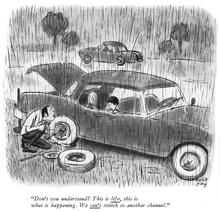
Erin writes: Robert Day, a longtime cartoonist and cover artist at the magazine, began contributing to The New Yorker in September of 1931. Prior to joining the magazine, Day had been a freelance cartoonist at the New York Herald Tribune. In a career at the magazine that spanned forty-five years, from 1931 to 1976, he published nearly eighteen hundred cartoons and eight covers. Many times, the prolific cartoonist had more than one cartoon in an issue. One of my favorite Day cartoons ran in the July 25, 1970, issue. In it, a father fixes a flat tire along a busy highway and says to his two young children, “Don’t you understand? This is life, this is what is happening. We can’t switch to another channel.” Day died in 1985, at the age of eighty-four. In the obituary The New Yorker ran after his death, former art editor Lee Lorenz wrote of Day: “His unadorned brush drawings, with their juicy, effortlessly flowing line, were as elegant as anything we have ever published.”
Robert Day New Yorker July 25 1970.jpg
Q. What is the breakdown of The New Yorker‘s readership between New York and the rest of the world?

Jon writes: According to 2005 data from the Audit Bureau of Circulation, The New Yorker has 183,732 subscribers in the New York metropolitan area, representing 19 percent of its total circulation of 1,051,919. (Circulation includes both paid subscriptions and newsstand sales.) The New Yorker has 965,341 subscribers in the United States, 14,044 subscribers in Canada, and 20,453 subscribers in the rest of the world. The state with the most subscribers is California, with 177,814; the state with the fewest is South Dakota, with 723. The smallest market for The New Yorker in North America is the Yukon Territory, with seven subscribers. There are several countries–including Malawi, Brunei, the Dominican Republic, and Albania–with only one subscriber to the magazine. The current subscription rate is $52 domestic, $90 for Canada, and $112 for other countries.

In its early years, the magazine was not above poking fun at its own international subscription rates. A spoof in the October 2, 1926, issue took the form of a letter from a reader in Vevey, Switzerland, complaining about the cost of subscribing to The New Yorker ($7): “Do you know what I could get with seven whole American dollars over here? Merely (choice) six bottles of real Gordon gin…two pairs of natty sport shoes…two pairs of white flannel trousers, a return ticket to Paris…or the services of a gifted Swiss cook-waitress-chambermaid for almost one month.”

We don’t know what the going rate for domestic help in Switzerland is these days, but the price of an international subscription to The New Yorker will still buy six bottles of Gordon’s gin from a Manhattan liquor store ($18.99 per 1.75 liter bottle), a pair of Zoom LeBron IIIs from Nike ($110), one new pair of flannel pants from the Orvis catalog ($98), or a one-way second-class ticket on the TGV between Geneva and Paris (70 Euros or about $90, if purchased a month in advance).

Q. What are some departments that no longer exist? Did the magazine ever have regular, say, tennis or vaudeville reviews?

Erin writes: While certain departments–such as A Reporter at Large and The Current Cinema–have existed since the start of the magazine, many others have fallen out of fashion. In some cases, department titles have simply evolved over time. A few of my personal favorites of these extinct departments include That Was New York (1928-81), Of All Things (1925-51), and H. L. Mencken’s Days of Innocence (1941-43).

Other extinct departments are equally varied. Broadway Rackets (1927), a column by Jack Wynn, concerned mob rackets and scams operating in midtown Manhattan at the time. Speakeasy Nights (1927-29), by Niven Busch, Jr., reviewed Manhattan speakeasies during the Prohibition era. Ring Lardner’s Over the Waves (1932-33) discussed popular radio programs of the day. The Army Life (1941-44), by E. J. Kahn, was a chronicle of soldiers’ activities around the globe during the Second World War. And Notes for a Gazetteer (1959-66), written by Philip Hamburger, explored the cultures of various cities across the nation and was a sort of precursor to Calvin Trillin’s U.S. Journal.

The magazine also ran a regular Football column from 1926 to 1980 (written primarily by R. E. M. Whitaker), a Tennis Courts (or On the Courts) column from 1926 to 1947, and a Yachts and Yachtsmen column from 1927 to 1941. Other sports the magazine used to cover on a regular basis include boxing, horse racing, golf, rowing, polo, and hockey. About the House (1926-74), an interior-decorating column, and Lois Long’s Feminine Fashions (1926-82) round out an eclectic assortment of extinct departments.

Some departments that stop running in the magazine later reappear in a slightly different version: the Tables for Two restaurant column ran as a stand-alone column from 1926 to 1962, and then later re-emerged in the Goings On About Town section in 1995. Similarly, The Wayward Press (written primarily by A. J. Liebling) ran from 1927 to 1963, and was re-introduced in 1999 by Hendrik Hertzberg; and the Shouts & Murmurs “casual” (1929-34), which was originally written by Alexander Woollcott, reappeared in 1992.

Many of these extinct departments reflect a playful sensibility. What are we to make of department names like the Department of Correction, Amplification & Abuse, or the Department of Misquotation, Correction & Inter-Urban Relations? Equally droll are When New York Was Really Wicked (1927-28), Our Windswept Correspondents (1954), and A Reporter in Bed (1942-50). As I pored over the vast archive of departments, I wondered if any headings could have been left unaddressed. Apparently, there is at least one. According to The Years with Ross (1957), by James Thurber, Harold Ross once told Thurber that he’d “never run a department about dogs.”

Q. Are there plans to update The Complete New Yorker?

Jon writes: Yes. An update is just about to be released. It includes issues from February 2005 through the end of April 2006. The update, which comes in the form of a new disk 1 for the DVD set, costs $19.99 and is available from The New Yorker Store at www.newyorkerstore.com.

The update has been designed to integrate seamlessly with the first eighty years, and the user’s reading lists and notes will be preserved. In addition to providing fourteen months of additional issues, it features modifications and improvements to the archive’s search engine. The update will also be included on the portable hard drive version of The Complete New Yorker, which is being released on September 18.

Q. Why did it take so long for The New Yorker to get a table of contents?

Erin writes: The New Yorker famously did not have a conventional table of contents until 1969. But the magazine actually started running a small index of articles or departments with the March 5, 1927, issue; it was originally located in the middle of each issue and later moved to the first page of the Goings On About Town section.
New Yorker index March 5 1927.jpg
The first conventional T.O.C. ran in the March 22, 1969, issue. This version included all major departments, including fiction and poetry, and authors, as well as cover artists and cartoonists. According to Ben Yagoda’s book About Town (2000), when a longtime editor, Daniel Menaker, mentioned the new T.O.C. to a fact-checker at the magazine, the checker protested, “But now readers will know what’s in the magazine.”

TOC '69

In the April 18, 1988, issue, the magazine ran the first full-page T.O.C. with new type and layout; it was also the first T.O.C. to feature the current Eustace Tilley image above the index.

TOC '88

A greatly expanded T.O.C.–including titles, blurbs, and major illustrations and photographs as well as articles–debuted in the October 5, 1992, issue, which was then-editor Tina Brown’s first issue. The current T.O.C. was unveiled in the February 21 & 28, 2000, seventy-fifth anniversary issue, and it featured a new layout and red typeface for certain departments.

Q. During the Second World War, was there a special wartime edition of the magazine for soldiers?

Jon writes: From September 1943 through the end of 1946, The New Yorker produced a special overseas edition for the armed services, which was distributed free to soldiers by the Special Service Division of the U.S. Army. The “pony” edition, as it was known, began as a monthly, but became a weekly with the March 25, 1944, issue. Smaller in format than the regular magazine (its dimensions were 8 1/2 by 6 inches, and it usually ran to 26 pages), the pony New Yorker contained no advertising. It also omitted the Goings On About Town listings, and, with a few exceptions, movie, music, and theatre reviews. It did, however, replicate the typography and layout of the regular magazine. The entire Talk section was reproduced, along with numerous cartoons and a full page of Newsbreaks at the back. The pony also reprinted many longer pieces, including John Hersey’s “Hiroshima,” which appeared in its entirety.

Credit has been given to the pony edition for the expansion of The New Yorker‘s readership after the war. Writing in the December 28, 1946, issue, E. B. White noted that it was the last issue that would be reproduced in a pony edition:

As near as we can make out from reports that have come in, the pony New Yorker was a success. Held together by only one staple, it was a quick disintegrator, but its fugitive little pages were studied by homesick men and women all over the uncivilized world…. The small type was calculated to destroy what was left of a soldier’s vision; nevertheless, the pony was hungrily read–some copies by a dozen or more people. At one time, what with the copies of the regular edition mailed second-hand by soldiers’ families, our service readers outnumbered our civilian readers ten to one. Thank God that is no longer the case, and thank God for the reason why it isn’t.

Addressed elsewhere in Ask the Librarians: VII: Who were the fiction editors?, Shouts & Murmurs history, Sloan Wilson, international beats; VI: Letters to the editor, On and Off the Avenue, is the cartoon editor the same as the cover editor and the art editor?, audio versions of the magazine, Lois Long and Tables for Two, the cover strap; V: E. B. White’s newsbreaks, Garrison Keillor and the Grand Ole Opry, Harold Ross remembrances, whimsical pseudonyms, the classic boardroom cartoon; IV: Terrence Malick, Pierre Le-Tan, TV criticism, the magazine’s indexes, tiny drawings, Fantasticks follies; III: Early editors, short-story rankings, Audax Minor, Talk’s political stance; II: Robert Day cartoons, where New Yorker readers are, obscure departments, The Complete New Yorker, the birth of the TOC, the Second World War “pony edition”; I: A. J. Liebling, Spots, office typewriters, Trillin on food, the magazine’s first movie review, cartoon fact checking.

Ask the Librarians: The Debut

A column in which Jon Michaud and Erin Overbey, The New Yorker’s head librarians, answer your questions about the magazine’s past and present. E-mail your own questions for Jon and Erin; the column has now moved to The New Yorker‘s Back Issues blog. Illustration for Emdashes by Lara Tomlin.
Q. How and when did A.J. Liebling start writing for The New Yorker? Was it under his own name, or was it as an anonymous Talk of the Town reporter? Can one recognize his style from his early work in the magazine?

Jon writes: Liebling was hired by The New Yorker in 1935, when he was thirty years old. Prior to joining the magazine, he had worked as a newspaper reporter, most recently for The New York World-Telegram (where Joseph Mitchell was a colleague). During his last two years at the World-Telegram, Liebling had begun contributing freelance Talk of the Town stories to The New Yorker. His first (unbylined) story in the magazine was “Prosperity Pens,” in the January 7, 1933 issue, about a pyramid scheme involving the sale of fountain pens, wallets, and flashlights.

According to Raymond Sokolov’s biography, Wayward Reporter (Harper & Row; 1980), Liebling initially had some difficulty making the transition from newspaper journalism to the longer-form reporting practiced at The New Yorker. His first bylined piece was a three-part profile of the preacher Father Divine (June 13, 20, and 27, 1936), co-written with St. Clair McKelway. By then, Liebling had published more than twenty-five unbylined Talk stories. Because the Talk section was so heavily rewritten and edited at that time, it is difficult to make a comparison between Liebling’s mature style and his writing in these early pieces. It is not difficult, however, to notice that, from the beginning, Liebling was an omnivorous reporter. Among those early Talk stories are pieces on subjects as diverse as the Bronx County Motor Vehicle Bureau, the Ethiopian Consul General, a retired fireman who had become a parrot merchant, and the bell-ringer at Riverside Church. There were also several pieces about boxing, one of the numerous subjects Liebling would go on to write about with distinction during his thirty-year career at the magazine.

Q. Who does those little line drawings found throughout the magazine, and why is no credit ever given them? Have “spots” always been listed in the table of contents?

Erin writes: The “spot” drawings that run throughout the magazine have appeared in The New Yorker since the very first issue, in 1925. Initially, there were just a few spots in each issue. The drawings were small and often playful, and many were unsigned. From the 1940s onward, the spot illustrations appeared more frequently. Early spot illustrators included Victor De Pauw, Roger Duvoisin, H. O. Hofman, George Shellhase, Virginia Snedeker, Beatrice Tobias, Edward Umansky, and Garth Williams. Several artists known for their cartoons and covers–such as Constantin Alajalov and Abe Birnbaum–also contributed spot drawings.

From the 1950s to the 1980s, artists like Raymond Davidson, Pierre Le-Tan, Kenneth Mahood, Jenni Oliver, and Gretchen Dow Simpson all published spots in the magazine. During the 1900s and early 2000s, a stable of illustrators was used, and spots were sometimes rerun after six months or so. These artists include Laurent Cilluffo, Jacques De Loustal, Philippe Petit-Roulet, Emmanuel Pierre, Robert Risko, and Benoit Van Innis. Beginning with the February 14 & 21, 2005 issue, the magazine began running credited spots by a single artist. In April 2005, spots started being listed in the Table of Contents.

Q. When was the last typewriter spotted in the office?

Jon writes: Today. There are three typewriters in the library (two IBM Wheelwriters and a Brother ML 300). Though the majority of our work is done on computers–and has been for some time now–there are still a few archival resources we maintain with typewriters. We’re the only department in the office that still uses typewriters on a regular basis.

Q. When did Calvin Trillin start writing food pieces? How many different kinds of cuisine has he covered?

Erin writes: Calvin Trillin has had a long career at The New Yorker, writing about subjects as diverse as the civil rights movement (“An Education in Georgia,” 7/13/63), female coal miners in Pennsylvania (“Called at Rushton,” 11/12/79), a tick-tack-toe-playing chicken in Chinatown (“The Chicken Vanishes,” 2/8/99), and the death of a U.S. soldier in Iraq (“Lost Son,” 3/14/05). The first lengthy food piece he wrote for the magazine was a U.S. Journal article, “Eating Crawfish” (5/20/72), about the Crawfish Festival in Breaux Bridge, Louisiana. He has contributed a total of forty-four food pieces to the magazine. Many of these pieces ran as U.S. Journals and focused on regional American cuisines, such as New England clambakes (1978), Little Italy’s San Gennaro festival (1981), catfish eating in Florida (1982), and barbecue contests in Memphis (1985). Trillin published twenty-one of these food-centered U.S. Journals from 1972 to 1982.

Beginning in 1982, Trillin also published seven pieces on foreign cuisines, including those from Hong Kong, Ecuador, and France. From the 1980s to the present, many of his food pieces have run under the department headings of Our Far-Flung Correspondents, American Chronicles, and Annals of Gastronomy. Other culinary topics he has covered include pizza baron Larry (Fats) Goldberg (1971 and 1987), oyster eating in Delaware (1980), Arthur Bryant’s restaurant in Kansas City (1983), Haagen-Dazs’s and Ben & Jerry’s ice cream (1985), Chinatown restaurants (1986), Manhattan bagels (2000), Cajun boudin sausage (2002), Shopsin’s café in Greenwich Village (2002), and San Francisco takeout (2003).

Q. What’s the first movie The New Yorker ever reviewed? How many movie critics have there been at the magazine, and who are they?

Jon writes: The first movie reviewed by The New Yorker was F.W. Murnau’s silent The Last Laugh (Der Letzte Mann), starring Emil Jannings. The review, by Will Hays, Jr., appeared in the first issue of the magazine–February 21, 1925–in a column of criticism and celebrity gossip called “Moving Pictures.” Hays deemed the movie “a superb adventure into new phases of film direction…a splendid production.”

Hays wrote only three more movie columns for the magazine. Over the next few years, the column was written by Theodore Shane (signed T.S.) and Oliver Claxton (O.C.). It also sometimes ran unsigned. The first long-term reviewer, John C. Mosher, took over in 1928 and held the post until 1942. Thereafter, the magazine’s movie critics were: David Lardner (1942-44), John McCarten (1945-1960), Brendan Gill (1960-68), Roger Angell (1960-61 and 1979-80), Penelope Gilliatt (1967-1979), Pauline Kael (1967-1991), Terrence Rafferty (1988-1997), Anthony Lane (1993-present), Daphne Merkin (1997-1998) and David Denby (1998-present).

When the regulars were away, or when the magazine was between longer-tenured reviewers, a great variety of writers filled in. The list includes E.B. White, Wolcott Gibbs, John Lardner, Philip Hamburger, Edith Oliver, Whitney Balliett, Susan Lardner, Renata Adler, Veronica Geng, and Michael Sragow.

Q. Are cartoons fact-checked? What’s the
sort of thing that checkers ask to be changed in a drawing or caption?

Erin writes: Every cartoon is fact-checked for accuracy and also checked against the library’s archive to make sure that a similar cartoon has not run previously in the magazine. The New Yorker fact-checking department verifies both visual and text accuracy of a particular cartoon: If a drawing of the White House has the wrong number of columns on it or if a man’s coat is buttoned on the wrong side, then the fact-checking department informs the cartoon department of the discrepancy. The cartoon department will then either make the change or not depending on whether the discrepancy is intentional or not. In addition, if a cartoon caption gets a proper name wrong or, say, locates the Nôtre Dame in Bangkok, the fact-checking department will point out these inaccuracies. The cartoonists have learned that even a detail as small as the number on a taxicab will be checked to make sure it does not represent an actual cab number.
Addressed elsewhere in Ask the Librarians: VII: Who were the fiction editors?, Shouts & Murmurs history, Sloan Wilson, international beats; VI: Letters to the editor, On and Off the Avenue, is the cartoon editor the same as the cover editor and the art editor?, audio versions of the magazine, Lois Long and Tables for Two, the cover strap; V: E. B. White’s newsbreaks, Garrison Keillor and the Grand Ole Opry, Harold Ross remembrances, whimsical pseudonyms, the classic boardroom cartoon; IV: Terrence Malick, Pierre Le-Tan, TV criticism, the magazine’s indexes, tiny drawings, Fantasticks follies; III: Early editors, short-story rankings, Audax Minor, Talk’s political stance; II: Robert Day cartoons, where New Yorker readers are, obscure departments, The Complete New Yorker, the birth of the TOC, the Second World War “pony edition”; I: A. J. Liebling, Spots, office typewriters, Trillin on food, the magazine’s first movie review, cartoon fact checking.
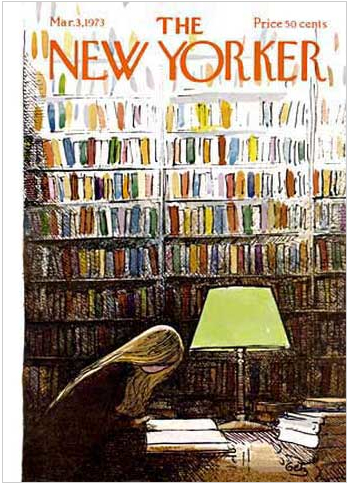
Keep Those Cards and Letters Coming

with questions for the New Yorker senior library staff, who will be answering them here. The first column will appear very soon; look for it, then dare to submit your own. Want your query to be pondered and investigated at the heart of the brain trust? (If I add “the belly of the beast,” we’ll have a Bodies-worthy anatomical mixed metaphor on our hands.) Here’s your chance. I’m obviously screening questions, so make yours a good one. Feel free to be anonymous; just let me know what you prefer.

Also, via Boing Boing, it’s Chico Marx on the piano—literally, on the piano.

More about the New Column

emdashes_getzcover1973.jpg
Wondering who those mystery staffers are? The brand-new monthly column here on Emdashes will be written by two of The New Yorker‘s senior library staff, who’ll be researching and answering your questions. Well, not all of your questions, smartypants! We’re being very picky.

These two know pretty much everything–and what they don’t know, they know who to ask or where to look it up in the vast archive over which they preside. (True fans: It takes your breath away to stand inside it.) They’re the caretakers of the entire history of the magazine, and have awesome knowledge. Tap into it by emailing me your best questions, and you might even make it into the first batch in the column, which will debut next month. I’m excited.

[Arthur Getz cover, above, courtesy of the Cartoon Bank. It’s from March 3, 1973, so it was likely on my parents’ kitchen table the day my sister was born (a day I swear I remember). I also dig this 1957 Getz cover of the cool inside of a bookstore on a sunny day.]

Sneak Preview: A New Column Written By…

You. At least, in part. And not by me. I’ll explain.

Like me, you read The New Yorker. With interest. Loyally, actively, critically. Ardently. You love to wrangle with it. Perhaps you’ve just picked it up for the first time. Don’t you wish you could ask it a few questions? To confirm a subtle change that no one else seems to have noticed? To go behind the scenes of the DVD archive with some juicy institutional knowledge? To debunk a hoary myth once and for all? Or a other dozen things? Did you ever have a New Yorker question that could only be answered by someone who’s actually there?

Well, now you can.

Starting soon, two New Yorker staffers (whose identities will remain a secret for now) will answer the best of your questions each month, right here on emdashes. Before that can happen, of course, these wise experts need some good, fun, challenging questions to answer. So what have you always wanted to know? Email me all your queries about New Yorker history, its writers, editors, cartoons, style, subjects, design—anything that’s ever fascinated or confounded you—and I’ll put them into the right hands. Don’t bother inquiring who asked who to the Condé Nast masked ball, but almost everything else goes.

If your question is chosen and I print the (for now) mystery columnists’ answer on emdashes, you’re free to either use your name or initials or remain anonymous, so please indicate in your email which you prefer. Have fun, be specific, don’t hold back, and can’t wait to see what you ask—not to mention the answers.

Update: I’ve gotten some swell entries so far today. Remember, it’s got to be a high-quality question—a real puzzler or a triumph of arcana, or perhaps the soul of elegant simplicity—to be posted and answered here. So keep brainstorming! Quipsters, you make my inbox shake like a bowlful of jelly, but I’m only forwarding the real stuff, so try to use your power for good. So email in those questions. Only questions emailed to me will reach the desk of people who will answer them!

Further update: I’ve revealed more about the columnists here.
(There was a drawing by a young lady named Brooke here, which I’ll fill in later after I’ve transferred the image from blogspot; here are more vibrant body parts.)