Category Archives: Hit Parade

The Way We Live Now

Fourteen! If this blog were a child, it’d be a smart-mouthed teenager. I founded it in 2004, dedicating it to the superb writer Donald Antrim. So what is Emdashes? It’s either a pair of long dashes in a sentence–like these–or a culture blog whose original tagline was “The New Yorker Between the Lines.” In its active days, it was a _New Yorker_ magazine fanblog. More on all of that here.

Here’s a long-winded description of me if you’re here for the first time: I’m a writer, editor, and digital strategist; my keenest interests are books and culture, politics and social issues, technology and design. I was a staff theater critic for Time Out Chicago; here are those reviews. As a book critic and feature writer, I’ve interviewed Edward Gorey, Aisha Tyler, J. K. Rowling, Lewis Lapham, Ayaan Hirsi Ali, Nick Hornby, Cathleen Schine, Françoise Mouly, Paul Auster, and gifted young designers, among many others. I’ve also written about poetry–and am myself a poet.
Online archives being what they are, much of my journalism lives in the Lexis-Nexis Federal Penitentiary or in the twilight of the Wayback Machine. I’ve started migrating pieces to my portfolio; in the meantime, some are reprinted here in posts tagged “Clips.” A few more samples at hand: features and interviews about graphic design, including a deep dive into the career of founding New Yorker art director Rea Irvin, for Print magazine; liveblogging for a hyperlocal-business summit; book reviews for Salon. For NYCgo.com, I celebrated the life of dance legend Frankie Manning, whom I’d previously interviewed for Newsday.
On the advertising and digital marketing side, as managing editor of Ogilvy & Mather’s brand newsroom, I edited, art-directed, and co-wrote hundreds of pieces of content for IBM–blog posts, landing-page copy, infographics, and social media assets. You can get a taste of the work I oversaw from this SlideShare recap of our team’s live coverage of Mobile World Congress.
For arts and public-policy nonprofits, I’ve written and/or edited site copy, reports, and press releases. While helping build the Rockefeller Foundation’s content strategy for its “100 Resilient Cities” launch, I interviewed architecture critics about resilient buildings. I’ve written a lot of e-commerce and email-marketing material, including editorial and marketing e-blasts for the art-collecting site 20×200. As a Groupon copywriter in the site’s salad days, I wrote droll profiles in its giddy house style. I’ve also ghostwritten blog posts for B2B companies and features for business magazines.
Personal stuff: My photos are here on Instagram. I work as a DJ and sound improviser for the Dirty Little Secrets improv show, which plays monthly at Niagara in NYC. Aside from my often not-serious “serious” poetry, I serve as an occasional occasional poet. Yes, I’m the author of that corduroy sestina. A clerihew I composed appeared on The New Yorker‘s own blog, bringing it all full circle.

Other New York Times Headlines About Snake Handling

saint-exupery-snake.jpegBill Haast, 100, Florida Snake Handler, Is Dead
Snake Handler Bitten by One of World’s Most Poisonous Vipers
Snake Handler Hospitalized After Suffering 102d Bite
Snake Handler Dies of Bite, As His Father-in-Law Did
Snake Handler Recuperating
Jolo Journal; When the Faithful Tempt the Serpent
Kentucky Man Killed by Rattler In Rite of Snake-Handling Cult
Defiant Snake Handler Dies
SQUEEZED BY AN ANACONDA; A TRYING MOMENT FOR AN EXPERT SNAKE HANDLER
Drought means booming business for Southern California snake handlers
Handling Hogs
SNAKE BITES A SHOWMAN; “Rattlesnake Pete” Gruber Thought to be Dying at Rochester
Zoo Burglar Tries to Steal Deadly Cobras; Mystery in Raid on the Bronx Reptile House
CHURCHES CHIDED ON MATERIAL AIMS
One African Takes Fangs Over Fido As a Sentry

The Contested Number of Years That Bill Murray Is Stuck in Groundhog Day

Harold Ramis says ten. (The screenwriter, Danny Rubin, invites you to pony up to find out what he thinks.) These folks say eight years, eight months, and sixteen days. My favorite estimate comes from this brilliant breakdown, which gives it as 12,403 days of Sonny and Cher and sweet vermouth on the rocks with a twist, or almost 34 years. Poor Phil. He really earned that happy ending.
–Emily Gordon

What Not to Wear, Ogg

Ancient bones suggest cavemen wore boots
Neanderthal Shell Discovery Shows Cavemen Wore Makeup
Cavemen wore jewelry 19,000 years before Earth was created
“It is common knowledge that cavemen wore dreadlocks, not for spiritual reasons, not for fashion, just for the fact that the comb wasn’t invented yet.”
How To Make a Caveman or Cavewoman Costume (“To top the costume off, make sure to make your hair frizzy and messy much like how cavemen wore it back in the day. Finally, you can opt to carry a wooden club or crude stone axe. Don’t forget to act like a caveman by walking funny and by speaking gibberish.”)
“It is possible, the article opined, that cavemen wore mullets out of sheer practicality.”
Sexy Neanderthals Wore Feathers
Susan Sarandon Wears Teeth Bracelet!
–Emily Gordon

Steve Martin and Deborah Solomon Bring Down the House, Sort Of

Martin Schneider writes:
It was a curious scene Monday night at 92Y. Steve Martin and Deborah Solomon, who is responsible for the “Questions For” feature in The New York Times Magazine, were slated to entertain a mostly filled Kaufmann Concert Hall (and, via simulcast, many other viewers at synagogues around the country) with an hour or so of lively chat.
It took only a few minutes for Solomon to alienate the audience thoroughly.
Solomon’s strategy was to treat the event like a book report, covering, almost chapter by chapter, Martin’s new novel about the art world, An Object of Beauty. As Martin pointed out, it was wise to assume that the percentage of spectators who had read the book, published only a few days earlier, was “zero,” making in-depth discussion of the characters’ foibles something less than the optimal plan. That did not stop Solomon.
92Y’s status as a specifically Jewish center of culture is usually best left unmentioned during events (it is a thoroughly ecumenical center), so it seemed a breach of decorum to praise Martin for making positive characters of the Nathansons, a Jewish art-dealer couple in the book, while reserving his satirical barbs for a gentile couple named Boggs. Later, Solomon wanted to relate a complicated sequence late in the book in which a character dons Joseph Beuys’s “Felt Suit.”
It was about at this point that 92Y, to its credit, attempted to steer the discourse to more fruitful terrain. A young lady strode onstage and handed Solomon a card: “Ask him about his career.” Cue thunderous applause.
For his part, Martin, always the consummately professional entertainer, understood immediately that Solomon had lost the audience, and poked fun at her (apparently they are friendly offstage). When, a bit later, the same young lady handed Solomon the audience Q&A cards, Martin deadpanned, “Go back to the book.”
To be honest, I’m not the biggest Steve Martin fan. There’s little doubt that he’s ridiculously talented, works hard, has a keen intelligence, and has succeeded in a variety of fields in addition to comedic acting, including fiction and banjo music. Credit to him for all that. Generally, however, his comedy seems somewhat overrehearsed and “cold” to me, and cast of mind in other arenas strike me as a bit whitebread.
Still, the man is good, as evidenced, for instance, by his “leaked”/hilarious tour rider, which he released over the summer. It’s a testament to his skills that even I, a skeptic, found myself emailing that link to my friends—it was that brilliantly executed.
So, long story short, the event was a bit of a dud, but that shouldn’t reflect poorly on Steve Martin or 92Y.
Update: 92Y has offered to refund ticketholders. Classy move.

Even When It’s Bold Italic: Typefaces to Love and Serenade

“Obsessing about fonts is a form of procrastination, so of course I have indulged in it ever since I graduated from a TRS-80 Model III to a Macintosh.” –Caleb Crain
“The main thing, though, is to use some nonproportional typewriter-style font–you need the sentences to look their worst until the dress rehearsal of the galleys, when all the serifs come out dancing.”
–Nicholson Baker
Emily Gordon writes:
My Chicago actor pal, taking a break from rehearsing Speed-the-Plow, just pointed out this 2007 gem from Slate: “My Favorite Font: Anne Fadiman, Jonathan Lethem, Richard Posner, and others reveal what font they compose in and why.” I wonder if they’ve all changed their minds by now? Caleb, how about you?
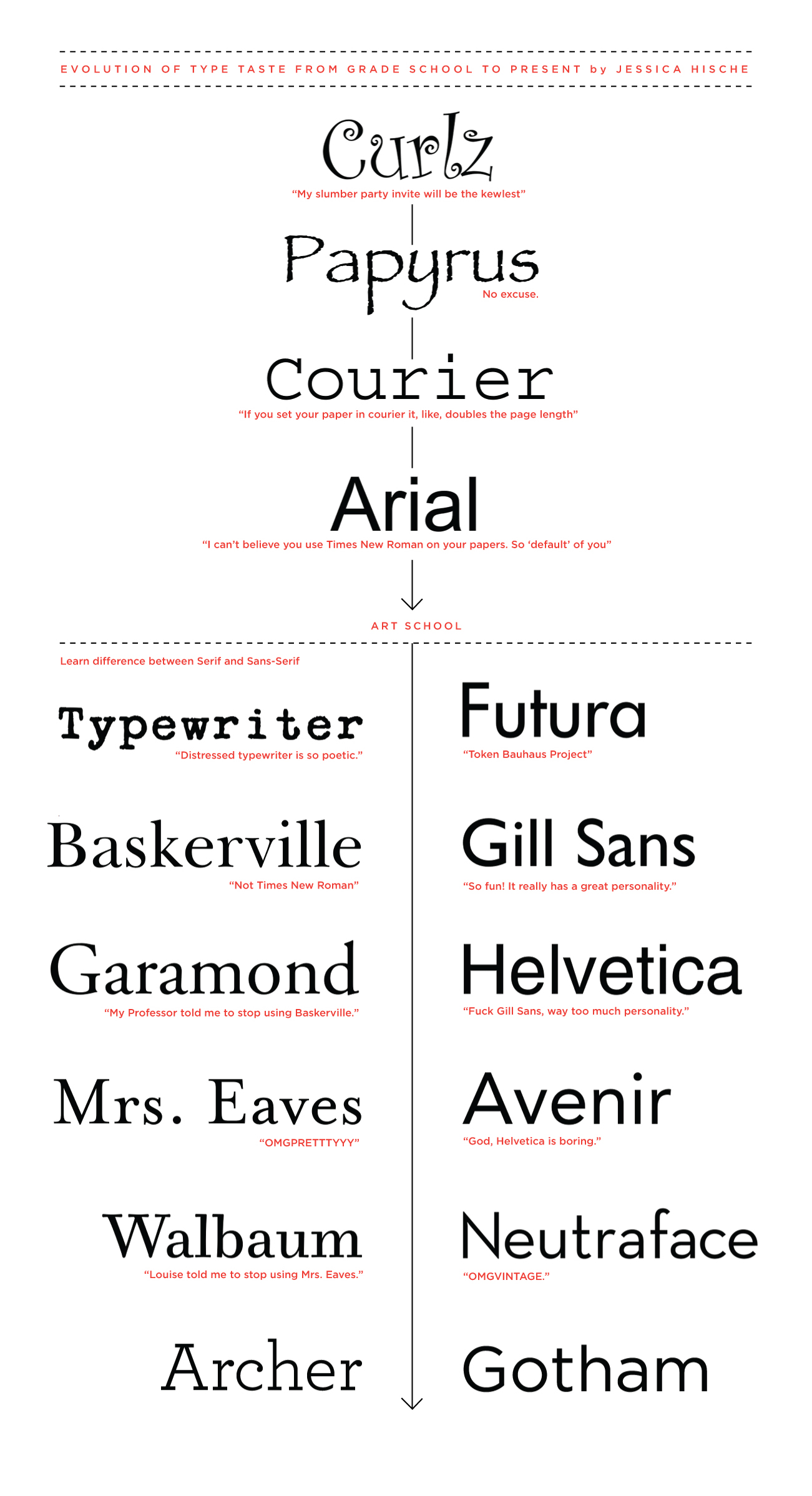
That thought sent me searching for this hilarious Jessica Hische post from earlier this year, a mini-autobiography of a typophile called “My Evolution of Type Taste from Grade School to Present”–click to enlarge and read her arch asides on questionable font attractions. Meanwhile, ambling along the googleway, I landed on this post about various other designers’ favorite faces.
All this brought me, musically and giddily, back to the song that is in my head 1) every time I see my sunscreen, which is called Sport Face, and 2) every time I hear Lady Gaga’s “Poker Face.” Yes, it’s DD40’s (Jason Kinney and Mark Searcy) Gaga-meets-typographer beards spectacular, “Neutra Face.” Here’s what Michael Conroy at the Wired U.K. blog wrote about it:

In a video that smacks of “it’s Friday afternoon, why not?” four guys have remixed Lady GaGa’s Poker Face into an homage to Neutraface, the light and airy modern font that I’m sure you’re all very familiar with…or perhaps not.

Either way, the sight of four hirsute men reimagining the Poker Face clip to perfection (“You’ll read my, you can read my Neutraface…even if it’s bold italic”) is sure to make you smile, not least their brilliantly choreographed moves portraying “bold” and “italic”, which should be licensed for use on dance floors everywhere.

Check out this and other songs DD40 have released – on cassette tape, no less – at their website.

I’ve seen this video several dozen times since it first rocked the world of fonty montys everywhere, and I still think it’s incredibly funny. And (as the YouTube commenters well know) damn sexy, too!


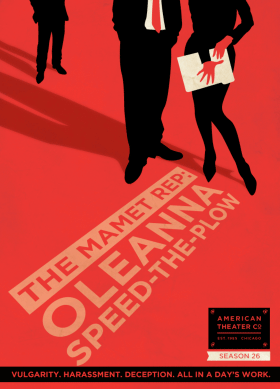
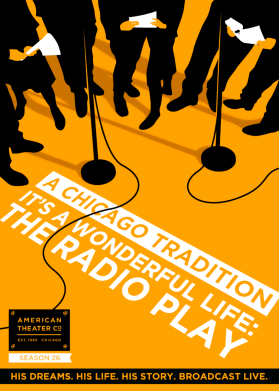
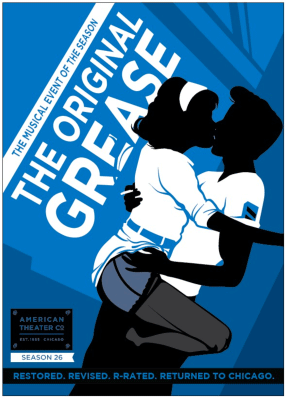
Speaking of design and Art, and Speed-the-Plow, aren’t these handsome posters for the American Theater Company’s new season? (Click on “the plays.”) If anyone knows who the designer is, let me know. (Update: DesignScout. Thanks Lance!) I will not be missing this (R-rated! sassy!) production of Grease.
mamet_small.gif
life_small.gif
meal_small.gif
grease_small.gif
Finally, check out this fantastic 1932 map of Harlem nightclubs, drawn by the cartoonist Elmer Simms Campbell. I love this for many reasons, including the appropriately prime spots for Cab Calloway and the Savoy Ballroom, and the hand-lettering is just so. Happy procrastinating!

Who Will Win the Punctuation Popularity Contest?

Emily Gordon writes:
A few stars–and we don’t mean asterisks–are emerging in our punctuation-addressing contest to win Ben Greenman’s new book, What He’s Poised to Do. Here are the rankings of letter recipients so far, out of 82 entries and counting. What does this say about these marks, or about us as a society? We don’t know. All we know is, some of these little symbols are coming home with an armful of valentines (and a little hate mail), and some are Charlie Brown, weeping into their sandwiches. If you’re for the underdog, as we generally are, take a moment to send a note to, say, the solitary slash, or, for that matter, the ubiquitous but apparently invisible backslash. Send a salami to your manicule in the army! Keep those cards and letters coming.
The current rankings (to be updated frequently for those placing bets):
Ellipsis: 10
Semicolon (which has withstood some harsh attacks in the past): 8
Apostrophe: 7
Exclamation Point: 7
At sign: 3
Ampersand: 3
Asterisk: 3
Colon: 3
Parentheses: 3
Period: 5
em dash: 2
Grawlix: 2
Interrobang: 2
Manicule: 2
Question Mark: 2
Tilde: 2

Tied with one piece of fan (or unfan) mail each: acute accent, air quote, at-the-price-of, bracket, bullet, comma, curly quote, diaeresis, dollar sign en dash, exclaquestion mark, hyphen, interpunct, interroverti (formerly the inverted question mark), macron, percent sign, pilcrow, pound sign, quotation mark, smart quote, underline, Oxford comma.

No postcards, no wedding invitations, no junk mail, no J. Crew catalogue, no nuthin’: backslash, bullet, caret, copyright symbol, dagger, dash ditto mark, degree, ditto mark, double hyphen, inverted exclamation point, guillemets, lozenge, number sign (number sign! that’s the hashtag you use so shamelessly!), the “therefore” and “because” signs, slash, solidus, and tie.
Here are some stark and potentially upsetting images of those characters who have received no mail. Can you look into their fragile strokes and deny them the notice they crave?
\ • © ^ ° † ‡ « » = 〃 ⁀ ◊ ∴ ∵ ¡ # / ⁄
Note: We realize that some of these marks are really less punctuation than they are typographical elements. But since they’re getting letters, or we think they should, we’re including them.

Pylcrafte: The Origins of “Pilcrow”

_Pollux writes_:
“Pilcrow” is a strange word for the punctuation mark used to signify new paragraphs. Lucy, one of the letter-writers in our ongoing contest in which you address the punctuation mark of your choice, had to look it up. We did, too. Where does it come from?
The words “pilcrow” and “paragraph” may have a common ancestor. Walter William Skeat, in his _Notes On English Etymology_ (1904), theorizes how the Latin _paragraphus_ (“paragraph”) eventually became the word “pilcrow.”
First, _paragraphus_ became corrupted as _paragraphe_.
_Paragraphe_ became _parragraffe_, to which an “excrescent t,” as Skeats calls it, was added at the end.
The variant _pargrafte_ appears in the _Ortus Vocabulorum_, a Latin-English dictionary printed in 1500 by the delightfully named Wynkyn de Worde. The variant _pylcrafte_ appears in another dictionary, the _Promptorium Parvulorum et Clericorum_.
So _pargrafte_ became _pylcrafte_.
“This is rather violent,” Skeats admits, but cites the change of r to l as a common occurrence in Indo-European languages. “Due to mere laziness,” _pylcraft_ or _pilcrafte_ became corrupted as “pilcrow.” Now you know!
Declare your love for the pilcrow “here.”:http://emdashes.com/2010/07/so-you-love-punctuation-write.php
.

So You Love Punctuation? Write a Letter to Your Favorite Mark, and You Might Win a Copy of Ben Greenman’s Brand-New Book!

ben greenman book cover.jpg
Update: We’ve announced the finalists, and the winner!
We loved every single letter to every single mark. Thank you!
Ben Greenman‘s new book, What He’s Poised to Do, was recently published by Harper Perennial, and critics are already hailing its mix of emotional sophistication and formal innovation. Just the tip of the iceberg: Steve Almond, writing in the Los Angeles Times, calls the fourteen stories in the collection “astonishing,” and Pauls Toutonghi at Bookslut calls them “beautiful”–even better, “a book so beautiful, you’ll feel mysteriously compelled to mail it to a stranger.
The book, in large part, deals with letters: how they are (or aren’t) effective conveyances for emotional intimacy and truth. Along with the book, Mr. Greenman has launched a site called Letters With Character, which invites readers to write letters to their favorite fictional characters–most recently, Alyosha Karamazov, Madame Psychosis from Infinite Jest, and Ernest Hemingway’s Yogi Johnson from The Torrents of Spring.
Here at Emdashes, we love letters (especially those sent through the postal mail), but there’s something we love even more: punctuation. Indeed, when we discovered that the upside-down question mark–as in ¿Qué?–had no official name, we challenged you, our readers, to rename it, and now the frequent (you wouldn’t believe how frequent) googlers who seek this information know the answer: it is the interroverti, all thanks to you.
In the same spirit, we’re combining two of our top-ten passions in life and challenging you to write a letter to your favorite punctuation mark, or perhaps one you find elusive, insufficiently loved, or sound but overexposed. Tell it anything you want: your fears, your frustrations, your innermost desires. Then put it in the comments section below so we can read it, too. Deadline: August 16. (We know all too well that it can take a bit of time to write a good letter–or even a telegraphic telegram.)
Here is a partial list of possible correspondents, with the current tally of blushing recipients marked in bold, and also ranked here in descending order of popularity: the acute accent, the air quote, the ampersand (3), the apostrophe (7), the asterisk (2), the at-the-price-of, the at sign (3), the backslash, the bracket, the bullet, the caret, the colon (3), the comma, the curly quote, the dagger, the dash ditto mark, the diaeresis, the dollar sign, the double hyphen (which is perhaps not what you thought it was), the ellipsis (10), the em dash (2)–toward which some jurors are slightly biased–or the en dash, the newly coined exclaquestion mark, the exclamation point (7), the full stop (2), the grawlix (2), the hyphen, the interpunct, the interrobang (2), the inverted exclamation point, the interroverti (formerly the inverted question mark), the little star, the macron, the manicule (2), the number sign, the parenthesis (((3))), the percent sign, the period (3), the pilcrow, the pound sign, the question mark (3), the quotation mark (or a pair of them), the controversial semicolon (7), the smart quote, the slash, the tilde (2), the underline, the Oxford comma, or any other mark close to your heart but not listed here. We will select the best letter and award the writer a signed copy of Mr. Greenman’s book, which may in fact contain the beloved mark in question. He may even add an extra one just for you.
Remember: Post your letter in the comments below by August 16, and you’ll be entered to win a signed copy of this exceptionally satisfying book of stories by one of our favorite writers. The best of the entry letters will all be collected in a post of their own, with sparkles, blue ribbons, and plenty of punctuation. If you can’t wait till mid-August to find out if you’ve won, and/or have friends who love letters and will love this book, of course, you can also order a copy.
Posting tip: You can use basic HTML tags to make line spaces; try the paragraph and break tags, as needed. If you don’t know how or would like our help, we are obsessive editor types and are happy to right the spacing for you.
Art note: The painting on the book cover is by Alyssa Monks, whose portraits of women and men and bodies and children and water and funny faces are scorchingly beautiful.
Factual note: We realize that some of these marks are really less punctuation than they are typographical elements. But since they’re getting letters, or we think they should, we’re including them.
Related posts and links:
Short Imagined Monologues: I Am the Period at the End of This Paragraph. [Ben Greenman, McSweeney’s]
Exciting Emdashes Contest! ¿What Should We Call the Upside-Down Question Mark?
Our in-depth coverage of punctuation–five years and counting!
More Emdashes contests, giveaways, and assorted bunk
Is That an Emoticon in 1862? [NYT/City Room]

Stop Being So “Smug,” Imaginary New Yorkers!

Martin Schneider writes:
Recently Ezra Klein, Ta-Nehisi Coates, Conor Friedersdorf, and Andrew Sullivan have been blogging about New York City’s overweening cultural clout and—interesting, this—the tendency of its residents to behave in a smug manner.
I must say, the discussion has been extremely disappointing, and I came away from it feeling frustrated, annoyed, and not a little insulted. I guess it is helpful to find out how much people dislike you for reasons that seem insufficient or inaccurate. Such is the power of cultural envy, or something like cultural envy.
The discussion proceeded along the following lines: Friedersdorf wrote about New York’s worrisome centrality in all cultural matters and its pernicious effects on other major cities. Sullivan weighed in, agreeing and complaining about how “irritating” New Yorkers’ “narcissism” is. Accepting New Yorkers’ smugness as a given, Coates then wrote a fairly empathetic post in which he gamely tried to put that smugness in context. Then Ezra Klein (this was my entry point into the discussion) quoted Coates approvingly and called the behavior of New Yorkers “unseemly.”
As a lifelong New Yorker, all I can say is: WTF?
Notice how quickly the discussion devolved: in short order, it went from a look at the unfortunate tendency of New York to “hog” (my word) the major cultural and literary outlets to complaints about the self-obsessed behavior of New Yorkers. Quite literally, the discussion went from “It’s too bad that smart people in Phoenix and Houston and Denver don’t get a chance to have the literary spotlight” to “Yes; I’d never want to live in New York; the city is overrated and the people are narcissistic” to “Well, yes, but the people there are smug for a reason” to “New Yorkers are unseemly because they won’t shut up about how great their city is.”
That, my friends, is some serious devolution. In no time, the subject of the relationship of, say, The New Yorker (the magazine) to the literary scene in Denver (this is an interesting subject) was dropped completely in favor of an attack on unnamed New Yorkers for unspecified actions. In three posts focusing on the inability of New Yorkers to shut up about how great New York is, you know how many beastly New Yorkers were quoted or referenced doing this?
The answer, you may be surprised to learn, is zero.
That’s right: confronted with presumably countless examples of snobbish New Yorkers disparaging Indianapolis, Tulsa, Atlanta, or Baltimore, Klein, Coates, and Sullivan couldn’t be bothered to name a single instance of anybody doing this. In this discussion, that was taken as a given, just as in a book you don’t have to cite anyone to establish that Amsterdam is north of Rome. It is a truth just as self-evident, apparently.
This gets all the more astonishing if you contemplate analogous scenarios. Imagine if any of these men had endeavored to make some point about, say, Mexican-Americans in the same manner. Ahh, “Mexican-Americans are fine people and work hard, but they obsess too much about soccer and they have no interest in education,” let’s say. Do you think any of them would venture such a statement without casting about for some empirical evidence that what they were saying is true? Even a single anecdote? I doubt it. But apparently New Yorkers are not accorded the same courtesy. Such are the pleasures of living in America’s cultural capital or whatever.
I’m going to push back on this “self-evident” premise. Before I get to that, I want to make it clear that I do agree that certain New Yorkers, and I’ll even include myself in this group, are capable of some insensitivity on the question of the cultural offerings available in New York in comparison to those available in other parts of the country. There’s something to that, and saying so is basically fine. What I mainly question here is the use of the words “narcissicism” and “smug.” If the exact same discussion had been about New Yorkers’ “sense of entitlement,” I might not take much issue.
Let’s start with Klein’s post. Klein basically says that you can’t get New Yorkers to shut up about how great New York City is. Let’s quote:

About the worst thing that can happen to you in life is to be in a room with two Texans who start trying to tell you about the Alamo. Or about Texas. Or about how Texas was affected by the Alamo. But there’s something endearing about it, too. Texans are battling stereotypes that don’t tend to favor them. It’s like talking up your mom’s meatloaf. New Yorkers, by contrast, have what’s considered the greatest city in the country and can’t stop talking about it. It’s like an A-student bragging about his grades, or a rich guy making everybody look at his car. It’s unseemly.

So, from Sullivan’s “narcissism” we quickly get to Klein’s picture of New Yorkers incessantly talking up their city. Many of the people reading this are New Yorkers. I ask you, New Yorkers: Does this portrayal seem accurate to you? I may be completely blinkered, but it does not seem accurate to me. If anything, New Yorkers tend to betray an unspoken assumption that New York is superior and are less prone to acting evangelical about touting the city. Am I wrong about this?
Let’s talk about New York for a moment. Coates, to his credit, mentions the sheer size of New York City (he says that it’s “like ten Detroits”) and points out that, statistically speaking, you’re going to get a good number of boors in a population that large, no matter what you do. He refers to New York City as “what happens when you slam millions of people who are really different into close proximity.” Right on.
So given that, let me ask: Are taxi drivers from Ghana “smug”? Are the Pakistani owners of bodegas a “narcissistic” bunch? Who are we talking about here, exactly? When Sullivan and Klein talk about narcissism and smugness, aren’t they really talking about educated New Yorkers who work in publishing and similar fields? Does that make a difference? If they’re more “entitled,” is it still fair to make such sweeping generalizations about them?
To get a little personal here: Last week I spent a couple of days in South Carolina with extended family; the group was about 20 people, most of whom were raised in South Carolina or Georgia. Smart people; nice people. The entire time I was with them, at no point did I gush about this great museum exhibition or that awesome indie rock gig; it wouldn’t occur to me to do that, because it would obviously be rude and seek to put the others present at some sort of disadvantage. Also, it’s unclear how interested any of these people would be in a band they had never heard of or an exhibition they would have no opportunity to attend. It’s equally unclear to me how many New Yorkers would prattle on about the city in this manner. It seems to me, not so many.
We didn’t spend all that much time watching television, but some of us did catch the tail end of VH1’s Top 100 Songs of the 1990s and Betty White on Saturday Night Live. Both shows made for good communal watching experiences because we all had the same cultural purchase on the material. Everyone below a certain age was familiar with Nirvana, and we all could enjoy the punchlines involving the potty-mouthed Ms. White. And that was great; there was no potential for anybody to feel left out.
Another story: twice this year I drove out to Cleveland to witness a particularly memorable indie rock project called the Lottery League. (By all means, click and be amazed.) I met a lot of grand people during both trips, and I enjoyed it so much that I’m currently seeking to relocate there for the summer and maybe beyond.
Most Clevelanders are pretty wary of New York, for reasons I find perfectly comprehensible. A microcosm of that view can be found in the relationship between the “have” Yankees and the “have-not” Indians. It’s little wonder that Clevelanders (along with pretty much everyone else in the country) are sick and tired of the successes of the Yankees and that they refer to the team as the “evil empire.” (Given that, it would be a disappointment of epic proportions if LeBron James ends up abandoning his native Ohio for Madison Square Garden. I really hope he stays in Cleveland.) The Yankees serve as a symbol for everything New York has and other places don’t, and people hate New York for that.
It’s an accident of history that New York City is what it is, and yes, New Yorkers cherish it, you’re damn right we do. We are sometimes unthinking about assuming that another place might have, I don’t know, good theater, and we sometimes have to catch ourselves mid-sentence to avoid appearing rude. We do take that sort of thing for granted, yes. One name for that is “living in a place.”
It’s useless to deny that New York City tends to hog the attention-getting people and events that make a difference in the cultural arena. When you interact with outsiders about it, you can choose to pretend that it isn’t true (“Oh, I’m sure Indianapolis has great theater too!”), or you can disparage other places (“God, I could never live in Denver, there probably isn’t a decent restaurant in the whole city.”), or you can honor the reality in a relatively humble way (“Wellllll, you know New York, we’re all a little fussy about theater and the like, but it sure is gorgeous here on this South Carolina beach….”). Does that last one count as smug or narcissistic? I’m genuinely curious.
The fact is, New York City is a very specialized ecosystem, and its natives don’t always thrive outside that particular rainforest. This is a well-known phenomenon, isn’t it? The New Yorker who can’t leave the city, even though part of him hates it? We’re all a little misshapen.
So maybe a little compassion for us “smug” New Yorkers. As far as I know, anyone who envies the city is free to drive on over and move in, we’re very welcoming that way. And since we’re accustomed to teeming multiplicity in all its forms, we’re a little slower to describe vast groups of people with a single disparaging adjective without any kind of evidentiary backup. It’s kind of a local tradition ’round these parts.