
In today’s comic, Paul considers the tasty, salty angle of the McCain-Obama debate. Click the drawing to enlarge! (And anticipate the munchies.)

More by Paul Morris: “The Wavy Rule” archive; “Arnjuice,” a wistful, funny webcomic; a smorgasbord at Flickr; and beautifully off-kilter cartoon collections for sale (and free download) at Lulu.
Monthly Archives: September 2008
Banks, But No Banks

Lines Cribbed in (Supposedly) Early Fall, As I Remove My Favorite Jacket
“It’s fall, dear.”
“I say it’s summer, and I say the hell with it.”
This Will Probably Be My Favorite Sentence on the Internet All Week
“Sassy mice claiming rights beyond their station might appear in any number of second-tier long-running comic strips (see for instance Garfield, 9/8-11/08).”
Friday Bouillabaisse: Noble Nursing, “Sexy Puritans,” the ’64 World’s Fair, Ricky Gervais, Suzanne Vega, Chimamanda Adichie, and a Very Doggy Tilley
We’ve already noted the commendable choice of Alex Ross as one of this year’s MacArthur Fellows; Chimamanda Adichie is also a winner, and I’m so glad. Here’s the MacArthur website’s description of a third accomplished and deserving recipient, Regina Benjamin:
Regina Benjamin is a rural family physician forging an inspiring model of compassionate and effective medical care in one of the most underserved regions of the United States. In 1990, she founded the Bayou La Batre Rural Health Clinic to serve the Gulf Coast fishing community of Bayou La Batre, Alabama, a village of approximately 2,500 residents devastated twice in the past decade by Hurricanes Georges, in 1998, and Katrina, in 2005. Despite scarce resources, Benjamin has painstakingly rebuilt her clinic after each disaster and set up networks to maintain contact with patients scattered across multiple evacuation sites. She has established a family practice that allows her to treat all incoming patients, many of whom are uninsured, and frequently travels by pickup truck to care for the most isolated and immobile in her region.
This immediately brought to mind “Children of the Bayou,” Katherine Boo’s outstanding 2006 piece about Louisiana nurses who travel to help young mothers learn to care for their babies. I find myself recommending it every few months. Boo has a satisfyingly long interview with Matt Dellinger on the New Yorker website; read it, and find the piece. It’ll slay you.
Speaking of noble professions, I was moved to tears by a comment from a social worker about how Suzanne Vega’s song “Luka” helped child advocates do their jobs by raising awareness about abuse and taking a little of the fear out of reporting it. The comment is on Vega’s absolutely terrific essay for the New York Times about writing the song and listeners’ many (and sometimes surprising) reactions. I was also struck by Vega’s description of what having a hit song feels like: “‘Hit’ is a good name for it — a feeling of intense communication with a huge amount of people at the same time. As with a baseball and a bat, a cracking, quick connection. As with drugs, a sudden alteration of reality. You could get used to it.”
I was led to all this by Clive Thompson’s post about Vega’s “Tom’s Diner,” a song close to many hearts, but particularly those graduates of Barnard and Columbia who have also listened to the cathedral bells and thought of a long-lost midnight voice, over sodden fries and (deliciously) gluey gravy. Vega writes stirringly about that song for the Times, too.
I love these shots of futuristic World’s Fair bus shelters left over from the 1964 World’s Fair, from my friend Paul Lukas, who discovered the far-out shelters northwest of Shea Stadium after last night’s thrilling Mets game.
Very funny: Things that upset Ricky Gervais.
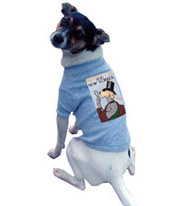
The website Baby New Yorker has some very cute stuff, and is also a natural choice for the New Yorker-minded. The Baby Talk onesie has a New Yorker cartoon feel to it, to be sure, and you’ve got to see the Dog New Yorker Shirt for yourself: “Our Comical Canine Version of the Original Eustace Tilley by Rea Irvin, Cover illustration for The New Yorker, 1925.” A small image is below, but you’ll want to click inside the Baby Talk website to see all the very funny detail. Yes, this is unsolicited endorsement; it’s good for the soul.
I am interviewed.
Meanwhile, Tom Perrotta writes in Slate:
Caribou hunting aside, Sarah Palin represents the state-of-the-art version of a particular type of woman–let’s call her the Sexy Puritan–that’s become a familiar and potent figure in the culture war in recent years.
…
I didn’t think too much about Sexy Puritans as a type until I began looking into the abstinence-only sex-education movement while researching my novel, The Abstinence Teacher. I expected to encounter a lot of stern James Dobson-style scolds warning teenagers about the dangers of premarital sex–and there were a few of those–but what I found over and over again were thoughtful, attractive, downright sexy young women talking about their personal decision to remain pure until marriage. Erika Harold, Miss America of 2003 (the right sure loves beauty queens), is probably the best-known to the wider public, but no abstinence rally is complete without the testimony of a very pretty virgin in her early- to mid-20s. At a Silver Ring Thing event I attended in New Jersey in 2007, a slender young blond woman in tight jeans and a form-fitting T-shirt–she wouldn’t have looked out of place at a frat kegger–bragged about all the college boys who’d tried and failed to talk her into their beds. She reveled in her ability to resist them, to stand alone until she’d found the perfect guy, the fiancé with whom she would soon share a lifetime full of amazing sex. While her explicit message was forceful and empowering–virginity is a form of strength and self-sufficiency–the implicit one was clear as well: Abstinence isn’t just sour grapes for losers, a consolation prize for girls who can’t get a date anyway.
Doesn’t that make you think of those wonderful, ardent, chaste, and slightly self-contradictory Strawberry Queens from Plant City, Florida, the subjects of that terrific New Yorker story by Anne Hull a month or so ago? Here’s a slide show from that piece; Brian Finke did the riveting portraits of the shortcakes and their long gowns.
Next week, know what it is? The New Yorker Festival, the high point of the Emdashes year, in all sincerity (we are, in fact, card-carrying members of The New Sincerity, and also, for crying out loud, The Corduroy Appreciation Club.) For the fourth straight year, we will be attending events, racing to the Starbucks/McDonald’s/Bryant Park/office, and posting our impressions. We’ll even be Twittering. Later, after videos are released of some of the events, we’ll post links to those, too. Gee baby, ain’t I good to you?
Forget Jet-Paks: We Demand More Skybridges for New York
Jonathan Taylor writes:
A few weeks ago, a friend and I were admiring a skyscraper in lower Manhattan, the American International Building at 70 Pine Street. Its tower—well described as an Art Deco hypodermic needle—is so thin and set back that it’s hard to look at from street level, but the almost parodically Deco style of its lobby can be seen despite the security guards posted to ward off idle venturers. A few weeks later, after the rescue of American International Group, I confirmed my guess that the building is the company’s headquarters (the Federal Reserve Bank of New York is conveniently nearby) but learned that it hasn’t always been. It was completed in 1932 as Sixty Wall Tower, known also as the Cities Service building, because it was the headquarters of oil company Cities Service Co. until the company moved to Tulsa, Oklahoma, in 1974. (I remember from growing up in Tulsa the ubiquity of the name “Cities Service,” probably as where a lot of kids’ dads worked. A relatively literal-minded child, I was perplexed by the company name’s stubborn failure to make clear to me what kind of company it was. Cities Service later became Citgo, now owned by the government of Venezuela.)
Frequently noted about the Cities Service building is the fact that it originally had eight “double-decker” elevators that served the floors above 28, two floors at a time, saving on elevator shafts and maximizing rentable floor space. In the April 30, 1932, issue of The New Yorker, E.B. White wrote a Talk piece about these new Otis elevators. White’s description of the system’s logic made it crystal clear, only after making it painfully clear that I should have been more confused by it than I thought I was:
People seem to think that to get into a double-decker, you have to walk either up a flight of stairs or down a flight. This isn’t so. The Cities Service building has two street entrance levels (on account of the way the land slopes off), and no matter whether you enter downstairs or upstairs, there will be four elevators that will make the even stops and four that will make the odd stops. No walking. In other words, when the double-deckers are at the starting position, their upper decks are being loaded with people coming in from one street, their lower decks with people coming from another street; four will stop ODD/EVEN and four EVEN/ODD.
The double-decker system was phased out in the building in the 1960s, according to this 1998 Times article. Among the buildings that today use double-deckers is the Citigroup Center in Midtown, itself the subject of a gripping May 29, 1995, New Yorker article by Joe Morgenstern (department: “City Perils”) about the discovery of a structural defect that might have caused it to collapse in a major hurricane, and the secret, after-hours work undertaken to correct it.
White ended his Talk piece on the elevators by noting, a bit sourly, that Sixty Wall Tower “isn’t in Wall Street, and can’t even be seen from Wall Street,” which is one block away. But the name stems from another of the building’s gewgaws, even more interesting from the point of view of that wonderful topic, the futurism of the past. The tower was joined to another belonging to Cities Service, at 60 Wall Street, by a connecting bridge on the 16th floor, allowing it to lay claim to that address. The bridge is now gone, but in that age, when the city was rapidly levitating upward in a skyscraper-building race, such bridges might well have seemed to be the logical wave of the future. In light of what seems to be the omnipotence of real estate values in the city’s economy, it’s still hard to believe that someone hasn’t found a way to profit from turning more corridors of air space into rights of way. That dream—and a hint of the obstacles to it—can be found in another Talk piece, of October 21, 1933, about the city’s taxation and regulation of such bridges (then numbering about 100, according to the article). They required the approval of the Board of Estimate, the Borough President, the Fire Department, and the Municipal Art Commission.
Somewhere in there (the piece is not clear) was the crucial say-so of “Edward Libaire, Assistant Engineer of the Division of Franchises” and “the city’s bridge expert for twenty-eight years.” Libaire rejected a proposal for another skybridge between the Cities Service tower and 60 Wall Street, on the second-story level, arguing that it would “hide too much of the sky.” But despite his stern standards for bridges that “won’t shut off too much light and that people will admire,” Libaire “pictures New York in 1983 with block-square skyscrapers connected with bridges that form great aerial highways.”
Now that New York City’s revenue base is being threatened by the financial crisis, perhaps Mayor Bloomberg would like to take a new look at skybridges. The Talk piece says that at that time—during the original Great Depression—”Nearly $400,000 of the yearly income of the city is from its tax on bridges between buildings.” (That’s $6.7 million in today’s dollars, according the federal government’s own “inflation calculator”:http://data.bls.gov/cgi-bin/cpicalc.pl.)
By the way, the Sun in January carried this update on the state of skybridges in the city today.
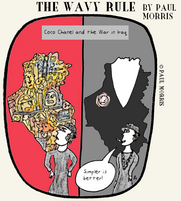
The Wavy Rule, a Daily Comic by Paul Morris: Intelligent Design
Today’s installment is reminiscent of an old Might magazine article about the importance of graphic designers in international affairs. The only thing I remember about it was that the solution for Northern Ireland involved use of Photoshop’s gradient feature on the embattled border. Click to enlarge!
More by Paul Morris: “The Wavy Rule” archive; “Arnjuice,” a wistful, funny webcomic; a smorgasbord at Flickr; and beautifully off-kilter cartoon collections for sale (and free download) at Lulu.
File Under Awesome: Caption Contest Now Searchable
Good news! The _New Yorker_ website now has a feature that lets you search on past “caption contests”:http://contest.newyorker.com/CaptionContest.aspx! Click on “Caption Archive” and there you are! You can access “every caption submitted to the contest, as well as see all of your captions.” (You will have to register to use the feature.) If you’re wondering what to search on, here are some “suggestions”:http://emdashes.com/mt/mt-search.cgi?IncludeBlogs=2&tag=Cartoon%20Caption%20Contest&limit=20.
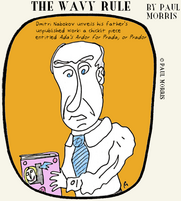
The Wavy Rule, a Daily Comic by Paul Morris: Sole Authorship
_Today’s entry puts me in the mind of John Hodgman’s failed palindromes: “Tow a what? Thaw!” Similarly, egret, neo tickle? Click to enlarge!_
More by Paul Morris: “The Wavy Rule” archive; “Arnjuice,” a wistful, funny webcomic; a smorgasbord at Flickr; and beautifully off-kilter cartoon collections for sale (and free download) at Lulu.
Hugging a Semicolon: National Punctuation Day

Paul “The Wavy Rule” Morris writes:
“Hey, it’s National Punctuation Day today!” I exclaimed to a co-worker who had just come back from break involving coffee-drinking and texting on a cellphone, an act that sadly failed to employ any punctuation marks.
“Oh, okay,” he said. “What am I supposed to do now? Hug a semicolon?”
Well, no, National Punctuation Day does not involve hugging semicolons (which are, in any case, notoriously shy punctuation marks). This Day, which has a website devoted to it, has a series of activities that you can do to honor these symbols of ours. Cook a question-mark meatloaf, bake exclamation-point cookies, take a picture of annoying punctuation gaffes, and celebrate the difference that good punctuation-mark use makes.
The benevolent founder of Emdashes (itself a website name that celebrates a punctuation mark), Emily Gordon, who eats, shoots, and leaves, loves and respects punctuation marks–so much so, in fact, that she decided to run a contest to name an unnamed one. (Interroverti, The Qué Mark, and Quiggle were the winners.)
Aldus Manutius, and all the typographical innovators in history, would be proud. Let us celebrate National Punctuation Day by using punctuation marks even more: let’s use semicolons in our text messaging (“The party sounds fun; I should go”), interpuncts on our iPhones, and ellipses in our e-mails (“You didn’t go to the party… Why?”).