Monthly Archives: August 2006

A Goldmine of Pauline Kael Reviews

Emily Gordon writes:
Just discovered this, here; it may even be the entirety of 5001 Nights, but I’ll have to look into that. Just because it’s a now-unsightly Geocities page (though there are far worse) doesn’t mean it doesn’t contain essential information. Like this, her review of Jaws (condensed from the long version in When the Lights Go Down:

Jaws
US (1975): Horror
124 min, Rated PG, Color, Available on videocassette and laserdisc

It may be the most cheerfully perverse scare movie ever made. Even while you’re convulsed with laughter you’re still apprehensive, because the editing rhythms are very tricky, and the shock images loom up huge, right on top of you. The film belongs to the pulpiest sci-fi monster-movie tradition, yet it stands some of the old conventions on their head. Though JAWS has more zest than an early Woody Allen picture, and a lot more electricity, it’s funny in a Woody Allen way. When the three protagonists are in their tiny boat, trying to find the shark that has been devouring people, you feel that Robert Shaw, the malevolent old shark hunter, is so manly that he wants to get them all killed; he’s so manly he’s homicidal. When Shaw begins showing off his wounds, the bookish ichthyologist, Richard Dreyfuss, strings along with him at first, and matches him scar for scar. But when the ichthyologist is outclassed in the number of scars he can exhibit, he opens his shirt, looks down at his hairy chest, and with a put-on artist’s grin says, “You see that? Right there? That was Mary Ellen Moffit-she broke my heart.” Shaw squeezes an empty beer can flat; Dreyfuss satirizes him by crumpling a Styrofoam cup. The director, Steven Spielberg, sets up bare-chested heroism as a joke and scores off it all through the movie. The third protagonist, acted by Roy Scheider, is a former New York City policeman who has just escaped the city dangers and found a haven as chief of police in the island community that is losing its swimmers; he doesn’t know one end of a boat from the other. But the fool on board isn’t the chief of police, or the bookman, either. It’s Shaw, the obsessively masculine fisherman, who thinks he’s got to prove himself by fighting the shark practically single-handed. The high point of the film’s humor is in our seeing Shaw get it; this nut Ahab, with his hypermasculine basso-profundo speeches, stands in for all the men who have to show they’re tougher than anybody. The shark’s cavernous jaws demonstrate how little his toughness finally adds up to. This primal-terror comedy quickly became one of the top-grossing films of all time. With Lorraine Gary; Murray Hamilton; Carl Gottlieb, who co-wrote the (uneven) script with Peter Benchley, as Meadows; and Benchley, whose best-seller novel the script was based on, as an interviewer. Cinematography by Bill Butler; editing by Verna Fields; music by John Williams. Produced by Richard D. Zanuck and David Brown, for Universal. (Spielberg didn’t direct the sequels-the 1978 JAWS 2, the 1983 JAWS 3-D, and the 1987 JAWS THE REVENGE.)
For a more extended discussion, see Pauline Kael’s book When the Lights Go Down.

Related on Emdashes:
Paulette Does Dallas
Anticipation (as Sung By Carly Simon)

Jonathans Are Illuminated: Unhappiness-Challenged

Does Michiko Kakutani have trouble with despair? Specifically, understanding what it might be like to be caught in it? Her self-congratulatory review of Jonathan Franzen’s The Discomfort Zone would seem to suggest that this is so, which would be an unfortunate deficiency in a critic of literature. She also seems not to have been following the progress of the essay over the past twenty-odd years. She writes:

There are two extended riffs in this volume where Mr. Franzen momentarily puts aside his fascination with himself to give the reader some wonderfully observed musings on two subjects that have long preoccupied him: Peanuts cartoons and bird-watching.

I’d like to see her attempt “musings” as “wonderfully observed” as those in “My Bird Problem” and “The Comfort Zone” (both of which first appeared in The New Yorker). She continues, pointlessly, “Indeed the young Mr. Franzen comes across as less of a Snoopy — ‘the warm puppy who amused the others with the cute things he said and then excused himself from the table and wrote cute sentences in his notebook’ — than as a kind of mean-spirited Lucy on steroids.” Must authors be Snoopys? I’d rather read Lucy’s memoir, msyelf. Let’s not forget that her review of Nick Hornby’s comically unsettling novel A Long Way Down lacked both depth and empathy in the extreme. She writes of Franzen’s book, “Just why anyone would be interested in pages and pages about this unhappy relationship or the self-important and self-promoting contents of Mr. Franzen’s mind remains something of a mystery.” It is simply impossible to view any art, in particular contemporary nonfiction, without the ability to answer that question.

Ask the Librarians (II)

A column in which Jon Michaud and Erin Overbey, The New Yorker’s head librarians, answer your questions about the magazine’s past and present. E-mail your own questions for Jon and Erin; the column has now moved to The New Yorker‘s Back Issues blog. Illustration for Emdashes by Lara Tomlin; other images are courtesy of The New Yorker.
Q. When did Robert Day start drawing for The New Yorker? For how long? How many drawings were published, and do you have a favorite?

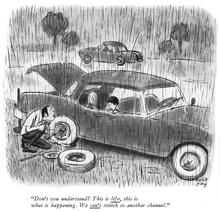
Erin writes: Robert Day, a longtime cartoonist and cover artist at the magazine, began contributing to The New Yorker in September of 1931. Prior to joining the magazine, Day had been a freelance cartoonist at the New York Herald Tribune. In a career at the magazine that spanned forty-five years, from 1931 to 1976, he published nearly eighteen hundred cartoons and eight covers. Many times, the prolific cartoonist had more than one cartoon in an issue. One of my favorite Day cartoons ran in the July 25, 1970, issue. In it, a father fixes a flat tire along a busy highway and says to his two young children, “Don’t you understand? This is life, this is what is happening. We can’t switch to another channel.” Day died in 1985, at the age of eighty-four. In the obituary The New Yorker ran after his death, former art editor Lee Lorenz wrote of Day: “His unadorned brush drawings, with their juicy, effortlessly flowing line, were as elegant as anything we have ever published.”
Robert Day New Yorker July 25 1970.jpg
Q. What is the breakdown of The New Yorker‘s readership between New York and the rest of the world?

Jon writes: According to 2005 data from the Audit Bureau of Circulation, The New Yorker has 183,732 subscribers in the New York metropolitan area, representing 19 percent of its total circulation of 1,051,919. (Circulation includes both paid subscriptions and newsstand sales.) The New Yorker has 965,341 subscribers in the United States, 14,044 subscribers in Canada, and 20,453 subscribers in the rest of the world. The state with the most subscribers is California, with 177,814; the state with the fewest is South Dakota, with 723. The smallest market for The New Yorker in North America is the Yukon Territory, with seven subscribers. There are several countries–including Malawi, Brunei, the Dominican Republic, and Albania–with only one subscriber to the magazine. The current subscription rate is $52 domestic, $90 for Canada, and $112 for other countries.

In its early years, the magazine was not above poking fun at its own international subscription rates. A spoof in the October 2, 1926, issue took the form of a letter from a reader in Vevey, Switzerland, complaining about the cost of subscribing to The New Yorker ($7): “Do you know what I could get with seven whole American dollars over here? Merely (choice) six bottles of real Gordon gin…two pairs of natty sport shoes…two pairs of white flannel trousers, a return ticket to Paris…or the services of a gifted Swiss cook-waitress-chambermaid for almost one month.”

We don’t know what the going rate for domestic help in Switzerland is these days, but the price of an international subscription to The New Yorker will still buy six bottles of Gordon’s gin from a Manhattan liquor store ($18.99 per 1.75 liter bottle), a pair of Zoom LeBron IIIs from Nike ($110), one new pair of flannel pants from the Orvis catalog ($98), or a one-way second-class ticket on the TGV between Geneva and Paris (70 Euros or about $90, if purchased a month in advance).

Q. What are some departments that no longer exist? Did the magazine ever have regular, say, tennis or vaudeville reviews?

Erin writes: While certain departments–such as A Reporter at Large and The Current Cinema–have existed since the start of the magazine, many others have fallen out of fashion. In some cases, department titles have simply evolved over time. A few of my personal favorites of these extinct departments include That Was New York (1928-81), Of All Things (1925-51), and H. L. Mencken’s Days of Innocence (1941-43).

Other extinct departments are equally varied. Broadway Rackets (1927), a column by Jack Wynn, concerned mob rackets and scams operating in midtown Manhattan at the time. Speakeasy Nights (1927-29), by Niven Busch, Jr., reviewed Manhattan speakeasies during the Prohibition era. Ring Lardner’s Over the Waves (1932-33) discussed popular radio programs of the day. The Army Life (1941-44), by E. J. Kahn, was a chronicle of soldiers’ activities around the globe during the Second World War. And Notes for a Gazetteer (1959-66), written by Philip Hamburger, explored the cultures of various cities across the nation and was a sort of precursor to Calvin Trillin’s U.S. Journal.

The magazine also ran a regular Football column from 1926 to 1980 (written primarily by R. E. M. Whitaker), a Tennis Courts (or On the Courts) column from 1926 to 1947, and a Yachts and Yachtsmen column from 1927 to 1941. Other sports the magazine used to cover on a regular basis include boxing, horse racing, golf, rowing, polo, and hockey. About the House (1926-74), an interior-decorating column, and Lois Long’s Feminine Fashions (1926-82) round out an eclectic assortment of extinct departments.

Some departments that stop running in the magazine later reappear in a slightly different version: the Tables for Two restaurant column ran as a stand-alone column from 1926 to 1962, and then later re-emerged in the Goings On About Town section in 1995. Similarly, The Wayward Press (written primarily by A. J. Liebling) ran from 1927 to 1963, and was re-introduced in 1999 by Hendrik Hertzberg; and the Shouts & Murmurs “casual” (1929-34), which was originally written by Alexander Woollcott, reappeared in 1992.

Many of these extinct departments reflect a playful sensibility. What are we to make of department names like the Department of Correction, Amplification & Abuse, or the Department of Misquotation, Correction & Inter-Urban Relations? Equally droll are When New York Was Really Wicked (1927-28), Our Windswept Correspondents (1954), and A Reporter in Bed (1942-50). As I pored over the vast archive of departments, I wondered if any headings could have been left unaddressed. Apparently, there is at least one. According to The Years with Ross (1957), by James Thurber, Harold Ross once told Thurber that he’d “never run a department about dogs.”

Q. Are there plans to update The Complete New Yorker?

Jon writes: Yes. An update is just about to be released. It includes issues from February 2005 through the end of April 2006. The update, which comes in the form of a new disk 1 for the DVD set, costs $19.99 and is available from The New Yorker Store at www.newyorkerstore.com.

The update has been designed to integrate seamlessly with the first eighty years, and the user’s reading lists and notes will be preserved. In addition to providing fourteen months of additional issues, it features modifications and improvements to the archive’s search engine. The update will also be included on the portable hard drive version of The Complete New Yorker, which is being released on September 18.

Q. Why did it take so long for The New Yorker to get a table of contents?

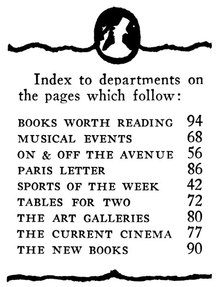
Erin writes: The New Yorker famously did not have a conventional table of contents until 1969. But the magazine actually started running a small index of articles or departments with the March 5, 1927, issue; it was originally located in the middle of each issue and later moved to the first page of the Goings On About Town section.
New Yorker index March 5 1927.jpg
The first conventional T.O.C. ran in the March 22, 1969, issue. This version included all major departments, including fiction and poetry, and authors, as well as cover artists and cartoonists. According to Ben Yagoda’s book About Town (2000), when a longtime editor, Daniel Menaker, mentioned the new T.O.C. to a fact-checker at the magazine, the checker protested, “But now readers will know what’s in the magazine.”

TOC '69

In the April 18, 1988, issue, the magazine ran the first full-page T.O.C. with new type and layout; it was also the first T.O.C. to feature the current Eustace Tilley image above the index.

TOC '88

A greatly expanded T.O.C.–including titles, blurbs, and major illustrations and photographs as well as articles–debuted in the October 5, 1992, issue, which was then-editor Tina Brown’s first issue. The current T.O.C. was unveiled in the February 21 & 28, 2000, seventy-fifth anniversary issue, and it featured a new layout and red typeface for certain departments.

Q. During the Second World War, was there a special wartime edition of the magazine for soldiers?

Jon writes: From September 1943 through the end of 1946, The New Yorker produced a special overseas edition for the armed services, which was distributed free to soldiers by the Special Service Division of the U.S. Army. The “pony” edition, as it was known, began as a monthly, but became a weekly with the March 25, 1944, issue. Smaller in format than the regular magazine (its dimensions were 8 1/2 by 6 inches, and it usually ran to 26 pages), the pony New Yorker contained no advertising. It also omitted the Goings On About Town listings, and, with a few exceptions, movie, music, and theatre reviews. It did, however, replicate the typography and layout of the regular magazine. The entire Talk section was reproduced, along with numerous cartoons and a full page of Newsbreaks at the back. The pony also reprinted many longer pieces, including John Hersey’s “Hiroshima,” which appeared in its entirety.

Credit has been given to the pony edition for the expansion of The New Yorker‘s readership after the war. Writing in the December 28, 1946, issue, E. B. White noted that it was the last issue that would be reproduced in a pony edition:

As near as we can make out from reports that have come in, the pony New Yorker was a success. Held together by only one staple, it was a quick disintegrator, but its fugitive little pages were studied by homesick men and women all over the uncivilized world…. The small type was calculated to destroy what was left of a soldier’s vision; nevertheless, the pony was hungrily read–some copies by a dozen or more people. At one time, what with the copies of the regular edition mailed second-hand by soldiers’ families, our service readers outnumbered our civilian readers ten to one. Thank God that is no longer the case, and thank God for the reason why it isn’t.

Addressed elsewhere in Ask the Librarians: VII: Who were the fiction editors?, Shouts & Murmurs history, Sloan Wilson, international beats; VI: Letters to the editor, On and Off the Avenue, is the cartoon editor the same as the cover editor and the art editor?, audio versions of the magazine, Lois Long and Tables for Two, the cover strap; V: E. B. White’s newsbreaks, Garrison Keillor and the Grand Ole Opry, Harold Ross remembrances, whimsical pseudonyms, the classic boardroom cartoon; IV: Terrence Malick, Pierre Le-Tan, TV criticism, the magazine’s indexes, tiny drawings, Fantasticks follies; III: Early editors, short-story rankings, Audax Minor, Talk’s political stance; II: Robert Day cartoons, where New Yorker readers are, obscure departments, The Complete New Yorker, the birth of the TOC, the Second World War “pony edition”; I: A. J. Liebling, Spots, office typewriters, Trillin on food, the magazine’s first movie review, cartoon fact checking.

Chicklets, Alight

My friend Ron Hogan has some wise words at Galleycat about the foolish, ill-informed debate about what is and isn’t “chick lit.” A sample:

“The women whose stories are collected here are not the party-girl likes of Plum Sykes and Candace Bushnell, who got their starts writing fashion copy and sex columns,” sneers [the St. Petersburg Times‘ Collette] Bancroft. Funny—you know who else got her start writing fashion copy? Dorothy Parker. Oh, and I guess Bancroft would like to ask Dawn Raffel to hand in her literary credibility card, since working as an editor for Oprah magazine probably means she can’t be a real writer. But wait, Bancroft’s not done yet: “Instead, these women have studied at the Iowa Writers Workshop, taught at Princeton and Sarah Lawrence, published in Granta and McSweeney’s.” Well, if you’ve been through a creative writing program, I suppose you must be a real writer…like Princeton graduate Jennifer Weiner, perhaps?

One of the things you learn pretty quickly in publishing is that writers make their living however they can, and there’s no shame in or necessary identification with even the fluffiest-seeming jobs, because work is work. An Iowa MFA graduate may earn some of her income writing peppy copy for the Martha Stewart TV-show website (the least fluffy workplace I’ve ever seen, by the way; these people are like air traffic controllers and day traders in one, and they almost never take breaks) and some of it teaching literature as an adjunct at City College, while reading manuscripts for free for The Paris Review. There are temps at Life & Style who edit literary magazines and submit near-perfect Talks of the Town; a Condé Nast drone may have just had a play produced and runs a reading series after work. Perhaps the smartest person I know just finished a stint at O magazine. It should go without saying that there are hordes of non-Ivy Leaguers publishing good contemporary literature (and enrolled in top-quality MFA programs, or else going it alone). And people who write book reviews for the St. Petersburg Times as often as not have a novel or nonfiction book or screenplay of their own in the works and will someday be on the other side of the critical table. Haven’t we learned by now that it’s foolish to judge a book by the profession or education of its writer?

Festival Schedule Really Announced!


I was just teasing before. Race to the New Yorker Festival site and get your tix, quick! You’ll have stiff competition for your top choices, so I hope your hand-to-mouse coordination is up to speed. All those video-game-playing and political-blog-reading hours have surely been good for something!

Revised: Aha, I got ahead of myself; the schedule’s not actually up yet, nor can you purchase tickets yet, so rest your hot little hands for now. Revised again: I’d decided to eighty-six this post and let you subscribe to the Festival Wire to get it your own self, but it seems if you sign up today you won’t get the schedule, so I’ll leave it up. You should really subscribe anyway.

Text-reddening and related links mine. Thanks, commenter, for the alert! You can buy your tickets on Sept. 7, so get your fingers limber before then. And do me a favor—don’t leave annoying messages on the Festival Comment Line. A very nice young man has to field them, and people barking about not getting Trillin tickets makes him sad, I hear.

FRIDAY, OCTOBER 6
An evening of paired readings by writers whose stories have appeared in The New Yorker; a New Yorker Town Hall Meeting on Islam and the West; and a New Yorker dance party.

FICTION NIGHT

Monica Ali and Aleksandar Hemon
7 P.M. Ailey Citigroup Theatre ($16)

Donald Antrim and Tobias Wolff
7 P.M. Cedar Lake Dance Studios ($16)

Yiyun Li and Edwidge Danticat
7 P.M. Bowery Poetry Club ($16)

Lorrie Moore and Julian Barnes
7 P.M. Newspace ($16)

Antonya Nelson and Thomas McGuane
7 P.M. Anthology Film Archives ($16)

Uwem Akpan and Louise Erdrich
9:30 P.M. Bowery Poetry Club ($16)

Charles D’Ambrosio and Sherman Alexie
9:30 P.M. Anthology Film Archives ($16)

Andrea Lee and T. Coraghessan Boyle
9:30 P.M. Cedar Lake Dance Studios ($16)

Jonathan Safran Foer and Edward P. Jones
9:30 P.M. Newspace ($16)

Gary Shteyngart and George Saunders
9:30 P.M. Ailey Citigroup Theatre ($16)

THE NEW YORKER DANCE PARTY
Join the internationally renowned d.j. Michael Mayer and The New Yorker’s Sasha Frere-Jones for a night of minimal techno and house music.
10 P.M. to 2 A.M. T New York ($20)
(Please note: You must be 21 to be admitted to this event.)

THE NEW YORKER TOWN HALL MEETING ON ISLAM AND THE WEST
Moderated by New Yorker staff writer George Packer. Panelists, to be announced, will include political figures, scholars, writers, and Muslim leaders.
7 P.M. Town Hall ($10)

SATURDAY, OCTOBER 7
A day of interviews, panel discussions, and New Yorker Talks, a new series; a poetry reading with John Ashbery; an About Town lunch prepared by Mario Batali.

WRITERS AND THEIR SUBJECTS

Manolo Blahnik and Michael Specter
1 P.M. Supper Club ($25)

The Honorable Stephen Breyer and Jeffrey Toobin
4 P.M. Celeste Bartos Forum
The New York Public Library ($25)

A poetry reading by John Ashbery
4 P.M. Florence Gould Hall
French Institute Alliance Française ($25)

IN CONVERSATION WITH

Roz Chast interviewed by Steve Martin
10 A.M. Supper Club ($25)

Calvin Trillin interviewed by Mark Singer
10 A.M. Celeste Bartos Forum
The New York Public Library ($25)

Garry Kasparov interviewed by David Remnick
1 P.M. 37 Arts ($25)

Tom Stoppard interviewed by John Lahr
1 P.M. Directors Guild of America ($25)

Pedro Almodóvar interviewed by David Denby
4 P.M. Directors Guild of America ($25)

NEW YORKER TALKS

Oliver Sacks
Revisiting “Awakenings”
10 A.M. Florence Gould Hall
French Institute Alliance Française ($25)

Anthony Lane
This Is Not Acting: Ava Gardner and the Mysteries of Stardom
1 P.M. 37 Arts ($25)

PANELS

Global Warming
With James Hansen, Martin Hoffert, Robert Socolow, and Timothy E. Wirth. Elizabeth Kolbert, moderator.
10 A.M. 37 Arts ($25)

Midterm Elections
With Barney Frank and Dana Rohrabacher. Hendrik Hertzberg, moderator.
10 A.M. 37 Arts ($25)

Fiction Into Film
With Michael Cunningham, Jhumpa Lahiri, Mira Nair, Edward Norton, Sarah Polley, and Liev Schreiber. Deborah Treisman, moderator.
10 A.M. Directors Guild of America ($25)

Winning the War on Terror
With Bradford Berenson, Deborah Pearlstein, Michael Scheuer, and Ali Soufan. Jane Mayer, moderator.
1 P.M. Celeste Bartos Forum
The New York Public Library ($25)

TV, Movies, and the Mob
With Lorraine Bracco, Paul Haggis, Harold Ramis, Gerald Shargel, and Frank Vincent. Jeffrey Goldberg, moderator.
1 P.M. Florence Gould Hall
French Institute Alliance Française ($25)

Fake News
With Andy Borowitz, Scott Dikkers, and Ben Karlin. Nick Paumgarten, moderator.
4 P.M. 37 Arts ($25)

Medical Breakthroughs: The Next Frontier
With J. Michael Bishop, Daniel Callahan, Eric Kandel, and Eric Topol. Atul Gawande, moderator.
4 P.M. 37 Arts ($25)

ABOUT TOWN

What You Can Do with Boiling Water
Mario Batali talks with Bill Buford
Mario Batali will discuss making, cooking, and serving pasta with Bill Buford as the two of them make lunch. Their dishes will be served with a selection of Italian wines.
1 P.M. Italian Wine Merchants ($125)

BOOK SIGNINGS
(Please note the schedule of book signings at the bottom of this e-mail.)
11 A.M. to 5 P.M.
Barnes & Noble Booksellers
Union Square (Free)

SATURDAY NIGHT, OCTOBER 7
Early and Late Shift events, many of them featuring live musical performance, throughout the city. There will also be an evening New Yorker Talk, with Lawrence Wright, and a sneak preview of the feature film “Borat: Cultural Learnings of America for Make Benefit Glorious Nation of Kazakhstan.”

EARLY SHIFT

Steve Coogan talks with George Saunders
7:30 P.M. Cedar Lake Dance Studios ($35)

Milos Forman talks with David Denby
7:30 P.M. Directors Guild of America ($35)

PJ Harvey talks with Hilton Als:
A Conversation with Music
7:30 P.M. Supper Club ($35)
(Please note: You must be 21 to be admitted to this event.)

Liev Schreiber talks with John Lahr

7:30 P.M. Newspace ($35)

NEW YORKER TALKS

Lawrence Wright
“My Trip to Al-Qaeda”
8:30 P.M. 37 Arts ($25)

LATE SHIFT

Composers on the Edge
Mason Bates, Corey Dargel, Nico Muhly, and Joanna Newsom talk with Alex Ross:
A Conversation with Music
10 P.M. BargeMusic ($35)

The New Pornographers talk with James Surowiecki:
A Conversation with Music
10 P.M. Newspace ($35)

Randy Newman talks with Susan Morrison:
A Conversation with Music
10 P.M. Supper Club ($35)
(Please note: You must be 21 to be admitted to this event.)

Gustavo Santaolalla talks with Jon Lee Anderson:
A Conversation with Music
10 P.M. Cedar Lake Dance Studios ($35)

Saturday Night Sneak Preview
“Borat: Cultural Learnings of America for Make Benefit Glorious Nation of Kazakhstan”
10 P.M. Directors Guild of America ($15)

SUNDAY, OCTOBER 8
A free screening of “Barry Lyndon,” with an accompanying talk by Simon Schama; a day of About Town excursions and events throughout the city; a benefit interview with Jon Stewart; talks by New Yorker writers; and a series of Master Classes.

ABOUT TOWN

Cruising Manhattan: An architectural boat tour with Paul Goldberger
Paul Goldberger discusses the architecture of Manhattan on a chartered ferry ride around the island. Brunch will be served.
10:30 A.M. Lexington Classic Cruiser
New York Skyports Marina ($75)

Sunday Matinée with Simon Schama
A screening of the 1975 film “Barry Lyndon,” directed by Stanley Kubrick, starring Ryan O’Neal in an adaptation of the William Makepeace Thackeray novel about the rise and fall of an Irish rake among the eighteenth-century British aristocracy. A discussion with Simon Schama will follow.
11 A.M. Directors Guild of America (Free event; first come, first seated.)

To the Ends of the Earth: An explorers’ brunch
Bruce Beehler, Constanza Ceruti, Reinhold Messner, and Bruce Robison will talk with David Grann about modern-day exploration. Brunch will be served.
1 P.M. Explorers Club ($75)

My Life in Three Courses
Nora Ephron talks with Ken Auletta
Nora Ephron cooks three dishes, each representing a distinct phase in her life, while Ken Auletta helps out in the kitchen. Snacks and drinks will be provided.
1 P.M. Culinary Loft ($75)

Inside the House of Zac
Zac Posen talks with Judith Thurman
In his atelier, Zac Posen will discuss the creation of his new collection—from concept to manufacture, from the runway to the boulevard.
1 P.M. The meeting place will be indicated on the tickets. ($75)

Come Hungry
Calvin Trillin leads his sixth annual gastronomic walking tour of downtown, sharing his favorite eateries and culminating in a dim-sum banquet in Chinatown.
1 P.M. The starting point will be indicated on the tickets. ($100)

IN CONVERSATION WITH

Jon Stewart talks with David Remnick
4 P.M. Directors Guild of America ($50)
All ticket proceeds will go to the Committee to Protect Journalists and the U.S.O.

NEW YORKER TALKS

Mohammed Nasseehu Ali
Blinding the Seer: Our Love/Hate Relationship with Prophets
10 A.M. 37 Arts ($25)

Malcolm Gladwell
The Case Against Secrets
1 P.M. 37 Arts ($25)

Zadie Smith
Fail Better
4 P.M. 37 Arts ($25)

MASTER CLASSES
Seminars for people with advanced interest in the topic.

Master Class in Editing
With Roger Angell, Dorothy Wickenden, and Daniel Zalewski.
10 A.M. Condé Nast Auditorium ($25)

Master Class in Criticism
With Hilton Als and Anthony Lane.
1 P.M. Condé Nast Auditorium ($25)

Master Class in Cartooning
With Matthew Diffee and Edward Koren.
4 P.M. Condé Nast Auditorium ($25)

BOOK SIGNINGS
(Please note the schedule of book signings at the bottom of this e-mail.)
11 A.M. to 5 P.M.
Barnes & Noble Booksellers
Union Square (Free)

HEADQUARTERS
The New Yorker Festival headquarters is at the Union Square Barnes & Noble Booksellers, 33 East 17th Street. There you can find additional information on Festival programs and purchase last-minute available tickets. You may also purchase books and DVDs by New Yorker and Festival contributors. The headquarters will be open on Friday from 3 to 10 P.M., on Saturday from 10 A.M. to 10 P.M., and on Sunday from 10 A.M. to 5 P.M.

BOOK SIGNINGS
Following is a schedule of Saturday and Sunday free book signings at Festival Headquarters. Schedule subject to change.

SATURDAY, OCTOBER 7

11 A.M.
T. Coraghessan Boyle — “Talk Talk”
Edward P. Jones — “All Aunt Hagar’s Children: Stories”

12 NOON
Andy Borowitz — “The Republican Playbook”
Matthew Diffee (editor) — “The Rejection Collection:
Cartoons You Never Saw, and Never Will See, in The New Yorker”
Featuring: Marisa Acocella Marchetto, Danny Shanahan, David Sipress, Barbara Smaller, Gahan Wilson, and Jack Ziegler

1 P.M.
Elizabeth Kolbert — “Field Notes from a Catastrophe: Man, Nature, and Climate Change”

2 P.M.
Thomas McGuane — “Gallatin Canyon: Stories”
Antonya Nelson — “Some Fun: Stories and a Novella”

3 P.M.
Julian Barnes — “Arthur & George”
Andrea Lee — “Lost Hearts in Italy: A Novel”

4 P.M.
Jeffrey Goldberg — “Prisoners: A Muslim and a Jew Across the Middle East Divide”

David Remnick — “Reporting: Writings from The New Yorker”

SUNDAY, OCTOBER 8

11 A.M.
Calvin Trillin — “A Heckuva Job: More of the Bush Administration in Rhyme”

12 NOON
Monica Ali — “Alentejo Blue: Fiction”
Gary Shteyngart — “Absurdistan: A Novel”

1 P.M.
Roz Chast — “Theories of Everything: Selected, Collected, and Health-Inspected Cartoons by Roz Chast, 1978-2006”

2 P.M.
Lawrence Wright — “The Looming Tower: Al-Qaeda and the Road to 9/11”

3 P.M.
Donald Antrim — “The Afterlife: A Memoir”
George Saunders — “In Persuasion Nation: Stories”

4 P.M.
Bill Buford — “Heat: An Amateur’s Adventures as Kitchen Slave, Line Cook, Pasta-Maker, and Apprentice to a Dante-Quoting Butcher in Tuscany”
Nora Ephron — “I Feel Bad About My Neck: And Other Thoughts on Being a Woman”

Tickets to all Festival events may be purchased on Thursday, September
7th, at 12 noon E.S.T. All programming is subject to change. Tickets available online at ticketmaster.com, at all outlets, or by phone: call 1-877-391-0545. All ticket orders are subject to service charges.

The 2006 program schedule will also appear in the September 11th issue of The New Yorker, on newsstands September 4th. The Festival schedule will also be posted on the same date on festival.newyorker.com.

See you at the Festival!

The image source, of 4-H photos from the ’20s (that’s an egg race above), is lots of fun.

The Gallery of Joseph Mitchell’s Daughter

Here’s an intriguing and touching story about Joseph and Therese Mitchell’s daughter, in the Asbury Park Press (links and boldface mine; normally I wouldn’t reproduce a whole piece, but this one is worth it). Bobbi Seidel writes:

A few years ago, Nora Mitchell Sanborn was looking for a new place to live. She was also wondering about a way to showcase photographs taken by her late mother.

Sanborn found both in the waterfront borough of Keyport.

In 2004, she opened Mitchell Sanborn Gallery on West Front Street. Last August, she moved into what she calls a “wonderful old house from 1837.”

Today, the two-room gallery with its white walls and glass storefront is home to an exhibit about every six weeks, says Sanborn, who is set to retire in February from a 30-year career as a probation officer in Middlesex County. Art classes and poetry readings take place at the gallery, too.

“It’s a great town, a very interesting town. People from Keyport and from all over the county come into the gallery to hang out and talk. I’ve met some really wonderful people,” she says.

At the time of house hunt, she didn’t know this would happen.

“I was living in Eatontown and was looking for someplace to live,” Sanborn says. “I wanted someplace by the water, with a downtown where I could walk to. And I was looking for something to do with my mother’s pictures. I thought, “Well, why don’t I just open a gallery?’ “

Her mother, Therese Mitchell, was a professional photographer who had shot pictures of New York City in the 1930s and ’40s. She died in 1980. Sanborn’s father, Joseph Mitchell, was a writer for New Yorker magazine and the author of several books. He died in 1995.

“By the time I came along, she was mainly taking pictures of the writers and artists of the New Yorker,” says Sanborn, 66.

After her father’s death, Sanborn and her sister, Elizabeth Mitchell of Atlanta, found boxes of negatives of her mother’s photos.

“My father was absolutely bereft when my mother died. He couldn’t look at the pictures. They made him too sad. My sister and I found them in the apartment in New York where we grew up.

“The first show I had was my mother’s pictures and paintings from my landlord of years ago in New York. He was 92 when he painted them,” she says. “After I opened, I thought, “What would I do for artists?’ But I’ve never had to look for artists. They just keep coming.”

The second show was an exhibit of the work of 28 artists from Keyport. Last year, she displayed the work of 37 Keyport artists. An exhibit of her mother’s photos of New York City, matched with excerpts of her father’s writing, ends Saturday.

Exhibits today vary greatly — anything that strikes her, she says.

“Old Friends,” a joint show, runs Sept. 9 to 23 with Jane L. Wechsler’s photos of European circuses and of New York Harbor, as well as portraits and nudes by Ira Robbins, a graphic designer and teacher. Gallery hours for this show are 5-7 p.m. Thursdays and Fridays and noon to 4 p.m. Saturdays and Sundays.

Sanborn, whose husband, John, died in 1998, has two children, Jack, 40, and Elizabeth, 36, and two grandchildren.

Related:
Photo of Nora Mitchell Sanborn in her gallery, New Jersey Independent
Article, “My Mother’s Photographs,” not online, in the Spring 2002 issue of The Recorder
New York Sun piece about a crowd of Mitchell family and friends gathering at the Shaffer City Oyster Bar for the publication of Old Mr. Flood; good stories here.

An Australian Fiction Writer’s Big Break

Cate Kennedy

From Australia’s The Age:

Next month is going to be a big one for serial short-story award-winner Cate Kennedy. First, her collection Dark Roots is to be published by Scribe. Of course, that’s plenty exciting but the icing on the cake is provided by The New Yorker, which is going to include one of her stories, Black Ice, in its September 11 edition. (She’s following in the footsteps of great Australians such as Amy Witting.) So Kennedy is chuffed. “It would never have happened if I’d just sent it to them. It’s really thanks to Henry Rosenbloom (of Scribe), who sent it to their New York agents.” The Benalla-based writer, who has twice won the Age short-story competition, is in the final stages of working with New Yorker editors – there are five who work on the magazine’s fiction – on her story. They are concerned with some of the Australian terms, musing over gum trees and weatherboards apparently. “I do have the power of veto but I am saying yes to whatever they say,” Kennedy says. So with the combination of Dark Roots appearing and the story in The New Yorker, is she expecting big things? “I just want to get the collection out in the world and get people reading it. I’m not sure it will lead to an international signing.” What Kennedy wants to do now is write a novel. “I need to write one. It’s like my albatross. I’ve done a bit of poetry, non-fiction, this collection. I have to address the novel question.” This might not be helped by the presence of her six-month-old daughter, Rosalyn. “She does dictate my writing time but I actually find I’m more productive.”

Jonathans Are Illuminated, and Henry VIII


From Daily Candy, to which I’m always on the verge of unsubscribing solely because of those uninviting drawings of knock-kneed, vapid-faced quasi-women they insist on featuring as a brand identity, but which nevertheless has about one good tip out of ten (or maybe eight). For instance:

Last Resort: Everyone’s already skipped town and left you in charge of apt/pet/plant/mistress sitting? Well, at least you can still let your mind wander. Crack open a copy of The Subway Chronicles, a new series of mass transit-inspired essays from straphangers like Jonathan Lethem, Colson Whitehead, and Calvin Trillin (coming out on Tuesday on amazon.com). [Francine Prose and Stan Fischler are the book’s two other contributors.]

Boldface mine; blankface theirs. I should add that I also subscribe to Daily Candy London and although the bad drawings are also featured there, the writing is significantly better. The British—they know the language. It’s sad but it’s true. Speaking of which, my friends Georgina Sowerby and Brian Luff in Crouch End have a hilarious special episode on their Comedy 365 network, called “Big Squeeze: The Seven Wives of Henry VIII.” As they describe it:

A special one-off episode of the Big Squeeze, in which Sowerby & Luff have a crack at costume drama. Can Georgina become the 7th wife of Henry VIII? How will Cardinal Luff cope with this latest twist in the King’s marital status? Most importantly, will Brian & Georgina be able to persuade Ray Winstone to play the part of Henry VIII?

Listen to it here, and then hear Henry VIII reveal his most intimate secrets (“Did you know that oil paintings add about ten pounds?”) in an exclusive interview with Chris Skinner, truly the Barbara Walters of our time. Then subscribe to both of their podcasts on Comedy 365, and you’ll be happy every time you listen.

Related:
Recently in Jonathans Are Illuminated; partial Jonathans archive
All about Brian Luff’s audio novel, Sex on Legs
Gloopy Love and The Office, Neverending, and more about these geniuses of British podcast comedy, including Ricky Gervais, Sowerby and Luff, and Chris Skinner