
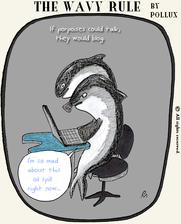
Click on the cartoon to enlarge it!
Monthly Archives: May 2010
Gary Coleman, 1968-2010
_Pollux writes_:
“Why should I be afraid of the camera?” Gary Coleman asked, in an April 1979 interview in _Ebony Jr._ magazine (Vol. 6, No. 10). “If it wore a black cape and had fangs, I’d be scared of it. But since it doesn’t, then why be afraid? There’s really nothing to this.” Coleman was eleven at the time. _Diff’rent Strokes_, of which Coleman was the life and soul, had already been on the air for four months.
By the time Coleman celebrated his 21st birthday, the actor had attempted to take control of his life, and his finances, by suing his parents and former manager for mismanaging his $3.8 million trust fund. His life had become a mixture of misfortune and success. Celebrities attended the actor’s 21st birthday. The mayor of Los Angeles, Tom Bradley, declared February 8 to be “Gary Coleman Day.” Coleman cut into an enormous birthday cake shaped like a train (the actor was a model train aficionado).
By 1999, Coleman had filed for bankruptcy and his life was a downward spiral of legal, domestic, and police troubles. Coleman’s calamities seemed to engender more derision and Schadenfreude than understanding.
He had become a punch-line and a pop culture trivia question: Did you know Coleman had worked as a security guard on a movie set? His misfortunes did not always bring out the best in people, or in the media.
Coleman’s life was a reverse image of the American dream. His riches-to-rags story became a subject for parody. There was a character named Gary Coleman in the musical _Avenue Q_. The song “It Sucks to Be Me” captured the tragedy of his life: “I’m Gary Coleman / From TV’s Diff’rent Strokes / I made a lotta money / That got stolen / By my folks! / Now I’m broke and / I’m the butt / Of everyone’s jokes.”
I stood next to Gary Coleman once while in line at a Pavilions supermarket in Culver City. Often, when an actor ages, he or she loses whatever spark that made the actor an object of affection or admiration.
But as Coleman chatted with the checkout girl, one could still see the same boy who, back in 1979, was completely unafraid of the camera. Despite his misfortunes, the bubbling confidence was still there, and to which we should pay tribute.
The Wavy Rule, a Daily Comic by Pollux: Accented

Click on the image for a detailed view!
Will Gary Coleman’s Death Affect the Gary Coleman Role in “Avenue Q”?
Emily Gordon writes:
The blog Instant Tea, part of the Dallas Voice, asks the same question, as does the Washington Post, in this live chat exchange (the questioner is not, I assume, anyone from the actual show):
Avenue Q: Do the producers retire its “Gary Coleman”?
Hank Stuever: Hmmm. Good question. Get me rewrite. There are so many living, washed-up tv stars to sub in.
Maybe our friend Ben Bass can provide some insight, since he knows the folks behind the musical. Having reported a rejected Talk of the Town piece back when Obama was elected, about whether the line “George Bush is only for now!” would be replaced (they decided to keep it), I have a hunch they may hold on to the Gary Coleman character, too.
Besides, how many leading parts for black women (Coleman is played by a woman; in New York, currently by Danielle K. Thomas) are there in high-profile, touring shows? Not that many. I vote to preserve Coleman’s memory in this highly affectionate, vibrant portrayal of what his life might have been if he’d taken another path. Till our dreams come true, we live on Avenue Q.
The Wavy Rule, a Daily Comic by Pollux: Preorder

Click on the image for a detailed view!
The Wavy Rule, a Daily Comic by Pollux: Passive-Aggressive Pinkberry Patronage

Click on the image for a detailed view!
Irreplaceable Magazines, Irreplaceable Editors
Martin Schneider writes:
Jason Kottke today linked to some scanned pages of Sassy from the early 1990s. Jason observes, “Sassy seems to be one of those rare magazines that is dearly missed but doesn’t really have a modern day analogue. (See also Might and Spy.)”
True enough. What occurred to me, however, was that those three magazines have something in common: a very strong editorial hand. In all three cases the editors are pretty well-known people: Jane Pratt in the case of Sassy, Dave Eggers for Might, and Kurt Andersen/E. Graydon Carter for Spy. So the reason they either don’t exist or have not been replaced is that those specific people have elected to do other things.
But it feels like the “rule” of a strong, irreplaceable editor needs more to it. There are other magazines run by strong editors where it’s easy to imagine the magazine continuing in that editor’s absence. Anna Wintour at Vogue, for instance. David Remnick at The New Yorker. Carter at Vanity Fair.
So we can add a corollary. The irreplaceability of an editor is inversely related to the size of the operation, expressed in terms of circulation, revenue, ad pages, whatever.
Let’s stick with circulation for a moment. One way that a magazine becomes “a big deal” is when it expresses the hopes, dreams, fears, etc. of an impassioned, interested sliver of the population. That was true for Sassy and Spy, certainly; not so sure about Might but let’s say it’s true there too. As a counter-example, you could imagine that being true of Wired, say, but Wired got too big and important—that is to say, its readership combined an impassioned sliver and a larger group that was only mildly interested in the content. In other words, its readership had “graduated” to a general readership, making it possible for Wired to have multiple editors over time.
So I’d ask two questions: Are there any other magazines in Jason’s group? Do 2600, Raygun, SPIN, The Comics Journal, Adbusters count as potential members of that group (potential, since some of them still exist) or not? Who are the editors of those magazines? I can name three of them off the top of my head, but I won’t say which ones.
The other question is, Are there magazines that break my rules? One magazine that I had in mind for this category was Interview, which was founded by Andy Warhol and decidedly represented a “sliver” of the reading public, but it’s been chugging along for quite a while now. Is it an exception, or did its revenue or something pass some benchmark way back when? I don’t know the answer.
Sempé Fi: The Thin Black Line

_Pollux writes_:
The May 17, 2010 issue of _The New Yorker_ was The Innovators Issue. The issue’s cover, called “Novel Approach,” by the Dutch artist “Joost Swarte”:http://www.joostswarte.com/, captures the process of invention and inspiration, and the insanity that drives them both.
In the 17th and 18th centuries, scientists and thinkers were obsessed with solving the problem of longitude. In our own day, we are concerned with solving the issue of global warming.
In “Novel Approach,” Swarte gives us a wordless comic in his trademark _ligne claire_ style. As Sean Rogers elegantly “put it”:http://www.walrusmagazine.com/blogs/2009/06/16/joost-swarte-further-summer-reading/, “Swarte’s drawings communicate so clearly because they’re executed in so concise and direct a fashion. Clarity of line engenders clarity of thought: each line set to paper acts as one element among equals, like a term in a balanced equation, or a word in a sentence that comes quickly but elegantly to the point.”
In “Novel Approach,” however, we are presented with a series of drawings that are open to various interpretations. Are we following a linear story, or, unguided by captions or balloons, can we start at any point in a series of panels that symbolize the fits and starts of innovation?
If we take a closer look at Swarte’s drawings, I believe there is a linear story here. It is the story of global warming and man’s tardy efforts to solve this problem.
Swarte’s hero, a bald, bespectacled man, is reading a newspaper -which perhaps is running stories on the issues of climate change. While he does so, numerous forms and shapes, all black in color, hover, enshroud, inspire, or approach Swarte’s hero.
Black smoke in various forms and increasing intensity emerges from the man’s pipe; from a passing car; from a large truck. In the second row of panels, black smoke belches forth from a factory.
In the next illustration, the man is alarmed by the levels of bovine flatulence. Do cow farts cause global warming? According to “The Straight Dope”:http://www.straightdope.com/columns/read/832/do-cow-and-termite-flatulence-threaten-the-earths-atmosphere, “animal methane does present a definite threat to the biota. It’s believed 18 percent of the greenhouse effect is caused by methane, putting it second on the list of offending gases behind carbon dioxide.”
In the next drawing, a black sun angrily glares at the man, who is engrossed in his newspaper. The sun is warmer and more dangerous.
In the third row, we see the effects of global warming: emigrating penguins; a large, black tidal wave, symbolizing the increased threat of tsunamis; and flooding. Swarte’s hero wades through black waters. It doesn’t seem to disturb him; in fact, it is moving him closer to an idea.
In the last row, he gets a flash of inspiration while swimming underwater. The world is perhaps covered by a Panthalassic Ocean.
His idea? A propeller beanie (also colored black) that will allow him to read his newspaper in peace amongst the clouds. Will it come to that? Swarte’s hero does not solve the issue of global warming at all; his novel approach, which is also the surreal approach of a mad fool, is simply to sit atop the clouds while our world turns into a water planet.
Swarte’s clean lines provide us with a future that is all too frightening in its clarity. Will we take action before it’s too late or will we all drown in an angry sea cluttered with empty cans and dead fish?
The Wavy Rule, a Daily Comic by Pollux: H-E-Double hockey sticks
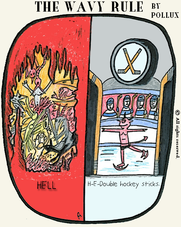
Click on the image for a detailed view!
The Wavy Rule, a Daily Comic by Pollux: Urning Power

Click on the image for a detailed view!