Monthly Archives: May 2010

Lessons of the Great “Social Security Reform” Fracas of 2005

Martin Schneider writes:
In 2005 I attended a debate on the then-hot topic of “Social Security Reform,” featuring Josh Marshall of Talking Points Memo, Paul Krugman of The New York Times, and Michael Tanner of the Cato Institute. I was reading a transcript of the debate earlier this evening, and I was struck by an odd parallel or perhaps mirror relationship between that political fight, which the Democrats won, and the fight to pass the Affordable Care Act in 2009-10, which the Democrats won.
The parallel I’m interested in is not that the Democrats won both fights. Rather, the resemblance has to do with what a ruling party does when it pushes an ambitious reform that is not very popular.
A little bit of context. The debate took place on March 15, 2005. After his reelection in 2004, George W. Bush chose to move forward on a favored policy idea of his, Social Security Reform. The Republicans had initially called the project “Social Security Privatization,” but after noticing how poorly that term polled, they switched up their terminology and began accusing Democrats of having attempted to demonize them with this term, “privatization.” (Something very similar happened later the same year with the term “nuclear option.”) The “private accounts” morphed into “personal accounts”—Republicans generally began running away from their own terms.
That spring, Marshall had a huge amount of fun trying to make Republican congresspersons squirm by asking them whether they supported Bush’s plan on Social Security (whatever name you gave it). Over those weeks, it became harder and harder to get any Republican congressperson to state on the record that they supported privatizing Social Security. The plan fizzled out, in the face of Democratic unity in favor of preserving the current system for the time being.
(I mentioned that Marshall got some enjoyment by embarrassing and neutralizing these Republicans. That is a massive understatement; I think when Marshall looks back on his illustrious career of Internet muckraking, this episode, in which he tarred this or that Republican a “bamboozler,” will be on the short list of the most satisfying moments of all.)
In the debate, Marshall was asked to describe the political aspect of the battle over Social Security reform (as opposed to the substantive side). In his opening remarks, Marshall said this:

The second thing is, and Democrats did this very quickly, is their party unity took away all the political cover. It was really going to be up to Republicans to make privatization an entirely Republican enterprise, and they were too afraid to do it because a lot of those representatives could see how their constituents were going to react and so forth.

Re-reading the transcript tonight, it was this passage that reminded me so much of the fight to pass the ACA (what used to be known as “the health reform bill”). That phrase, “an entirely Republican enterprise”…. that’s the position the Democrats were in all of last year, wasn’t it? You bet it was.
A person might conclude from this that Democrats and Republicans both obstruct, but that the Democrats happened to be better at it (aided by a larger minority than the Republicans now have). But I think there’s something more fundamental going on that tells you a great deal about the two parties and what they stand for.
Consider these two statements:

In 2005 the Republicans, in control of the White House and Congress, proposed a bold new reform that would affect a key area of American life, and it didn’t poll very well, and as soon as the unpopularity of the proposal was made apparent, the Republicans dropped the policy when they realized that it would be associated solely with Republicans.

In 2009-10 the Democrats, in control of the White House and Congress, proposed a bold new reform that would affect a key area of American life, and it didn’t poll very well, and as soon as the unpopularity of the proposal was made apparent, the Democrats, with a great deal of difficulty, passed the policy even though they realized that it would be associated solely with Democrats.

To put it more simply, both parties were given an opportunity to foist their favored policies on the nation in a unilateral way. The Republicans did not want to be associated with their own stated policies, but the Democrats were willing to be associated with their own stated policies.
I have a few conclusions about this, which may reflect my political bias.
Conclusion 1: By and large, Republican positions are minority positions, and Democratic positions are majority positions. Or to put it another way, the Bush administration and the Republican Congress of 2002-2007 found it difficult to implement their ideas because they were favored by such a small portion of the electorate. The Democrats of 2010 do not have this problem; their ideas held by a great many people, broadly speaking.
Conclusion 2: Democrats are sincere about their policy ideas; Republicans are not. I don’t want to overstate this too much, but there is more than a kernel of truth to it. Republican ideas ideas sound appealing and have some populist appeal but would have pernicious effects. Republicans express generalized distaste for the government services, but a lot of that is just rhetoric, and when push comes to shove, they are not very interested in decreasing those services. Contrariwise, the Democrats are more willing to argue for the benefits of social services and intelligent deployment of government generally, and when the going gets tough, it turns out that they actually do believe that.
And lastly,
Conclusion 3: Democratic ideas are good ideas; Republican ideas are bad ideas. Again, don’t want to take this too far. But the fight in 2005 was between a group that wanted to kill or at least diminish Social Security in favor of retirement accounts tied to the stock market in some broad way. Surely, the stock market crash of 2008 reveals this to have been a terrible idea.
Similarly, the fight of 2009-10 was between a group that wanted to provide uninsured people with health care and a group that was quite happy to keep them uninsured. Democratic ideas are easier to defend not only because they are popular but also because they are genuinely good ideas.
Thus endeth the sermon.
Sempé Fi: Winds of Change

5-10-10 Bob Staake Tilt.JPG
_Pollux writes_:
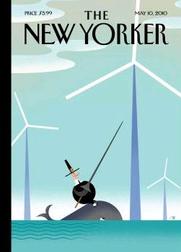
Some _New Yorker_ covers require some explanation, and this is certainly the case with the cover for the May 10, 2010 issue of _The New Yorker_. _Sempé Fi_ is here to help.
Bob Staake’s “Tilt” features a Pilgrim riding a whale tilting a lance at a wind farm in the middle of the ocean. The imagery, and title, refer to Don Quixote. The focus of the cover, however, is on the waters off Massachusetts (hence the Pilgrim) rather than the sun-drenched fields of La Mancha. Specifically, the covers refers to the controversial Cape Wind project, the United States’ first offshore wind farm.
Composed of 130 wind turbines, Cape Wind is to be built on Horseshoe Shoal in Nantucket Sound. Public opinion survey results reveal that most Bay Staters support the project and its goal of providing clean, renewable energy, but opponents include the Alliance to Protect Nantucket Sound, which cites economic, environmental, and aesthetic concerns.
Greenpeace, however, supports Cape Wind, and has its own concerns about the Alliance to Protect Nantucket Sound, “accusing”:http://www.greenpeace.org/usa/campaigns/global-warming-and-energy/copy-of-wind-power/in-support-of-cape-wind/greenpeace-support-s-cape-wind the organization of disseminating false and misleading information about the Cape Wind project. Greenpeace alleges, for example, that the Alliance of falsely tripled the size of Cape Wind in the Alliance’s description of the controversial project, as well as depicting Cape Wind to be much closer to shore than it would be.
Interestingly, the wording that the _Boston Globe_ used for its coverage on this distortion evokes Staake’s imagery: “Foes tilt at larger-than-life Cape Windmills – Error in flier inflates the size of proposed turbine farm in Nantucket Sound.”
And so the battle rages. Staake’s round little Pilgrim tilts a lance at a towering wind turbine, but it is an ineffective lance.
Both the Pilgrim and the whale are dwarfed by the powerful-looking and triumphant towers of Aeolus. The Pilgrim’s old fashioned weapon and clothing evokes the futile and somewhat backward-looking opposition to the Cape Wind project. “It is easy to see,” Don Quixote says to Sancho just before battling the windmills, “that you are not used to this business of adventures. Those are giants, and if you are afraid, away with you out of here and betake yourself to prayer, while I engage them in fierce and unequal combat.”
_Cape Cod Today_ “interviewed”:http://www.capecodtoday.com/blogs/index.php/2010/05/03/cape-wind-makes-new-yorker-cover?blog=53 Staake regarding this cover. “Like most of us here on the Cape,” Staake remarked, “I have mixed feelings about the project and I think the cover reflects that, though I have to say I think it’s pretty cool that in a few years my Chatham studio will be powered by wind.”
Would any future disaster involving Cape Wind reach the magnitude and create the damaged wreaked by the Deepwater Horizon disaster? Are wind farms beautiful to look at? Would sea life be adversely affected by the presence of a wind turbine?
In any case, the debate may be moot: Ken Salazar, the Secretary of the Interior, gave the project the green light in late April. Staake’s whale-riding, lance-wielding Pilgrim cuts a silly figure against a backdrop of turbines slicing the sky.
As with any major development project, there are pros and cons, mixed feelings, rational opposition, irrational opposition, strong support, and fierce and sometimes unequal combat. Bob Staake’s “Tilt” captures the spirit of this combat and debate.

The BP Logo: Emblem of an Evil Empire

BPLogo3.gif
_Pollux writes_:
You’ve seen it in the news a lot recently. You’ve seen it online. It graces the sides of unsafe oil rigs. It’s the BP logo.
The sunburst logo debuted in 2000 in an explosion of green, white, yellow. The logo unveiling was accompanied by mythological references to Helios, the Greek god of the sun (and the father of Phaëton, who irresponsibly set the earth on fire).
Greenpeace rightfully mocked the logo after its debut. Margarit Ralev “writes”:http://logoblink.com/2009/06/18/greenpeace-laughs-at-bp-logo/ about an incident in which Greenpeace handed out fake copies of the _International Herald Tribune_ at a summit in Brussels.
The newspaper included a satirical BP advertisement that proclaimed: “When we greened our identity, we felt confident that cosmetic changes would be enough.”
Corporate logos are tied to identity, but they reveal nothing about a company beyond the image they wish to project. Cosmetic changes are meaningless without management, structural and safety modifications that would have avoided, for example, the Deepwater Horizon disaster. When dictators come to power, they change flags, coins, country names, and city names, and care much less about improving the lot of their people.
Cosmetic changes are simply easier. It’s much easier to change one’s stationary than it is to reform Station 42872 (“Deepwater Horizon”).
And now the Gulf of Mexico isn’t seeing friendly sunrays of green and yellow, only an ocean of fire, gooey emissions, and dead porpoises. We don’t see sunbursts on the news, only burst pipes.
_Star Wars’_ evil Galactic Empire also had a logo:
300px-Galactic_Empire_logo.png
Perhaps it’s time for BP to perform another redesign:
galactic_empire_revamped3.png

Laura Bush: Unexpectedly, Probably Inadvertently, Fascinating

Martin Schneider writes:
I’m still reeling from the resentments and denial and misguided assumptions inherent in Laura Bush’s interview with Chris Wallace of FOX News, as quoted in this Jezebel post, anyway. (I haven’t watched the interview itself.)
The takeaway is that Laura Bush censored herself in order to conform to the image of a good conservative wife, and now she’s upset that she doesn’t get the fawning press that Michelle Obama gets. Something like that. For me, the whole thing is resonant in tons of ways, as if the cross-section of gender, politics, and society isn’t generally volatile.
Bush’s mild griping about being placed in a “box” proves yet again that when it comes to femininity, even relatively shrewd choices that involve denying one’s own power as a woman are counterproductive. Laura Bush, who I believe is pro-choice, anti-war, and in favor of increased civil rights for homosexuals, took one for the team, played the quiet wifey, and now she envies liberal women who, whether it works out well or badly, express their entire selves, come what may.
It’s also interesting that she identifies liberal women as getting some big break from the media—is she familiar with Hillary Clinton?
Given her political beliefs and her apparent disappointment about her role as First Lady, I’d suggest that she consider voting Democratic next time.
Beyond that, it’s fascinating to see just how much denial is tied up in the conservative, or at least Bushian, worldview. Laura Bush had to lobotomize her public persona, and is today not so happy with the outcomes that flowed from that choice. Meanwhile, conservatives of all stripes took a “don’t talk about Daddy’s drinking problem” attitude towards Bush’s deficiencies. There’s something deep going on here. Liberals may be blinkered on all sorts of things, but we don’t have the specific problem of getting tied up in knots because we refuse to countenance this or that.
Jezebel has it right when it observes that Michelle Obama didn’t exactly rush to be placed in a “box.” Laura may tell herself that it’s not proper for a First Lady to do X or Y, but for once, the “trickle-down” logic of Republicans turns out to be on the money. If it’s not proper for the First Lady to do that, then doesn’t that logic extend to “ladies” of all descriptions? How far down the chain of power do you have to go before it’s all right for a wife to have a different public opinion than that of her husband?
The problem with George Bush’s ideas about executive privilege is that you can’t draw a circle around the presidency and say, “We believe in accountability in life, but not in this area”—people are going to draw logical conclusions from a move like that, for instance that you are ipso facto opposed to accountability.
And the exact same thing holds true for the First Lady. When you issue yourself a gag order, you can’t then turn around and complain that your complexity has been silenced or whitewashed. And that predicament has everything to do with the limitations of conservative visions of propriety and femininity.
Update: Having now watched the video, I now confess to a suspicion that this post is just a tad too strident. Most of her assertions are fair enough, taken at face value. For example, First Ladies are in a box, and that doesn’t have that much to do with Laura Bush or any specific person. Plus she comes off as really sensible and likable. However, the logic I’m responding to is still inherent in certain utterances and elisions, and as such, I still think that my take and also Jezebel’s take are both entirely in bounds.