
_Pollux writes_:
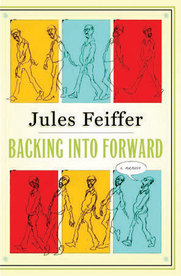
On a recent trip to New York, I was accompanied by Jules Feiffer’s autobiography, Backing Into Forward (published by Nan A. Talese). Between snatches of fitful, airborne sleep and occasional glances at a muted version of _Hachiko: A Dog’s Story_, Feiffer’s book served as a great and inspiring companion.
_Backing Into Forward_ can be read non-linearly. Feiffer’s book reads less like a traditional autobiography than a collection of self-contained, stand-alone essays. Like Feiffer’s comic strips for _The Village Voice_, each piece throws light on a particular anxiety, time period, or person. _Backing Into Forward_ has chapters named, for example, “The Jewish Mother Joke,” “Hackwork,” “Mimi,” “Lucking Into the Zeitgeist,” and “Process.”
The chapter named “Process,” for example, consists of a single page. Feiffer describes his process for arriving–or not arriving–at a completed comic strip. “I’d be humming along nicely–and then I’d arrive at what should have been the last panel without a thought in my head. I didn’t know how to end the thing. So I’d stash the idea in a drawer and forget it. A year or ten or twenty-five went by and, searching for something else, I’d come across the unfinished idea. Thirty seconds later the ending would announce itself. I’d draw it and send it in. Twenty-five years in the making: a comic strip.”
Feiffer skips backward and forward into time as he writes about his childhood in the Bronx, his journey to the West Coast and back again as a hitchhiker, his time in the army, his mother, his rise to fame, and his entry into the world of comics via work as Will Eisner’s gopher and subsequent ghost writer. As he tells it, Feiffer was a wimpy kid who found refuge in the world of comics. As a young man, he was tongue-tied and awkward around women. Feiffer is funny and honest about what fame did to his relations with women: now _they_ had to nervously come up with an opening line if they wanted to talk to him.
The same distinctive voice that reverberates through _Sick Sick Sick_ and _Feiffer_ is here: Feiffer is both acerbic and candid about his childhood, talent, family, doubts and frustrations (both sexual and creative), and fears (most of all, his fears). But it is an autobiography about hope and determination as well: nothing, not even a Korean War-era draft, an overbearing mother, or heartbreak- could stop Feiffer’s goal of becoming a comics artist.
Feiffer’s work appeared often in The New Yorker, but, interestingly, he writes that it was the dream of newspaper work that propelled him towards his goal. “Although I had been an admirer of _The New Yorker_ since childhood, the magazine had never played a part in how I worked or thought about work… [A]s much as I loved the work of Peter Arno, Charles Addams, Whitney Darrow, George Price, Helen Hokinson, Gluyas Williams, Alan Dunn, Sam Cobean, Frank Modell, and other _New Yorker_ regulars, I could not imagine myself appearing in their magazine.”
It is his candor that made his comics, plays, children’s stories, and screenplays unique and mordant examinations of American Anxiety from the Vietnam era to our present decade. Feiffer is still relevant. His “Obama! Ourbama!”:http://www.jeanalbano-artgallery.com/feiffer-exhibit/feiffershow.html print captures the optimism that took hold of many of us at the beginnings of 2009, sizeable shreds and shards of which still remain.
_Backing Into Forward_ includes many illustrations and photographs, and it ends with three pages of drawings in a chapter called “Last Panels.” Feiffer, in tux and top hat, ends with a _Sick Sick Sick_-style farewell: “Now the great thing about being a cartoonist…is that you can draw yourself as anyone you like….So excuse me…As I finish my dance.”
Monthly Archives: May 2010
Stop Being So “Smug,” Imaginary New Yorkers!
Martin Schneider writes:
Recently Ezra Klein, Ta-Nehisi Coates, Conor Friedersdorf, and Andrew Sullivan have been blogging about New York City’s overweening cultural clout and—interesting, this—the tendency of its residents to behave in a smug manner.
I must say, the discussion has been extremely disappointing, and I came away from it feeling frustrated, annoyed, and not a little insulted. I guess it is helpful to find out how much people dislike you for reasons that seem insufficient or inaccurate. Such is the power of cultural envy, or something like cultural envy.
The discussion proceeded along the following lines: Friedersdorf wrote about New York’s worrisome centrality in all cultural matters and its pernicious effects on other major cities. Sullivan weighed in, agreeing and complaining about how “irritating” New Yorkers’ “narcissism” is. Accepting New Yorkers’ smugness as a given, Coates then wrote a fairly empathetic post in which he gamely tried to put that smugness in context. Then Ezra Klein (this was my entry point into the discussion) quoted Coates approvingly and called the behavior of New Yorkers “unseemly.”
As a lifelong New Yorker, all I can say is: WTF?
Notice how quickly the discussion devolved: in short order, it went from a look at the unfortunate tendency of New York to “hog” (my word) the major cultural and literary outlets to complaints about the self-obsessed behavior of New Yorkers. Quite literally, the discussion went from “It’s too bad that smart people in Phoenix and Houston and Denver don’t get a chance to have the literary spotlight” to “Yes; I’d never want to live in New York; the city is overrated and the people are narcissistic” to “Well, yes, but the people there are smug for a reason” to “New Yorkers are unseemly because they won’t shut up about how great their city is.”
That, my friends, is some serious devolution. In no time, the subject of the relationship of, say, The New Yorker (the magazine) to the literary scene in Denver (this is an interesting subject) was dropped completely in favor of an attack on unnamed New Yorkers for unspecified actions. In three posts focusing on the inability of New Yorkers to shut up about how great New York is, you know how many beastly New Yorkers were quoted or referenced doing this?
The answer, you may be surprised to learn, is zero.
That’s right: confronted with presumably countless examples of snobbish New Yorkers disparaging Indianapolis, Tulsa, Atlanta, or Baltimore, Klein, Coates, and Sullivan couldn’t be bothered to name a single instance of anybody doing this. In this discussion, that was taken as a given, just as in a book you don’t have to cite anyone to establish that Amsterdam is north of Rome. It is a truth just as self-evident, apparently.
This gets all the more astonishing if you contemplate analogous scenarios. Imagine if any of these men had endeavored to make some point about, say, Mexican-Americans in the same manner. Ahh, “Mexican-Americans are fine people and work hard, but they obsess too much about soccer and they have no interest in education,” let’s say. Do you think any of them would venture such a statement without casting about for some empirical evidence that what they were saying is true? Even a single anecdote? I doubt it. But apparently New Yorkers are not accorded the same courtesy. Such are the pleasures of living in America’s cultural capital or whatever.
I’m going to push back on this “self-evident” premise. Before I get to that, I want to make it clear that I do agree that certain New Yorkers, and I’ll even include myself in this group, are capable of some insensitivity on the question of the cultural offerings available in New York in comparison to those available in other parts of the country. There’s something to that, and saying so is basically fine. What I mainly question here is the use of the words “narcissicism” and “smug.” If the exact same discussion had been about New Yorkers’ “sense of entitlement,” I might not take much issue.
Let’s start with Klein’s post. Klein basically says that you can’t get New Yorkers to shut up about how great New York City is. Let’s quote:
About the worst thing that can happen to you in life is to be in a room with two Texans who start trying to tell you about the Alamo. Or about Texas. Or about how Texas was affected by the Alamo. But there’s something endearing about it, too. Texans are battling stereotypes that don’t tend to favor them. It’s like talking up your mom’s meatloaf. New Yorkers, by contrast, have what’s considered the greatest city in the country and can’t stop talking about it. It’s like an A-student bragging about his grades, or a rich guy making everybody look at his car. It’s unseemly.
So, from Sullivan’s “narcissism” we quickly get to Klein’s picture of New Yorkers incessantly talking up their city. Many of the people reading this are New Yorkers. I ask you, New Yorkers: Does this portrayal seem accurate to you? I may be completely blinkered, but it does not seem accurate to me. If anything, New Yorkers tend to betray an unspoken assumption that New York is superior and are less prone to acting evangelical about touting the city. Am I wrong about this?
Let’s talk about New York for a moment. Coates, to his credit, mentions the sheer size of New York City (he says that it’s “like ten Detroits”) and points out that, statistically speaking, you’re going to get a good number of boors in a population that large, no matter what you do. He refers to New York City as “what happens when you slam millions of people who are really different into close proximity.” Right on.
So given that, let me ask: Are taxi drivers from Ghana “smug”? Are the Pakistani owners of bodegas a “narcissistic” bunch? Who are we talking about here, exactly? When Sullivan and Klein talk about narcissism and smugness, aren’t they really talking about educated New Yorkers who work in publishing and similar fields? Does that make a difference? If they’re more “entitled,” is it still fair to make such sweeping generalizations about them?
To get a little personal here: Last week I spent a couple of days in South Carolina with extended family; the group was about 20 people, most of whom were raised in South Carolina or Georgia. Smart people; nice people. The entire time I was with them, at no point did I gush about this great museum exhibition or that awesome indie rock gig; it wouldn’t occur to me to do that, because it would obviously be rude and seek to put the others present at some sort of disadvantage. Also, it’s unclear how interested any of these people would be in a band they had never heard of or an exhibition they would have no opportunity to attend. It’s equally unclear to me how many New Yorkers would prattle on about the city in this manner. It seems to me, not so many.
We didn’t spend all that much time watching television, but some of us did catch the tail end of VH1’s Top 100 Songs of the 1990s and Betty White on Saturday Night Live. Both shows made for good communal watching experiences because we all had the same cultural purchase on the material. Everyone below a certain age was familiar with Nirvana, and we all could enjoy the punchlines involving the potty-mouthed Ms. White. And that was great; there was no potential for anybody to feel left out.
Another story: twice this year I drove out to Cleveland to witness a particularly memorable indie rock project called the Lottery League. (By all means, click and be amazed.) I met a lot of grand people during both trips, and I enjoyed it so much that I’m currently seeking to relocate there for the summer and maybe beyond.
Most Clevelanders are pretty wary of New York, for reasons I find perfectly comprehensible. A microcosm of that view can be found in the relationship between the “have” Yankees and the “have-not” Indians. It’s little wonder that Clevelanders (along with pretty much everyone else in the country) are sick and tired of the successes of the Yankees and that they refer to the team as the “evil empire.” (Given that, it would be a disappointment of epic proportions if LeBron James ends up abandoning his native Ohio for Madison Square Garden. I really hope he stays in Cleveland.) The Yankees serve as a symbol for everything New York has and other places don’t, and people hate New York for that.
It’s an accident of history that New York City is what it is, and yes, New Yorkers cherish it, you’re damn right we do. We are sometimes unthinking about assuming that another place might have, I don’t know, good theater, and we sometimes have to catch ourselves mid-sentence to avoid appearing rude. We do take that sort of thing for granted, yes. One name for that is “living in a place.”
It’s useless to deny that New York City tends to hog the attention-getting people and events that make a difference in the cultural arena. When you interact with outsiders about it, you can choose to pretend that it isn’t true (“Oh, I’m sure Indianapolis has great theater too!”), or you can disparage other places (“God, I could never live in Denver, there probably isn’t a decent restaurant in the whole city.”), or you can honor the reality in a relatively humble way (“Wellllll, you know New York, we’re all a little fussy about theater and the like, but it sure is gorgeous here on this South Carolina beach….”). Does that last one count as smug or narcissistic? I’m genuinely curious.
The fact is, New York City is a very specialized ecosystem, and its natives don’t always thrive outside that particular rainforest. This is a well-known phenomenon, isn’t it? The New Yorker who can’t leave the city, even though part of him hates it? We’re all a little misshapen.
So maybe a little compassion for us “smug” New Yorkers. As far as I know, anyone who envies the city is free to drive on over and move in, we’re very welcoming that way. And since we’re accustomed to teeming multiplicity in all its forms, we’re a little slower to describe vast groups of people with a single disparaging adjective without any kind of evidentiary backup. It’s kind of a local tradition ’round these parts.
Sempé Fi: Out With the Old
_Pollux writes_:
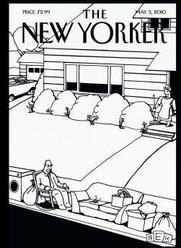
The work of Bruce Eric Kaplan, also known by the shorthand of BEK, graces both the inside and the outside of the May 3 issue of _The New Yorker_. That’s quite a coup for an artist “who”:http://www.mediabistro.com/articles/cache/a1455.asp used to live “in a space that was meant to hold just one car and maybe some old boxes or tools or whatever it is people put in (half of) a garage” and submitted cartoons to _The New Yorker_ for three years before one was accepted.
Kaplan’s cartoon (on page 60) is about people watching a thriller about bunny rabbits (“Don’t go into that hole!”). His cover, called “Spring Cleaning,” depicts the act of clearing out the clutter from a suburban house.
Part of the clutter on the curb consists of items like an old washer, sofa, and lamp, as well as another old relic: the cleaner’s husband. The husband’s attachment to his rocking chair, which has suffered the same fate, symbolizes the inertia and dotage that led to his being discarded in the first place.
The spring cleaner grins in triumph; she has rid herself of some dusty and useless items, perhaps to be replaced by newer models. The long winter is over.
In “Spring Cleaning,” Kaplan retains the distinctive style of his cartoons: the boxy, pupil-less figures with the starfish stance, the heavy blacks and lack of grays and washes, and the off-kilter and dark humor.
Kaplan wrote one of my favorite _Seinfeld_ episodes, “The Cartoon.” This episode satirized the “typical _New Yorker_ cartoon,” in which a frustrated and confused Elaine accuses the _New Yorker’s_ cartoon editor of simply running doodles of “a couple of bears at a cocktail party talking about the stock market.”
Kaplan’s cartoons are of course not about bears at a cocktail party talking about the stock market, but are set in a slightly skewed reality in which reality and our darkest thoughts intersect. Kaplan’s cover is set in a surreal suburban landscape, in which the old station wagon is parked in the driveway and the paterfamilias is parked on the curb.
The gag cover would work just as well as a 4 inch by 4 inch cartoon within the magazine’s pages, but its presence on the cover gives us a refreshing, black-and-white slice of BEK’s brain at the very beginning.
The Wavy Rule, a Daily Comic by Pollux: Crowe is Copernicus
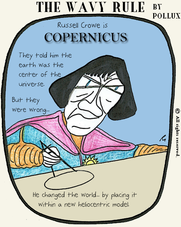
Click on the image for a detailed view!
The Wavy Rule, a Daily Comic by Pollux: The Mixed Metaphors
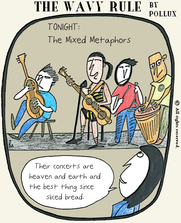
The band in the drawing was inspired by my recent attendance at a show at The Mint in Los Angeles. The band in question was “Mahndo”:http://www.myspace.com/1amandadumas, whose lead singer is Amanda Dumas. They were great.
Click on the image for a detailed view!
Wikivamp: Wikipedia’s New Look
_Pollux writes_:
Wikipedia looks different today. That’s because the Wikimedia Foundation has revamped the site, including “redesigning”:http://blog.wikimedia.org/2010/05/13/wikipedia-in-3d/ its “puzzle globe” logo.
Now we have improved search suggestions, so if you start to type in, for example, the word “punctuation,” you get the suggestions below.

What is “Punctuation (chess)”? Acccording to the article, chess commentators use punctuation marks to designate whether a chess move was bad or good.
The Google-like search suggestions are definitely an improvement. Google in fact donated two million dollars to Wikipedia in February. Google’s own collaborative encyclopedia, Google Knol, at its release dubbed a “Wikipedia killer,” is not even guilty of minor assault.
For editors, Wikipedia has revamped the toolbar designed to make editing much easier and intuitive. Wikipedia is encouraging feedback, and has a submission form at their New Features section.
A revamp of Wikipedia was inevitable as the online encyclopedia reached maturity. Whether the revamp is a real improvement or just a series of cosmetic changes remains to be seen, but to use my newfound knowledge of chess punctuation, **!?** (interesting move).
The Wavy Rule, a Daily Comic by Pollux: Humorism
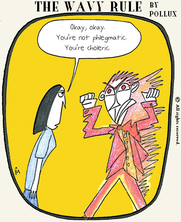
Click on the image for a detailed view!
The Wavy Rule, a Daily Comic by Pollux: Curly T-Ball
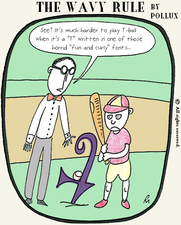
Click on the image for a detailed view!
The Wavy Rule, a Daily Comic by Pollux: Mammoth Hemoglobin
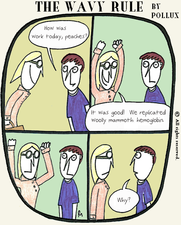
The joke is a joke, but the science is “real.”:http://www.nytimes.com/2010/05/04/science/04mammoth.html?src=me Click on the image for a detailed view!
The Wavy Rule, a Daily Comic by Pollux: Pelican Con Science
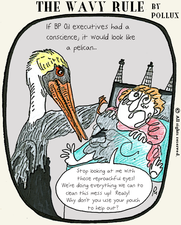
Click on the image for a detailed view!