
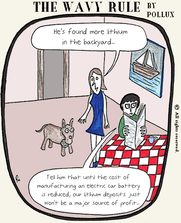
Click on the image for a detailed view! I was fascinated by Lawrence Wright’s recent _New Yorker_ “piece”:http://www.newyorker.com/reporting/2010/03/22/100322fa_fact_wright, called “Lithium Dreams,” on Bolivia’s lithium deposits and the political, environmental, and financial implications associated with owning these riches.
Monthly Archives: March 2010
The Wavy Rule, a Daily Comic by Pollux: The Motorcycle Daisies

Click on the image for a detailed view!
Georgia O’Keeffe at the Slots: More on Casino Carpets
Jonathan Taylor writes:
One holiday season of the high 1990s, I drove over from New Orleans to rendezvous with some friends at the Beau Rivage casino in Biloxi, Mississippi. I had to head back late the same night to catch a plane the next morning. But after an evening on the casino floor, back in my friends’ room I realized I had dropped my keys—somewhere. By the time I called Lost & Found, they had already been turned in, which I still consider inexplicable, and you would too, if you’ve been in a casino and seen what the carpet patterns are like. (Not quite as good, though, as the guy in London who returned the wallet I jet-laggedly left in a phone booth—a guy whose job was to put up those cards and stickers for prostitutes that used to plaster London phone boxes.)
Anyway, Lauren Collins has a nice Talk piece on a gallery show of photographs of casino carpeting by Polish-born, Swedish -raised Chris Maluszynski at 25CPW “this week” (gallery site seems to have no info on the show). It reminded me that there was another nice short piece on the topic in The Believer a few years ago, “Rolling Out the Carpet for Homo Ludens” by Alexander Provan (the print issue had a nice insert of sample patterns).
Provan wrote:

….hotels and casinos are increasingly looking to trade gimmickry for packaged elegance, starting with the carpets. Oddly, many of the new floor-coverings feature forms and figures that would look familiar to the so-called non-objective filmmakers, animators and painters emergent in the first half of the twentieth century, such as Oskar Fischinger, Jordan Belson and the Whitney Brothers–call it visual Muzak. On a recent trip to Las Vegas I saw densely packed geometries, monochromatic patterns, abstract figures in various stages of metamorphosis. The new carpets at Harrah’s appropriate the quivering striations of Georgia O’Keefe’s “Music–Pink and Blue II” and wash all tension away with buckets of brown and orange. At the Mirage, russet amoeba cartoons exchange organic matter over a tan backdrop. At Carson City’s Nugget Hotel, Paul Klee’s “Variations (Progressive Motif)” is amplified beyond the bounds of good taste and supersaturated in canyon hues….
Mark Pilarski, a longtime Vegas insider and consultant, agrees that the abstract geometric patterns are used “to break up the space,” in accordance with the Friedman Standards. But he also contends that, for those in the business, “The main reason is that your eyes are focused to look up at the machines. You just can’t keep looking at that busy pattern when you’re walking.” A solid pattern, he adds, “would look like a football field. I’ve seen this once–the casino looks like the runway of an airport, like infinity. But the guests don’t want that, they don’t want it to be infinity out there.”
“Friedman” is Bill Friedman, author of Designing Casinos to Dominate the Competition.
The Wavy Rule, a Daily Comic by Pollux: Limbaugh in the Legion
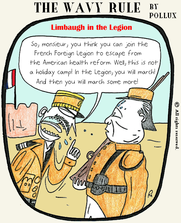
Click on the image for a detailed view!
Sempé Fi: Empire State of Mind
_Pollux writes_:
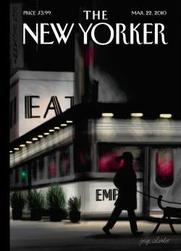
“The Empire Diner, the world’s finest and possibly hippest Diner, is famous not only for its outstanding atmosphere, but also for great food, top notch service, and being a homestyle, basic-food restaurant.” So proclaims the “website”:http://www.empire-diner.com/ of Empire Diner, which forms the backdrop of the March 22, 2010 cover of _The New Yorker_.
The cover artist, “Jorge Colombo”:http://www.newyorker.com/online/blogs/fingerpainting/2010/03/evening-walk.html, renders Chelsea’s Empire Diner into a glowing, nocturnal haven, the windows of which are illuminated with bursts of grays and dark pinks. The reflection of a traffic light is visible on one of the Diner’s windows, emphasizing the perpetual movement of cars on the road.
Instead of a straightforward and literal depiction of the Diner, of which there are plenty in countless television shows (such as _Law & Order_) and films (such as _Men in Black II_), Colombo here gives us a nighttime scene whose “main character” is not a customer of the Diner at all but a figure walking her dog.
The dog-walker is completely enshrouded in shadows and darkness, while the Diner twinkles and glows in the background. Colombo’s “Evening Walk,” created on his iPhone, focuses its attention on the contrast between the figure outside of the Diner and the Diner itself. Colombo himself is an outsider looking in. Instead of sitting down to a meal of a Negimaki Burger and Jack’s Chili Sundae, he is outside of the 24-hour Diner, looking, absorbing, and creating.
Like many of Colombo’s covers, “Evening Walk” is a study of color and light. Colombo’s eye is that of an artist rather than someone intent on simply creating something on his iPhone. The newness of using the iPhone for artistic purposes has worn off, but the power of Colombo’s interpretations of New York City has not.
Empire Diner, which has New York Landmark status, is immortalized by Colombo, but “Evening Walk” is not an advertisement for the Diner. Colombo partially obscures, perhaps intentionally, the words “Empire” and “Eat.” The emphasis here is on Colombo’s brushes with the life and magic of the city streets rather than his considerable skill with the Brushes application.
The Wavy Rule, a Daily Comic by Pollux: Training Day

Click on the image for a detailed view!
The Wavy Rule, a Daily Comic by Pollux: Cooking the Books

Click on the image for a detailed view!
‘Memory Is Not a Journalist’s Tool’: Janet Malcolm on Autobiography
Jonathan Taylor writes:
At the NYRBlog, Janet Malcolm with four packed paragraphs of “Thoughts on Autobiography from an Abandoned Autobiography“:
When one’s work has been all but done—as mine has been for over a quarter of a century—by one brilliant self-inventive collaborator after another, it isn’t easy to suddenly find oneself alone in the room…
The “I” of journalism is a kind of ultra-reliable narrator and impossibly rational and disinterested person, whose relationship to the subject more often than not resembles the relationship of a judge pronouncing sentence on a guilty defendent. This “I” is unsuited to autobiography. Autobiography is an exercise in self-forgiveness. The observing “I” of autobiography tells the story of the observed “I” not as a journalist tells the story of his subject, but as a mother might.
‘The Fame Monster Has Won’: The First NYer Lady Gaga Cartoon
Jonathan Taylor writes:
Flavorwire marks a moment in time: the first New Yorker cartoon about Lady Gaga, by David Sipress. (h/t a message from Jessica Ferri.)
The Wavy Rule, a Daily Comic by Pollux: The Other Dennis the Menace

Click on the image for a detailed view!