
Martin Schneider writes:
Slate‘s Tom Scocca is on to something here with some reassignment suggestions for the New Yorker editors. I also enjoyed his description of the magazine as “America’s leading crypto-newsweekly,” which is simultaneously complimentary and deliciously suggestive of a subtle publishing conspiracy.
Category Archives: The Squib Report
Happy Birthday, TPM!
Martin Schneider writes:
In October, the political blogosphere celebrated the 10th anniversary of Andrew Sullivan’s “Daily Dish” blog. I did not contribute any testimonials, not because I don’t find Andrew Sullivan an interesting and stimulating blogger but because I don’t feel any particular kinship with him. Sullivan’s very good, but he’s not “my guy.” (This is a phrase my dad always used, usually about musicians, but not about Sullivan. Sullivan’s was my mom’s “guy.”)
Little did I realize that Josh Marshall would be celebrating his 10th anniversary as a blogger just a few weeks later. (The actual date is tomorrow, November 13.) This time, my affinity runs much deeper.
It’s always necessary to say that one was there “at the beginning,” whether it’s an unknown band that later becomes much bigger or a project like Talking Points Memo. And to the same extent, it’s always impossible to really be there at the beginning, as a fan, there’s always some larval era one missed, an era others had glimpsed. I can say that I’ve been reading TPM since about 2001, I’m fairly certain before 9/11, and well before the Trent Lott ouster that got Marshall so much notoriety.
A few short comments about TPM. Marshall’s known for bringing a certain kind of principled muckraking to the Internet, but for my money he’s the wittiest political blogger out there. He’s perfected the use of the amusing headline to serve as the acerbic comment on the (often very brief) post contents. During the first few years, there were more of Marshall’s longer, discursive commentaries. I can remember writing Marshall at one point when the telegram-length posts seemed to be taking over the site altogether. I told him that the posts I really liked were the three- to four-graf jobs where he supplied a little overview. He wrote back to say that he agreed, and that he would be doing more of those. (That did happen.)
From 2002 to 2009 I would frequently write Marshall arguing some specific point that I thought he might excerpt. I wanted so badly to be a mysterious Reader MS whose email he had decided to quote. I don’t think it ever happened until earlier this year, when David Kurtz dedicated a post to a very brief wisecrack of mine. (I don’t remember offhand what it was, but it was a proud day around here. I’ll try to find it.)*
With Obama in office and the ACA law passed, I’ve found that I don’t write in as much anymore, and the unread posts in my Google Reader pile up, a first for me. With Obama heading into a tough campaign in 2012, maybe I’ll find my inner political junkie again.
Suffice it to say, Marshall is a little bit more partisan than I am—a very little bit more—but overall his politics and my politics track very closely. Kevin Drum is the only other blogger about whom I can say that, but Marshall was there first (at least on my radar), and when I think about how politics on the web should be conducted, it’ll always be Marshall I think of first.
Josh Green of The Atlantic Monthly contributes a nice piece about the early days of TPM.
* Update: I found the post in which they quoted an email of mine.
Two Quick Hits: Orlean and Wright
Martin Schneider writes:
Over the past three weeks or so, I encountered two New Yorker contributors in unexpected venues, and in both cases the takeaway was that the person might be the best at what they do. I thought I’d pass those on.
On August 11, the vastly entertaining mostly-political discussion website bloggingheads.tv posted a “diavlog” with Elizabeth Gilbert (Eat, Pray, Love) and Susan Orlean (billed as “Julia Roberts” and “Meryl Streep,” har har). It’s the third dicussion for bloggingheads.tv Orlean has done—the first two were with Kurt Andersen and Walter Kirn (“George Clooney”)—and she has a tremendous knack for “casual” conversation that is in fact studded with wit and wisdom. She is really good at these things.
At the 2007 New Yorker Festival, I had the great luck to see Orlean and Mark Singer conduct a “master class” in the art of writing profiles; that session was transcendently wonderful, one of the best NYF events I’ve ever seen, particularly for a New Yorker junkie. Orlean is deceptive: At first blush, she gives off a mildly distracted, breezy impression, but the more you listen, the more you realize how incredibly high this woman’s signal-to-noise ratio is. Over and over again, one is struck by the sheer number of acute observations, proferred with grace and insight.
Last week, at Talking Points Memo, Josh Marshall posted a “bleg” in which he asked his readers for guidance in finding a good, non-polemiized narrative account of the events leading up to 9/11. The overwhelming winner (as a piece of journalism) was Lawrence Wright’s The Looming Tower. This was a revelation to me, on a few levels. First, I had not actually known that that was the subject of The Looming Tower. But more interestingly, according to TPM’s readers, The Looming Tower is pretty much the only thorough, journalistic treatment of the 9/11 attacks.
Also in 2007, Emily and I got to see Wright perform his one-man show, My Trip to Al-Qaeda, which was penetrating and fascinating and troubling. Good news, then, that Wright has a follow-up due to premiere at the New Yorker Festival and run in New York City through October.
So thank you. Orlean and Wright, for so consistently defining excellence.
Mad Men, Season 4: The Subaru Parallel
Martin Schneider writes:
One more quick thing about the most recent episode, “The Chrysanthemum and the Sword.” The news that SCDP would be handling Honda’s nascent automobile division could not but remind me of Randall Rothenberg’s engrossing book Where the Suckers Moon. That 1994 book detailed the circa-1990 process whereby Subaru hired a new advertising agency for its upcoming campaign and, as such, is an essential resource—one I haven’t seen mentioned enough—for anyone who wants to read more about Don Draper’s job description (albeit 25 years later).
Mad Men‘s description of Honda’s new cars as “motorcycles with a frame around them” (or whatever) immediately brought me back to Rothenberg’s account of Subaru’s early years. At the time—an automobile enthusiast could confirm if this is still true—Subaru was kind of the ignoble stalwart on the lower end of the Japanese automobile market. Their cars were clunky, cheap, and reliable, and they were also known for pioneering the four-wheel drive. Somehow I can’t help but think that Weiner and Co. are obliquely referring to Where the Suckers Moon here; it’s just too close.
Mad Men, Season 4: The Futility of Resisting Bodily “Sin”
Martin Schneider writes:
It’s interesting how positive a reaction the Honda shenanigans got from all the pro bloggers documenting every detail of the Draper Saga. During one commercial break while watching the most recent episode, “The Chrysanthemum and the Sword,” I commented to my co-watchers, “What is this, Three’s Company?” It reminded me of the Ham Scam from s04e01, after which Don scolded Peggy, but good. Nobody I read pointed out the parallel. The Honda sequence was as rich and enjoyable as everything that happens in Mad Men, but I didn’t enjoy it more than anything else on the show.
I was more taken by the plight of Sally Draper, whose predicament is getting more gut-wrenchingly alarming by the scene. I think what skewers our hearts so damnably about Sally is that nothing is really under her control. Her supposedly “rebellious” act of cutting her own hair seemed just beyond her conscious mind, and her fleeting sexual attraction to The Man from U.N.C.L.E.’s David McCallum was as unthinking and genuine as her howl of rage at her family’s blithe callousness after her grandfather’s death in season 3.
In other words, the aftermath of shock, outrage, cruel parenting, and psychological treatment was so swift, severe, and unremitting that the viewer, I think, semi-forgot that Sally’s moment was truly an “innocent” one—she didn’t “mean” anything by it.
It reminded me of probably the most memorable passage from George Orwell’s essay “Such, Such Were the Joys,” which is about Orwell’s own tweenhood at an expensive English boarding school. The opening passage is about the principal’s attempts to discipline the young Eric Blair (Orwell’s given name) into refraining from wetting his bed—by all means do read it at the link above. When the narrative of events is overwith, we get Orwell’s takeaway. I think you’ll be able to see why I thought of this after watching the adults mistreat Sally.
I knew the bed-wetting was (a) wicked and (b) outside my control. The second fact I was personally aware of, and the first I did not question. It was possible, therefore, to commit a sin without knowing that you committed it, without wanting to commit it, and without being able to avoid it. Sin was not necessarily something that you did: it might be something that happened to you. I do not want to claim that this idea flashed into my mind as a complete novelty at this very moment, under the blows of Sambo’s cane: I must have had glimpses of it even before I left home, for my early childhood had not been altogether happy. But at any rate this was the great, abiding lesson of my boyhood: that I was in a world where it was not possible for me to be good. And the double beating was a turning-point, for it brought home to me for the first time the harshness of the environment into which I had been flung. Life was more terrible, and I was more wicked, than I had imagined. At any rate, as I sat snivelling on the edge of a chair in Sambo’s study, with not even the self-possession to stand up while he stormed at me, I had a conviction of sin and folly and weakness, such as I do not remember to have felt before.
I suspect that I am in complete unity with literally all other Mad Men devotees when I say that I eagerly await the moment, probably towards the end of season 6 (which Matt Weiner has said will be the last), in which Sally Draper, perhaps a year or two away from hitching a ride to Woodstock (one assumes that Woodstock is the ultimate destination, no?), tells off the legions of deranged authority figures, including her dad and especially her mom, in such a manner that lets us know that she may not be “OK,” as the 1970s bestseller had it, but she is at any rate her own woman and will not stand for it any longer. Maybe she’ll even churn out a Wigan Pier in the years to come.
I guessed right on Doris Day!
Fighting the Birthers: A Primer
Martin Schneider writes:
A few days ago I got involved in an online argument with two impassioned “birthers”—people who believe that, for a variety of reasons, Barack Obama is not eligible for the presidency. Against all expectations, I was able to put forward some arguments that, I think, confounded my opponents, and I learned something along the way too. It was an unexpectedly constructive exercise, I thought.
The venue was Ezra Klein’s blog at the Washington Post. Klein, who is extremely prolific, always throws up a “lunch break” blog around midday with some frivolous content. Last week, on President Obama’s birthday, he made a joke in his “lunch break” post about Rush Limbaugh having made fun of the indeterminacy of Obama’s birthdate and put up a YouTube video of Louis Armstrong (whose birthdate is genuinely contested).
Two commenters, “prsmithsr” and “dancingrabbit,” began pushing some birther arguments; after a great many posts of significant length, they quickly managed to drown out all other comment and briefly threatened to be “the last word” on the subject. On 8/5/10 at 2:32PM, prsmithsr follows four consecutive posts by dancingrabbit with this: “Total silence. You do have a way of killing a debate lol!” In other words, the two of them had won the debate, and it was time for prsmithsr to dance in the end zone a little.
For reasons I can’t remember, I came to the thread many hours later, at 8/6/10, 6:31AM, and after that there are a few exchanges between myself (“wovenstrap”) and dancingrabbit. Today’s the 8th — the debate appears to be over, and while it’s possible that dancingrabbit just turned his focus to some other venue because the thread had run its course, I do think that my counters to him were difficult ones to answer. I’m not dancing in the end zone, exactly, but they definitely didn’t win the argument, which is something.
As far as I can see, the birther argument has two main tributaries: Obama is not a “natural-born” citizen and Obama was not born in Hawaii. You may think that these two claims are almost the same—not being born in Hawaii would probably mean that Obama is not a natural-born citizen, after all—but the situation is more complex than that. It’s important to understand that these two claims are distinct. The first claim, about Obama’s lack of “natural-born” status, is a claim about his parentage. The second claim is a claim about his birthplace. They’re different things, and you have to attack the two claims separately.
Somewhat surprisingly, the claim about Obama not being a “natural-born citizen” is not totally without merit, and recognizing this is key in addressing the argument properly. The Constitution states:
No person except a natural born Citizen, or a Citizen of the United States, at the time of the Adoption of this Constitution, shall be eligible to the Office of President; neither shall any Person be eligible to that Office who shall not have attained to the Age of thirty-five Years, and been fourteen Years a Resident within the United States.
Translation: Unless you were alive at the time of the founding of the country, you must (a) be a natural-born citizen, (b) be 35 or older, and (c) be a resident of the United States for 14 years or more.
Some of these claims aren’t entirely clear. Does “fourteen years” mean the last fourteen years or any fourteen years? That distinction mattered a lot to Herbert Hoover, who had lived in Europe not long before becoming president. Also, what is a “natural-born” citizen, anyway? How is it different from a naturalized citizen? What’s that term mean?
The answer is that the term has no fixed meaning. Anyone who tells you they know what the term means is lying. It’s a term that is not defined in the Constitution and has not properly been defined since, to the satisfaction of all parties.
The poster dancingrabbit in Ezra’s thread was arguing that the Framers themselves believed that a “natural-born citizen” is the child of two American citizens. Since Obama’s father was not then and never became an American citizen, we can see that this way of defining “natural-born citizen” is utterly crucial for their argument.
In support of this argument are some seminal writings by a writer named Vattel that the Framers relied on. Vattel uses plural terms to discuss the parents of “natural-born citizens,” so, our birthers figure, not too unreasonably, so too did the Framers. You can read dancingrabbit on this—there’s a whole lot of weight placed on a pivotally placed s here and another one there.
The presumption that we can rely on outside materials to determine what the Constitution means is a highly ideological one. It brings us back to the debate in legal circles between “originalists” and their opponents. In my opinion originalism is a bankrupt philosophy because it assumes as a matter of course that people living more than 200 years ago had better judgment about our affairs than we do.
But let’s simplify this. The things wrong with reliance on Vattel are:
1. Vattel’s writings are not part of our founding documents, and
2. There is plenty of case law suggesting that birth within the United States is sufficient to establish “natural-born citizenship.”
So far, so good. What you can say to a birther on the subject of “natural-born citizenship” is, “You know, nobody knows what this term means, for sure. It hasn’t really been defined. But you’re saying that the writings of some 18th-century Frenchman tell us what it means, and I’m saying that the rulings of contemporary American judges tell us what it means.”
In my opinion, this is a difficult argument for a birther to win. It highlights the bad faith involved in searching for something, anything that might suggest that Obama’s non-American father might exclude Obama from eligibility—even if it involves going back a couple centuries and jumping over an ocean. It’s more reasonable to say, “If this were to come before a judge today, it’s quite likely that that judge would rule that Obama’s birth in Hawaii was sufficient to establish natural-born status. I don’t know that’s what the judge would rule, but I think so. You think Vattel trumps our judiciary; I don’t see any reason for holding that view.”
What about Obama’s birth in Hawaii? Isn’t there compelling evidence that Obama was not born in Hawaii?
The simple answer is no, there isn’t.
I am indebted to James Fallows for the insight, but the simple question to ask anyone claiming that Obama was not born in Hawaii is, “Is there any evidence—a visa, perhaps?—that Obama’s mother, Stanley Ann Dunham, was traveling abroad in 1961?” Clearly, if Obama’s mother was not in Kenya in 1961, then Obama was not born there either. That’s as close to “game, set, and match” as these things come. Even birthers.org does not dedicate a single word to the location of Ms. Dunham when Obama was born, that I could find. Absent a document proving that Dunham had traveled to Kenya (or anywhere else) around 1961, all of the “evidence” about the birth certificate and the insufficient birth announcement is just poppycock. Worse, it’s proof of bad faith, a lack of objectivity.
The bad faith and, potentially, racism involved in the birhters’ arguments should be clear enough, but I don’t want to dwell on that.
One last point about the logical connections between Obama’s parentage and birthplace that birthers make. Basically, birthers tend to treat the two claims as having equal status. That is to say, it’s an AND proposition. Obama must have two American parents and he must be born in the United States to be a “natural-born citizen” and thus eligible for the presidency. To put it another way, if EITHER one of Obama’s parents was not an American citizen OR Obama was not born in Kansas, then he is ineligible.
But that’s not actually the way the logic works. If Obama was born in Hawaii, then that pretty much seals the argument (at least in my “what would a judge rule?” hypothetical). To put it another way, if Obama was born in Hawaii, then it does not matter who his father was.
In my last, unanswered comment to dancingrabbit, I wrote this:
Consider the following analogy. We are trying to determine whether something is a pizza or not. We say that a pizza is defined as a circle of dough covered in cheese and tomato sauce. That is what a pizza is. However let us say that we add that a pizza can also be made of cardboard if it is a prop in a student play. The second definition only comes to play if the first definition is not met — if the first definition is met, then you don’t need to look at the second definition. You are basically saying, “that circle of dough with cheese and tomato sauce cannot be a pizza because it is not made of cardboard.”
You see? Obama is a pizza…. it makes no sense to argue that he is not made of cardboard as if that alone can settle the issue. He doesn’t need that argument. If he was born in Hawaii, which frankly is pretty certain, then he’s a natural-born citizen, almost certainly. The citizenship status of his father is not germane, because Obama’s natural-born status is a settled matter. You start looking at his father’s citizenship status only if Obama’s birth in Hawaii is truly placed into doubt.
And as far as that goes, the House of Representatives, in a unanimous vote, upheld the proposition in 2009 that Obama was born in Hawaii. That’s not “proof,” properly speaking, either, but it’s a good way of signaling that birther belief is more fringe-y than perhaps the speaker realizes.
Mad Men, Season 4: Saarinen’s Curves
Martin Schneider writes:
Watching Mad Men the last two weeks (“Public Relations” and “Christmas Comes But Once a Year”), it’s been a shock to see how thoroughly its creators have used the plot point of a new office environment as an opportunity to pivot from what I’ve been calling the 1950s/”Sinatra” side of the 1960s to something closer to, say, Swinging London, not to mention Woodstock. I had once assumed that the show would find this transition difficult—at this point, I think this show can do anything.
The sight of the airy, sleek, symmetrical, somewhat plastic new SCDP office, with its Eero Saarinen furniture and Op Art wall decor, puts me in the mind of a possible key influence none of the smarties I read at Slate or Vanity Fair have mentioned—yet. I refer to Jacques Tati.
At the Awl’s “Footnotes of ‘Mad Men,'” Natasha Vargas-Cooper, excited about the new relevance of infidelity lyrics from “How to Succeed in Business Without Really Trying,” doesn’t seem to notice the fairly obvious Tati reference implied by a resonant screenshot of the show (I assume) she has posted. That is, this picture:

Myself, I can’t decide whether the Mad Men staff spent last summer screening Playtime or are barely conscious of the echo. I suspect it’s closer to the former option.
Bloggingheads-ganza: The Intentional Idiocy of Byron York
Martin Schneider writes:
A few days ago Timothy Noah of Slate and conservative writer Byron York engaged in a Bloggingheads.tv “diavlog,” as they are called.
What to do when you are an “intelligent” conservative confronted with the proposition that FOX News is essentially a bunch of partisan liars whose work cannot be taken seriously? I don’t know—that’s not my problem. Byron York doesn’t handle it a whole lot better:
Here’s my little recap:
York: The New York Times is afraid of the power of FOX News and conservative talk radio, so it compensates for that power by forcing inflammatory to remain in a “freak show” zone of non-mainstream stories.
Noah: Couldn’t it just be that FOX News sucks?
York: Oh, no, not at all! There are terrific stories that FOX is reporting all the time that the Times ignores. For example, some NASA official said something nice about Muslims—and Obama maybe sort of agreed with him! Why is this not a major story in the New York Times??
Noah: Uh, why is that a story? Wouldn’t it be a story if a NASA official said something mean about Muslims?
York: I don’t know, it seemed like a pretty smoking story to me.
What my little dramedy above cannot express is the sheer number of boring seconds York, in his slow-talking way, dedicates to this utter non-story. Anything better than actually own up to the mendacious ways of FOX News.
A few minutes later, York mentions a silly comment on JournoList by Spencer Ackerman to the effect that, in the wake of the Rev. Wright problems Obama was facing in early 2008, that liberals should just pick conservatives at random and accuse them of racism. Noah says, basically, “Well okay, but it’s not like he acted on it.” York’s response to this is priceless, right at the 34-minute mark: “Well, people on the right believe that they have been accused of racism, on a number of occasions!” Really! Conservatives feel that they have been accused of racism…. why is that, do you think?
To this, Noah says, rather deliciously, that you’ve got a few things going on there, the original question was whether Ackerman did anything—he didn’t—and anyway muddying the issue is that, basically, conservatives do a lot of racist things. So there’s that. See for yourself:
The obtuseness on display here is fairly staggering. The coalition that makes up the Republican Party is structured around reaction to the Civil Rights Movement. That’s just Politics 101. If York thinks that racism is distributed equally across the political spectrum, he’s not qualified to write about politics for a living, period. So my conclusion is that he is lying.
One last thing. Towards the end they’re discussing the unemployment benefits extension that the Republicans blocked last week. I think nothing can describe current conservative obtuseness with respect to important policy issues than York’s insistance, with the country facing serious unemployment problems and possibly a double dip recession, that there’s a serious risk in creating a “dole” and making unemployment a permanent condition for many Americans.
That’s right: You can talk to conservatives all you want about the miseries of unemployment and the benefits of softening those miseries—conservatives aren’t interested in that! It’s much too satisfying to wag a scolding finger and imply that some minor negative externalities outweigh that positive good. That’s as good as conservatives get—Byron York is probably a nice guy, and he’s not dumb. He’s about as good as it gets, quite seriously. And he cannot be made to care about treating unemployed people well.
Noah is terrific again in just not buying into any of York’s nonsense. Noah admits that some studies have shown a small effect of the type York has mentioned. York says, Well, shouldn’t that be taken into account? And Noah says, No, it shouldn’t!
James Sturm’s Online Hiatus: Essential Online Reading
Martin Schneider writes:
I just stumbled on James Sturm’s experiment on Slate involving staying off the Internet for a few weeks and seeing what happens.
The results have been marvelous, witty, wise, insightful, hilarious, and resonant—it’s one of the best things I’ve seen in weeks. I think just about everyone would find a point of access here; that’s one of the great things about it. I’m going to embed a few of my favorite panels and then leave you to read it.
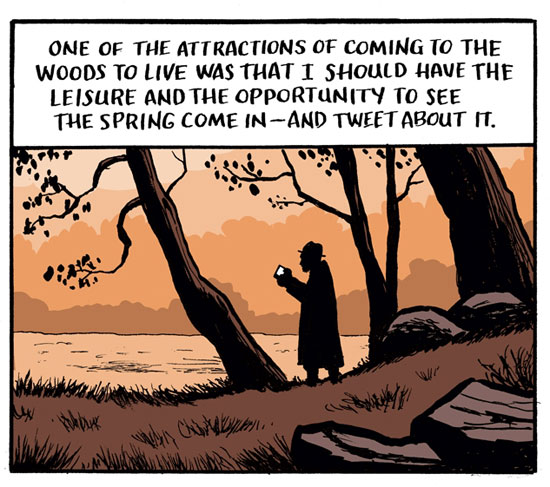
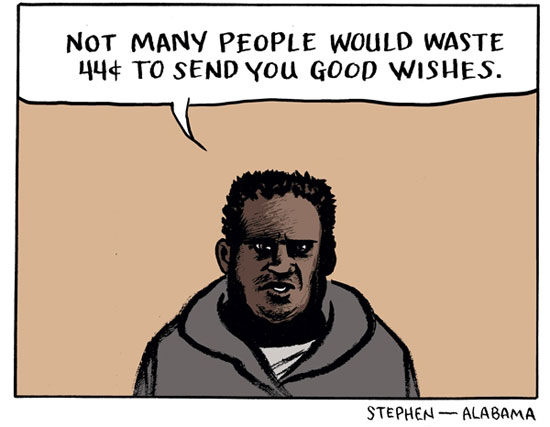
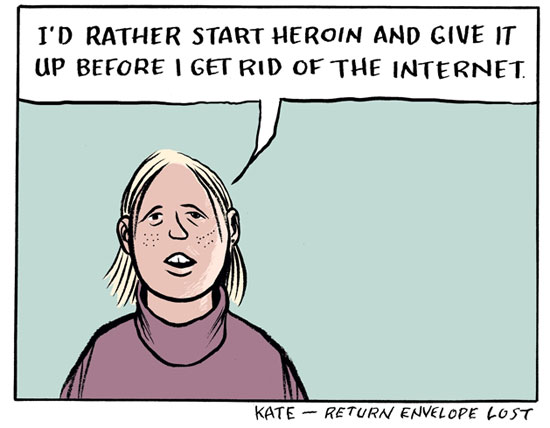


There are eight installments; this is the first.
The New Republic: Web 2.0 Fail
Martin Schneider writes:
During the World Cup, The New Republic had a pretty cool blog dedicated to the tournament, as they had in 2006. It was a fun, eclectic blog, and I enjoyed it a lot. I even wrote a post about Luke Dempsey’s brilliant found poem.
There were a few times I wanted to chime in a comment or two, as I often do elsewhere in the blogosphere. Much to my surprise, the site demanded that I log in before posting—not with my www.tnr.com account username—which would be fine—but with my New Republic magazine subscription account username.
That’s right: if you want to write “first!” in a TNR blog comment thread, you’re going to have to buy 20 issues of the magazine. For the record, the page they send you to is here.
Does that business model remind you of anything? The year 2000, maybe?*
======
*I’m sorry if this is coming off as harsh, but it’s really meant as tough love. I know it’s a bad environment for magazines right now. But TNR pays really well-qualified people to blog for them, and those blogs are pretty awesome, and stuff like this just ensures that the money, time, and energy spent developing those blogs will not attract permanent users.**
** Could it be a browser issue? A cookie issue?