
For those of you who have OD’d on political commentary and yet crave more—my Google Reader is dry as a bone!!—The New York Review of Books has assembled its “usual cast of smarties”:http://www.nybooks.com/articles/22017 to weigh in on Indecision ’08.
Seems a good a place as any to mention the best book on politics I have ever read, _Nixon Agonistes: The Crisis of the Self-Made Man,_ by Garry Wills. For those of you preemptively weary of Watergate and the twitchy Nixon of the second term, fear not: the book was written in 1969, before all of that.
I particularly recommend chapter 6, “The Hero,” which is a defense of Nixon’s old boss, Dwight Eisenhower. The chapter is a compelling brief for the political virtues of charisma, shrewdness, and moderation; much to my astonishment, it (the chapter) is available in full at “Google Books”:http://books.google.com/books?id=5cVKKLSC788C&printsec=frontcover&dq=nixon+agonistes&ei=aaULSd-8HZbMzQTvxvTsAw#PPA115,M1. (Actually, looking at it again, it’s probably necessary to read the previous chapter, “Checkers,” too; it’s also very good.)
This recommendation does not arise purely by chance. You see, I see a lot of Barack Obama in Wills’s description of Eisenhower, which could be a very good sign indeed. Wills emphasized Ike’s uncanny ability to win political battles deftly, with a minimum of overt conflict. What the pundits and the pols sometimes forget about politics is that winning isn’t the only thing; one must win _well,_ win and leave the other players involved devoid of rancor. I think Obama has this quality.
I was reminded of this trait of Obama’s during that brief interlude about a week after the Republican convention, when McCain, riding a wave of Palin-mania, managed to eke his way into the lead. Ever the optimist, I made two bets that week, one with a McCain supporter and another with a nervous Obama supporter, on the premise that Obama’s good times were far from over. There were many such bets to be made at that moment.
We forget it now, but there was ample discussion to the effect that McCain’s momentum had definitively established that Obama was too recessive, was not sufficiently capable of attack, and—naturally—should have chosen Hillary Clinton to be his VP. In one of his two-handers with John McWhorter that made 2008 such a delight, perpetual Obama skeptic Glenn Loury “expressed this view”:http://bloggingheads.tv/diavlogs/14432 (start at about 29 minutes in) on a bloggingheads.tv “diavlog” recorded on September 14.
Loury made reference to the “knife fight” Obama had suddenly found himself in and observed that the Clintons would surely be mighty helpful in such a context. A few moments later, Loury used the words “elegant, articulate, intelligent” to describe Obama and generally left behind the impression that Obama might be too much of a Nancy boy for big-time politics.
Allow me expand on that: the person Loury was describing in such terms had very recently waged a six-month battle with the accepted heir apparent to the Democratic nomination—a battle that ended, of course, in his own triumph. It was this person that Loury could profess to describe as somehow weak or lacking steel or nerve.
It is useful in politics to win knife fights; it is even more useful in politics to emerge from tense confrontations with one’s adversaries and not leave all of the other players feeling as if a knife fight has just occurred. To describe a political … _warrior_ like Obama in such terms is ridiculous; it’s like saying that Greg Maddux displayed too much finesse to be a “really” effective pitcher. Yes, the Clintons often win knife fights—do they engage in anything else? How about someone who can play the Jedi mind trick on an adversary and leave nobody thirsting for blood?
My view of Obama’s deftness with regard to avoiding traditional political battles—that’s straight _Nixon Agonistes,_ chapter 6. If you read it, you might even recognize a shrewd Hawaiian-born pol between the lines.
Monthly Archives: October 2008
The Wavy Rule, a Daily Comic by Paul Morris: Prison is a Series of Tubes
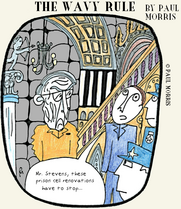
Will Uncle Ted Stevens, Alaska Senator, go to prison? And if so, what will he do there? Click on the cartoon to enlarge it!
Read “The Wavy Rule” archive.
David Foster Wallace: The Biography
Jason Kottke called the recent _Rolling Stone_ “profile”:http://www.rollingstone.com/news/story/23638511/the_lost_years__last_days_of_david_foster_wallace/print of David Foster Wallace “as close to a biography of David Foster Wallace as you’ll get,” and I think that’s exactly right.
Since that post nearly two weeks ago, I had a transatlantic flight and the article was not online in full, so I bought the issue of _Rolling Stone_ at the airport. Not only is the article, by David Lipsky, the closest thing to a biography we will get (until we get one), but it’s so thorough that it’s difficult to imagine what additional substance a book-length version of same would provide.
According to “Jason,”:http://www.kottke.org/08/10/the-lost-years-and-last-days-of-david-foster-wallace _RS_ just made the full version available online; do yourself a favor and check it out.
“With ‘Gesture’ You Know Where You Stand. But ‘Nuance’?”
Don’t look now, but James Wolcott’s been on fire lately. This “meditation”:http://www.vanityfair.com/online/wolcott/2008/10/over-at-tpm-david-kurtz.html on hellish gridlock under a President McCain is brilliant, right up to the last deliciously _weltschmerz_-soaked line. And this “reminiscence”:http://www.vanityfair.com/online/wolcott/2008/10/sheila-omalley-at-the-sheila.html of Pauline Kael’s connection to Barry Levinson’s _Diner_ really gets me where I live. I spent my college years inhaling as many of Kael’s words as I could get my hands on, and _Diner,_ which came out when I was 12, was the sort of quirky “how can this be a classic when TBS plays it every weekend?” gem that impressed me a lot during the same period. I didn’t know that she rescued the movie; more people should.
The Wavy Rule, a Daily Comic by Paul Morris: Batteries Included
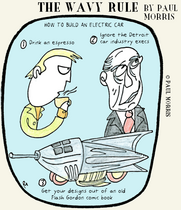
_Paul writes_: It’s not like it’s a colony on Mars, or a hair-restoring drug. Or a tree that produces croissants, or trolleys that run on sarcasm. The technology for the electric car is already here, and has been here for quite some time. The fact that it’s been quashed by the auto industry borders on the criminal. If someone killed the electric car, can it be resuscitated? For the world’s sake, I hope so.
Click on the cartoon to enlarge it!
Read “The Wavy Rule” archive.
The Polite Honor the Long-Winded
We notice that “_Polite Magazine_”:http://www.politemag.com/ (love that name) recently featured a “short appreciation”:http://www.politemag.com/brennan.htm of Maeve Brennan. Much like “Emily”:http://emdashes.com/mt/mt-search.cgi?tag=pigeons&blog_id=2 here at Emdashes, Brennan was very observant and was fond of pigeons. I’ve had her collection _The Long-Winded Lady_ for a while now and I keep meaning to get to it. Soon!
The Wavy Rule, a Daily Comic by Paul Morris: My Last Palin Cartoon (I Hope)
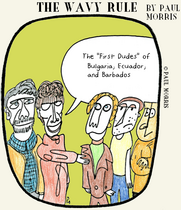
_Paul writes_: He’s called the “First Dude.” He’s been CC’d on e-mails from the office of his wife, Governor Sarah Palin of Alaska, although he has no official title or role in the state government. He has also involved himself in other matters of governance, both financial and personnel-related. For all Sarah Palin’s talk about being a modern independent woman, she can’t take two steps without the suffocating presence of this one-time secessionist snowmachiner. God forbid that he become a sort of co–Vice President of the country in the same way that he served as a sort of “shadow governor” of Alaska.
Click on the cartoon to enlarge it! Read “The Wavy Rule” archive.
Happy Birthday, David Remnick!
Remnick was born October 29, 1958. For this, we are thankful. And for those looking for a birthday present for him, may we suggest The Best of Bob Dylan’s Theme Time Radio Hour?
—E.G.
Most Popular Topics From the New York Times Today
_A friend notes: _
Most Popular Topics:
1. Jennifer Hudson
2. Barack Obama
3. Ted Stevens
4. Oil and Gas
5. Sarah Palin
6. Credit Crisis
7. John McCain
8. David Axelrod
9. Global Warming
10. General Electric
Deadline Poets: Obituaries Panel at the NYPL
Jonathan Taylor writes:
I got a last-minute ticket to Monday’s sold-out “Perverse Pleasures of Obituaries” event at the New York Public Library. It’s fair to say that The Economist‘s obituaries editor, Ann Wroe, stole the show, or was smartly handed it by the NYPL’s Paul Holdengräber, on a platter of quotes from Aristophanes and Rilke. Wroe and her predecessor, Keith Kolquhoun, have edited the new Economist Book of Obituaries.
The Economist publishes just one substantial, often heroically sympathetic, appreciation a week. Wroe frequently plucks a relatively obscure figure from among the deaths covered by other papers to illuminate his or her illuminatingness, as in the case of Martin Tytell, New York City’s last typewriter “surgeon.”
However, Wroe evidently does have the latitude to commit the occasional “double-header,” in an instance such as the synchronous deaths of Brooke Astor and Leona Helmsley. This obit rather belabors the obvious contrasts between the two rich women before concluding with a leveling wave of the scythe: “Both ended sadly, left alone with their dogs and the ghosts of their husbands in dust-draped city apartments or empty summer homes. But in the memory of most New Yorkers one was a saint and the other a sinner. Richesse oblige.”
Unlike newspapers like The New York Times and London’s Daily Telegraph (which, Wroe noted, specializes in “colonels” and “decadent aristocrats”), The Economist doesn’t have need for an extensive file of prewritten obits. Only seven, in fact, one of which is Saddam Hussein’s, evidently never published for whatever reason; she let slip that others include the (now former) king of Nepal, bookish former British Labour Party leader Michael Foot, and Nelson Mandela. It was not clear whether the bigger package she promised for Margaret Thatcher’s death was counted as one of these seven. Prince Philip, she said, was not among them, although she declared he wasn’t “looking too well lately” (!).
The presence in the audience of Times obit writers Bruce Weber and William Grimes, along with former public editor Daniel Okrent, steered the event toward Times protocol fetishism. For a lot of people present, I don’t think this was an idle concern, although in reality it is. Weber piped up at one point with an allusion that I think went mostly unheard, to the status conferred by the inclusion in an obit’s headline of “the verb”—presumably “Dies.” Something else to take account of in the morning scan.
The obit of the day to crop up in the conversation was that of southwestern mystery novelist Tony Hillerman, with Okrent emitting, virtually in a heartfelt cry, that “the world has changed.” Before the event, I had been looking in The Complete New Yorker at the magazine’s obituary practices over time (81 under the category “Obituary,” another 85 under “Postscript,” numerous others under “Comment”), and bethought myself to see whether it had taken note of Hillerman’s novels.
The earliest citation was from 1970; author: Edmund Wilson. Here was a find! I thought—Wilson, famous for his blinkered dismissal of “detective fiction,” on Tony Hillerman!? In fact, the interminable Wilson piece was the second part of a consideration of “Two Neglected American Novelists,” Henry B. Fuller and Harold Frederic.
Hillerman’s The Blessing Way was reviewed in the appended Briefly Noted section: “Highly recommended.”