

Click on the cartoon to enlarge it! Read “The Wavy Rule” archive.
Monthly Archives: October 2008
Why Do People Talk so Much about the Bradley Effect?
Ever since Barack Obama failed to win the New Hampshire primary (for reasons probably having little to do with people lying to pollsters), the media just cannot get enough of the Bradley effect. (For a cogent explanation of why the Bradley effect has been on the endangered species list since about 1991, and why it probably didn’t even happen to Tom Bradley himself, in the mayoral race of Los Angeles for 1982, see “here”:http://www.onthemedia.org/transcripts/2008/10/24/04.)
The Bradley effect is an attempt to measure the existence of hidden racism among the electorate. People are racists but cloak their views before a judgmental pollster, goes the theory. It’s worth pointing out that the phenomenon itself requires a special combination of circumstances. If you make a line chart of “racism in society over time,” where it starts out at 100% (everyone is always racist) and it slopes diagonally downward to 0% (nobody knows what racism is), the Bradley effect would only obtain when you have a bunch of racists but the racists aren’t really in charge of the discourse. In other words, too much racism in the society and nobody’s embarrassed about expressing it; too little racism and it doesn’t get expressed. You have to have a whole bunch of racists who are feeling a bit sheepish. In a way, it’s not surprising that the window for the Bradley effect is always a fleeting one.
My opinion is that for a subject of a poll misrepresent what candidate he or she supports to an anonymous pollster who possesses no power to alter the subject’s life … well, you have got to be talking about some serious shame/embarrassment. In other words, not wanting to vote for the black guy isn’t a potent enough cocktail of shame and embarrassment to induce the lie. You have to be supporting … pretty much a Klansman or a Nazi to elicit it.
At this point, I’d like to bring in two men, “David Duke”:http://en.wikipedia.org/wiki/David_Duke and “Jörg Haider”:http://en.wikipedia.org/wiki/J%C3%B6rg_Haider.
I hear a lot about the Bradley effect, but I rarely hear anyone mention David Duke. David Duke was a former Grand Wizard of the Ku Klux Klan who participated in a runoff election in the Republican primary for the gubernatorial race in Louisiana in 1991. A man named Edwin Edwards beat Duke pretty solidly, it turned out, but there were a few weeks there in which that outcome did not seem ensured, and in that period you heard a lot about white racists lying to pollsters. To be frank, it’s the last time (barring the possible exception of Harold Ford’s 2006 Senate run) that people talked about this subject at all in the United States. Here’s _The New York Times,_ after Duke “got beat”:http://query.nytimes.com/gst/fullpage.html?res=9D0CEFD91F3AF93BA25752C1A967958260:
Although the prospect of a large “hidden vote” for David Duke received a lot of speculation from poll takers and commentators in the weeks before Louisiana’s runoff election for governor, a hidden vote did not materialize in Edwin W. Edwards’s victory over Mr. Duke.
A hidden vote could have occurred if some voters were not willing to disclose their preferences to poll takers. In Mr. Duke’s past attempts at public office, his support was stronger than some polls had predicted, making some poll takers wary about simply using their standard methods in the runoff.
They seemed to take the effect pretty darn seriously, even if it didn’t manifest.
Between 1991 and 2008, you didn’t hear much about the Bradley effect in the United States. But you did hear about it (albeit not by that name) quite a bit in Austria, a country that featured the most successful radical right-wing politician in Europe: Jörg Haider.
By chance, Haider died in car crash a couple of weeks ago. In the 1990s, he led the Freedom Party of Austria to a series of very successful showings, finally entering a coalition government in 2000. Before Haider, the FPÖ was kind of a forgotten little right-wing party where the former Nazis would hang out; not a big deal. Haider changed all that, gradually building it up to nearly 30% of the vote and generally freaking a lot of liberals out, both inside and outside of Austria. Also, Haider would occasionally say flattering things about the Third Reich, which would get him into trouble.
And in Austria, you heard constantly about how polls were underrepresenting his support. I’m not an expert, but well-informed Austrians assure me that the electoral tallies tended to outstrip his support in polls.
In Austria, support for the Nazis is a crime punishable by “incarceration”:http://en.wikipedia.org/wiki/David_Irving; it’s a serious business, and the social sanctions against it are high—maybe not as high as here, but still very high. As with the KKK, perhaps, you don’t just casually admit to any anonymous caller that you are into supporting crypto-Nazis in Austria. Haider was deft enough a politician to blur his own Nazi ties (I myself think they were somewhat overstated)—but the whiff of social sanction was never far from him.
So that’s my thesis. if it’s just mild distaste for the black candidate, you’re not going to go and _change the candidate you support_ to a pollster—that’s the threshold we’re discussing here. You might not admit the racism on the phone, but you’ll say you support the other guy because of his tax policies. Only for a candidate who is synonymous with evil are you going to cloak your views.
Personally, I think that the Duke and Haider cases constitute almost a death blow to the Bradley effect if you think through their implications; in one of the two cases, it didn’t even exist! The media want to keep interest in the race high, so they have incentives to dismiss countervailing examples like David Duke. But that doesn’t mean we should believe them.
New Yorker Prehistories: Entourage, Algonquin Edition
_A friend notes: _
The Algonquin Round Table makes Mental Floss‘s fab list of “7 Entourages That Changed the World.” Lou Harry and Todd Tobias write: “We love Vincent Chase and his HBO cohorts as much as the next magazine, but we’re not going to stand idly by while they hog the entourage limelight. Those guys might make waves in Hollywood, but the following power crews made history.” Read and cheer! Then learn lots more about the sharp-edged rounders at the Dorothy Parker Society website, a treasure trove of all things Algonquin.
The Wavy Rule, a Daily Comic by Paul Morris: Dr. No and Dr. I-Couldn’t-Agree-More
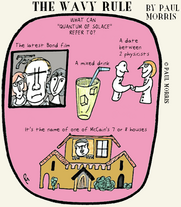
_Paul writes:_ You’ve seen the billboards for the new Bond film, and maybe, like me, you’ve wondered what the meaning of “Quantum of Solace” is. This was the name of a short story by Sir Ian Fleming, but the plot of the film has no similarity to that of the short story. The name sounds mysterious enough to intrigue moviegoers, I suppose. _Beverly Hills Chihuahua,_ by the way, delivers exactly what you’d expect.
Click on the cartoon to enlarge it! Read “The Wavy Rule” archive.
Literary Notes from All Over: a Digital Edition
Benjamin Chambers writes:
* Anyone else notice that The New Yorker is launching a “digital edition” later this year? You’ll read this edition via the Web, it’ll look just like the magazine, but you’ll get access to it before the print edition arrives in your mailbox or even most newsstands. Current subscribers can get the digital version free for the duration of their subscriptions, as long as they sign up; non-subscribers can get a free, four-issue trial subscription, though after that, it’s $39.95. Looks promising. (Searchable, too.)
* Wouldn’t it be nice if you could collect all of your favorite TNY stories in one place? Thanks to Emily, I found a link on Galleycat about AnthologyBuilder.com, a service that allows you to pick and choose from its list of stories to create your own anthology. Right now, there’s a limit on what you can choose from, but the possibilities are obvious. Perhaps TNY is already figuring out a way to pay its current authors so it can build such a service of its own? If I could create a personal TNY anthology, I’d include some John Cheever, Mary Lavin’s “The Great Wave,” Muriel Spark’s “In the House of the Famous Writer,” and … well, I’m just getting started. I’ll have to work on a list. Which stories would you include?
* Something I didn’t expect to ever see, but found touching: notes from David Foster Wallace’s memorial service, courtesy of Stephen, of the blog Band of Thebes. I quite liked the notes, but there’s something terribly ironic about Wallace’s memorial service being rendered in bursts of shorthand reminiscent of Twitter.
* Dzanc Books, an independent literary publisher (which numbers among its authors TNY poet Terese Svoboda), is holding a Write-a-Thon on November 15th to raise funds for its writers-in-the-schools workshops. Check it out, round up some sponsors for the big day, and when November 15th comes, write your heart out.
He was E-mail Before E-mail was Cool
Benjamin Chambers writes:
Remember when e-mail was new? If you’re like me, probably not as well as you think you do, if John Seabrook’s January 10, 1994 story on Bill Gates, “E-mail from Bill,” is anything to go by.
For instance, Seabrook talks about how odd it was to meet Gates for the first time, after first exchanging a number of e-mails:
As we shook hands, he said, “Hello, I’m Bill Gates,” and emitted a low, vaguely embarrassed chuckle. Is this the sound one E-mailer makes to another when they finally meet in real space? I was aware of a feeling of being discovered.
Doesn’t this seem to be a fairly odd observation under the circumstances—not to mention precious? I have to wonder how in this context e-mailing people before meeting them in person differs from corresponding with them by letter: what had really changed? Hindsight is 20/20 and all that, but Seabrook gets even goofier:
Maybe this is the way lots of people will communicate in the future: meet on the information highway, exchange messages, get to know the lining of each other’s mind, then meet face to face. In each other’s physical presence, they will be able to eliminate a lot of the polite formalities that clutter people’s encounters now, and say what they really mean. If this happens, it will be a good thing about the information highway: electronic communication won’t reduce face-to-face communication; instead, it will focus it.
Still, it’s kind of fun to read such an unabashedly wide-eyed view of the medium from a time when e-mail really was new. It’s like opening a time capsule.
Seabrook followed up his Gates profile with an “In the Mail” piece on pp. 8-9 of the February 7, 1994 issue of TNY. (It doesn’t appear on the TNY website or in the index of The Complete New Yorker.) In it, he summarizes reader response to his article and includes some additional thoughts on what it was like to go from having virtually no e-mail correspondence to an amount of e-mail that must have seemed overwhelming for the time:
“[T]he morning that article appeared on the newsstands, I checked my mailbox and found it stuffed: twenty-nine messages. In the following three weeks, I received three hundred and ninety-six electronic messages from readers, almost all of them strangers. Over that period, I also received eight phone calls about the article, seven letters, and one fax … In my greenness about the information highway, I put my E-mail address in the article, and now I suppose I will be hearing from readers for years.”
I gather Seabrook wasn’t put off by his readers’ responses though, because he helpfully supplied his e-mail address again. I’ll reprint it here, just as a reminder of times (and companies) gone by: 73124,1524@compuserve.com. (Remember when you could put a comma in your e-mail address? Oh, for the days of the open range!)
Seabrook also writes about his changing feelings about receiving so much e-mail: at first he was thrilled, then overwhelmed, and finally more interested in the process than the content: “Now I find myself looking forward more to composing E-mail than to receiving it … Composing E-mail composes me.” Wonder if he still feels that way?
He quotes from a number of readers, who are variously humorous, frivolous, and bemused by the possibilities of the new medium. My favorite:
Real problem with the Information Superhighway is typified by this letter: God only knows how many idiots like me will tie up your time with responses.
Amazing how much things have changed, no?
In the Future, All Campaigns Will Be Conducted in Twitter
On the heels of the stupendous “success”:http://twemes.com/nyfest of our New Yorker Festival Twitter “experiment”:http://emdashes.com/2008/09/twitter-your-way-through-the-f.php, I still found myself wondering what the point of the service really is—the similar function on “Facebook”:http://www.gravity7.com/blog/media/uploaded_images/fbook_feed-707592.jpg has the virtue of being integrated into pages that people will consult in the course of other activities.
But then in the course of just a few days, Twitter popped up in probably the two most attention-getting presidential campaign stories of the moment. It turns out that Michele Bachmann (the Minnesota representative who announced a desire to investigate “anti-American” members of Congress) and Ashley Todd (the McCain worker who faked the politically motivated attack by an Obama supporter) used their Twitter accounts just before they became notorious. In both cases their tweets actually bear on the reasons for their eventual fame.
In retrospect, Bachmann’s optimistic “tweet”:http://twitter.com/MicheleBachmann a few days ago that she would soon be appearing on _Hardball_, where she made her unfortunate remarks, is almost touching: she had no way of knowing that appearing on the show would undo her career. And Todd intentionally used Twitter to lay the “groundwork”:http://www.thesmokinggun.com/archive/years/2008/1023083twitter1.html for her hoax, indicating that she was hunting for a Bank America “on the wrong side of Pittsburgh,” complete with helpfully racist conception of what constitutes the right side of that fine town. How odd. Does William Ayers have a Twitter feed? (“Watching Bears game w/ BHO, planning violent overthrow of TPTB, LOL.”) Does Levi Johnston?
Norman Lewis’s Letters From a Vanished Spain
Jonathan Taylor writes:
Patrick French’s authorized biography of V.S. Naipaul, The World Is What It Is, will come out in the U.S. next month, complete with its salacious revelations of marital cruelty. After it was published in Britain in spring, the formidable Stephen Mitchelmore questioned the connection being hastily drawn between the writer’s vices and his books:
When I found out Naipaul was married, it was after I’d read and enjoyed the overtly autobiographical novel The Enigma of Arrival which does not (if a twenty-year-old memory serves) mention any other presence in the narrator’s Wiltshire cottage. Does this demonstrate a protective love or contemptuous indifference? Such is the ambiguity of writing.
Another new British bio, Semi-Invisible Man by Julian Evans, is not set for U.S. release. Like Naipaul, its subject, Norman Lewis, was a novelist and travel writer whose work appeared in The New Yorker. This work, too, turns on the writer’s sculpting of lived experience, switching, almost silently, between fiction and nonfiction as needed. An observation about Lewis in the Times Literary Supplement review of Semi-Invisible Man nicely illustrates the parallel. Lewis’s Voices of the Old Sea (1984) is a spare memoir of three summers he spent in an isolated Catalonian fishing village in the 1950s:
Lewis’s visits, we learn from the biography, were made in a large Buick, in the holidaying company of his partner of the the time and their children. You wouldn’t guess this from Voices of the Old Sea. Lewis was a secretive, contradictory man who nursed his inconsistencies because they fitted his understanding of how the world worked.
I haven’t gotten my hands on Semi-Invisible Man yet. But the UK reviews sent me to Voices of the Old Sea, and thence to some of Lewis’s New Yorker articles, mostly published in the 1950s and 60s.
Voices conjures the elemental traditional life of the village he called Farol, on the eve of its destruction by the tourist industry. This conquest was decades old by the time Lewis wrote the book. Farol’s residents were adamantly attached to a hardscrabble subsistence economy and a culture of atavistic paganism still not yielding completely to Catholicism, much less to anything called “Spain.” Their cosmology was dualistic: one world was Farol, the seaside, cat-infested village whose authority figures were fishermen. Its eternal Other was Sort, and inland, dog-riddled hamlet of cork farmers and other peasant landlubbers who wore shoes rather than rope sandals (chief among Farol’s superstitions was an abhorrence of leather).
As land and houses are bought up to build a hotel, a kind of suspense builds slowly, even though the final outcome seems obvious. And in fact it is shocking when suddenly the villagers, once dismissive of the possibility of change, cheerfully exterminate any private habit of life once the price became irresistible, to be replaced with something palatable to visitors’ expectations of Spain. It’s a sobering read for anyone historically minded who has been to the Costa Brava, or any other part of Europe extensively developed for tourism, and is tempted to think they have an eye for what is “authentic” to the place.
Lewis’s contemporary account of his sojourns in southern Spain, in a March 10, 1956, New Yorker “Letter from Ibiza,” has the same principal theme. He sought out Ibiza as he migrated “farther south each year to keep ahead of the tourist invasion.” Ibiza also exhibited a basic dichotomy between fisherman and peasant.
The existence of the generous, impoverished fisherman and that of the peasant, with its calculation and lacklustre security, are separated by a tremendous gulf. For a fisherman, to be condemned to plant, irrigate and reap, bound to the wheel of the seasons, his returns computable in advance to the peseta, is the most horrible of all fates.
However, the fisher and the farmer had in common their absolute faith in methods and customs that Lewis dated back to Roman, Carthaginian, and Arab rule over the island, equidistant between Iberia and Africa.
The Ibizan peasant is the product of changeless economic factors—a fertile soil, an unvarying climate, and an inexhaustible water supply from underground sources. These benefits have produced a trancelike routine of existence…. Much of the past is conserved in the husk of convention, and archaic usages govern his conduct toward all the crucial issues of life.
But already, Ibiza had a steady flow of transient bohemians and “modern remittance men—the free-lance writer who sees two or three of his pieces in print a year, and the painter who sells a canvas once in a blue moon.” And as in Catalonia, mass tourism was approaching, luring Ibiza’s fishermen into the unthinkable occupation of captaining boat excursions, and sometimes into trysts with “fair strangers.”
In Ibiza, Lewis describes this phenomenon almost whimsically; when he refers to the island’s “first cautious step forward into the full enlightenment of our times,” the undoubted irony is gentle. Similarly, in his October 15, 1955, New Yorker “Letter From Belize,” Lewis sees a “glamorized and air-conditioned Belize emerging as another Caribbean playground for the people of the industrial North” as a bona fide solution to the country’s economic problems, however unappealing it might be to the discriminating traveler. While alluding knowingly to the New Yorker reader’s distaste for “the chagrins of the tourist area,” he concludes with tips for “someone seized by weariness of the world” to retire in Belize, “Gaugin-style.”
But by the 1980s, Lewis had no remaining illusions about “the full enlightenment of our times.” His 1968 London Times article “Genocide in Brazil,” which exposed the oppression of Amazon peoples, had led to the founding of the tribal rights group Survival International. And in place of the little ironies facing the lucky discoverer of an “unspoiled” place, Voices of the Old Sea is a terse requiem. The beginning of tourist boat outings in Farol represent the collapse of the main pillar of the existing order, recorded with the bitter knowledge that there is now no traditional society that is not doomed, if it has not already disappeared.
Given how much Spain’s Costa Brava had changed already by the time Lewis was writing, Voices of the Old Sea is devastating in its understatement. Refraining from overtly referring to the full extent of the later transformation of the place, Lewis lets us fill in the blank sequel ourselves with the shocking knowledge we already have about our “enlightened” age. (I can only wonder what Lewis would have made of The New Yorker‘s other “Letter from Ibiza,” by Nick Paumgarten in 1998.)
Some differences between the article and the book point to the ways Lewis reshaped his experiences in order to bring out what he saw, in hindsight, as their ultimate meaning. An apparent allusion to Farol in the “Letter From Ibiza”—”my favorite Catalonian village”—gives it a “native population of a thousand,” and says 32 hotels had already been built. Without saying so explicitly, Voices of the Old Sea gives the impression of a village of perhaps a few dozen households, and the drama focuses on the creation of a single hotel, heightening the sense of nearness to extinction of the bearers of the old ways.
This misleading effect seems to amount to a clever method of omission, rather than an altering of the facts outright. But without the biography, I haven’t even succeeded in tracking Farol down to correlate his account to any known place. This epic blog comment is the most extensive discussion I’ve found about whether the village exists, or existed, under that name, or was perhaps a fictionalized place in which Lewis synthesized his area experiences.
Lewis’s longest New Yorker work was the 1964 serialization of his book on the Sicilian Mafia, The Honored Society. What keeps him interested in Sicily is the same thing as in Ibiza. The glittering history of an island, its Roman and Arab past seemingly concealed under a decrepit present, but to the lingering eye, actually revealed by it. The Mafia, he writes, is the descendant of an organization formed to defend the poor from the depredations of the Inquisition, which were more economic than theological. It eventually allied itself instead with the feudal landowning class, and after World War II, inhabited the shell of electoral politics (with the help of the U.S. military).
It is the same deadly combination of atavism and modernity that is also often Naipaul’s subject; the two also share a dazzling focus on its material manifestation in landscapes scarred by man. Joan Didion wrote in 1980 that for Naipaul, the world is “charged with what can only be described as a romantic view of reality, an almost unbearable tension between the idea and the physical fact.” The World Is What It Is, indeed. Or, as Lewis put it in the title of a memoir: The World, The World.
Like any other writer, a biographer is wrestling with “the tension between the idea and the physical fact.” French has the goods on “the physical fact”: Naipaul handed over his wife’s damning diaries, sight unseen, and The Guardian says they “take us probably as far as it is possible to go to the core of the creative process.” Andrew O’Hagan in the London Review of Books notes that in Semi-Invisible Man, Evans, who was Lewis’s editor and friend, reveals his misgivings about whether and how to use his own diary entries about a maritally sensitive incident. O’Hagan suggests the degree to which Evans grapples with “the idea,” in fact calling the book “an improvisation on the very idea of being Norman Lewis.”
In either case, it’s worth remembering that, however close we are getting to “the creative process,” it’s only through another’s creative process. I for one am looking forward as much to reading Evans’s book as French’s.
The Wavy Rule, a Daily Comic by Paul Morris: For Whom the Nobel Tolls
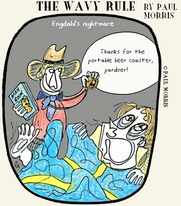
Martin “has been covering”:http://emdashes.com/2008/10/american-writers-to-emulate-no.php Horace Engdahl’s snobbish, narrow-minded, and rather insensitive remark that Americans are “too insular and ignorant” to really be in the running for a Nobel Prize for Literature. If I ever write a novel, it’ll be called _Engdahl’s Nightmare_. Let’s hope it wins the Nobel.
Click on the cartoon to enlarge it!
Read “The Wavy Rule” archive.
Two Thoughts on the Subject of Barry Blitt
1. On September 23, Kevin Drum at the _Mother Jones_ website wrote a “post”:http://www.motherjones.com/kevin-drum/2008/09/obama_and_ayers.html about conservative efforts to find evidence of deep ties between Barack Obama and William Ayers, the former Weatherman who committed several serious terrorist acts in the early 1970s. The point of Drum’s post was that those efforts had turned up virtually nothing. As most potential voters know, John McCain has since attempted to make the relationship between Ayers and Obama a central theme of the election campaign.
When I first read Drum’s post, I had a revelation, which is that _the underlying truth always matters._ It seems to be true that Obama is not close to William Ayers, which, if it is important to you to prove that the two men have a close relationship, is a serious problem.
But more to the point, it also seems clear that, whatever one thinks of Obama, he is not an especially “radical” thinker, apparently has never shown the slightest interest in using violence to further his goals, and doesn’t subscribe to the antiestablishment antipathy of Ayers or his former pastor Jeremiah Wright.
Again, the underlying reality matters: In much the same way that Obama is not a 1960s-era radical who has shown any interest in blowing up buildings for political reasons, Obama is also not a box turtle. Ads that set out to prove that Obama is such a radical or box turtle are equally likely to fail—because the underlying premise is moot.
Speaking of Barry Blitt’s now notorious “fist jab” cover, Art Spiegelman said something related to this at the New Yorker Festival; I mentioned it in my “writeup”:http://emdashes.com/2008/10/new-yorker-festival-art-spiege.php of the event. He said that it took the whole country two news cycles to realize that … Obama is not a radical. This fact lies at the core of the sneaky brilliance of the cover.
The underlying truth matters. The cover, and the decision to run the cover, both stem from an understanding of Obama’s nature as patently not very radical, and that may be why the slow, slow fuse of the cover was so effective, and (in the end) so much less worthy of contempt.
2. Yesterday Daniel Radosh put up a very insightful “post”:http://www.radosh.net/archive/002512.html about the potential misuse of satire once it is “liberated” from its original context.
To back up a moment, most of us are familiar with the occasional phenomenon of satirical news stories from _The Onion_ or some other source popping up in the press as “legitimate news stories”:http://en.wikipedia.org/wiki/The_Onion#The_Onion_taken_seriously. Also at the Festival, Stephen Colbert alluded to a similar incident in which a website dedicated to defending Tom Delay incorporated a clip from _The Colbert Report_ in which Colbert “defended” Delay. (Thanks to Rachel Sklar’s comprehensive “account”:http://www.huffingtonpost.com/2008/10/05/stephen-colbert-at-the-em_n_132019.html of that event, which helped me pin down my memory.)
One of the premises of the original debate around the Blitt cover was that _New Yorker_ readers or really anyone seeing the cover with the familiar “New Yorker” lettering would be very unlikely to regard the drawing as a smear against Obama; others, presumably fearful of future Republican attacks, contended that the image was so loaded that its power might well exceed the borders of that _New Yorker_ frame.
True to his fellow satirists, Radosh disclaims any responsibility on the part of the satirist for the unintended uses of his or her work and simultaneously takes the position that such uses are unlikely anyway. (I stress I’m not slamming him for this; this stuff is tricky.) In the post yesterday, Radosh brought to our notice a fascinating counterpoint to the Blitt cover.
You see, it turns out that those horribly “racist” “Obama Bucks”:http://thinkprogress.org/2008/10/16/obama-bucks/ (scare quotes are necessary, I’m afraid) started out as a liberal satire of Republican excesses—a distant shadow of the Blitt cover, one might say—and then got widely reported as an _example_ of those excesses. Remarkably, Diane Fedele, a Republican Party official in California who found the image and decided to use it in a newsletter, has been obliged to “resign”:http://www.salon.com/wires/ap/2008/10/23/D940B6OO0_obama_illustration/index.html her post.
I’m not sure that Fedele’s credulity or ill intent, however defined, really makes the original satire any better or worse; from where I sit, it still looks pretty crude to me, if undeniably potent. Maybe it all reflects poorly on Republicans, that a satire of their excesses could be regarded by friend and foe alike as legitimate examples of same; I don’t know.
But as for Blitt’s cover, it is a reminder that the existence of the frame matters, and quality matters too. I’m guessing that Blitt is a more experienced practitioner of visual satire than the creator of those Obama Bucks, and that experience may be the element that prevented the image from actually harming people, instead sparking a discussion about whether it might harm people.