Monthly Archives: January 2010

“It’s a Wise Child” Possibly to Air on the Fox Network? Egad.

Martin Schneider writes:
I didn’t know until today that Fox has a show in the works that sounds for all the world like the modern-day version of the radio show that made the young Glass siblings national celebrities. Look:

Fox executives said the premiere of “Our Little Genius,” originally scheduled to debut Tuesday after “American Idol,” had been postponed and possibly cancelled over concerns about the integrity of the concept. The quiz show was supposed to pit super smart six to 12-year-old kids against Ivy League professors.

[snip]

The show’s premise allowed the kids’ parents to decide whether they keep answering expert-level questions to win up to $500,000 in prize money.
[snip]
The sudden withdrawal of the program so close to its debut has raised eyebrows about whether the contestants were either given the answers in advance or put under intense pressure to prepare for the program. The show had already come under pressure for putting stress on such young contestants vying for “life-changing money,” according to the Fox advertising campaign
Fox made a big push for “Little Genius” billing it as a new spin on Burnett’s popular Fox series “Are You Smarter Than a Fifth Grader?” which pokes fun at adults who can’t answer elementary-school age questions.
Prior to the announcement Burnett acknowledged that the kids on the show—who he found through nation-wide casting calls—may not have a normal social lives. One potential six-year-old contestant is enrolled in college-level classes.
“I do believe that these genius kids probably have a little more difficulty socially in peer groups,” Burnett said last month.

Didn’t any of these people read “A Perfect Day for Bananafish”?

A Pair of Observations on the Passing of J.D. Salinger

Martin Schneider writes:
I cannot top Pollux’s exemplary writeup here, so I won’t try.
Instead I wanted to make two points about Salinger, one of which will be made many times in the days to come, and the other of which might well get missed in the hubbub.
1. Like many people, I read Salinger with great enthusiasm when I was in high school and college, and I haven’t thought about him much in several years. I believe it became somewhat fashionable in recent years to dismiss Salinger as a what — “minor author” or the like? — and I never found that to be an astute or fair assessment. Salinger was the real deal, comfortably in the first rank of postwar American authors, and it would take a lot of very clever and sustained argumentation to swerve me from that view. If American letters today saw a 1 percent increase in Salinger’s skill at narrative, dialogue, theme development, wit, and subtlety, the critics would never stop proclaiming this a Golden Age of American Literature. It’s pretty much as simple as that.
That’s the point I think won’t get lost in the shuffle. But what about this?
2. In writing this post about the, er, Golden Age of the Big Nonfiction Book, I spent quite a while studying this wonderful page by Daniel Immerwahr.
One thing that becomes very clear very quickly is that it is rather rare for truly top-notch writers to crack the annual top ten list. They probably make the weekly top ten list with some frequency. But for a whole calendar year? That is uncommon.
Salinger placed two books in the annual top ten list, and one of them (Franny and Zooey) was popular enough to make the list in two completely different years. (The other one was Raise High the Roofbeams, Carpenters.) Neither of these, of course, is the monumental novel for which Salinger will always be remembered.
Compare the totals for a few other major postwar authors:
Mailer: 1
Roth: 1
Bellow: 2
Updike: 2
Heller: 1
Vonnegut: 3
Irving: 1
We all know that Salinger sold a great many books, and quickly became a cultural phenomenon. I think we still risk underestimating the sheer bookselling power—and, obviously, popularity—that Salinger represented even before he became a long-term icon known for his seclusion. Salinger published four books—how many did Bellow and Updike write?
Posit that every serious American author craves that ineffable combination of critical recognition and a readership numbering in the millions.
Nobody, but nobody, combined those two things like J.D. Salinger.

J.D. Salinger, 1919-2010

_Pollux writes_:
“If Mr. Salinger is around town, perhaps he’d like to come in and talk to me about New Yorker stories.” So William Keepers Maxwell, Jr., _The New Yorker_’s fiction editor, wrote in 1947. Salinger would contribute several short stories to _The New Yorker_ that year, beginning a career that was at once fascinating and strange, and in many ways, tragic.
There seems to be only one photo of J.D. Salinger: the black-and-white author photo that graced millions of copies of _Catcher in the Rye_. There are, of course, other photos of Salinger, but he will remain for us the young author with the 1950’s style haircut and intelligent face whose stories have become required reading in the library of American literature.
Salinger intrigued us because he was the combination of two American tales: the instant literary celebrity and the famous recluse. Salinger did what most of us are sometimes tempted to do but know we shouldn’t do: hermetically seal himself against the world and close himself to all but the most minimal communication and interaction with the world.
“Although the myth of J.D. Salinger has been partially eroded by recent biographies and memoirs,” Raychel Haugrud Reiff has written in her book on J.D. Salinger, “the myth of Holden Caulfield remains. He will always be the sixteen-year-old whose sense of alienation in a phony, corrupt world speaks to readers worldwide.”
For us here at Emdashes, J.D. Salinger was one of the many figures in an intriguing pantheon of _New Yorker_ writers. Last year we “celebrated”:http://emdashes.com/2009/01/jd-salinger-turns-90.php the fact that we could read his last published piece, “Hapworth 16, 1924”.
We hoped for, as many have hoped for, that Salinger would have published more. But Salinger has passed from life into history, disappearing from the scene as mysteriously as the ducks on the lagoon in Central Park South.

When You Bend It, You Can’t Mend It

Emily Gordon writes:
I should have known Hendrik Hertzberg would be a Kate McGarrigle fan, and here is his heartfelt, ardent tribute to her. I heard about her death on Jonathan Schwartz’s timeless, dreamlike radio show last weekend and have had her songs caught in my head, even more than usual, since then. “And it’s only love, and it’s only love,/That can wreck a human being and turn him inside out.”
Hertzberg wrote this (and more–read all of it) as a Carnegie Hall program note for a McGarrigle Christmas show, and I think it’s just right:

The songs and singing of the McGarrigles have turned out to be a font of consolation: a pool of sweetness, a well of sadness, a geyser of exaltation. They have music to suit every stage of love and life. And they are the muses and matriarchs of an extraordinary family circle–a raffish orchestra of parents, siblings, offspring, exes, friends, and collaborators. We, their fans, are part of this circle, too. There are enough of us to assure our uncompromising heroines of a livelihood, but not so many that we risk the loneliness of a crowd.

Every stage of love and life–including this one, the unreal, suspended sadness of hearing one of your favorite voices on the radio and in your thoughts, and knowing the breath and mind behind that voice are gone.

Sempé Fi: The Life of the World to Come

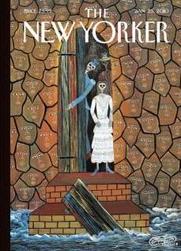
1-25-10 Frantz Zephirin The Resurrection of the Dead.JPG
_Pollux writes_:
The cover for the January 25, 2010 issue of _The New Yorker_ was created by a Haitian artist, “Frantz Zephirin.”:http://www.haitian-art-co.com/artists/fzephrin.html Zephirin, according to the Contributors page, “lives on a mountain overlooking the village of Mariani, not far from the epicenter of the earthquake that struck the country on January 12th.”
From his mountaintop, Zephirin has a clearer, closer view of the tragedy that manifests itself in an abstract vision of the afterlife. On _The New Yorker_ website, Blake Eskin has written a “Cover Story”:http://www.newyorker.com/online/blogs/newsdesk/2010/01/cover-story-frantz-zephirin.html on Zephirin’s piece. As Eskin points out, Zephirin’s cover was painted in 2007. Nevertheless, its symbolism and its associations with life and death are particularly appropriate for this 2010 cover, in view of the enormous losses and tragedy associated with the recent earthquake.
On _60 Minutes_, we see construction equipment scooping up the dead from the tragic earthquake, and piles of nameless bodies lying in a flattened cityscape. We hear numbers and more numbers: the number of casualties, the earthquake’s magnitude, the amount of monetary aid pouring in, the numbers to call, the number of troops sent by various governments, the number to which we can send text messages in aid of the disaster. We hope it is not so bad as the initial reports say, and realize that it is, in fact, worse.
Zephirin’s cover, called “The Resurrection of the Dead,” is an affirmation of the individuality of those who have perished in the disaster. Instead of numbers or piles of bodies, we see faces, many faces, with eyes and mouth open. According to “one website”:http://www.haitian-art-co.com/artists/fzephrin.html, Zephirin’s work is “characterized by its bright colors, patterns, tightly compacted compositions; and by the human figures with animal heads, which represent his cynicism for the ruling body.”
Instead of mangled bodies, we see beautiful faces, and each face is slightly different from the next. The expressions that we see are neither particularly happy nor sad, nor particularly masculine nor feminine. As androgynous as an angel, each face looks out from variously-shaped, interlocking tiles that hold up the vast vault of the afterlife. As Elizabeth McAlister points out in Eskin’s Cover Story, “the unblinking faces of the spirits of the recently dead. Just crossed over, they still have eyes, which are the blue and red of the Haitian flag.”
Through the open door, we see darkness and cobwebs. At first, I believed this to be a vision of hell, inhabited by grinning skeletal figures, one of whom wears a military uniform, representing military misrule and intervention, both internal and external. The other figures are dressed in clothing of the upper bourgeois. The female skeleton is similar to the figures one sees in a Frida Kahlo painting.
But it not so much hell as a border crossing between life and death. As Eskin’s piece points, gallery-owner Bill Bollendorf identifies the three skeletal figures in the doorway as representing the Guédé, “members of a family of spirits who guard the frontier between life and death. The woman in the wedding dress is Gran’ Brigitte, and the man in the blue uniform is her husband, Baron Samedi.”
Zephirin’s skeletal inhabitants open the wooden door that marks the boundary line. They grin triumphantly. The destructive power of the natural world, worsened by decades of misrule and corruption, has triumphed for the moment.
Debris, in the form of a wooden board, washes against the steps that lead to the this border crossing. The fast currents of this version of the River Styx will no doubt wash the debris away. Time moves the currents. And soon the door will close.
But the faces will remain forever, looking at us, asking us not to forget them.