
_Pollux writes_:
“In the country of Westphalia… lived a youth whom Nature had endowed with a most sweet disposition. His face was the true index of his mind. He had a solid judgment joined to the most unaffected simplicity; and hence, I presume, he had his name of Candide.”
With these words, Voltaire pays tribute to his creation. The New York Public Library is now featuring an online “exhibition”:http://candide.nypl.org/?hpfeature=3 for Voltaire’s _Candide_ in which you can pay your own tribute to this 18th century work.
It’s not just any online gallery. This exhibition is calling all artists and readers to contribute their own visions, tributes, and adaptations of _Candide_. “Here”:http://candide.nypl.org/content/do-it-yourself-emcandideem is the link for Do-It-Yourself-Candide. Have fun!
Monthly Archives: January 2010
The Wavy Rule, a Daily Comic by Pollux: Don’t Ever Leaf Me
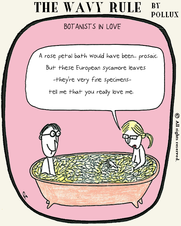
Click on the image for a detailed view!
Sempé Fi: The Long and Winding Road

_Pollux writes_:
A young man glides eagerly through the dark streets of the city. He’s hunched forward for maximum speed. He speeds past an apartment building with largely darkened windows save one, and a closed store named “Minx.” Where will this road lead him?
“Frank Viva’s”:http://www.francisaviva.com cover for the January 18, 2010 issue of _The New Yorker_ strikes me as being a cross between a Valentine’s Day cover and a Christmas cover.
This may or may not have been the illustrator’s intent, but mid-January is when we begin to see Valentine’s Day gifts and paraphernalia in the stores, as well as Christmas trees lying sadly in alleyways and dumpsters. We are like the Roman god Janus, with two heads looking in opposite directions at the past and the future.
Viva’s cover, called “Great Expectations,” depicts a young man on a bicycle bearing gifts in a shoulder bag. There is a tube and a box wrapped in shiny, red wrapping paper. His canine companion, bearing a tag and a bouquet of flowers in its mouth, sits in the bicycle’s basket. The cyclist, depicted in an elongated, paper-cutout style, sits on a delightfully whimsical, mechanically impossible bicycle.
I was curious about how the image was created, so I contacted Mr. Viva directly. The final artwork for “Great Expectations” is digital, but the work began as a pencil sketch. On his blog, Oliver Yaphe “writes”:http://oliveryaphe.com/tag/frank-viva that Viva’s style is “modern and distinct and gaining serious momentum.”
We can see some of Viva’s sketches “here”:http://www.vivaandco.com/TheWork/Illustration/Sketchbooks.aspx, where you’ll find some similarly styled bicycles.
We may be like the two-headed Janus, but Viva’s cyclist looks only forward: perhaps the cyclist is on his way to declare his love to a current or hoped-for girlfriend; the dog itself may be a gift. The young man expects great, crowning success. The night is gloomy, but the young man’s great expectations illuminate his face and create a cheerful scene.
This is Viva’s first cover for _The New Yorker_. According to his website, “when _The New Yorker_ called, Frank jumped up and bumped his head (rather badly) on the desk lamp. It didn’t hurt a bit.”
Viva is an illustrator, writer, graphic designer, and children’s book author. “Great Expectations” is, according to his website, inspired by his forthcoming children’s picture book, “Along a Long Road”:http://www.vivaandco.com/TheWork/Illustration/HarperCollins.aspx, which features a young boy on a cycling adventure through his city.
Viva’s cyclist for this _New Yorker_ cover seeks not only adventure but also romance. The road takes him to someone’s door. Hope propels him forward. We cheer him on.
The Wavy Rule, a Daily Comic by Pollux: Belief
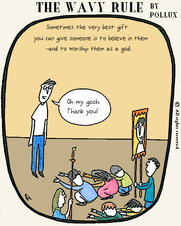
Click on the image for a detailed view!
The Wavy Rule, a Daily Comic by Pollux: The Race Goes to the Swift
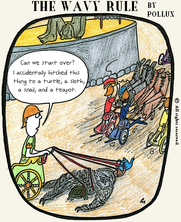
Click on the image for a detailed view!
The Wavy Rule, a Daily Comic by Pollux: Rain Where and When
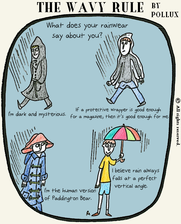
Click on the image for a detailed view!
The Wavy Rule, a Daily Comic by Pollux: Logical Collapse
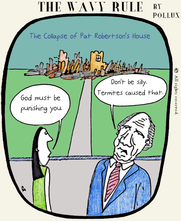
Click on the cartoon to enlarge it!
The Decline of the Non-Fiction Game-Changer: Real or Imagined?
Martin Schneider writes:
A couple of hours ago I had a very interesting conversation with four intelligent and well-informed twentysomethings (that is, people a good deal younger than myself), none of whom rely on books as a significant source of information, inspiration, and so forth.
I hasten to add that this is not in any way meant as a criticism or even something to sigh about. I know plenty of people who are really into books, and I know plenty of people who are not; these just happened to be some of the ones who are not.
If it is not implied in my presentation already, it may need to be stated explicitly that the non-book people are not in any material way (I would venture) less informed than the book people; they simply rely more on television, blogs, podcasts, magazines, and the like for their information.
We were talking about safety standards or some such topic, and someone mentioned Ralph Nader’s 1965 book Unsafe at Any Speed, which did so much to bring the subject of automotive safety into the public discourse. Then someone made a trenchant point: In the postwar era there were quite a few non-fiction books that had a profound impact on society, of which category Unsafe at Any Speed serves as an excellent paradigm. What are those books for our era?
We had a fairly difficult time thinking of more than about two.
This basic situation, the feeling that there used to be many books profoundly influencing society and the apparent reality that there are no longer very many such books, can lead further discussion in a few different directions.
To start with, is it really true? Perhaps it is worth making a kind of inventory of serious, ground-breaking non-fiction books for the different eras. Presuming that it is true, what does it mean? Perhaps it means that change occurs through different channels today, primarily computing technologies. Does it mean that intellectuals have smaller sway than they once did? Does it mean that change is less “top-down” than it once was? Are the books that are truly generating change for some reason not making much of an impact on the best-seller lists? (This is not as implausible or contradictory as it might at first sound.) Is it a sign that society required certain truly major adjustments after about 1960, and that the societal changes that we today require are but variations on those earlier upheavals? Is it just that we lack perspective on, say, 1995 in way that we do not lack perspective on 1965?
I’m not sure what I think about any of those questions. I have some ideas, to be sure, but they all seem rather tentative. Before we continue, it may be helpful to list some of the books that constitute the “canon” of major non-fiction books that played a significant role in American social and political movements in the 1955-1975 period. After that, I’ll throw out a few contenders for the 1990-2010 period.
An excellent resource for this task is Daniel Immerwahr’s “Books of the Century” project, which lists the top ten New York Times best-sellers (fiction and non-fiction) as well as a short list of notable books for each year from 1900 to 1999. It would be more helpful if the project extended to 2010, but it doesn’t.
Here’s my list of important, change-inducing books from 1955 to 1975:
Edward Bernays, The Engineering of Consent (1955)
William H. Whyte, The Organization Man (1956)
Vance Packard, The Hidden Persuaders (1957)
John Kenneth Galbraith, The Affluent Society (1958)
William J. Lederer and Eugene Burdick, The Ugly American (1958)
Barry Goldwater, The Conscience of a Conservative (1960)
Paul Goodman, Growing Up Absurd (1960)
Daniel Bell, The End of Ideology (1960)
Jane Jacobs, The Death and Life of Great American Cities (1961)
Rachel Carson, Silent Spring (1962)
Michael Harrington, The Other America (1962)
T. S. Kuhn, The Structure of Scientific Revolutions (1962)
Betty Friedan, The Feminine Mystique (1963)
Martin Luther King, Jr., Why We Can’t Wait (1964)
The Autobiography of Malcolm X (1965)
Ralph Nader, Unsafe at Any Speed (1965)
Eldridge Cleaver, Soul on Ice (1968)
Timothy Leary, The Politics of Ecstasy (1968)
Elizabeth Kübler-Ross, On Death and Dying (1969)
Kate Millet, Sexual Politics (1970)
Boston Women’s Health Collective, Our Bodies, Ourselves (1971)
Thomas Harris, I’m O.K., You’re O.K. (1971)
Dee Brown, Bury My Heart at Wounded Knee (1971)
Alex Comfort, The Joy of Sex (1972)
Peter Singer, Animal Liberation (1975)
Susan Brownmiller, Against Our Will: Men, Women, and Rape (1975)
A few notes before moving on. I think this is a very solid list of genuinely influential non-fiction books for this period. I also think that a person perusing Mr. Immerwahr’s list might plausibly want to add a few more to the list (and perhaps remove a couple). I have intentionally tried to be narrow in my choices, however. I wanted to choose books that left an authentic imprint in social and political movements, and in my opinion the standard for inclusion has to be a legacy in the form of major legislation or a lasting political bloc. Or at least within shouting distance of such a legacy.
Therefore, if you can answer “yes” to the question “Did this book serve as a call to arms for a group with a particular identity or cause or grievance?” then the book should certainly make the list.
But the books’ influence should not primarily be artistic, scientific, academic, aesthetic, or temporal in nature.
Therefore, if you can answer “yes” to any of the following questions, then the book (I think) should not make the list:
Is the book’s primary importance restricted to those in the scientific community or academia?
Is the book a work of cultural criticism?
Is the book important because it blends fact and fiction or otherwise offers a stylistic tour de force?
Is the book a work of reportage?
These questions rule out names like Kael, Sontag, Capote, Styron, Halberstam, Theodore White, Wolfe, Chomsky, Bouton, etc., etc., and I think properly so. All of those individuals wrote fine and important books, but none of them truly alerted the broadly educated class of some wrong that required righting or of some worthy mode of expression that had thitherto gone unexpressed.
I will concede that even my parsimonious standard may have included a few books too many; I’m not sure whether, for instance, Growing Up Absurd or The Hidden Persuaders qualify, but somehow I feel they are probably close enough. Similarly, Kuhn was writing for academics, but his eventual impact was just barely diffuse enough as to avoid seeming parochial. But hey—it’s just a list. I’m quite ready to admit that this or that title doesn’t really count.
I also note that there are no works primarily about homosexuality in the list (I think), but I’m not sure what I can do about that.
Let us now turn to the 1990-2010 period. What books since the end of the Cold War had a similar societal impact? Well,
Rush Limbaugh, The Way Things Ought To Be (1992)
Francis Fukuyama, The End of History and the Last Man (1992)
Barack Obama, Dreams from My Father (1995)
Samuel P. Huntington, The Clash of Civilizations (1996)
Jared Diamond, Guns, Germs, and Steel (1997)
Tom Brokaw, The Greatest Generation (1998)
Thus endeth our involvement with the helpful Mr. Immerwahr’s list. Here is a fairly expansive list of additional candidates, with a good deal of help from Wikipedia and without the years listed:
Al Gore, An Inconvenient Truth
Sam Harris, Letter to a Christian Nation
Robert Putnam, Bowling Alone
Malcolm Gladwell, The Tipping Point
Naomi Klein, No Logo
Naomi Klein, The Shock Doctrine
Barbara Ehrenreich, Nickel and Dimed
David Brooks, Bobos in Paradise
Bernard Goldberg, Bias
Eric Schlosser, Fast Food Nation
Michael Pollan, The Omnivore’s Dilemma
Rick Warren, The Purpose Driven Life
Nicholas Negroponte, Being Digital
Bill McKibben, Maybe One
Alisa Smith and J.B. MacKinnon, The 100-Mile Diet
Chris C. Mooney, The Republican War on Science
Richard Thaler and Cass Sunstein, Nudge
Sarah Palin, Going Rogue
Robert Bly, Iron John
Dave Foreman, Confessions of an Eco-Warrior
Derek Humphry, Final Exit
Ronald Numbers, The Creationists
Peter D. Kramer, Listening to Prozac
Elizabeth Wurtzel, Prozac Nation
Cornel West, Race Matters
Michael Moore, Downsize This!
Paul Krugman, The Great Unraveling
Al Franken, Rush Limbaugh Is a Big Fat Idiot
John Perkins, Confessions of an Economic Hit Man
“Anonymous,” Imperial Hubris
Harry Frankfurt, On Bullshit
Thomas Frank, What’s the Matter With Kansas?
Steven Johnson, Everything Bad Is Good for You
Ron Suskind, The One Percent Doctrine
Worldchanging.org, Worldchanging
Have I been unfair to anybody? Is anyone left out, unjustly named? I do not think that either list misrepresents the basic situation by very much. (By the bye, what are the major works of either period addressed to homosexuals, Latinos, Muslims? Anybody know?)
Now—unlike the 1955-1975 group, the 1990-2010 list resembles a brainstorming session, for which the standards for inclusion were far looser. By the standards of the first group, I count only eight titles that would definitely qualify, and just to keep the subject interesting I’ll keep that list to myself.
Conclusions? I’m loath even to venture any. But here’s a modest one: Everyone reading this knows that the 1960s plus a few years on either side were the great liberal expansion in the United States. And we all know just as clearly that the years since were a difficult time for the keepers of the liberal flame. The movements that thrived in more recent years were more pinched, more selfish, more inward, more “personal,” and more wary. With a couple of notable exceptions, even the liberal manifestos seemed to wilt or founder, in this sometimes churlish and fractious land, too often steered by money and reaction and spite. These lists show that, I think.
They also, maybe, point to a modest decline of the hardcover tome in the grand scheme of things. For the second period also contains the rise or apotheosis of goth culture, rave culture, guido culture, furry culture, lad culture, grunge, New Sincerity, metrosexuals, simple living, needlepoint, the EFF, the open-source movement, flash mobs, improv comedy, steampunk, feng shui, body modification, peer-to-peer file-sharing, hipsterism, emo, perpetual travelers, transhumanism, and three dozen other lifestyles and innovations I’m way too old to know much about.
Most of those subcultures aren’t as important as the civil-rights movement, but each did represent some new way of thought or expression, and even the courageous furries had to learn to become a properly recognized group, with the rights and rites that define a capital-C community. How many of the items in the last paragraph were sparked in any measure by a big, attention-getting non-fiction book? Darn few, methinks.
Introducing a New Imprint: Predetermined Dwelling
Martin Schneider writes:
Here’s the lede from “The Death of the Slush Pile,” by Katherine Rosman, in the Wall Street Journal:
In 1991, a book editor at Random House pulled from the heaps of unsolicited manuscripts a novel about a murder that roils a Baltimore suburb. Written by a first-time author and mother-to-be named Mary Cahill, “Carpool” was published to fanfare. Ms. Cahill was interviewed on the “Today” show. “Carpool” was a best seller.
That was the last time Random House, the largest publisher in the U.S., remembers publishing anything found in a slush pile. Today, Random House and most of its major counterparts refuse to accept unsolicited material.
What I love about this is that the name of the company is Random House.
(After I wrote the above, it occurred to me that I should find out how Random House got its name. According to Wikipedia, “Random House was founded in 1927 by Americans Bennett Cerf, Christopher Coombes and Donald Klopfer, two years after they acquired the Modern Library imprint. Cerf is quoted as saying, ‘We just said we were going to publish a few books on the side at random,’ which suggested the name Random House.”)
The Wavy Rule, a Daily Comic by Pollux: Cut Back
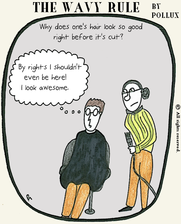
Click on the image for a detailed view!