

Click on the image for a detailed view!
Monthly Archives: January 2010
Sempé Fi: Poles Apart

_Pollux writes_:
Deep layers of snow cover a lot of America and Europe at the moment. While commuters may not be having a good time, skiers have the opportunity to revel in resorts reporting record attendance levels.
Skiers are on top of the world, both literally and figuratively, and “Top of the World” is the name of “Jan Van Der Veken’s”:http://www.fabricagrafica.be/content/page.asp cover for the January 11, 2010 issue of _The New Yorker_.
This is the Belgian illustrator’s second cover for _The New Yorker_, and it depicts, like his first cover, a smiling, winter-bound young couple. However, while Van Der Veken’s December 7 “cover”:http://emdashes.com/2009/12/sempe-fi-o-christmas-tree.php was the very picture of closeness, depicting two Christmas shoppers literally wrapped together, the skiing couple on his January cover share the ski-slope and little else.
The young man takes a picture of the snowy landscape. The young woman chit-chats with someone on her cell phone. They are having a pleasant time, but are not really sharing the experience together.
On her blog, designer Poppy Gall has written a “post”:http://poppygall.com/blog/tag/jan-van-der-veken/ on this cover:
The way artist Jan Van Der Veken juxtaposes a stylized retro ski poster look and digital gizmos makes me smile. This is a familiar scene at any ski area. Skiers with iPhones know they’re worthless while wearing gloves. But those slim cameras do fit nicely in your pocket.
Van Der Veken’s juxtaposition of retro and ultra-modern is seamless. He fuses past and present into an image that comments on our own era while reaching back to artistic styles and designs of the 1950s. Van Der Veken’s young skiers are thoroughly modern, and there’s no better way to depict a couple of 2010 than to include the technological gadgets that we can’t seem to do without.
It would be pointless to lament about how disconnected people are when they are together and connected, not to each other, but to their iPhones, Panasonic Lumixes, and Blackberries.
But that is how we function nowadays, whether we like it or not. While iPhones may be useless while wearing gloves, they may come in handy when it comes to finding directions to the ski lodge or, God forbid, in an emergency situation. A true vacation for some would be to go offline for days on end; for others, the prospect of that would be nightmarish.
Van Der Veken’s mountaintop scene, however, is not a nightmarish vision, but one of splendid semi-isolation.
The Wavy Rule, a Daily Comic by Pollux: Date-sensitive Male

Click on the image for a detailed view!
The Wavy Rule, a Daily Comic by Pollux: Silly Love Songs

Click on the image for a detailed view!
The Wavy Rule, a Daily Comic by Pollux: Gin a body meet a body comin thro’ the scan
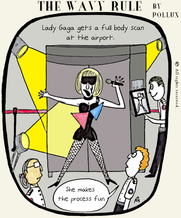
Click on the cartoon to enlarge it!
The Wavy Rule, a Daily Comic by Pollux: Love in the Time of a Minor Cold

Click on the image for a detailed view!
Sempé Fi: Old News

_Pollux writes_:
It’s not just out with the old and in with the new. The old are condemned to hard labor for all eternity, like Sisyphus rolling his boulder up a hill.
“Ivan Brunetti’s”:http://en.wikipedia.org/wiki/Ivan_Brunetti trademark egg-headed, stick-legged little people appear as lab technicians on the January 4, 2010 cover of _The New Yorker_. The cover, called “Ring Out the Old, Ring In the New,” gives us a twist on the old iconography associated with New Year’s.
In Brunetti’s vision, Baby New Year is being manufactured and readied by hard-working scientists, mathematicians, data analysts, and technicians.
Father Time, meanwhile, who is associated with the older, passing year, is unhappily mopping the floor of the manufacturing plant. 2009 was a year that will forever be associated with economic woes; perhaps Brunetti’s Father Time has found that he cannot retire comfortably. He must keep on working. Despite his experience, he is at the bottom of the ladder at the factory.
Will the same fate await Baby New Year 2010? The year 2009 was once full of hope and energy too, until economic and political challenges added wrinkles and gray hair to its once youthful frame.
Brunetti’s technicians, perhaps fueled by hopes of green jobs and economic recovery, work hard to ensure that 2010 will be a good year.
However, despite their best, most scientific efforts, other forces will be at work in the coming year as well: chance, chaos, divine intervention, randomness, serendipity, and fate. It’s a new year: may it be a happy one.
The Wavy Rule, a Daily Comic by Pollux: Relationship Cycles
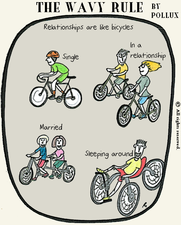
Click on the image for a detailed view!
Notes on “Notes on Camp”: The Persistence of an Aesthetic
Martin Schneider writes:
A couple of weeks ago I caught the final show in John Waters’ Christmas Tour, which ended at B.B. King’s. He was vastly entertaining. Afterwards, he made his way to the bar area and greeted a few of the diehards who opted to hang around (it was after midnight), of which I was one. A fun experience.
In connection with this event, I was talking to my young companions (a good fifteen years younger, as it happens) about the concept of Camp, and mentioned Susan Sontag’s famous 1964 essay. Not very surprisingly, neither of my friends had ever heard of it, a circumstance for which mere youth is not the full explanation. Now, in 2010, it suddenly popped into my head to give it a look. Now that was a terrific idea.
The form of jottings, rather than an essay (with its claim to a linear, consecutive argument), seemed more appropriate for getting down something of this…. etc.
1. It’s the best-written thing I’ve read in months. Months.
2. The astonishing variety of references in the essay are a clue to a problem that was never much of a problem anyway. That is, since Sontag later became a symbol of a certain kind of highly refined left-wing thinker and aesthete (nothing of the kind ever really happened to Pauline Kael, for instance, despite her quasi-apocryphal “Nixon” remark), to what extent was Sontag occupying a necessary role in society, one that someone else might just as well have occupied, and to what extent was she an original?
It’s safe to say that Sontag was really very original indeed. The references show the wide range of her intellect, curiosity, and perhaps most important, pleasures, and that sort of thing is not readily reproducable. Sontag forged a path that led to a place only she could have reached.
3. Is there anything that any hipster has ever done, anywhere, that would have surprised Sontag? I doubt it. This is the reason there is no “Notes on Hipsterism.” There isn’t any point, Sontag had already gotten there.
4. This doesn’t make her infallible. I think punk might have perplexed her a bit, or even maybe Devo or Kraftwerk. The article coincides with the arrival of the Stones and the Beatles, so she could not have ventured any thoughts on rock or used rock bands as examples (jazz seems to occupy that slot in her cosmology). Does anyone know if she ever had any serious “take” on rock music?
5. Sontag seems to have been the first and possibly most perfect example of a type that is relatively common nowadays, the intellectual who enjoys high and low culture with equal avidity. Sontag is more “perfect” because her choices include opera, high art, and the entire gamut of high modernism. Her latterday incarnations are far, far less likely to know Richard Strauss and Jean Genet, although they probably enjoy Jane Austen and chop-socky movies about equally.
6. The essay has not dated in any material way.
The Wavy Rule, a Daily Comic by Pollux: Reform Stalls
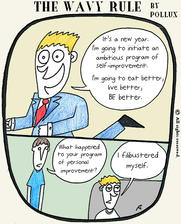
Click on the image for a detailed view!