
Martin Schneider writes:
Jason Kottke today linked to some scanned pages of Sassy from the early 1990s. Jason observes, “Sassy seems to be one of those rare magazines that is dearly missed but doesn’t really have a modern day analogue. (See also Might and Spy.)”
True enough. What occurred to me, however, was that those three magazines have something in common: a very strong editorial hand. In all three cases the editors are pretty well-known people: Jane Pratt in the case of Sassy, Dave Eggers for Might, and Kurt Andersen/E. Graydon Carter for Spy. So the reason they either don’t exist or have not been replaced is that those specific people have elected to do other things.
But it feels like the “rule” of a strong, irreplaceable editor needs more to it. There are other magazines run by strong editors where it’s easy to imagine the magazine continuing in that editor’s absence. Anna Wintour at Vogue, for instance. David Remnick at The New Yorker. Carter at Vanity Fair.
So we can add a corollary. The irreplaceability of an editor is inversely related to the size of the operation, expressed in terms of circulation, revenue, ad pages, whatever.
Let’s stick with circulation for a moment. One way that a magazine becomes “a big deal” is when it expresses the hopes, dreams, fears, etc. of an impassioned, interested sliver of the population. That was true for Sassy and Spy, certainly; not so sure about Might but let’s say it’s true there too. As a counter-example, you could imagine that being true of Wired, say, but Wired got too big and important—that is to say, its readership combined an impassioned sliver and a larger group that was only mildly interested in the content. In other words, its readership had “graduated” to a general readership, making it possible for Wired to have multiple editors over time.
So I’d ask two questions: Are there any other magazines in Jason’s group? Do 2600, Raygun, SPIN, The Comics Journal, Adbusters count as potential members of that group (potential, since some of them still exist) or not? Who are the editors of those magazines? I can name three of them off the top of my head, but I won’t say which ones.
The other question is, Are there magazines that break my rules? One magazine that I had in mind for this category was Interview, which was founded by Andy Warhol and decidedly represented a “sliver” of the reading public, but it’s been chugging along for quite a while now. Is it an exception, or did its revenue or something pass some benchmark way back when? I don’t know the answer.
Category Archives: Eds.
Coming Soon: David Remnick’s Biography of Obama
_Pollux writes_:
As “announced”:http://www.nytimes.com/2010/02/23/books/23arts-OBAMABIOGRAP_BRF.html in the _New York Times_, Alfred A. Knopf will be publishing David Remnick’s biography of Barack Obama on April 6, 2010.
The book, entitled _The Bridge: The Life and Rise of Barack Obama_, has been in the works for a while, as Emily “reported”:http://emdashes.com/2008/12/hooray-a-new-david-remnick-boo.php here at Emdashes in 2008.
Happy Birthday, David Remnick!

Emily Gordon writes:
We’re running this nifty photo collage, which our designer friend Jennifer Hadley (creator of the original Emdashes logo) created last year for a significant milestone, to wish The New Yorker‘s editor many happy returns of the day. The image is made up of magazine covers and other images (including a Russian postcard) from Remnick’s birth year, part of the environment of word and image that formed an editor perfectly suited to both a righteous tradition and a challenging new age.
Who could have predicted how the picture of print media would change? Thankfully, we still have great magazines to celebrate, and as always but especially today, the one whose host we toast is The New Yorker.
This Seems as Good a Time as Any
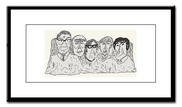
to tell you that we think “The Editors of The New Yorker,” Pollux’s drawing of Harold Ross, William Shawn, Robert Gottlieb, Tina Brown, and David Remnick, is so suitable for framing that it’s already framed, and available from those clever ducks at CafePress. Buy one for your favorite New Yorker lover and hang one in your office to remind yourself that you won’t let your standards slip, economy be damned. These five wouldn’t stand for it, and, with them keeping watch, neither will you! –E.G.
Happy 10th Anniversary, David Remnick!
I’ll expand this post a bit later this week, but for now, I’ll just wish David Remnick a very happy 10th anniversary at The New Yorker. Here’s another of his many appreciators (who just turned 21! the twentysomethings are reading–see below), with a similar cheer and a link to a Financial Times profile about Remnick’s first decade at the magazine. From the FT piece:
Remnick has much to celebrate after 10 years: circulation of The New Yorker has risen by 32 per cent, to more than 1m copies a week; re-subscription rates, at 85 per cent, are the highest in the industry; and despite the conventional wisdom that young readers don’t have the attention span to do more than blog, text and twitter, the magazine has seen its 18-to-24 readership grow by 24 per cent and its 25-to-34 readership rise 52 per cent. Twenty-four of its 47 National Magazine Awards were awarded under Remnick’s tenure. Perhaps most reassuring of all, The New Yorker’s balance sheet has moved from red to black – although its private ownership precludes him from revealing how much profit it makes.
Let’s hope he’s celebrating today and not just fielding calls about the cover; that’s what the animatronic Eustace Tilley is for.
Nicely Put: On Paul Muldoon
The New Yorker, which I’ve now read for nearly 40 years, is surely publishing better poems now that Paul Muldoon has taken over for Alice Quinn. His selections are interesting, witty, striking, running the gamut from free verse to traditional poems. Quinn’s poems were often self-indulgent, sentimental, mannered, boring.
This is just another sign of the magazine’s revival under David Remnick, who has returned it to the best days of Shawn and Ross, and perhaps surpassed them. Too bad this excellent, wide-ranging cultural treasure keeps improving in a climate of anti-intellectualism and short attention spans. I often hear quite well-read folks say they no longer read the New Yorker, or just glance at the cartoons. Too bad, you fools.
That’s from Chasing the Blues, and that’s a fine site, by the way. I’m so happy I happened on it. I would argue there are many exceptions to the note about Quinn’s taste, but I’m not here to argue; I’m here to be glad we’re not said fools, often the very people who don’t read poetry because—we know the real reason, right? It’s too much work to worry about whether you’ll understand it. Be brave, prosey people!
Remnick’s Jazz List: Let the Omission-Counterlisting Begin!
Martin Schneider writes:
In theory, I oppose lists of cultural distinction; in practice, I devour them greedily.
In conjunction with his Profile of legendary WKCR DJ Phil Schaap, David Remnick (with the help of Richard Brody) has compiled a fine, judicious, respectful, I daresay typically Remnickian list of the 100 most essential jazz recordings for the newcomer to jazz.
I can’t even hear the words “Phil Schaap” without thinking of my father, let alone “Django” or “Teagarden.” I would reckon he owned about two-thirds of these albums—or owned the material in other configurations (hint: bargain-bin compilations). A few of them, I’m certain, he bought as 78s. He was a child of the Depression, and his tastes ran to Benny and Louis and on through Thelonious and Billie Holiday. (Our first cat was called Billie.)
The whole first half is simply a list of the musicians my father loved the most. But even after the advents of free jazz and fusion and confusing, dissonant Ornette Coleman and Charles Mingus, none of which pleased him too much, he continued to find enough energy in contemporary jazz to visit the Village Vanguard with great gusto and regularity, even into this century.
I can say with complete confidence my dad would have approved of this list; that it emanates from the editor of The New Yorker, another lifelong passion of his, would have cheered him doubly.
Designing Woman Tina Brown
From today’s New York Post (via MediaBistro): “Tina Brown has turned to legendary avant-garde design firm Number 17 to handle her new yet-to-be-named Web venture, a news-aggregation service that is being backed by her longtime friend, media mogul Barry Diller.” I can attest both to No. 17‘s design acumen and their laudable foosball hosting and playing skills.
Elsewhere in design, journalism and political science double major (and keyboard player) Teddy Applebaum, given the challenge of a mock blow-in card, struggled among various versions of Rea Irvin’s New Yorker typeface and their cost (“oodles of cash”), and had to settle for a poor imitation. Occasional spelling oversights aside, I think the kid‘s got something, don’t you?
Speaking of blow-in cards, there was an eloquent defense of them in Wired some months ago that I keep thinking about, and not just because of the witty execution. It seems the cards really bring in the dough, and in these uncertain times, that’s something we’ve got to support (as this Jack Ziegler cartoon suggests), right? Or at least not judge too harshly, especially when in the forest, which could probably use more edifying reading material, anyway.
Maybe We’ll Witness Tony and Tina’s Wedding After All
Martin Schneider writes:
So they want to turn Tina Brown’s biography of Princess Diana into a musical. Over at Gawker, readers are busy casting the musical—mostly with people who never stray from film or TV. (I love that “NOOOO!” department.) It would be the first time a New Yorker editor has inspired a musical since Andrew Lloyd Webber’s legendary flop Ross!
I think the only rational response is to think up silly song titles. I came up with a few to get us started:
“Royal Love Train”
“Balmoral Hazard”
“Shy Di”
“Squidgygate”
“Raine, Raine, Go Away”
“The War of the Waleses” (medley)
“The 42 Longs”
“I’m Just Looking For a Guy with a Gulfstream”
“Hasnat Khan a Lovely Smile?”
“The Royal Oui”
“Mama and Paparazzi”
“That’s an Awful Lot of Flowers”
“The People’s Princess”
Got any to add to the list? (And just kidding about Ross!)
Doesn’t This Law & Order Guy Look a Little Like David Remnick?
I know how this sounds, but I was watching a few minutes of that dreadful but hypnotic Taxi TV the other day, and there was a Law & Order promo on; the faces of a bunch of actors flashed by, and I could have sworn one of them was the jazz-appreciating editor himself. Once you really look at the guy (it’s got to be Jeremy Sisto as Detective Cyrus Lupo), it’s a little less doppelganger-y, but there’s something to it.
OK, enough silliness for today! (Here’s Remnick calming down Elizabeth Kolbert after a particularly dire climate-change report.)


