Monthly Archives: October 2009

New Yorker Festival: Ricky Jay

Marin Schneider writes:
In 2000, the first year of the New Yorker Festival, Mark Singer interviewed Ricky Jay in the Milton Berle Room at the Friar’s Club; on the Festival’s tenth anniversary, the programmers had them recreate the experience in the much larger space of City Winery. The two men, palpably friends, have a kind of fraught rapport; Singer self-consciously leery of stumbling into secretive terrain, with Jay apparently willing to plumb same. Jay noted that Singer’s 1993 profile did so much to elevate—and, in some sense, ruin—Jay’s career as a cultish practitioner of sleight of hand and historian of same.
Jay cannot help but carry an air of mystery with him. Singer mentioned that his profile of Jay is the only one of his long career in which he did not know the subject’s age or real name at the time of publication. As he put it, such information was irrelevant to the purposes of the profile, and “somehow it got past the fact-checkers.” (Wikipedia says that “Max Katz” is in his 61st year or thereabouts.)
Endearingly, Jay revealed that he had only two outlandish goals when he started out. One was to appear in a James Bond movie, and the other was to write a New Yorker article. And he did both!
One of my favorite quotes from the session came when Jay discussed the tension between the secrecy inherent to magic and the openness required to attract new practitioners. Jay has always been more about spreading the word, to the consternation of one of his mentors, Dai Vernon, who asked him, “Professor, why give animals tools?”
Jay is one of the most informed people in the world on magicians of the past; as his working partner Michael Weber once observed, “Ricky remembers nothing after 1900.” In that spirit, I turn over the rest of this post to the masters mentioned during the session. I’ll just put the bare information; after all, the Internet is available for further exploration. I think Jay would appreciate the gesture, even if it involves no digital (in the sense of “fingers”) trickery.

The first magician on record was “Dedi,” who lived in ancient Egypt under King Cheops. Among other things he did the Cups and Balls trick and one involving the apparent substitution of a goose’s head from one body to another. (Attention ASPCA: I don’t think the geese survived this trick.)
Daniel Wildman, the “equestrian apiarist”—what an amazing turn of phrase.
Bartholomeo Bosco, 19th-century master of the “cups and balls” trick.
Chung Ling Soo, whose death while attempting the tricky maneuver of catching a bullet in his teeth was ruled “death by misadventure.” Oh my.
Toby the Sapient Pig, also known as the “Philosopher of the Swinish Race.”
Rabbi Hirsch Dänemark, who could watch as an audience volunteer poked a pin through the first few pages of the Talmud—and then not only identify which words the pin had pierced but extemporize a sermon using those words!
Chabert the Human Salamander, who would enter an oven with a raw steak in his hand. Jay: “He emerged tartare, the steak was cooked to perfection.”
Matthias Buchinger, who became a world-class practitioner of magic and calligraphy despite having no arms or legs and attaining a stature of 29 inches tall. This fellow sounds like one of the most fascinating people of all time—a sentiment Jay was quick to express.

Jay’s evident love for these crazy characters was something to behold. It was very touching to hear him talk about the quixotic task of researching these men without easy access to sources; in the meantime, his efforts have been supplemented by countless others, and much of it is available on the Internet.
Thus does the scholar, bringer of light, trump the magician, exploiter of darkness.
What’s in This Week’s New Yorker: 11.02.09

Martin Schneider writes:
A new issue of The New Yorker comes out today. It is the Cartoon Issue. A preview of its contents, adapted from the magazine’s press release:
In this year’s Cartoon Issue, “The Funnies” features cartoons by Pat Byrnes, Drew Dernavich, Matthew Diffee, William Haefeli, Bruce Eric Kaplan, Marisa Acocella Marchetto, Victoria Roberts, David Sipress, Mike Twohy, P. C. Vey, Christopher Weyant, and Jack Ziegler.
Chris Ware relates a family drama in a comic strip.
“I Don’t Get It” explains some of the more obscure cartoons that have run in our pages.
Roz Chast envisions a social-networking site for the antisocial.
Zachary Kanin reveals the shocking truth about vampires.
Also, we introduce the Cartoon Kit Contest with “Talk Show,” featuring drawings by Alex Gregory. Using the backdrop, characters, and props provided, readers are invited to create a cartoon and submit it on newyorker.com.
In “Robots That Care,” Jerome Groopman looks at the use of robots to assist in physical and social rehabilitation. Maja Matarić, a professor of computer science, has “begun working with stroke and Alzheimer’s patients and autistic children, searching for a way to make machines that can engage directly with them, encouraging both physical and cognitive rehabilitation,” Groopman writes.
In “Wild, Wild Wes,” Richard Brody explores the career of the filmmaker Wes Anderson, and previews his new movie, the animated feature “Fantastic Mr. Fox,” based on the children’s book by Roald Dahl.
In Comment, Louis Menand questions whether the White House’s war on Fox News is worthwhile.
In The Talk of the Town, Cornel West discusses his thoughts on Barack Obama with David Remnick.
In The Financial Page, James Surowiecki explains how the biggest banks on Wall Street have actually got bigger during the financial crisis.
Barbara Demick relates one survivor’s story of the brutal famine in North Korea during the nineteen-nineties.
In Shouts & Murmurs, Ian Frazier tells the story of Fanshawe, a New Englander with just one name.
John Lahr takes in Patrick Marber’s update of the August Strindberg play After Miss Julie and the new musical Memphis.
Elizabeth Kolbert reviews Cass R. Sunstein’s book On Rumors, which describes how the Web, with its multitude of partisan sites and blogs, has become a breeding ground for political extremism.
Peter Schjeldahl visits the Arshile Gorky retrospective at the Philadelphia Museum of Art.
David Denby reviews Amelia, You Cannot Start Without Me–Valery Gergiev, Maestro, and La Danse.
There is a short story by Javier Marías.

Sempé Fi: By the Book

Drooker_IntheWorldofBooksr_10-19-09.JPG
_Pollux writes_:
You call “Eric Drooker”:http://www.drooker.com/ when you need surreal cityscapes depicted at interesting angles. His past work has revealed multiple, parallel New York Cities ranging from neo-Egyptian versions of it to arctic visions of the city.
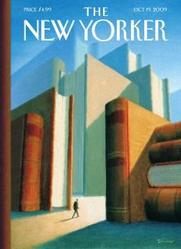
Now we have his cover for the October 19, 2009 issue of _The New Yorker_, called “In the World of Books.” Drooker has shown us visions of stacked books before, for the November 6, 2006 “cover”:http://www.cartoonbank.com/2006/New-Yorker-Cover-1162006/invt/130216 of _The New Yorker_.
However, while his 2006 cover depicted a man happily reading a book, on this 2009 cover we see a very small figure that is completely dwarfed by a series of book-skyscrapers. No reading is being done. The books look threatening here, not inviting. The books intimidate rather than nourish.
Drooker’s figure walks into a soft pastel glow, perhaps representing the light of knowledge. Are these books that he’s never read but really should? The volume of reading he needs to do is daunting.
I’m reminded by a passage from Italo Calvino’s _If on a winter’s night a traveler_, a book about books: “Eluding these assaults, you come up beneath the towers of the fortress, where other troops are holding out: the Books You’ve Been Planning To Read For Ages, the Books You’ve Been Hunting For Years Without Success, the Books Dealing with Something You’re Working On At The Moment, the Books You Want to Own So They’ll Be Handy Just in case…”
Books are still with us, real books that have yet to be supplanted by upstart e-books and perhaps never will. They remain a dominant part of the culture, and the New York City publishing industry remains a vital part of the cultural landscape.
The October 19, 2009 issue of _The New Yorker_ has within its page articles on books and the publishing world: Rebecca Mead’s piece on Alloy Entertainment (which, according to the company’s “website”:http://www.alloymarketing.com/entertainment/index.html, is “a fully integrated entertainment company that develops and produces original books, television series, and feature films”) and Joan Acocella’s review of Hilary Mantel’s _Wolf Hall_.
The issue also contains Daniel Zalewski’s story on books for obstreperous children and James Wood on Lydia Davis’s short fiction.
Books are still with us. They’re our friends, our allies. But they seem less like friends on Drooker’s cover than sad giants increasingly neglected in a world filled with other distractions and entertainments. They are like Tolkien’s Ents: still very formidable and powerful, but increasingly enshrouded by sadness and oblivion.

Sempé Fi: Money, Money, Money

Clowes_Lazar_Ulriksen_FoodChain_10-12-09.JPG
_Pollux writes_:
The cover for the October 12, 2009 issue of _The New Yorker_ is unique in that it is not one cover, but three, drawn by three different artists. The artists’ styles vary, but there is a narrative sequence in the thrice-covered magazine. The piece is called “The Food Chain.”
The cover is also unique in the sense that its composition was discussed on a new feature of _The New Yorker_ website, called “Behind the Cover.”:http://www.newyorker.com/online/blogs/tny/2009/10/money-issue-covers-video.html
I saw some of this feature on “Taxi TV” on the way to _New Yorker_ festival events. _Behind the Cover_, which features Françoise Mouly and the three artists, offers a great insight on the creation of the triple cover.
“Daniel Clowes”:http://en.wikipedia.org/wiki/Daniel_Clowes introduces us to the main character of “The Food Chain”: a rich Park Avenue matron. She finds herself in a grubby fast food joint. Clowes’ literal way of depicting human faces lends itself well here: she looks worried and confused.
She’s up next, and she’s not sure about what to order. The man that Clowes depicts behind her, on the other hand, looks comfortable in this environment. His worries are of a different kind, but his face betrays little emotion.
Have economic circumstances forced her to eat something other than foie gras crumbles, specially farmed Almas beluga caviar, and Rothschild estate wine? She clutches her purse. Her gleaming earrings and pearl necklace look out of place in an eatery that reeks of fatty French fries, melting snowcones, and contaminated hamburger meat.
We turn to the next cover. Drawn by the versatile “Zohar Lazar”:http://www.zoharlazar.com/, the cover is reminiscent of cartoons drawn by Peter Arno. The illustration is black and white save for the garish pink and yellow splashed across the fast food restaurant’s sign and array of products.
In Lazar’s scene, awash in Arnovian ink, a limo awaits the matron. She proudly carries her purchase. A maid carries the fries. A driver stiffly and elegantly holds the limo door open.
The October 12 issue in fact contains cartoons pulled “from the Archives,” from the time of the Great Depression. These include cartoons drawn by Gardner Rea, Leonard Dove, Alain (the pen name of Daniel Brustlein), and Helen Hokinson.
“Mark Ulriksen’s”:http://www.markulriksen.com/ cover, the last in the sequence, reveals the punchline: the burger wasn’t for the matron at all but for her poodle. Her worried expression was not caused by her thoughts on what food she would like for herself, but what would her poodle eat?
She made the right choice; the poodle’s tail wags happily and its tongue hangs expectantly. The narrative trick is revealed.
Ulriksen’s angular style and strange perspectives shift the focus from matron to canine. The third cover is focused on the dog’s happy face. The woman’s face is literally out of the picture.
We see a little of her home: solid oak tables upon which rich vases, expensive bound books, and fresh flowers rest. An immaculate carpet, the domain of the poodle and now littered with a few fries that have fallen carelessly on the floor (the maid will be fired for that).
What does “The Food Chain” say about our times? That fast food is only fit for dogs? Or that, despite the recession, the rich are not being forced to buy fast food for themselves in order to survive. It hasn’t come to that yet, if it ever will, and the woman’s jewelry, drawn by all three artists, glints proudly and arrogantly. It won’t end up in a pawn shop.
The point of “The Food Chain” is that the recession of 2008 and 2009 has yet to reach the society-altering magnitude of The Great Depression.
Most of the rich have remained rich. If they have to cut back, it’s not for themselves. The woman is scaling back a little, but not for herself. She’s cutting costs, perhaps temporarily, for Fifi the Poodle. She’s braved the drive down to the fast food joint. It’s been a hectic day.
The October 12 issue is “The Money Issue,” and some people have more money than others, and always will.

New Yorker Festival: Platon

Emdashes is thrilled to extend its impressive list of august Festival reporters. Trained as a doctor, Jenny Blair has twice been recognized by the National Headliner Awards for Special Column on One Subject for “First Opinion,” a column in the Hartford Courant describing her experiences in medicine. This is her first piece of writing for Emdashes—and, we hope, not her last.—Martin Schneider
Jenny Blair writes:
Any artist who lies awake wondering if his labors make any difference in the world ought to talk to Platon, the London-born portrait photographer. In his photography master class on the Festival’s last day, there was little technical talk.* Instead, in a series of fascinating anecdotes, the master revealed how he builds rapport with his subjects, then elicits portraits so powerful that one of them may have changed the course of a presidential election.
Platon’s technique is to disarm. A short man with a cheerful accent and goofy smile, he wore a bowler hat and stripy shirt and said right away that he finds New Yorker staffers intimidatingly brilliant. He lost few opportunities to denigrate his own intelligence and education. Yet by the end of the lecture it was clear that his lack of pretense is key to his mastery.
Take, for example, his reaction to the convolutions required to meet Vladimir Putin in person. (Platon caught the icy-eyed Putin for the cover of Time‘s 2007 Person of the Year issue.) The photographer waited for days to be summoned, then, upon getting out of the car at the dacha, saw his own chest bespeckled with laser sights from gunmen. He narrowly avoided unplugging the nuke phone in Putin’s office while setting up his equipment. Yet he gave the startled dictator a near-suicidal hug in a room full of bodyguards upon learning that Putin, too, adored the Beatles.
Christopher Walken required some indulgence. He arrived at the studio and proceeded to rummage aimlessly through cupboards, then posed with his back turned and insisted on being called to before each shot. “Chris!” Platon would say obligingly, whereupon Walken would whirl to face the camera. This game went on for take after take.
Such disingenuous interactions are Platon’s stock in trade. “Mr. So-and-So,” he likes to say, “you’re so successful and have been working/singing/writing for so long. Do you have any advice?” (Neil Young: “If you follow your heart as an artist, you’re never wrong.” Karl Rove: “If you’re photographing me, you’ve already made it.”) He described crouching to move beneath his subjects’ level when necessary. It all works: They unfold their arms and legs; they lean forward. Intuition like that is its own form of intelligence.
But he failed, Platon said, with Heath Ledger. No amount of cajoling could put Ledger at ease, and the photographer went home frustrated. Looking now at a portrait from that session, taken a year before Ledger’s death, Platon said, “You can see the confusion in his eyes.”
A photo in his New Yorker series of service personnel gave rise to his best story. A tender portrait of a mother at the grave of her son, an American serviceman and Purple Heart honoree killed in action, stood out because the soldier had been Muslim. A Koran leaned against the headstone, which carried a crescent and an Arabic name. Platon told the audience that Colin Powell, enraged by false accusations about Obama’s religion and the implied insult to Islam–a religion espoused by some soldiers who die for our country–cited that photo as a reason for his endorsement of Obama, just days before the election. There may not be a better reason to take a picture.
* Though he did reveal his preference for film cameras (medium-format Hasselblad and 35 mm Leica). “Digital,” he opined, “is shit.”

New Yorker Festival: Wallace Shawn and John Lahr

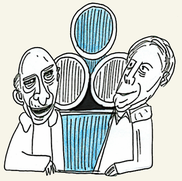
Shawn_Lahr_Polluxb.png
_Pollux writes_:
After the “Simon Schama lecture”:http://emdashes.com/2009/10/new-yorker-festival-simon-scha.php last Saturday I sped over to the City Winery on Varick Street.
I had time to spare but I had been uncertain about routes and taxis, being a confused Angeleno in the Big Apple. When I got there around six o’clock, there was already a line forming outside of the event that would start an hour and a half later. It was a good indicator of the anticipation surrounding this event.
Several older gentlemen in line looked like Wallace Shawn imitators. One woman asked a gentleman in line if he was Wallace Shawn. “No, I’m not,” he said.
“Oh, you have the same voice,” she said. My first glimpse of the real Wallace Shawn was of the actor and writer descending the spiral staircase in the middle of the Winery.
I sat at a small circular table and was soon served by a City Winery waiter. The rumble of the nearby subway rattled the glasses of my table as I ate a modest meal and waited for Shawn and “John Lahr”:http://www.johnlahr.com/, senior drama critic for _The New Yorker_, to come on stage. Table space was at a premium.
Shawn talked about his childhood, his career as a quiet and obedient student who nevertheless was also something of a class clown. Shawn talked about the puppet shows he and his brother Allen used to put on when Wallace Shawn was around sixteen years old.
His puppet shows were about serious people and serious issues, such as Socrates and the Congo Crisis involving Patrice Lumumba and Joseph Mobutu.
Shawn said that his father, William Shawn, liked old-fashioned musicals, and hated serious musicals of the post-war era.
Wallace Shawn talked about his career at the Dalton School, which if nothing else, he said, taught him self-esteem.
Shawn talked about a playwriting contest he entered in his early twenties. His self-esteem led him to believe that his entry would change the world, that Chicago would be renamed “Shawnville,” and that it would cause political change even though the play had no political content. It did not pan out like that, but he knew playwriting was what he wanted to do for the rest of his life.
Shawn mentioned his acting classes with Andre Gregory, who taught him that there were no rules. Shawn joked that some of the advice on acting he received from Gregory was to go and buy some cheap alcohol and come back to class after a few days. A clip from the film _My Dinner with Andre_ was played.
Prompted by Lahr’s intelligent questions, Shawn talked about the social and political themes of his plays. “Poor people in the world,” Shawn said, “do not actually accept that the rich should have a pleasurable life.” Shawn said that the poor are kept in line with violence and threats of violence. A clip from the film version of _The Fever_, starring Vanessa Redgrave, was played.
“I think the bourgeois should have a nice life,” Shawn said. “I think _everyone_ should have a nice life.”
Shawn talked about the philosophy behind his writing -if he’s not shocked by what he writes, he said, he tosses it into the garbage. He talked about his influences, which include Eugène Ionesco, Eugene O’Neill, and Henrik Ibsen.
Shawn was asked about his habit of inviting audiences attending his play “The Fever” to come on stage and share some champagne with him before the play begins. Shawn said that this was his way of lulling audience into a false sense of friendliness. The sip of champagne is not simply a congenial drink amongst friends; Shawn is poking fun at his audience’s bourgeois pretensions when he does this.
Our estimable editor of Emdashes, Martin Schneider, “participated”:http://emdashes.com/2007/01/friday-morning-guest-review-th.php in this strange ceremony during one production of “The Fever” on January 25, 2007.
Shawn was also asked about the Polanski case. Shawn said that he personally did not know any artists who believed they were above the law.
Someone asked Shawn about his oeuvre’s appeal to an American audience that largely feeds on fare such as _Survivor_ and _Dancing with the Stars_? Shawn said that he cannot write for people whom he doesn’t know. “I don’t know you,” he said to the person who made the query. “And I don’t know what _you_ like.”
The audience at the City Winery liked Shawn, and Shawn liked them. My Dinner with Wallace made for an enjoyable night.

Best of the 10.26.09 Issue: Peter Hessler, Finding the Center

Jonathan Taylor writes:
The world does not revolve around you: It’s the most basic experience of the traveler. Elaborating on the concrete ways this truth manifests itself is the most basic structure of travel narrative—but one that too often, paradoxically, cements the observer at the center of things. Peter Hessler’s dispatches from China are a lesson in overcoming this solipsism, and his “Letter from Lishui,” in the October 26 issue, takes points of view on “the outside world” as its topic of characteristically agile inquiry. (Subscribers only; free audio slide show here.)
Lishui is about 200 miles southwest of Shanghai, a bit inland from China’s Pacific coast. Its physical location is less important than its place in the global economy. It is a creature of the global economy because its factories produce components—”zippers, copper wiring, electric-outlet covers”—to be assembled by manufacturers elsewhere into finished goods. Yet it is at a firmly defined remove from the wider world. Representatives of foreign companies need not travel this far up China’s supply chain, and shrapnel of Western popular culture lands there in isolated bits: a gym called The Scent of a Woman, or a tattoo randomly reading Kent (the cigarette brand).
Hessler introduces “Little Long,” a dye factory technician who collects mangled self-help books like A Collection of the Classics, larded with dubious improving anecdotes about Western figures like Charles Darwin and John D. Rockefeller; and Wu Zengrong, who interacts with individuals a hemisphere away through an electronic veil, as a professional player of World of Warcraft.
Alongside Lishui’s fly-by-night pleather and bead factories, the government established something of a special district for the mass production of paintings, mostly kitschy old-world cityscapes. Any journalist could get a quick thrill out of describing a Chinese painting factory churning out thousands of scenes of Venice (known to the artists only a Shui Cheng, “Water City”), copying the details without a clue about what they are depicting. But Hessler cleverly uses these literal views of unknown places to illustrate the uses of information about the outside world in Lishui.

The degree of detail often impressed me. The outside world might be distant, but it wasn’t necessarily blurred; people caught discrete glimpses of things from overseas. In many cases, these images seemed slightly askew—they were focussed and refracted, like light bent around a corner. Probably it had something to do with all the specialization. Lishui residents learned to see the world in parts, and these parts had a strange clarity, even when they weren’t fully understood.

Hessler notes the distinctive way that residents of Lishui jump nimbly from one wave to the next in the senseless tides of the global economy, making do for themselves with little care why the world suddenly no longer wants pleather, but needs beaded shoes or hair bands instead. But when you consider those words by themselves, you can’t help but think that they apply, in their own way, to “us,” or any people planted any place on Earth.
Hessler loops back around to the U.S. to complete his point, which is not about China, or about art factories, but rather might be that the wider our global horizons, the more salient their limitations. A painting factory had received a commission from an unknown customer, via a middleman, to create art based on a series of photographs of what turned out to be Park City, Utah. Hessler shows pictures of the paintings, and the painters, to Park City folks. Mayor Dana Williams is excited that their local sites have gained global fame of a sort; others are suspicious or depressed by the subjection of their hometown to the low-cost foreign paintbrush. But Hessler’s plain tone, unchanged from when he’s in Lishui, allows Park City to take shape as another little place peering out at “the outside world” in curious fragments.
Mayor Williams knows a few words of Chinese and talks offhand about “the Tao”; his office is littered with calligraphic scrolls and a copy of Mao’s “Little Red Book” that he mines for “the useful stuff” (“Serve the people”). He is a mirror of Little Long, who knows just the English words for his nylon dyes (“Sellanyl Yellow N-5GL”) and learns from his A Collection of the Classics that Rockefeller wisely berated a waiter for complaining small-mindedly about a measly tip.
Everyone is the center of their own world, after all.

New Yorker Festival: Simon Schama

Schama_Pollux_09c.PNG
_Pollux writes_:
The ever-present electric blue _New Yorker_ festival banner greeted me as I filed into Florence Gould Hall at four o’clock in the afternoon last Saturday.
I sat in the back. Simon Schama soon strolled out: he was confident and witty, and constantly took swigs from his bottle of water.
The stage lit up with Drew Friedman’s “cover”:http://emdashes.com/2009/01/sempe-fi-valley-forged.php for the January 26, 2009 issue of _The New Yorker_. It’s called “The First,” and depicts Barack Obama as George Washington.
It was an appropriate backdrop, for Schama’s lecture was on “Obama and History.”
Schama argued, convincingly, that Obama is quite conscious of his place in history and his ability to make history through speeches alone. Obama’s critics have attacked the president for empty speechifying, and during the primaries Hillary Clinton had accused Obama of spinning gossamer webs of rhetoric that lacked substance.
But Schama said that Obama’s words can be considered “performative speech-acts” –that is to say, vocalizations that generate new historical epochs through the sheer force of the words themselves.
A prime example: Obama’s “They said this day would never come” speech on Iowa caucus night in January 2008.
Obama’s speeches aren’t merely ornamentation, Schama said, and the president’s winning of the Nobel Peace Prize recognizes the performative power of the president’s words to bring about change.
Teddy Roosevelt, enthusiastic leader of the Rough Riders during the Spanish-American War, won it too. So did Winston Churchill -but the British Prime Minister won it for Literature.
Schama said that the president is compulsively self-conscious about history, and that the president channels his “inner Cicero” as he tries to make real change possible.
Time is of course divided into arbitrary capsules, and human beings are usually not conscious of entering a new era. For example, people in the Middle Ages were not aware that they were medieval people living in an intermediary “middle era.”
Self-consciousness about entering into new historical eras can be bizarre and laughable. Schama quoted an example from an old film in which a medieval figure stands on a balcony and says, “Gentlemen! The Renaissance is here!”
How does Obama’s election fit into the larger scope American history? Obama’s election turns Declaration of Independence, up until now a list of fictions, Schama said, into reality. We are privy to a genuine moment of history, Schama said, and the original sins of the Founding Fathers regarding slavery and rights for all men can now be exorcised with Obama’s election. The Constitution is restored.
Schama said that sober-realism and being a “wet-blanketeer” is considered an “un-American” quality, and Obama has to tread a fine line between Jimmy Carter’s “Calvinist prophetic gloom” and Ronald Reagan’s silly triumphalism.
Obama’s bet during that election, one that panned out, was that the majority of Americans were fed up with the affably inarticulate George W. Bush. Bush’s “pseudo-folkloric wisdom” was no longer cute or charming in light of Katrina (“Brownie, you’re doing a heck of a job”), and Bush’s visceral bombast and repetition of beloved certitudes were no longer effective. American anti-intellectualism only goes so far.
The 2008 election was a referendum on character. Schama said that the election involved choosing the best “CEO of the sinking enterprise of the USA.” Obama’s calm composure and “summer of silence” won out over McCain’s rants and erratic sputters.
Now that history-conscious Obama is president, the president is aware that the wars in Afghanistan and Iraq are as much wars of words as conflicts involving guns and planes, Schama said.
Schama also pointed to the dilemma that has plagued the United States from its founding. How do we avoid foreign entanglements, as Washington had hoped, and avoid becoming just another power-hungry empire?
But Jefferson and Washington knew that we would not be able to avoid conflict when the world is full of enemies of democracy. Obama moves, Schama said, with a tragic self-awareness through history.
The time for change is now. Simon Schama’s lecture on October 17 was an enlightening look at Obama as a history-maker and at time and history itself.