
Jonathan Taylor writes:
Next Wednesday, October 28, the Center for Fiction is sponsoring a discussion of Proust’s À la recherche du temps perdu in English, at Columbia’s Maison Française, with Antoine Compagnon and The New Yorker‘s Adam Gopnik. (Full details below the jump—seating is limited, so RSVP to join this “little clan.”)
Warm up with a little combative reading on the newest translation into English, including Swann’s Way rendered by Lydia Davis, whose collected stories were discussed by James Wood in last week’s New Yorker.
I thought The New Yorker had carried a review of the Penguin translations, but I can’t find such a thing. It did do a Briefly Noted of a cunning book about the liberal use of English in the original. And Gopnik once wrote, in the abstract’s words, a “Comment about the similarities between Proust’s house in Illiers, and writer’s co-op on Broome Street.”
In other Proust news, a new Reader’s Guide to The Remembrance of Things Past, by Patrick Alexander, is recently out from Random House.
Marcel Proust: A Conversation
Antoine Compagnon and Adam Gopnik discuss
à la recherche du temps perdu (In Search of Lost Time) In English
Wednesday, October 28th at 7pm
The Maison Francaise of Columbia University
East Gallery in Buell Hall (campus entrance at 116th and Broadway)
This event is cosponsored by The Proust Society of America, a program of The Center for Fiction; Maison Française at Columbia University; and The French-American Foundation.
Antoine Compagnon is the Blanche W. Knopf Professor of French and Comparative Literature at Columbia University. On Proust, after editing Du côté de chez Swann and Sodome et Gomorrhe, he published Proust entre deux siècles. Compagnon is also a professor at the Collège de France and a member of the American Academy of Arts and Sciences.
Acclaimed journalist, lecturer and author Adam Gopnik is a three-time National Magazine Award winner and recipient of the George Polk Award for Magazine Reporting. He has been a staff writer for The New Yorker since 1986.
Seating is very limited to this event so you must RSVP. Please e-mail the Center atevents@centerforfiction.org or call us at 212-755-6710 to reserve a spot.
Monthly Archives: October 2009
The Wavy Rule, a Daily Comic by Pollux: The Other New Yorker Festival (#3)
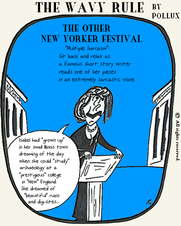
Not based on an actual person or event. Click on the image for a detailed view!
New Yorker Festival: T. Coraghessan Boyle and Mary Gaitskill

_Pollux writes_:
This year marked my first-ever _New Yorker_ festival. It was also my first time in New York City, unless I count a stopover on the way to South America and the time I was there to mark my second birthday.
More momentous than my second birthday, which involved plucking buds off a large potted plant in a hotel lobby, was my introduction to my first event at the festival: short-story readings by “T. Coraghessan Boyle”:http://www.tcboyle.com/ and “Mary Gaitskill.”:http://en.wikipedia.org/wiki/Mary_Gaitskill
The Angel Orensanz Center is a beautiful venue, a Gothic Revival synagogue whose upper reaches were illuminated by a soft blue light, giving the impression that one was in the open night air. Candlelight illuminated the stage, which was occupied by the two literary luminaries.
Gaitskill went first, and read the touching “Don’t Cry.” Boyle then read his funny story “The Lie.”:http://www.newyorker.com/fiction/features/2008/04/14/080414fi_fiction_boyle
The moderator, “Branden Jacobs-Jenkins”:http://www.newyorker.com/online/blogs/books/branden-jacobs-jenkins, joked that the shared theme of the evening was “Babies in Danger”: Gaitskill’s story featured a character named Janice facing dangers in Addis Ababa as Janice’s girlfriend attempts to adopt a baby in the city, while Boyle’s “The Lie” is about a man who plays hooky from work by claiming that his baby has just died.
In the Q&A session following the readings, Gaitskill remarked that writing novels for her is a more difficult process than writing stories, since novel-writing leads to a tendency to go all over the place, like “a confused dog in a field.” She commented that with a short story, she could “aim her brain” in order to compose a shorter, and tighter, piece of work.
The two authors were also asked about the act of reading their stories in front of an audience. Boyle said he likes to read stories that have a complete story arc. He added that he never writes anything for the specific purpose of reading it before an audience, but that the actual rhythm of the words as they are read aloud is just as important as their meaning. He likes to give a good show: “Art is entertainment.”
For Gaitskill, public reading is an opportunity to turn impersonal words into a performance. As she pointed out, public reading uses our most primitive musical instrument of entertainment: the human voice.
With public reading, Gaitskill said she can directly relate to her audience, and customizes her readings to specific audiences. She likes to emphasize certain words depending on her audience, making certain words harder or softer, for example.
Both authors were asked about the film adaptations based on their work. Gaitskill talked about “_Secretary_”:http://www.secretarythemovie.co.uk/html/home.html, which was adapted from one of her stories (the initial short story idea was inspired by a newspaper clipping) and the frustrations and challenges surrounding it.
There was a discussion on internal dialogue, which in a book can be represented or described. In a film, internal dialogue is, for the most part, sacrificed, sometimes to the detriment of plot or the larger meaning of the original work.
It was commented that moviemaking, ultimately, is a group project. The writer has to live with the sometimes dramatic changes involved in the metamorphosis from book to film.
As Boyle, whose novel “_The Road to Wellville_”:http://en.wikipedia.org/wiki/The_Road_to_Wellville, was adapted into a film starring Anthony Hopkins and Matthew Broderick, aptly put it this way: a film is just a like a musician doing a cover of another artist’s song. It’s just a version, and you can’t control it.
Boyle revealed that “The Lie” will also be turned into a film. According to this “blurb”:http://news-briefs.ew.com/2009/10/16/joshua-leonard-of-humpday-to-direct-t-c-boyle-adaptation-the-lie/, it will be directed by Joshua Leonard of _Humpday_ fame.
It was a stimulating evening, and a great introduction, for me, into the minds and mentalities of the participants (both audience and presenters) involved in the 2009 New Yorker Festival.
The Wavy Rule, a Daily Comic by Pollux: The Other New Yorker Festival (#2)
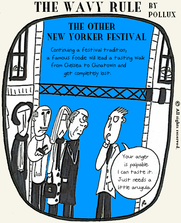
Click on the image for a detailed view!
Next Year’s SXSW Interactive: We’re In!
Emily writes (I’m the only person who contributes to the “Personal” category, but it’s always safe to specify):
I’m incredibly pleased to announce that the panel I proposed for the next South By Southwest Interactive has been accepted out of more than 2,300 submissions–and was in the first batch of the first day of announcements, no less. The lineup of speakers is likely to change slightly, as will the nuances of the discussion, but the longhorn and short of it is, I’ll be in Austin come March in my first official role as a content strategist, or critic of content strategy, or strategic content provider, or online publisher, or maybe just–editor/writer.
If you’re planning to be at SXSW, I’d love to hear from you, and if you have any more suggestions about what I should cover at this event, please let me know!
Ask the Librarians (VII)
This will be the final column in a series we have been enchanted by since Jon Michaud and Erin Overbey, The New Yorker‘s head librarians, agreed to answer readers’ questions about the magazine’s past and present. Their daily investigations into the magazine’s mysteries, and their preservation of its treasures, take all their time; that they so generously gave more of it to us, and that our association developed into a friendship over time, has been one of the most rewarding results of the Emdashes experiment.
Like parents at a graduation, we’re a bit choked up and very proud to announce that Ask the Librarians will soon move to The New Yorker‘s own Back Issues blog. As its debut post explains, “Look out for new features that will offer additional paths into The New Yorker‘s archives–all without paper cuts or dust-induced sneezes.” Gesundheit, godspeed, and we gaily say goodbye. We look forward to the next installment at its new (and wonderfully traditional) home! There’s a new e-mail address for submitting burning research questions, as you’d expect, and it’s tny.archive at gmail dot com. The Ask the Librarians illustration is by Lara Tomlin, whom we also thank for her warm and graceful contribution.
Q. Who have The New Yorker‘s chief fiction editors been, and what were their years of tenure?
Jon writes: For much of its history, The New Yorker frowned on the use of formal titles among its staff. As a result, there have been long periods of time when there was no designated chief fiction editor. Perhaps the best way to answer this question is simply to identify the staff members who have played a significant role in selecting and editing the fiction published by the magazine.
In this sense, The New Yorker‘s first fiction editor was Harold Ross. Ross’s founding concept of the magazine as a “comic paper” included short, often satirical pieces of fiction by the likes of Robert Benchley, Dorothy Parker, and Frank Sullivan. (For many decades thereafter, the fiction department handled the magazine’s humor writers, including James Thurber, E. B. White, Woody Allen, George W. S. Trow, and Garrison Keillor.)
In the late twenties, The New Yorker also began to cultivate and publish more serious literary fiction. A great deal of the credit for this goes to Katharine S. White, who, with Ross’s blessing, solicited work from Kay Boyle, Sally Benson, and others. Later, she would oversee the publication of stories by John Cheever, Vladimir Nabokov, and many other writers now associated with The New Yorker. White had come to the magazine in August of 1925 as a part-time manuscript reader (she was Katharine Sergeant Angell then), but was rapidly given greater responsibilities, and arguably did more than anyone but Ross to shape The New Yorker‘s editorial identity. During the thirties, Wolcott Gibbs and, later, William Maxwell, worked with Mrs. White in the fiction department.
In 1938, Katharine and E. B. White moved to Maine, reducing their contributions to the magazine. A year later, Gibbs became the magazine’s theatre critic. Gustave (Gus) Lobrano, who had been at Town & Country, was hired to fill the vacancy and stayed at the magazine until his death, in 1956. Maxwell left The New Yorker for a time to focus on his writing. When the Whites moved back to New York in 1943, Mrs. White returned to full-time editorial work and continued to exert an enormous influence on the magazine until her retirement in 1957.
William Shawn did not name a new chief fiction editor upon White’s retirement, though Maxwell, who had resumed full-time editing duties in the fifties, was seen as the department’s leading member. Katharine White’s son, Roger Angell, who had been contributing pieces to The New Yorker since the forties, was hired as a fiction editor. Other editors who were prominent during this period were Robert Henderson and Rachel MacKenzie. Writers published in this era included John O’Hara, John Updike, Frank O’Connor, J. D. Salinger, Harold Brodkey, and Mavis Gallant.
Maxwell retired in 1975, by which time he had helped to hire Charles McGrath and Daniel Menaker. Through the late seventies and early eighties, Roger Angell managed the department, which also included Frances Kiernan and Veronica Geng among its editors. McGrath was promoted to co-managing editor for fiction and then to deputy editor before leaving, in 1995, to become editor of The New York Times Book Review. Raymond Carver, Mary Robison, Ann Beattie, Alice Munro, V. S. Pritchett, Jamaica Kincaid, and Bobbie Ann Mason were regularly published during this period.
In 1995, Tina Brown hired Bill Buford to be fiction and literary editor. Buford had edited the English literary magazine Granta since 1978, transforming it from a mimeographed and stapled college journal into an important literary periodical. Menaker went on to become editor of Random House books and continued to contribute pieces to the magazine; Angell stayed at the magazine and, in time, reduced his editing responsibilities in order to do more writing. Fiction writers who made their New Yorker débuts during Buford’s watch include Donald Antrim, A. M. Homes, Martin Amis, Jhumpa Lahiri, and Junot Diaz.
The magazine’s current fiction editor, Deborah Treisman, succeeded Buford in 2002. Treisman first came to The New Yorker from Grand Street in 1997, where she had been managing editor. She was Buford’s deputy for five years before becoming fiction editor. Cressida Leyshon is the current deputy fiction editor. Aleksandar Hemon, Haruki Murakami, Louise Erdrich, George Saunders, Annie Proulx, and Edwidge Danticat have all been regular contributors of fiction to the magazine during Treisman’s tenure.
Q. What’s the history of Shouts & Murmurs? Has it always been written by a different person every week?
Erin writes: Shouts & Murmurs was originated by Alexander Woollcott, in 1929, as an essay column, filled with his musings on literary and theatrical happenings, as well as on the humorous miscellany and scandals of the day. Woollcott was a New York Times drama critic and Stars and Stripes colleague of Harold Ross’s before he joined The New Yorker in 1925. From 1925 to 1939, he also wrote a series of profiles on cultural celebrities, including Harpo Marx, Noel Coward, George S. Kaufman, and Frank Lloyd Wright.
Woolcott’s writing is notable for its ornate style, which was typically at odds with that of his contemporaries at the magazine. Brendan Gill, in his 1975 memoir Here at The New Yorker, said of Woollcott that he “combined a foul mouth with a sentimentality so extreme that he was sometimes referred to even by friends as ‘Louisa May Woollcott.’ ” Here is an excerpt from a Shouts & Murmurs published on August 5, 1933:
I must now break down and admit that, despite all my labors in this vineyard, the Wee Wee Cleaners & Dryers are doing business in Woodside, Long Island; that a drugstore sign in Watertown, Conn., advertises “Little Bibs for Little Spinach Spillers”; and that cards from the Westmoreland Club in Wilkes-Barre, Pa., announce “Club Night and Beer ‘Ception for New Members.” It is now my private ambition to attend a ‘ception at the ‘Quaintance Club out in Forest Hills. It will make me feel socially ‘portant. At such evidence that the Helpy-Selfy-Bekus-Puddy tide rolls on despite all the earnest jeers from this department, you might expect your correspondent, in his discouragement, to throw up his hands as well as his breakfast. But something has just happened to renew this fainting spirit, to revive this drooping head. Incorrigible readers of this page may recall that this campaign was originally inspired by the sight of a roadside eating place north of Pittsfield, in Massachusetts, which, as I noted with a cry nicely blended of incredulity and pain, was called the No Namie. Well, friends, no one can say now that this department his lived in vain. For the sign has come down at last and this summer the No Namie is called The Spot.
Shouts & Murmurs was written solely by Woollcott, and it ran from February 16, 1929 to December 29, 1934. He borrowed the title of the column from his 1922 book of theatre reviews. Woollcott suffered a heart attack during an appearance on the CBS radio show The People’s Platform on January 23, 1943, and he died later that day. He was fifty-six.
Shouts & Murmurs was reborn, as a humor column, in editor Tina Brown’s first issue, October 5, 1992. It replaced the longstanding humor “casuals,” which ran in the magazine for more than sixty years. This time, the Shouts column relied on a variety of contributors, including some of the leading writers and humorists of the last few decades. Those who wrote for Shouts in the nineties and early 2000s include Jay McInerney, John Guare, Martin Amis, Garry Trudeau, Wendy Wasserstein, David Sedaris, Joyce Carol Oates, Steve Martin, Nick Hornby, Salman Rushdie, Elaine May, Jon Stewart, Rick Moody, Noah Baumbach, Paul Rudnick, George Saunders, Woody Allen, and Nora Ephron.
Shouts moved from the back page to the front of the book in 1998. A number of Shouts pieces were collected in Fierce Pajamas, a New Yorker humor anthology co-edited by David Remnick and Henry Finder and published by Random House in 2002. A second New Yorker humor anthology, Disquiet, Please (also co-edited by Remnick and Finder), was released last year.
Q. I have been reading Sloan Wilson’s The Man in the Gray Flannel Suit. I understand that Wilson published some stories in The New Yorker. Can you tell me more about his contributions to the magazine?
Jon writes: Sloan Wilson (1920–2003) published twenty-four stories and two poems in The New Yorker between January, 1945, and October, 1953. The Man in the Gray Flannel Suit, which appeared two years after his last publication in the magazine, was a best-seller and was adapted into a movie starring Gregory Peck in 1956. The novel, which chronicled the domestic and working life of Tom Rath, a Second World War veteran living in suburban Connecticut with his wife in three children, was favorably reviewed in the “Briefly Noted” section of The New Yorker: “Mr. Wilson creates a realistic, perceptive picture of a tiny, frightened life being lived as largely as possible.”
Wilson’s first piece for The New Yorker was a poem, “The Soldiers Who Sit.” Its opening line articulates the goal of many of Wilson’s later stories and novels: “I would like to write a poem about the soldiers in this war.” Wilson served in the Coast Guard and aboard military transport ships in the Pacific. Like “The Man in the Gray Flannel Suit,” Wilson’s stories often deal with the difficulties faced by veterans returning to civilian life.
In fact, it is possible to read a many of his stories as warm-ups for the novel. The characters and the themes are already in place, and he merely needed a larger canvas. In “The Reunion,” an assistant sales manager helps a former shipmate get a better job in part so that he will not have to see him and be reminded of the war. In “Bygones,” a married veteran gets a letter from a woman in Germany with whom he had an affair. In “The Regatta,” a man traveling to the Harvard-Yale regatta aboard a sailboat sees a periscope and is reminded of his service on a submarine during the war.
Malcolm Gladwell used The Man in the Gray Flannel Suit to discuss changing ideas about the way people cope with trauma in the November 8, 2004 issue of The New Yorker. Gladwell contrasted Tom Rath, the protagonist of Wilson’s novel, with John Wade, the Vietnam veteran in Tim O’Brien’s In the Lake of the Woods. Gladwell writes that Tom Rath comes out of Wilson’s novel “stronger, his marriage renewed,” while Wade falls apart and is destroyed by his past.
Reading The Man in the Gray Flannel Suit I found myself thinking of Richard Yates’s Revolutionary Road, a more ferocious novel with a nearly identical subject and setting, published in 1961. (It was also the March selection of The New Yorker‘s online book club). Yates, who was born in 1926, served in Europe immediately after the war. The similarities between Yates and Wilson don’t end there. Yates’s only publication in The New Yorker, “The Canal,” was about two veterans discussing a Second World War battle during a cocktail party. Wilson’s “The Housewarming” tells the story of three men at a party discussing the war and the likelihood of another. In both stories’ closing scenes, a veteran is alone with his wife after the party where they have just been talking about the war. In Wilson’s story, the husband is unable to console his weeping wife: “he couldn’t think of anything at all to say to comfort her.” In “The Canal,” meanwhile, the more vitriolic Yates has his protagonists say to his spouse, “Will you please for God’s sake shut up?”
Q. Janet Flanner and A. J. Liebling famously covered France for The New Yorker. Have there been any other significant international beats, and who covered them?
Erin writes: The magazine has published thousands of foreign letters, from nearly a hundred countries, in its eighty-four-year history. The most famous, of course, is Janet Flanner’s Letter from Paris column, which she wrote under the pen name Genêt. Her Letter from Paris ran from October 10, 1925 (originally as Paris Letter) through September 23, 1939, right at the beginning of the Second World War. Flanner’s column started up again on December 23, 1944, and ran until September 29, 1975. (A. J. Liebling wrote the Letter from Paris column during the Second World War, from October 28, 1939, through November 4, 1944.)
There are other significant foreign letters columns published by the magazine that are less well-known. Mollie Panter-Downes’s Letter from London ran from September 9, 1939, until March 26, 1984. Panter-Downes was an English novelist who published her first novel, The Shoreless Sea, at the age of sixteen. In 1939, St. Clair McKelway sent a telegram to Panter-Downes, asking her to write a column for the magazine about “human rather than political events” in London.
She went on to document both in her column, covering the cultural, domestic, and political scene in London from the Second World War through the nineteen-eighties. In all, she published more than four hundred and seventy Letters from London. The following is an excerpt from a Letter published September 21, 1940, during the London bombings:
For Londoners, there are no longer such things as good nights; there are only bad nights, worse nights, and better nights. Hardly anyone has slept at all in the past week. The sirens go off at approximately the same time every evening, and in the poorer districts, queues of people carrying blankets, thermos flasks, and babies begin to form quite early outside the air-raid shelters. The Blitzkrieg continues to be directed against such military objectives as the tired shopgirl, the red-eyed clerk, and the thousands of dazed and weary families patiently trundling their few belongings in perambulators away from the wreckage of their homes…. The Nazi attack bore down heaviest on the badly nourished, poorly clothed people–the worst equipped of any to stand the appalling physical strain, if it were not for the stoutness of their cockney hearts. Relief workers sorted them out in schools and other centres to be fed, rested, and provided with billets. Subsequent raids killed many of the homeless as they waited. The bombers, however, made no distinction between the lowest and the highest homes in the city. The Queen was photographed against much the same sort of tangle of splintered wreckage that faced hundreds of humbler, anonymous housewives in this week’s bitter dawns…. The “diversion” in Regent Street, where a bomb fell just outside the Café Royal and did not explode for hours, cut off the surrounding streets and made the neighborhood as quiet as a hamlet…. The scene next morning was quite extraordinarily eerie. The great sweep of Regent Street, deserted by everyone except police and salvage workers, stared gauntly like a thoroughfare in a dead city. It would have been no surprise to see grass growing up out of the pavements, which were covered instead with a fine, frosty glitter of powdered glass…. Scenes like this are new enough to seem both shocking and unreal; to come across a wrecked filling station with a couple of riddled cars standing dejectedly by its smashed pumps makes one feel that one must have strayed onto a Hollywood set, and it’s good to get back to normality among the still snug houses in the next street.
Panter-Downes’s first year of London letters was published in 1940 by the Atlantic Monthly Press as the collection Letter from England. She died on January 22, 1997, at the age of ninety. Good Evening Mrs. Craven: The Wartime Stories of Mollie Panter-Downes, a collection of twenty-one of her short stories for The New Yorker, was reprinted by Persephone Books in 2008.
The magazine also ran a series of in-depth foreign letters during the Vietnam War by Robert Shaplen: Letter from Saigon (December 14, 1963–October 6, 1975), Letter from South Vietnam (April 24, 1965–November 13, 1978), and Letter from Vietnam (November 13, 1971–February 24, 1973). Shaplen wrote for Newsweek, Fortune, and Collier’s before joining the staff of The New Yorker in 1952. His pieces during and after the Vietnam War were less reflective of a particular ideological stance than of a persistent and abiding interest in the region and its people. He wrote comprehensively on the political and military strategies of both sides during the war, but always with an eye on the cultural landscape in which they were playing out.
Eventually, he became a harsh critic of America’s participation in the war. Here is an excerpt from a Letter from Saigon, which ran April 21, 1975:
This capital of a lost cause, fatalistically awaiting the climactic hour of the thirty-year Indo-China war, can, at best, become a hostage for peace on predominantly Communist terms if the inept and unpopular Thieu regime is replaced by one that is prepared to negotiate and avoid further carnage. It is generally agreed here that the sooner this happens the better. The mood of the besieged city, now one of benumbed resignation, could easily give way to the panic and hysteria that marked the collapse of Danang and other cities in the past month if the Communists choose the option of outright capture–or simply if, as seems even more likely here than it ever did elsewhere, angry and despairing soldiers and citizens, with nowhere to flee, turn into rioting mobs and vent their spleen on each other and on the six thousand Americans nervously anticipating evacuation…. Politically, American policy here is bankrupt. Too late–far too late–the more realistic American officials have come to admit that Thieu must go…. Whatever merit there is in [Thieu’s] case against the Americans, he seems determined to hang on as long as he can… The net effect of this, in both the Embassy and the Presidential palace, is catatonic. But in recent years, and especially the past year or two, I have increasingly come to feel that everything that happens in Vietnam is phantasmagoric, and that it has all happened before–all, that is, except the vast human tragedy now unfolding. And even this, of course, has been going on for a long time, at a different tempo, but now, at the moment of abject defeat, the futility of everything that has taken place here is being driven home more sharply by the frantic flights for survival, the pell-mell surges of huge numbers of refugees in every direction, the hasty dispatch of orphans abroad–climaxed by the awful air crash outside the Saigon airport–and, in general, the separation and destruction of whole families of innocent city folk and country folk as anger and bitterness have suddenly boiled over…. Perhaps the strangest thing is that, until one really looks beneath the surface, daily life in Saigon continues much as before…. The restaurants are fuller than they have been for several years, because of the influx of foreign correspondents. The flower stalls are still open, though the flowers are less plentiful and seem to fade more quickly. The city responds to a crisis–as it always has–with hidden reflexes, and then lapses back into its ordinary pace.
Shaplen was the author of more than ten books and nearly one hundred and sixty articles for the magazine before his death in 1988. He was among the many who fled Saigon by helicopter on April 29, 1979, as North Vietnamese troops were about to seize the city. In the introduction to his 1986 book, Bitter Victory, he wrote of the war that America “had never properly defined our original commitment, had become overinvolved militarily, had misconstrued our political aims, and then had angrily fought a bootless and cruel war ineffectually.”
One of the longer-running current foreign letters has been Jane Kramer’s Letter from Europe, which began in 1981. Kramer wrote for The Village Voice before joining the staff of The New Yorker, in 1964, and she has written more than one hundred and seventy pieces for the magazine. Her Letter from Europe has covered such varied topics as the election of Francois Mitterand, the Klaus Barbie trial, the coal miners’ strike in Britain, Salman Rushdie’s The Satanic Verses, the rise of Italy’s Silvio Berlusconi, and Pope Benedict XVI’s view on Islam. She is also the author of nine books and the first woman to win the Prix Européen de l’Essai “Charles Veillon,” Europe’s most prestigious award for nonfiction.
More recently, writers Adam Gopnik and Julian Barnes have covered the Paris and London beats for the magazine. Gopnik wrote a Paris Journal column from 1995 to 2005, and Barnes wrote a Letter from London from 1990 to 1994. Gopnik’s column was the seed for his best-selling book, Paris to the Moon (Random House, 2000), and in 1995, Vintage compiled and published Barnes’s London columns as Letters from London.
Addressed elsewhere in Ask the Librarians: VII: Who were the fiction editors?, Shouts & Murmurs history, Sloan Wilson, international beats; VI: Letters to the editor, On and Off the Avenue, is the cartoon editor the same as the cover editor and the art editor?, audio versions of the magazine, Lois Long and Tables for Two, the cover strap; V: E. B. White’s newsbreaks, Garrison Keillor and the Grand Ole Opry, Harold Ross remembrances, whimsical pseudonyms, the classic boardroom cartoon; IV: Terrence Malick, Pierre Le-Tan, TV criticism, the magazine’s indexes, tiny drawings, Fantasticks follies; III: Early editors, short-story rankings, Audax Minor, Talk’s political stance; II: Robert Day cartoons, where New Yorker readers are, obscure departments, The Complete New Yorker, the birth of the TOC, the Second World War “pony edition”; I: A. J. Liebling, Spots, office typewriters, Trillin on food, the magazine’s first movie review, cartoon fact checking.
The Wavy Rule, a Daily Comic by Pollux: The Other New Yorker Festival (#1)
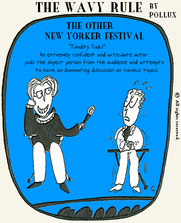
Click on the image for a detailed view!
New Yorker Festival: Ian Hunter and Graham Parker
Martin Schneider writes:
The interview/concert with Ian Hunter and Graham Parker at (Le) Poisson Rouge on Bleecker Street on Saturday night was ridiculously entertaining, and the most atypical New Yorker Festival event I’ve ever seen. I’d hazard a guess that the audience included more non-subscribers than usual. Why? Because the Mott the Hoople crazies were out in force.
Preliminary lubrication included free rounds of margaritas and tequila, which I recommend become standard practice for all future New Yorker Festival events. The first half of the show was talk; the second half, rock (albeit acoustic). The songs were good, but the really entertaining bit was the talk, because Hunter and Parker are cut from the same mold, irreverent, fun-loving, aged rock and roll scamps. I wouldn’t say they took Ben Greenman’s queries very seriously, but they aimed to entertain (with great success), and Greenman gleefully went along for the ride.
If this event had occurred in a movie, the governing conceit would be of two ridiculous washed-up old farts, basking in former glory and totally ridiculous. Fortunately, life isn’t so pat, and there was nothing to suggest that Parker and Hunter ever stopped being formidable creatures; they’re too talented and headstrong for that—and they know it. And besides, the idea that dissolute rock heroes of yore have anything to apologize for isn’t very interesting—or true.
I mentioned that the crowd was a bit raucous. The fans’ identification with both men, but particularly Hunter, was such that virtually every remark was met with either laughter or an intimate form of hostility: this last because when Hunter wasn’t being scurrilous, he was being blunt, as when he revealed that he often doesn’t relish performing or when he temporized about bringing the recently announced reunion of Mott the Hoople to New York City. So in between the laughs, you’d hear cries of “Aw c’mon!” and boos, but with not the slightest whiff of rejection. It was more like bargaining.
Moments after Parker said that the Beatles launched a million British bands, Hunter disagreed, noting that there was a brief window of time when the Beatles’ success didn’t appear to be all that remarkable; other acts had had two successive hits, after all. Besides, Hunter’s a Stones guy.
Both men apparently opened for big ’80s American rock acts. Parker related the difficulty of such gigs: crowds would yell “Fuck off, English faggots!” and then Steve Perry would launch Journey’s set with the statement, “Are you ready for some real rock and roll!?” (Puke.) But even worse was Styx (everyone present seemed to agree). Hunter called Dennis DeYoung of Styx a “prat” and a “pillock.” Ah, British invective.
Asked about the urge to keep writing songs after so much success, Hunter obliquely addressed the compulsion of the blank page with an odd (and American) comparison: “It’s like, Rickey Henderson…. he didn’t have a brain, he had a baseball field….”
I think very few people left disappointed. Kudos to the Festival for thinking outside the box here: this wasn’t the usual Festival fare, but it was a highly enjoyable event that belies the elitism The New Yorker is always accused of.
Set List:
Graham Parker:
[Didn’t catch the name — new song?]
“Silly Thing”
“Things Are Looking Up Of Late” (?)
“New York Shuffle”
Ian Hunter:
“I Wish I Was Your Mother”
“Irene Wilde”
“Man Overboard”
“Once Bitten Twice Shy”
New Yorker Festival: New Math
Martin Schneider writes:
Exhilarating day of four New Yorker Festival events stretched across 14 hours. I’m beat, and yet I have to get at least one of these accounts down now, or they won’t happen at all. I might not be as verbose as I was for Shteyngart/Saunders, but I’ll do my best. (Then again, maybe I’ll write on and on. We’ll see.)
Let’s start with New Math, with Nate Silver, Nancy Flournoy, Sudhir Venkatesh, and Bill James, hosted by Ben McGrath.
I scored a choice seat front row center fairly early, and after a few moments an older gentleman with what I took to be a British accent inquired about the vacant seat next to me. Having ensconced himself in the seat, he asked me what had interested me about this event, and thus began a good quarter-hour of pleasant and stimulating discussion with Graham Gladwell, Canadian mathematician (Ret.) and (of course) father of Malcolm.
Graham showed a lively interest in every subject on offer, as I explained the back stories of James, Silver, Venkatesh. Talk drifted to Malcolm’s latest article about the permanent neurological effects of violent NFL play, and he took the opportunity to reminisce about his youthful days of playing “rugger” and boxing. I must say that this professorial chap looked like just about the last person I could imagine trading jabs in the ring, but that was more or less his point, in his day that was what young men once did at the better schools. Anyway, he’s a wonderful fellow, and I greatly enjoyed chatting with him. (Come to think of it, I enjoy just about every conversation I have at every NYF.)
On to the main subject. I have to preface this by saying that I have only two real intellectual heroes who were important to me in my formative years, and one of them is George Orwell (deceased, 1950), and the other one is Bill James. I think there’s literally no other person on earth the NYF could have enlisted to speak who has more personal meaning to me. And yesterday morning I got to see the man up close, in person. It was obviously a heady moment for me. And I’m going to write about him to the exclusion of the others, if you don’t mind. (After pointing out the grace and wit with which Ben McGrath ran the panel.)
If you don’t know, Bill James has been writing about baseball statistics (and other aspects of baseball) since about 1975, and through a huge amount of work and persistence and insight and originality, was able to teach a new, educated generation of fans a way of looking at the sport that deviated from the rather platitudinous fashion of the previous few generations.
James spoke the least of the four panelists (by far), which fact I ascribe to a kind of reticence and shyness that may—perversely—be typical of the kind of self-directed, bold, irreverent genius (if I may put that out there) James is. Bold on the page, tentative in the flesh, something like that. It might have something to do with the Midwest, too. (James is a Kansan to the bone.)
James had one very good moment, which went almost entirely unnoticed, and one very bad moment, which likely made more of an impression. Let’s start with the misstep.
At a certain point, Venkatesh was discussing the role of statistical analysis in the history of ideas, good and bad, and he made reference to the use of statistics by eugenicists, obviously a pretty bad idea. James actually interrupted Venkatesh to say, no no, eugenics didn’t come out of statistical analysis, at all. Venkatesh countered, Certainly it did—look at Sir Francis Galton. And James said, quote, “Who the hell is Francis Galton?”
(Wince.)
After a bit of exposition by Venkatesh, James recovered with a rather good point, that if the conclusion was so pernicious and agenda-driven, then it can hardly be said that impartial statistical analysis was occurring.
What’s interesting about the exchange is that the mistake, of making such a sweeping statement without command of all the facts, is rather typical of James and yet is also part of what made him such a powerful advocate in the areas in which he knew his shit and was dead right, of which there were many. James sometimes uses the reach of his own knowledge as the measure for the subject, and a lot of times that’s OK but when it’s not you really notice it, as was the case here. If you don’t know about Sir Francis Galton, you probably shouldn’t make sweeping statements about eugenicists. I still find such blunders a small price to pay for his general fearless attitude toward cant. But that’s just me.
The good moment he had was every bit as interesting, I think.
The subject of political ends in relation to statistics was raised, and climate change had already been mentioned as an area in which statistical work is important. James pointed out that something is amiss in a debate in which the statistical basis for the conclusion that humankind is contributing to rapid climate change is essentially the private property of the tiny minority who can actually understand the debate (who all agree about it). If those conclusions are so rock-solid, there must be a way of distilling the arguments/data in such a way that regular people can understand it, and that manifestly has not happened at all. James added that he’s looked into the matter a bit, and he works with statistics every day of his life, and he can’t understand the data either. Something’s wrong here.
I don’t know about you, but I think that’s a pretty trenchant and profound point. Right or wrong, the argument is dysfunctional. The responses of the panelists who tackled James’s point actually dodged the issue. Flournoy made reference to the general heating of the earth since the last Ice Age, and said that the question is whether humans are compounding it, which seems to be the case. Silver made a rather good point, which was that when you have a sound scientific theory (adding carbon to the atmosphere heats the atmosphere) that the data is decidedly corroborating, that makes it far more difficult to dismiss either the data or the theory—but none of that alters the fact that the climate change crowd has failed to create models of the problem that people—the people who vote and could possibly be mobilized to solve the problem—can understand.
In a sense, it’s the scientists who are unwilling to give up their cherished intellectual superiority or whatever institutional perks come with keeping science specialized and arcane, the property of a certain kind of well-paid professional class. And (if the problem is as dire as all that) that’s an awfully high price to pay for such fleeting fame, status, salary, whatever. Just like SUV owners of only a few years ago, that’s the luxury they don’t want to give up. That incomprehensibility isn’t an accident, it has a clear institutional history (specialization etc.). As with Darwinism, the scientists’ attitude has been, basically, “Trust us.” And that kind of thing isn’t going to help us jettison the political static that has been souring the debate—which we’re going to have to do if we want to solve the problem.
I don’t think the panelists, so generally convinced that climate change is a sound theory (perhaps on a second-hand basis), quite grasped the point James was making. He wanted to argue about what’s wrong with the nature of the debate and the data, and what he got in response was the reasons to believe the experts—without a word about how we can, in practical terms, bring the debate to the people so that they can accept it (if it’s such a sound theory).
Afterward, in that random milling about that always occurs after such panels, I bounded on stage and told James how important his work had been to me, and I shook his hand. That felt really good!
So there you have it. James is my intellectual hero, and warts and all, I’ll pit mine against yours and I’ll win best three throws out of five, dammit. (Is that the expression?) Maybe Professor Graham Gladwell (Ret.) can be the referee.
Not Making a Hash Out of Hashtags
Unless it’s a delicious corned beef hash. New Yorker fans all talking to each other–we like it!