
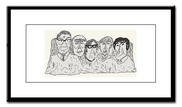
to tell you that we think “The Editors of The New Yorker,” Pollux’s drawing of Harold Ross, William Shawn, Robert Gottlieb, Tina Brown, and David Remnick, is so suitable for framing that it’s already framed, and available from those clever ducks at CafePress. Buy one for your favorite New Yorker lover and hang one in your office to remind yourself that you won’t let your standards slip, economy be damned. These five wouldn’t stand for it, and, with them keeping watch, neither will you! –E.G.
Monthly Archives: October 2009
New Yorker Festival: Saunders/Shteyngart Reading
Martin Schneider writes:
I have a friend who generally misses out on the first rush of New Yorker Festival ticket-buying and then finds himself disinclined to purchase tickets to the more readily available Friday author events because “why pay when you can see them at Barnes and Noble for free?” A fair point, for which there are sound responses, the main one being that not everyone who attends the Festival lives in New York (even if he does, and I do). But beyond that, the author events are not usually “just” readings, there’s often a conversation or a moderator livening things up.
But on some level I grant the premise. However you cut it, the Saturday and Sunday events are much more “value-packed” than the Friday author evenings, which the Festival recognizes by charging more for them. And truth be told, I would prefer an interview/conversation to a reading. And with two such great talkers as George Saunders and Gary Shteyngart—it’s quite possible that they would break my brain, or I would topple over in laughter, or something.
As I say, I was expecting talk, so when it became plain that Shteyngart and Saunders would be reading rather than talking, I was a bit crestfallen.
But not for long. It turns out that both men read just as well as they talk, and they talked afterward anyway.
Shteyngart read from his recently completed novel—if the name was mentioned, I didn’t catch it. It sounds like a humdinger, though, and I have a hunch it’ll be superior to his second novel Absurdistan, which I liked, and his first novel The Russian Debutante’s Handbook, which I haven’t gotten to but everyone else seemed to like. (Quick note: Shteyngart, who conforms to the archetypal “card” figure, can’t resist messing with the names of his books when he talks or writes about them. Anyone who’s read Absurdistan knows that he likes to refer to his first book as “The Russian Debutante’s Handjob,” or some such variation, and tonight I learned that he calls his second book “A-blurb-istan.”)
Anyway. The new book is set a year or eight into the future and features heightened and nightmarish versions of our contemporary life, a bit like Infinite Jest, perhaps. As Cressida Leyshon explained in her introduction, in the new book (paraphrasing) “America has defaulted on its debt to China, every citizen is defined by their credit rating, and nobody reads anymore.” As I say, this is a most promising brew. Shteyngart’s excerpt involved the protagonist bringing his new girlfriend to meet his Russian-immigrant folks out in Long Island, and it was very funny.
Afterward Shteyngart related that he had been fiddling with his initial plot elements in 2006 or so, among which were such outlandish possibilities as the collapse of the financial system as well as the Big 3 automakers—as well all know, events rendered that particular vision trite, so he had to find ways to make it all even worse….
Saunders read, as I was hoping, from his most recent New Yorker story “Victory Lap,” which, as Jonathan Taylor noted, is one of those stories that really sticks with you. I heartily agree! Saunders said it was the first time he had ever read it to an audience. (Nice!) The story is a mite confusing on the page, to be frank, but no less affecting for that. To hear Saunders channel a teenage girl, a teenage boy, a malevolent fellow, two sets of parents, and a baby deer was quite breathtaking and did much to clarify the precise course of events as well. So far as I could tell, the audience was rapt.
The discussion portion was full of quick wit and insight. My favorite bit came when Shteyngart explained the backstory of a scene from one of his novels, an event from his own life in which the brandishing of an American Express card was enough to stave off a pack of Czech skinheads. Instantly, Saunders: “Now that’s a commercial!”
As We Dash and Listen and Tweet and Sketch, Follow the Festival Blog…
Emily Gordon writes:
We’re in full Festival mode, Paul went back to his hotel just to draw about the Mary Gaitskill and T. C. Boyle event, and we’re tweeting like the mid-flight rockin’ robins we are, but in between bites of our hors d’oeuvres, you’re going to want some equally tasty tapas, and that you can find at the official Festival blog. Sneak preview: Jon Michaud, co-author of our soon-to-be-upgraded-to-first-class column Ask the Librarians, reports, to my pleased wonderment, that at last night’s event “Tales Out of School,” “Throughout the evening, the deputy books editor, Leo Carey, provided musical interludes on his cello.”
More reports from Martin and me tomorrow, and while Paul is going to do most of his rounding up and reflecting back home in Los Angeles, we’re already sure his posts are going to rock our world, since that’s what he does in Sempé Fi every week. We’ve been told that the title of that column is perhaps the most meta of our admittedly very meta activities here, and we smile shyly and say, “That’s just what we were going for.”
I’d like to add, gratuitously but happily, that I’ve always been glad I asked Cartoon Caption Contest winner #29 and Park City, Utah, resident T. C. Doyle how he felt about the work of T. C. Boyle, who had a story published in The New Yorker the very same week as the announcement of Doyle’s winning caption. Those Caption Contest winners are funny folks, the lot of them. (Also, smart; read what he says about Bruce Eric Kaplan.) And persistent, too!
The Wavy Rule, a Daily Comic by Pollux: The Hobbit Premiere

Click on the cartoon to enlarge it!
Read “The Wavy Rule” archive.
Festival Friday: Tix Still Available, “Tailing Tilley” Rained Out, &c.
Martin Schneider writes:
According to the New Yorker Festival’s Twitter feed, tickets to most events are available today at the Cedar Lake Theater at 547 West 26th St. (One hour left to buy!) This will presumably mean that there will be a few more tickets available at individual events.
“Tailing Tilley,” the interactive walking game involving Eustace Tilley, has been cancelled due to inclement weather. Dommage! The Festival “will be restaging it at a future date and tickets will be honored or refunded.”
For Festival veterans, note that there is no “Festival HQ” this year. As a substitute, the Festival is using the Conde Nast Building for quite a few of the Sunday events. The book signings are happening at McNally Jackson Books at 52 Prince Street.
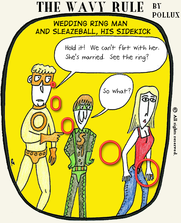
The Wavy Rule, a Daily Comic by Pollux: Wedding Ring Man and Sleazeball
Click on the cartoon to enlarge it!
Read “The Wavy Rule” archive.
Festival News: Proulx Event Cancelled, Lahiri Event Added
Martin Schneider writes:
Unfortunately, the Annie Proulx event on Saturday morning has been cancelled due to Ms. Proulx being “under the weather.” We hope that it’s just that and not something more serious. Get better soon!
Ticketholders for the Proulx event will receive a refund.
The Proulx event has been replaced, with some alacrity, by the following event:
In Conversation With
Jhumpa Lahiri
Interviewed by Deborah Treisman.
Saturday, October 17 at 10:00AM
at Florence Gould Hall
55 East 59th Street
New York, NY 10022
Between Park & Madison Avenues
4/5/6 to 59th Street & Lexington
Buy tickets here!
Review: “A Gate at the Stairs” (Newsday)
Lorrie Moore unlocks ‘A Gate at the Stairs’
By EMILY GORDON
A GATE AT THE STAIRS, by Lorrie Moore. Alfred A. Knopf, 322 pp., $25.
Lorrie Moore inspires fierce loyalty, for good reason: She’s the sheriff of a wild and lonely territory, in which empathetic people fight despair with charming words. Her language — its puns, musical refrains and catchphrases — only partly hides the sadness behind it. The result is that kind of silliness that peaks just seconds before bursting into tears.
The crises Moore addresses with high-spirited clowning have included romantic confusion, isolation, illness, death and even loss on a mass scale. Moore’s new novel, “A Gate at the Stairs,” artfully blends all these themes into a tale that’s as much a shifting of emotional seasons as it is a narrative.
Tassie Keltjin, a student in a college town much like Madison, Wisc. (where Moore lives and teaches fiction), takes a job as a nanny for a dynamic but scattered restaurateur, Sarah, who’s unable to conceive with her husband, Edward. The daughter Sarah adopts, a biracial little girl named Mary-Emma, brings out everyone’s desire to nurture, but the question of how best to love remains foggy. The parents who attend Sarah’s weekly rap sessions for parents of biracial children, preoccupied by origins and identity, can’t seem to get beyond talking in excitable circles. At the same time, Tassie falls in love with a friendly Brazilian in her Sufism class. But something is clearly not right, with either him or Sarah and Edward.
Why is the past so incongruous and confusing? These are persistent questions for everyone, but particularly so for Tassie, who was raised by moderately successful organic farmers in the country outside this liberal town. Tassie, who’s adjusting to work, love and living on her own, is continually stunned by newness, even as it amuses her. She can be the competent one on her volatile travels with the strong-willed Sarah and the vulnerable Mary-Emma, and with her slightly loopy roommate, but her dealings with the Brazilian are harder: she doesn’t heed the drastic signs of trouble until it’s far too late.
Moore never says so explicitly, but civic life after 9/11 is a backdrop throughout: governments, employers, boyfriends, teachers and parents engage in doublespeak, only to deny it moments later. Perhaps the most uncomplicated voice here come in the e-mails from Tassie’s younger brother, Robert, who is keenly seeking her guidance, but she’s too distracted to oblige.
Unlike the parents’ meetings, which sound like jumbled bumper stickers, Tassie’s interior monologue is sharp and specific and, needless to say, extremely funny — all a familiar balm to Moore fans. Similarly, Tassie’s conversations with her roommate are hilarious and true to life.
In the second half of the book, a terrible death enters the narrative. And Tassie’s linguistic playfulness, which transforms ugly facts and incoherent action into logic and wit, becomes far darker — but also much more lyrical. She returns home, city to country, down to earth. This is a new country: a pastoral Lorrie Moore novel. Tassie grows up, yes, but this is no mere coming-of-age novel. She embraces the death that is part of life. In the process, she, and Moore the novelist, enter a new realm of maturity and understanding.
(September 17, 2009)
Something Is Going On With That George Saunders Story
Jonathan Taylor writes:
I don’t read New Yorker fiction that regularly. I don’t bring up a New Yorker story and say, Did you read…? I did both with George Saunders’s “Victory Lap.” And then the person I say it to, who also doesn’t talk to me about New Yorker fiction, suddenly says she’s been thinking about it ever since she read it.
Emily recalls a similar flurry of people being struck and moved en masse when Lorrie Moore’s story “People Like That Are the Only People Here” came out in the magazine in 1997.
It’s true—you should read it on paper. On the subway, tonight.
A Feast of Friendly Links: R. Crumb, Lorrie Moore, Mad Men, W. H. Auden
Emily Gordon writes:
I haven’t done any link roundups in a while, but here are a few I think you’ll dig as we all gear up, from near and from far, for The New Yorker Festival. This post is also a celebration of some writer friends whose preoccupations often collide with mine:
My friend and Print contributing editor Bill Kartalopoulos comments on R. Crumb’s new Biblical epic.
My friend and thug-thumping Wisconsin labor advocate Dustin Beilke interviews the great Lorrie Moore for The Onion‘s AV Club. I reviewed her terrific new book, A Gate at the Stairs, for Newsday.
I can’t get enough of posts about the typography in Mad Men. These are already classics: my friend and content-strategist-about-town Andrew Hearst on the “jarring anachronism” of using Arial in the end credits; and Mark Simonson, designer and type designer, on–well, just read it. Featuring a cameo by our beloved Gill Sans.
And this isn’t exactly New Yorker-related, but Sophie Pollitt-Cohen, my favorite former babysat child (we need to coin a word for this) and frighteningly bright daughter of Katha “Learning to Drive” Pollitt and Randy “The Ethicist” Cohen (who are contributors), has a very funny new Huffington Post piece up about “comic books inspired by verse.” Speaking of being inspired by verse, happy birthday, Katha, far away in Berlin but always close to my thoughts!