A friend passes on information:
Acclaimed British writer Zadie Smith’s first book, White Teeth, won a number of awards, including the Guardian First Book Award and the Whitbread First Novel Award. Smith’s second novel, The Autograph Man, won the 2003 Jewish Quarterly Literary Prize for Fiction. On Beauty was published in 2005, and won the 2006 Orange Prize for Fiction.
Jonathan Safran Foer is the best-selling author of Everything Is Illuminated, which won numerous awards, including the Koret Award for best work of Jewish fiction of the decade, and, like White Teeth, the Guardian First Book Award. His second novel, Extremely Loud and Incredibly Close, was a finalist for the IMPAC Prize. Foer joined the NYU Creative Writing Program faculty in 2008, and lives in Brooklyn,
New York.
Date: Thursday, April 30th, 7:00 p.m.
Location: Tishman Auditorium, Vanderbilt Hall, 40 Washington Square South
Monthly Archives: April 2009
The Wavy Rule, a Daily Comic by Pollux: Crazy Ivans

Click on the cartoon to enlarge it!
Read “The Wavy Rule” archive.
New Yorker Covering “Swine Flu” Story since the Ford Administration
Martin Schneider writes:
Credit Twitter users supergork and echidnapi with the catch.
In the May 31, 1976, edition of The New Yorker, there appeared a “casual” (what today would be filed under “Shouts & Murmurs”) by Richard Leibmann-Smith satirizing the hullabaloo surrounding awards ceremonies. Leibmann-Smith spent page 31 (subscribers only) musing on the following scenario: what if the “Academy” in “Academy Awards” signified the American Academy of Medicine? What if there were a “Jonas” instead of an “Oscar,” with the categories Best Disease, Best Symptoms, Best Virus, and Best Potential Epidemic? Riffing on the most recent Oscar winner, One Flew Over the Cuckoo’s Nest, which had also effected a sweep of all the major categories just two months earlier, Leibmann-Smith chose as his awards juggernaut “Swine flu,” as in the piece’s title (prepare wince reflex), “Swine Flu Over the Cuckoo’s Nest.”
On the intersection of Twitter and swine flu, Randall Munroe expresses more amusingly something I had noticed as well.
Sempé Fi (On Covers): Journey’s End
Pollux writes:
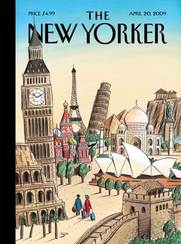
A collection of world monuments grace the cover of the April 20, 2009, issue of The New Yorker. These are the landmarks you have to see before you die—or at least, that’s what people say. It may be that one becomes reincarnated as a docent at the Taj Mahal or a Qualified, Talented, Experienced, Enthusiastic, Friendly employee of Walking Tours of Pisa, thus making your travels in this lifetime pointless.
Despite the world’s construction efforts and fervid competition between nations, the list of famous world landmarks has remained fairly standard over the past half-century or so. New buildings and structures have not supplanted Big Ben, the Eiffel Tower, and the Statue of Liberty. The London Eye has not become the landmark most associated with London.
In Italy, efforts to recreate the “Bilbao Effect,” the economic boom that occurred after the building of Frank Gehry’s Guggenheim Museum in that Basque city, have produced exciting, interesting buildings (Renzo Piano’s Parco della Musica; Richard Meier’s Jubilee Church; Meier’s Ara Pacis Museum), none of which are instantly recognizable landmarks, although we can judge Berlusconi’s Ego to be a recognizable Italian landmark.
China, despite gargantuan Olympic efforts, still relies on that ancient but great Wall to the north, as ineffective against marauding Mongolians in centuries past as it is effective at pulling in tourists.
Jacques de Loustal, who is, according to his website, a fan of the Fauvists, here holds back from the vivid coloring that characterizes his work and that of the Fauvist movement. His New Yorker cover is almost lugubrious, as if he were expressing the fact that all of the challenges and adventures associated with traveling are gone. Gone are the strong reds and bright blues that usually characterize his work.
His cover, entitled “Ultimate Destination,” is ultimately an exercise in sobriety, displaying little of the playfulness seen in his other travel-themed cover for The New Yorker, for example, which depicted two travelers dressed for a hard winter strolling across an exotic, subtropical beach.
“How do you see these trees? They are yellow,” Gauguin once advised. “So, put in yellow; this shadow, rather blue, paint it with pure ultramarine; these red leaves? Put in vermilion.” De Loustal puts in none of these. Perhaps it is intentional. All travel requires these days is a stroll in a graveyard of monuments, where we’re immunized from “real life” in Russia, China, or Australia, for example. Perhaps we are all traveling gnomes when we travel, and all we require is to have our picture taken in front of a landmark. And then we move on. We have conquered and landmark-spotted the monuments on our list, and now we can ignore the country and the routes that surround them.
The famous monuments have been transplanted for the benefit of two well-dressed travelers, who drag Samsonites down an unmarked and lonely route. The Statue of Liberty shares the same Loustalian waterway with a Venetian gondola, while the Parthenon looks over both. The Leaning Tower of Pisa tilts perilously close to the Pyramids while the Eiffel Tower remains as ramrod straight as a 1,000-foot baguette.
The world is flatter and the world is smaller. In this shrunken world of ours, it is possible to get a picture taken in front of St. Basil’s Cathedral and the next day find oneself at the Sydney Opera House’s gift shop, located in the lower concourse of that New South Wales landmark. You’ll be exhausted, of course, which will explain your purchase of a box of authentic tile fragments collected during the building’s original construction and sold for 135 Australian dollars.
As the Spanish say, “el mundo es un pañuelo“—”the world is a handkerchief,” and the world has become more a single ultimate destination devoid of context than a series of diverse, disparate locations.
What’s in This Week’s New Yorker: 05.04.09
Martin Schneider writes:
A new issue of The New Yorker comes out tomorrow. A preview of its contents, adapted from the magazine’s press release:
Philip Gourevitch, who covered the genocide in Rwanda for The New Yorker and in his book We Wish to Inform You That Tomorrow We Will Be Killed With Our Families, revisits Rwanda on the fifteenth anniversary of the genocide to meet with some of the people he previously profiled, and explores the unique reconciliation process that has been taking place there; today it is “one of the safest and the most orderly countries in Africa,” Gourevitch writes.
Ryan Lizza goes behind the scenes at the White House to chronicle how Peter Orszag, the new director of the Office of Management and Budget, put together the Obama Administration’s first budget.
Peter J. Boyer profiles Larry Jones, the racehorse trainer who trained Eight Belles, the horse that had to be euthanized at last year’s Kentucky Derby, and one of this year’s Derby hopefuls, Friesan Fire.
Jerome Groopman writes about new drugs, developed to treat cystic fibrosis, that may be able to correct the mutated gene responsible for the disorder.
Hendrik Hertzberg asks if it might be better to let Texas secede.
Lauren Collins talks to Dolly Parton about New York and her new musical, 9 to 5.
In Shouts & Murmurs, Noah Baumbach describes bees getting “buzzed.”
Nancy Franklin reviews Amy Poehler’s new comedy, Parks and Recreation.
Peter Conrad explores the work of the Portuguese writer António Lobo Antunes.
Peter Schjeldahl attends “The Pictures Generation” at the Metropolitan Museum of Art.
Joan Acocella watches dance works by Merce Cunningham and Karole Armitage.
Alex Ross covers Esa-Pekka Salonen’s farewell to the Los Angeles Philharmonic.
Anthony Lane reviews Il Divo and The Limits of Control.
There is a short story by Gail Hareven.
The Wavy Rule, a Daily Comic by Pollux: Invisa-Skew
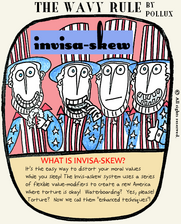
Click on the cartoon to enlarge it!
Read “The Wavy Rule” archive.
Egrets and Tigers and Editors, Oh My! Matthiessen on Wondrous Creatures
Martin Schneider writes:
File it under “lectures I wish I’d seen.” Yesterday, 81-year-old author Peter Matthiessen appeared at the Emerson Center in Bozeman, Montana, to tell tales from his adventuresome life, one that combines working as a commercial fisherman with helping George Plimpton found The Paris Review, undertaking naturalist expeditions in Siberia with submitting revisions to William Shawn.
Matthiessen described Shawn as “one of the strangest guys you could imagine” but also fiercely loyal to his writers. One suspects that to the good citizens of Bozeman, the valuable plumage of egrets and the “big red ears” of Shawn belong to much the same category (certainly, Gail Schontzler of the Bozeman Daily Chronicle implies as much).
Is Matthiessen speaking in New York any time soon? Is his novel Shadow Country the masterpiece many have claimed? I think the answers go “no” and “yes,” which I’ll regard as a glass half full.
The Wavy Rule, a Daily Comic by Pollux: Punctuated by Taste
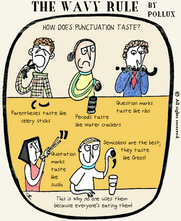
Click on the cartoon to enlarge it!
Read “The Wavy Rule” archive.
Finnegan Wins Second Overseas Press Award
Jonathan Taylor writes:
Congratulations to William Finnegan, winner of this year’s Overseas Press Club Madeline Dane Ross Award, presented to the “best international reporting in the print medium showing a concern for the human condition.” Finnegan was honored for his May 5, 2008, piece, “The Countertraffickers.”
The Wavy Rule, a Daily Comic by Pollux: Peace and Quiet

Click on the cartoon to enlarge it!
Read “The Wavy Rule” archive.