
Martin Schneider writes:
Shortly after the Stimulus Bill was passed in February, Steve Coll began a project of reading through the entire legislation and blogging about it at newyorker.com. This website has ignored that worthy development for far too long, and now, almost as if to remind us to post about it, Coll has done an invaluable “diavlog” with Michael Grabell of ProPublica, which is also covering the stimulus in great detail.
The stimulus bill is one of those subjects that probably a great many people wish they knew more about; probably far too many of us are exposed to media speculation over the politics instead of actual analysis of the bill’s real-world effects. If that describes you, I think the diavlog dialogue is an excellent starting point for further investigation. If nothing else, it will introduce you to a handful of overriding themes, as well as act as a prod to read the coverage Coll and Grabell are providing elsewhere.
On that subject, if you haven’t been reading Coll’s stimulus updates, we provide a public service of linking you to Coll’s “Blogging the Stimulus” posts. But we’ll go that extra step further and link to each of the posts, to provide that little bit of overview that might make it easier for some to dive in.
March 2, 2009: “Blogging the Stimulus Bill”
March 4, 2009: “Notes on Agriculture”
March 6, 2009: “The Census-Taker Full Employment Act”
March 6, 2009: “Policing the Recovery”
March 9, 2009: “Where No Stimulus Has Gone Before”
March 11, 2009: “Cooling Off Soldiers”
March 19, 2009: “Microloans for Unemployed Journalists?”
March 23, 2009: “Made in the Homeland”
March 31, 2009: “Old School Stimulus”
April 3, 2009: “Role Models”
April 13, 2009: “Smart Medicine”
April 17, 2009: “Schooling the Stimulus”
April 21, 2009: “Investing in Soldiers”
Monthly Archives: April 2009
Mirror Awards Bestow Nominee Status on Alterman, Auletta, Parker
From the press release:
Syracuse University’s S.I. Newhouse School of Public Communications today announced 29 finalists in six categories in the third annual Mirror Awards competition honoring excellence in media industry reporting. The competition drew nearly 140 entries. Fellow journalists and members of the media may vote for their favorites among the finalists by visiting mirrorawards.syr.edu/vote.cfm. Winners will receive the People’s Choice Award.
The media’s top writers, readers and leaders will gather to fete the Mirror Award winners at an awards ceremony in June in New York City. Ceremony details will be announced soon.
Finalists, chosen by a group of journalists and journalism educators, are:
Best Single Article–Traditional
* Eric Alterman, “Out of Print” (The New Yorker)
* Ken Auletta, “The Search Party” (The New Yorker)
* Seth Mnookin, “Bloomberg Without Bloomberg” (Vanity Fair)
* Clive Thompson, “Is the Tipping Point Toast?” (Fast Company)
[snip]
Best Profile–Traditional
* Mark Bowden, “The Angriest Man in Television” (The Atlantic)
* Mark Bowden, “Mr. Murdoch Goes to War” (The Atlantic)
* Lloyd Grove, “The Last Media Tycoon” (Condé Nast Portfolio)
* Charlie LeDuff, “Robert Frank’s Unsentimental Journey” (Vanity Fair)
* Ian Parker, “The Bright Side” (The New Yorker)
* Richard Pérez-Peña, “Web Sites That Dig for News Rise as Watchdogs” (The New York Times)
* Evgenia Peretz, “James Frey’s Morning After” (Vanity Fair)
[snip]
The Mirror Awards, established by the Newhouse School in 2006, honor the reporters, editors and teams of writers who hold a mirror to their own industry for the public’s benefit. Honorees are recognized for news judgment and command of craft in reporting, analysis and commentary on developments in the media industry and its role in our economy, culture and democracy.
For the full list of nominees, visit http://mirrorawards.syr.edu/vote.cfm—and vote!
Garry Trudeau Twitters, Talks (About Town), Takes a Moment to Tweflect
Emily Gordon writes:
1. Garry “Doonesbury” “Awesome” “Of Whom I Am a Lifelong Fan” Trudeau started Twittering as his self-absorbed, intrepid newsman character Roland Hedley.
2. Trudeau writes (or excerpts, or compiles) a Talk of the Town with some choice tweets from Hedley’s mystic journey to the G-20 Summit.
3. Mediabistro’s TVNewser interviews Trudeau about the whole twemonenon.
4. Starting words with “tw” is still funny, and maybe, like saying “www dot” to start a funny word or phrase to ironically convey its currency, it always will be.
Bob Staake (and Bo) Stump the Bag: Readers, Weigh In!
Martin Schneider writes:
One of my favorite political blogs goes by the somewhat unwieldy name BAGnewsNotes. The M.O. of Michael Shaw, who runs the site, is to interpret visual imagery in the political arena as an English major might dissect a poem. The symbolism of a hand gesture in an Associated Press photo of Hillary Clinton; a Newsweek cover that seems to say more than it intends; the inadvertent bestowal of a halo on the pate of President Obama, that sort of thing. It’s delightful, and after a while it gets you seeing news photos in a completely different way.
Sometimes, Shaw lets his readers have the first crack at the interpretation; so it was, today, with the current cover of The New Yorker. (I think I agree with “DennisQ” so far…) Have a look and add your thoughts, if you wish.
Liebling: Embraced by The Smart Set
Martin Schneider writes:
A few months ago I was a little hard on an A.J. Liebling article about Chicago. Fortunately, Michael Gorra’s generous and lengthy assessment of the new Liebling volumes from the Library of America provides an occasion for me to reconsider. It’s in The Smart Set, courtesy of Drexel University, and it’s well worth a look. One reason I like The Smart Set is that their visual aesthetic is a bit like ours!
William Hamilton, Jack Russells, Mint Juleps, and Quality Road
Emily Gordon writes:
From the Andover homepage, courtesy of my alumni email newsletter (I went there for only a year, but it was an eventful year!), a nice horse story that also has a New Yorker cartoonist connection:
**Horse breeder Ned Evans ’60 has a Kentucky Derby contender**
April 15, 2009 – According to renowned New Yorker cartoonist and fellow PA alum **William Hamilton** ’58, Ned Evans would rather spend the day with his four Jack Russell terriers on his 3,000-acre farm in Casanova, Va., than sipping mint juleps at Churchill Downs on May 2. But Evans will just have to settle in and make do: his colt, Quality Road, posting 5 to 1 odds, will be competing in one of the biggest horse racing events of the year–the Kentucky Derby.
A top-ranked North American equestrian breeder, Evans has raised horses for 40 years on his sprawling Spring Hill Farm. And although he’s turned out some 70 stakes winners, three-year-old Quality Road is his first Derby contender. Evans, however, declines to partake just yet in the sweet conjecture of what a Derby victory would mean to him.
“I’ll tell you afterward what it means,” he proffers. “I’m mainly concentrating on getting there and doing the best we can.”
After graduating from Andover, the Greenwich, Conn., native earned a BA degree from Yale in 1964 and an MBA degree from Harvard in 1967. Known to many in New York’s top business circles as a shrewd entrepreneur, Evans’s many successes culminated in 1979 when he became chief executive officer of publishing giant Macmillan, a position he held for more than a decade.
What some associates may not have known until recently is that starting in 1970, while climbing the ranks of New York’s business world, Evans, a self-proclaimed “weekend commuter,” was quietly creating and expanding a vast horse farm on the old Civil War grounds of Virginia’s rolling countryside. Today, Spring Hill is home to roughly 200 horses at any one time, all handpicked and paired for breeding by Evans himself.
“I arrange all the matings and 15 months later a foal is born,” says Evans. “They don’t go into training until they’re 2, and all kinds of things happen along the way, not enough of them good.”
But it wasn’t until this past November that Evans knew he had bred a special one. Quality Road had burst onto the scene for his maiden race at Aqueduct and “caught everyone’s eye,” says Evans. According to reports, the proud owner turned down a $2.5 million offer for the galloping wonder and decided he would take Quality Road to the Derby himself, thank you very much.
As for what Evans would do if Quality Road were to take the Derby title, his fond friend Hamilton may know best. “A Derby win would leave him at least briefly ecstatic. He would probably give his terriers a treat and smile a moment at the sky.”
To which Evans replies, “He seems to know the situation.”
The Wavy Rule, a Daily Comic by Pollux: “Untersetzerangst”
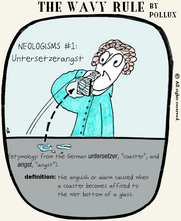
I felt we needed a word for an emotion we all feel sometimes. “Coasters with smooth flat surfaces,” as explained “on one site”:http://hubpages.com/hub/The-Many-Options-in-Buying-a-Coaster-Set, “often pool the liquid and this causes the glass or cup to stick to the coaster. Then when you pick up the glass or cup to take a drink, you find the coaster stuck to the bottom. If you don’t catch it in time, it will fall to the floor and possibly break into pieces.” And then your heart breaks too, because everyone loves coasters. Click on the cartoon to enlarge it!
Read “The Wavy Rule” archive.
The Wavy Rule, a Daily Comic by Pollux: Escape From Lorem Ipsum

Overall the city is well managed, but the Lorem Ipsums are blighted by violence, poverty, and bad graphic design. Click on the cartoon to enlarge it!
Read “The Wavy Rule” archive.
Hunting and Deciding: NYC Event Today With Jonah Lehrer
From the press release:
Please join us today—Monday, April 20—at 6 p.m., on the 7th floor of 20 Cooper Square, for food, drinks and a conversation with one of the brightest lights in the journalism of ideas: Jonah Lehrer.
Jonah will be discussing a story he wrote last summer for The New Yorker entitled “The Eureka Hunt: Why Do Good Ideas Come To Us When They Do?” That story sprung from his research for his latest book, How We Decide, which was published in February by Houghton Mifflin. Jonah will also be talking about the nexus between his book research, his magazine pieces and his very active blog, called The Frontal Cortex, which focuses on neuroscience. And yes, he’ll also be fielding questions about his recent appearance on The Colbert Report.
You can download Jonah’s New Yorker story at http://tinyurl.com/66qqhw. You can read his blog at http://scienceblogs.com/cortex.
The editor at large for Seed magazine, Jonah Lehrer is the author of Proust was a Neuroscientist (Houghton Mifflin, 2007) as well as How We Decide. In addition to The New Yorker and Seed, he has written for Nature, Wired, The Washington Post and The Boston Globe. He is also a contributing editor at Scientific American Mind and National Public Radio’s Radio Lab. A Columbia graduate, he also studied at Oxford as a Rhodes Scholar. The New York Times called Proust was a Neuroscientist “a precocious and engaging book that tries to mend the century-old tear between the literary and scientific cultures.” Publishers Weekly called How We Decide “a fascinating book . . . that will help everyone better understand themselves and their decision making.”
This event is part of the four-year-old “Inside Out” speaker series sponsored by the Science, Health and Reporting Program (SHERP) at NYU’s Carter Institute of Journalism. Leading the conversation, as usual, will be Robert Lee Hotz, distinguished writer in residence at the Carter Institute and the science columnist for The Wall Street Journal.
For logistical details, see: http://journalism.nyu.edu/events/?ev=2008-jonahlehrer
Omit Needless Controversy: Fifty Years of Strunk and White
Martin Schneider writes:
The fiftieth anniversary of the publication of Strunk and White’s The Elements of Style was last Thursday. I’m a copyeditor by trade, so one might say professionally implicated. My love of accuracy compels me not to pretend that the book is universally admired by all those who love words; far from it. (So much strong feeling!) For my part, I’ll just say it communicated certain things I needed to know at certain times in my life, and for that I am grateful.
A less contentious issue is E.B. White, who is always worth celebrating. Levi Stahl of I’ve Been Reading Lately has been lately reading his letters (you know, in a book, not in his desk drawer or anything), which sound delightful.
Oh yes, I almost forgot: subscribers can read the original 1957 article that sparked the publication of the book.