_Pollux writes_:
“You people should be ashamed of yourself,” Elaine complains to _The New Yorker_’s cartoon editor in one _Seinfeld_ episode. “You know ya doodle a couple of bears at a cocktail party talking about the stock market ya think you’re doing comedy.”
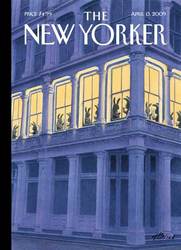
At first glance, “Harry Bliss’s”:http://www.harrybliss.com cover for the April 13, 2009 issue of _The New Yorker_ seems to be exactly what Ms. Benes was complaining about: a couple of cute animals talking about the stock market at a cocktail party. In this case, we see rabbits, not bears, but what is perceived as the spirit of the stereotypical _New Yorker_ cartoon and _New Yorker_ cover is there.
But Bliss’s cover is serious in intent, not comedic, and it visualizes a world in which we’re outside looking up at a convention of earnest Easter Rabbits, or perhaps ordinary gray rabbits (if rabbits who attend cocktail parties are ordinary), taking place in a late hour of the night. We’re shut out from the conversation, and from the warm yellows of a social club as we stand in a cold, violet-tinted avenue.
From street level, we can only imagine the low murmur of the rabbits and the clink of glasses bearing classy drops of Romanée-Conti. What are they discussing? Hindgut fermentation? The bail-out of Fannie Mae and the Flopsy Bunnies? The crisis in Mr. McGregor’s rubbish heap? The endless, expensive war with the badgers?
Bliss’s covers are beautiful, ranging from an “illustration”:http://www.cartoonbank.com/product_details.asp?mscssid=N75BLQT1QCKS9NR183NUWJWU397MBJ28&sitetype=1&did=5&sid=121165&pid=&keyword=Harry+Bliss§ion=all&title=undefined&whichpage=30&sortBy=popular of King Kong drenching grateful New Yorkers with a Super Soaker to “two museum-goers”:http://www.cartoonbank.com/product_details.asp?mscssid=N75BLQT1QCKS9NR183NUWJWU397MBJ28&sitetype=1&did=5&sid=123907&pid=&keyword=Harry+Bliss§ion=all&title=undefined&whichpage=9&sortBy=popular gazing at a digital camera’s rendering of a photograph of a painting while the original painting lies before them. Bliss is a master draftsman and his drawings are beautiful in the details.
The building in this cover is elegant and stately, the kind of place that you’re likely to feel nervous about entering if you have any number of social anxieties. You feel as if there may be a tough bouncer at the door—perhaps a hare from one of the tougher burrows, or a coney from below Coney Island’s Riegelmann Boardwalk.
Bliss’s cover evokes the feeling of separation and isolation encapsulated in an “Edward Hopper”:http://en.wikipedia.org/wiki/Edward_Hopper painting. Most of the cover, which is called “Spring Vision”, is enshrouded in darkness, emphasizing the coldness of a vantage point of a stranger looking into this springtime vision. It’s not only the distance but also the height that separates us from the warm light of a very exclusive leporid party. It may be springtime for these little rabbits, but it’s not spring yet for the rest of us.
Hopper’s paintings are less about loneliness than about the differences that keep people apart. Annie Proulx and Hopper himself felt that the lonely aspect of Hopper’s paintings was exaggerated. “The loneliness thing is overdone,” Hopper “once remarked.”:http://www.guardian.co.uk/artanddesign/2004/may/08/art His paintings, as Proulx “writes,”:http://www.guardian.co.uk/artanddesign/2004/may/08/art “were studies in mass and light expressed through the idiom of American landscape, architecture and figures.”
In the same way, Bliss’s cover is a study in mass and light. The sheer mass of the building dominates the cover. Bliss’s rabbits are an anonymous, almost featureless, mass of tipplers.
Bliss is an old hand at drawing rabbits for _New Yorker_ covers, which appear in the “form of skeletons”:http://www.cartoonbank.com/product_details.asp?mscssid=N75BLQT1QCKS9NR183NUWJWU397MBJ28&sitetype=1&affiliate=ny-slideshowsitetype=1&did=5&sid=51206&pid=&advanced=1&keyword=undefined&artist=Harry+Bliss§ion=covers&caption=&artID=&topic=&pubDateFrom=&pubDateTo=&pubDateMon=&pubDateDay=&pubNY=&color=0&title=undefined&whichpage=19&sortBy=popular of prehistoric megafauna or as “fedora-wearing commuters.”:http://www.cartoonbank.com/product_details.asp?mscssid=N75BLQT1QCKS9NR183NUWJWU397MBJ28&sitetype=1&affiliate=ny-slideshowsitetype=1&advanced=1&keyword=&artist=Harry+Bliss§ion=covers&caption=&artID=&topic=&pubDateFrom=&pubDateTo=&pubDateMon=&pubDateDay=&pubNY=2&color=0&isCacheSearch=1&whichpage=10 They also appear between the covers, in the form of loving rabbit families: a father hands his son a gift at a train station. The son is leaving for college. “Your mother wanted you to have this for good luck,” the father says. “It’s her foot.”
Bliss’s rabbits appear in various manifestations and display different attitudes. In “Spring Vision” they represent an image of exclusivity. We can’t reach them. Perhaps we don’t want to.
Monthly Archives: April 2009
Olivia Gentile Book Giveaway: Closed for Entries
What’s in This Week’s New Yorker: 04.27.09
Martin Schneider writes:
A new issue of The New Yorker comes out tomorrow. A preview of its contents, adapted from the magazine’s press release:
Margaret Talbot examines the increasing off-label use of drugs such as Adderall, Ritalin, and Provigil as “neuroenhancers”—to stimulate focus, concentration, or memory—and looks at the ethical implications of their use for our society.
Peter J. Boyer explores the crisis in the Detroit auto industry, noting that the Big Three automakers—General Motors, Chrysler, and Ford—are “mired in arrangements” with workers and unions “made long ago,” which have “ultimately rendered their businesses untenable.”
Elizabeth Kolbert writes about on Obama’s Earth Day climate initiatives.
Ben McGrath visits the new Yankee Stadium on Opening Day.
Dana Goodyear talks to Bret Easton Ellis about a new film based on his stories, his upcoming book, and Twitter.
Elif Batuman writes about the return to Russia’s Danilov Monastery of eighteen church bells that had hung in Harvard’s Lowell House since the nineteen-thirties.
In Shouts & Murmurs, Paul Rudnick relates the story of a clergyman sympathetic to the plight of Ted Haggard.
Roz Chast chronicles the pitfalls of spring cleaning.
Sasha Frere-Jones discusses the pop-music phenomenon Lady Gaga.
Jill Lepore explains how Edgar Allan Poe’s writing was informed by his poverty.
John Lahr looks at how August Wilson’s Joe Turner’s Come and Gone and Schiller’s Mary Stuart explore ideas of self and state.
David Denby reviews The Soloist and State of Play.
There is a short story by Guillermo MartÃnez.
The Wavy Rule, a Daily Comic by Pollux: High-Speed Connection

President Obama “unveils his plan for high-speed rail in the US”:http://www.reuters.com/article/domesticNews/idUSTRE53D78C20090414. I say it’s long overdue -by about two decades. Yes, we can! Click on the cartoon to enlarge it!
Read “The Wavy Rule” archive.
Reminder: Enter our Olivia Gentile Giveaway — Two Days Left!
Martin Schneider writes:
If you happened to miss Tuesday’s announcement of our giveaway of Olivia Gentile’s new book, you have two days to go! We’ve gotten an impressive response to our first post, which pleases us no end, but you shouldn’t let that dissuade you from entering—you gotta be in it to win it, some great bard once sang.
Send us an email, subject line “BLACKBURNIAN WARBLER,” and include your name and full mailing address. We won’t accept anything after 8:00 pm EST on Sunday, April 19, so don’t dilly-dally (we also advise you not to shilly-shally).
Good luck!
Introducing the Jeff Spicoli Amendment: Our Unserious Media
Martin Schneider writes:
This week was dominated by two news stories that our national commentators apparently could not cover without breaking into a gale of snickers: I refer to the problem of maritime raiders interfering with the merchant vessels of various nations (“pirates”) and the nationwide grassroots protests over the unfairness of the Obama administration’s tax policy and recent financial bailouts (“teabagging”).
Now we see how any political organization, be it the White House, Congress, the Republicans, the Democrats, can avoid scrutiny over a touchy subject that it wants to introduce into the public discourse: link it to some amusing word that reduces every commentator to a twelve-year-old. We’ll have the Cheech and Chong Estate Tax Legislation and the Pauly Shore Pollution Amplification Program (Pollux, there might be a cartoon in this theme for you).
Meanwhile, the G20 economic summit reminded me of another pet peeve. Our newscasters have given up the pretense that other countries, cultures, and particularly languages exist. How many times did CNN and its competitors refer to a president of France named sar-KOZE-ee? As far as I know there is no such person, his name is sar-ko-ZEE. Did anyone even try to suggest, in the prounciation of his name, that he wasn’t raised in Bayonne? I may have missed it. It wasn’t so much the butchering of his name that bothered me as the lack of awareness that it was happening.
It reminded me of circa 2006, when hardly a day would pass without some TV commentator pronouncing the name of the prominent Iranian anti-Semite thus: “Ach-men-whatever his name is.” Like my quasi-countryman Arnold Schwarzenegger, Ahmedinejad’s name (not difficult to master if you spend more than 15 seconds in the attempt) became the butt of the joke. Only this time it wasn’t the moviegoer in the street who was proudly claiming the mantle of ignorant provincialism; it was the very people who claim to bring us the world. And that’s a damn disgrace.
New Yorker Blog Roundup: 04.17.09
(This content is taken directly from the left nav bar on the magazine’s website.)
James Surowiecki imagines the billboard of the future.
George Packer traces Irving Kristol’s intellectual decline.
Evan Osnos learns more about Gairsville.
Hendrik Hertzberg praises another state for embracing the National Popular Vote.
Sasha Frere-Jones produces another memo from the Prince archives.
Paul Goldberger explains why Peter Zumthor deserves the Pritzker.
Steve Coll gives a spoonful of medicine.
The Front Row: Michel Piccoli.
News Desk: Jeffrey Toobin goes through the newest round of “torture memos.”
The Book Bench: Deborah Digges.
The Cartoon Lounge: Forget sexbots, let’s get taxbots!
Goings On: What has Bob Dylan been reading?
The Wavy Rule, a Daily Comic by Pollux: America’s Next Obsession
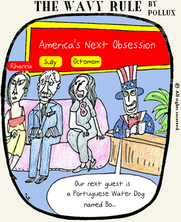
Click on the cartoon to enlarge it!
Read “The Wavy Rule” archive.
The Wavy Rule, a Daily Comic by Pollux: And Why Is It Called a “Minute” Anyway?
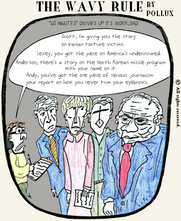
Click on the cartoon to enlarge it!
Read “The Wavy Rule” archive.
Bad Markets, Good Art? A Bracing Debate at the NYPL
Jonathan Taylor writes:
On Tuesday I caught a panel discussion called “The Death of Boom Culture?” at the New York Public Library, that I think is worth watching or listening to online once it becomes available. It was a conversation that, precisely in the way the guests were talking past each other, was a fascinating gloss on its topic, or its occasion: this essay by Walter Benn Michaels in the January/February Bookforum. Benn suggests that over the last three decades of rising inequality, literary fiction and other arts have predominantly flattered the prevailing world-view of the economically ascendant, embroidering on safe historical topics (Toni Morrison stood in for this phenomenon) while obscuring the structures of contemporary injustice.
The animated exchanges with David Simon (of “The Wire”), Dale Peck and, especially, Susan Straight, demonstrated how everything Benn Michaels said could be totally right, as far as it went, yet be achingly incomplete. Between his dead-on assessment of the phantom “boom,” and the viewpoint of artists who affirm its devastating realities, there was an interesting obstacle to communication. When Simon or Straight referred to the specific experience they draw on in making art that does do for American society what Michaels wants it to do, he was quick to roll his eyes (he said at one point, “I’m rolling my eyes”) at what he saw as appeals to personal identity. Simon’s gestures to genre narrative, and an audience questioner’s reference to hip-hop culture, pointed to a less narrow view of actually consumed culture that could fit in with Benn Michaels’s polemic—if only he considered it.
That there was no ready set of common terms for talking unflinchingly about an unjust system that all the participants are a part of, is something of a fulfillment of Benn’s critique. But I left more interested in cracking a book of Straight’s to read about “the actual structure of American society.”