_Pollux writes_:
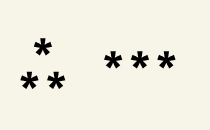
You don’t see the asterism very much. Three asterisks in a triangular or linear formation, the asterism is used in typography to indicate minor breaks or subchapters in a text.
Printers sometimes use it to call attention to a passage that follows, as explained in the fascinating book by Alexander and Nicholas Humez called _On the Dot: the Speck that Changed the World_. A terminal punctuation character, the asterism can be seen at the end of chapters, but also at the end of verses or stories.
Also known as a triple asterisk, the asterism had some other functions in past centuries.
According to Richard Taruskin in his _Oxford History of Western Music_, the asterism was used to denote an omission of some kind in 19th century typography. If the name of an author was unknown, for example, an asterism was used in place of the name.
19th century Russian music critic César Antonovich Cui used an asterism as his nom de plume (Taruskin, 311). This was because Cui had a day job that prohibited him from journalistic activities: Cui was a Russian army officer and wrote treatises on fortresses and fortifications.
How do you type the asterism? Only certain fonts support the Unicode character for the asterism, which is U+2042. According to this “site”:http://www.fileformat.info/info/unicode/char/2042/fontsupport.htm, the fonts that support the asterism include Arial Unicode MS, Cardo, DejaVu Sans, and Linux Libertine.
If you’re using Microsoft Word, click on “Insert” and then “Symbol.” In the “Font” drop-down, change the font to Arial Unicode MS. The asterism will show up under the “General Punctuation” subset, but you can also find it by typing “2042” in the character code window. Click on “Insert” or you can use the shortcut key of 2042, Alt + X. Watch it appear! Your subchapter will thank you for it.
So there’s more to the asterism than just a pile of asterisks. Its appearance seems to me a cry for love and attention. So beautiful, and so ignored. Write a “letter”:http://emdashes.com/2010/07/so-you-love-punctuation-write.php to an asterism (it may get directed to the ghost of Cui) here.
Author Archives: Paul
Daily Comic: Air Quotes
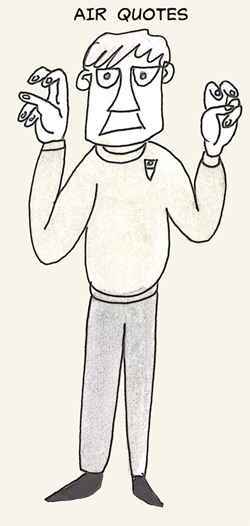
“Contest”: Write a letter to a punctuation mark. “Deadline”: August 15.
Daily Comic: Air Semicolon
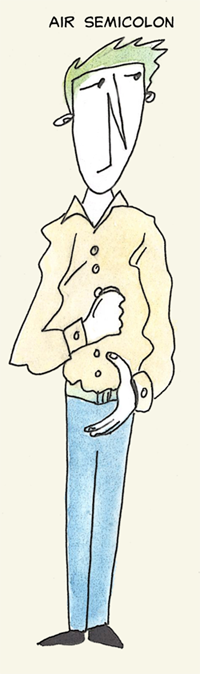
There is a contest; the contest involves writing a letter to a punctuation mark. There is a deadline; it is August 15.
Daily Comic: Air Colon
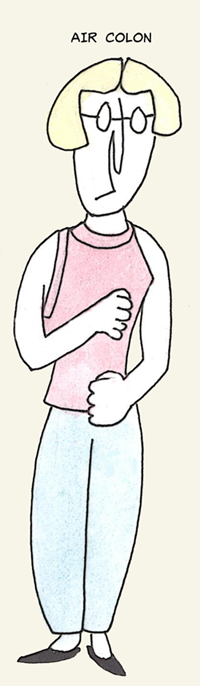
Contest: Write a letter to a punctuation mark. Deadline: August 15.
Daily Comic: Air Parentheses
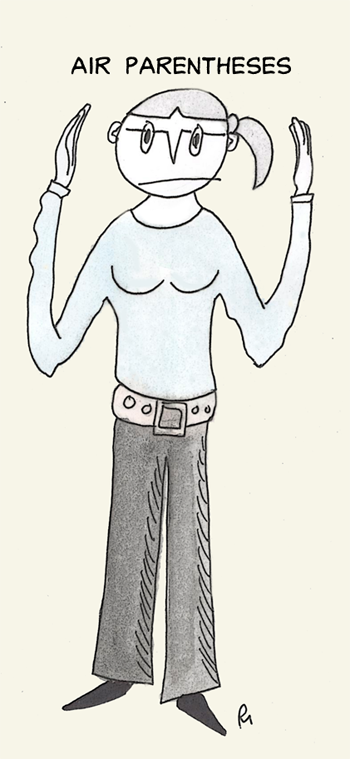
(Contest: Write a letter to a punctuation mark. Deadline: August 15.)
Pylcrafte: The Origins of “Pilcrow”
_Pollux writes_:
“Pilcrow” is a strange word for the punctuation mark used to signify new paragraphs. Lucy, one of the letter-writers in our ongoing contest in which you address the punctuation mark of your choice, had to look it up. We did, too. Where does it come from?
The words “pilcrow” and “paragraph” may have a common ancestor. Walter William Skeat, in his _Notes On English Etymology_ (1904), theorizes how the Latin _paragraphus_ (“paragraph”) eventually became the word “pilcrow.”
First, _paragraphus_ became corrupted as _paragraphe_.
_Paragraphe_ became _parragraffe_, to which an “excrescent t,” as Skeats calls it, was added at the end.
The variant _pargrafte_ appears in the _Ortus Vocabulorum_, a Latin-English dictionary printed in 1500 by the delightfully named Wynkyn de Worde. The variant _pylcrafte_ appears in another dictionary, the _Promptorium Parvulorum et Clericorum_.
So _pargrafte_ became _pylcrafte_.
“This is rather violent,” Skeats admits, but cites the change of r to l as a common occurrence in Indo-European languages. “Due to mere laziness,” _pylcraft_ or _pilcrafte_ became corrupted as “pilcrow.” Now you know!
Declare your love for the pilcrow “here.”:http://emdashes.com/2010/07/so-you-love-punctuation-write.php
.
Daily Comic: The Last Budgetbender
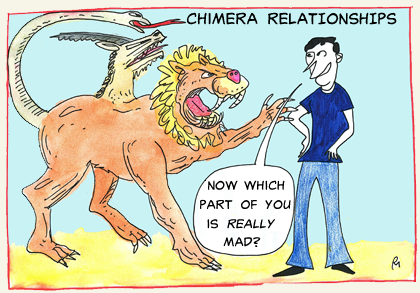
Daily Comic: Chimera Relationships
Daily Comic: Squishy Horses
Daily Comic: Story Time