
Monthly Archives: May 2005

(5.16.05 issue) Democracy is fun!

Big fish in a big pond
It’s that time again already—to vote in the next cartoon caption contest. Think of it as the Kentucky Derby, but you get to choose which horse—Adrian Zanchettin, Tom Szidon, or Lewis Gatlin—is fastest. On your marks…get set…go! Here are the captions—you’ll have to look at the drawing to choose properly.

“Frank called to say he’ll be late—he’s stuck at the office.”
Submitted by Adrian Zanchettin, New York, N.Y.

“Yes, I do miss the corporate jet. I miss the corporate jet very much.”
Submitted by Tom Szidon, Chicago, Ill.

“This is my stop. Phil, you’ll be C.E.O. till Sixty-third Street.”
Submitted by Lewis Gatlin, Elizabeth City, N.C.

Of course, as with last week, the choice is obvious, though again there’s a decent second that only just misses the mark. #1 wrote itself with a piece of software called Obvious Gag. It’s not that it’s a complete dud, but it’s flat; it doesn’t fizz. #2 is as ingenious as the grouping of consonants in Szidon’s name, but it would be funnier if one of the employees were saying it rather than the boss. I really admire it, though. #3 is the best. It takes the simple part of the joke and makes it into a whole universe, with its own logic. That’s why Lewis Gatlin has my vote, and, I hope, yours. Now, make your voice heard.

The New Yorker contest isn’t the only game in town. When you’re done with this decision, you can enter the Land Big Fish cartoon caption contest, see other entries as they’re submitted, and rate your co-competitors from 1 to 10 (in .5 intervals, Olympics-style). If you win, you get a free one-year subscription to the non-evocatively named Honey Hole, The Trophy Bass Magazine. On second thought, maybe they’d better change the prize to a lifetime supply of Jig & Pigs:

There are changes within Honey Hole Magazine, Inc. and this has caused a lot of gossip in the chat rooms and concern among members. When something changes after over 20 years some people decide to make up their own stories about what’s actually occurring (but they did that before any changes were ever made, too). It’s possible the magazine will be sold as well, but not done as yet. If you phone or email the office you will find that we’re still answering the phones and email. Email the office at honey100@airmail.net

We have sold the television show. We also made the decision to hold no further team or family events and because of this are restructuring magazine issues. This has everyone rushing to ask questions about the portions of Honey Hole that pertain to them. If it is not mentioned in the first paragraph, it has not changed. The club web site at TheBassClub.com is still open, club pages at HoneyHoleMagazine.com will be unavailable for viewing for a short period while the site is redone. We are removing team, family and television pages and have a lot of major renovations to do on the site as a whole. It is a lot easier to just take everything down and put it up fresh for the web site. So bear with us.

Thanks for your patience and kind emails and phone calls. We hope you all have a wonderful 2005.

It doesn’t sound that wonderful for the staff whose issues are being restructured. Hope things have improved, and in the meantime, pretend it’s the early part of the last century and all you do in your spare time is sit around thinking up clever captions for things and slogans for laundry soap. “Contest gold has all the lure of pirate gold,” as Wilmer S. Shepherd used to say, and he would know; he was “the founder of the Shepherd Correspondence School of Contest Technique (‘the Harvard of contest schools’) in Philadelphia,” reported Time in 1952. “Lesson Six (‘The Big Secret at Last’) tells students to relax and ‘start putting words on paper. Start with the first word that pops into your mind relating to the product. This word will suggest another word. Simply jot them down as they come to you—and keep writing!’ ”

That is really good advice. Use it for the next drawing, by Annie Levin, which looks like it’ll be lots of fun to work with. Professor Shepherd—who “won his first contest ($5 and all the ice cream he could eat) at the age of 12″—would want you to go for it.

Go In to Win! [Time archive]
Categories: , , , ,

NYC event: Mark Danner at NYPL, 6/1

Sometimes I actually open The New York Review of Books, and I’m rewarded this week by a review of Saturday I’m looking forward to and a piece by Daniel Mendelsohn about Tennessee Williams’ women (I assume the hed writer means “the women in Tennessee Williams’ plays,” but that’s much too long to fit given the pleasingly gigantic type sizes the NYRB uses on the cover). Guy Lawson reviews the new book about Rwanda, Shake Hands With the Devil; and Brian Urquhart, whose name I am very proud of having learned to spell some years ago, writes about Sadako Ogata’s (still working on that one) book The Turbulent Decade: Confronting the Refugee Crisis of the 1990s.

Since I have Russia on the brain, I’m particularly intrigued by Gary Shteyngart’s essay on Vladimir Voinovich’s Monumental Propaganda. Shteyngart writes: “If all Russian writers (as Dostoevsky said) are supposed to come ‘from under Gogol’s “Overcoat,” ‘ Voinovich has come directly out of Gogol’s ‘Nose.’ ” How could anyone stop reading there? Anyway, in the same issue is this notice for an event at the New York Public Library that sounds extremely interesting:

The Question Of Torture
Wednesday, June 1, 2005
at 7:00 PM
Celeste Bartos Forum

A discussion moderated by Kati Marton: journalist, author and human rights activist [fyi: married to Richard Holbrooke] with:

Mark Bowden: Atlantic Monthly contributor and author of Black Hawk Down

Mark Danner: Author of Torture and Truth: America, Abu Ghraib, and the War on Terror

Darius Rejali: author of Torture and Democracy

Elaine Scarry: Author of The Body in Pain: The Making and Unmaking of the World

Tickets are $10 general admission and $7 for Library Donors. Buy tickets through SmartTix here.

These events tend to sell out, so if you know you want to go, act quickly. I notice, in a quick scan of the NYRB‘s contents, that there are no women reviewers/essayists or poets this week (one or two of the books being reviewed are written or co-written by women, but mostly not). Hardly unusual, but unnecessarily annoying. Even aside from the eye-rollingly retro gender-equity thing, there’s plenty to say about what the NYRB could do to appeal more consistently to me and my friends (my principal resource on this question so far), but I’ll save that for another day.

The Question Of Torture [NYPL]
Abu Ghraib: The Hidden Story [NYRB, via MD’s homepage]
The Logic of Torture [NYRB; subscribers only]
New Yorker pieces by Danner [MD’s homepage]
Very useful collection of Abu Ghraib and torture links by Julia Lesage [Jump Cut]

(5.09.05 issue) Caption contest: Only you can prevent forest fires

There’s only one funny entry in this week’s cartoon caption contest, for the drawing of the scientist dressed as a very large rat (in incongruous shoes; see below). I shouldn’t have to tell you which one it is, but it’s the middle one: “More important, however, is what I learned about myself.” (Writer: NYC’s own Roy Futterman, who’s possibly the ad director for Criticas magazine—if true, it makes sense.) The other two, with all due respect, are not too funny. You still have time to refresh your memory of the picture and vote now to ensure that Mike Twohy gets the caption his drawing deserves. Voting ends at 11:59 P.M. E.S.T. this Sunday the 8th, so make haste.

I’m a little surprised nothing better came of the first round—the third finalist, “Well, it was just easier than making a thousand tiny lab coats,” is intriguingly nuts but awkwardly worded—but perhaps people will be so perplexed at the current options that they’ll come up with something genuinely good for the new drawing. It’s of a man (lots of men as central actors here, I note without comment) much the worse for wear, crawling toward a fully staffed phone bank whose sign reads “Emergency Hotline.” A woman (reacting) shouts down at him—what? Only you can decide. Let’s pull up the level a bit here, people.

By the way, a very fashionable person here in Williamsburg’s Atlas Cafe and I have just conferred about the abovementioned shoes of Twohy’s super-rat. I’ve known many scientists, and those who didn’t wear dress shoes to the lab usually wore sneakers. None wore shoes like this whiskered fellow’s; they look (according to Alexis the barista) like reinforced-toe work shoes, as you might wear on a construction site, or possibly orthopedics or hiking boots—Doc Martens, perhaps, or Timberlands. I would even venture to say that if I didn’t know better, I’d think they were those Mary Jane-ish shoes with thick soles and chunky heels that it was once necessary to own. In the days of Harold Ross, this kind of thing would send a cartoonist slinking from the art meeting back to the drawing board, tail between his legs (so to speak), but in this case it seems to have escaped notice. The footwear of the other scientist (and that of the somewhat Quentin Blake-ish rats) is not visible.

Categories: , , ,

(5.02.05 issue) Welcome to New America!

A response in the British press to David Remnick’s story on the dogged and bedraggled (and now victorious) Tony Blair. From Madeleine Bunting in The Tablet:

The nadir of this kind of political contempt was the interview of the Prime Minister by Little Ant and Dec, two ten-year-old interviewers who feature on ITV’s Ant and Dec’s Saturday Night Takeaway, as described by the New Yorker editor, David Remnick. One could sense the disbelief of the American journalist as he recounted that Blair was asked if he was “mad”, had ever eaten junk food such as Turkey Twizzlers, and worse.

The treatment of Blair—brutal, personal and demeaning—is similar to the way other celebrities are now routinely humiliated. Political strategists, early in the campaign, acknowledged the masochism of Blair as he got down to shirt sleeves, sweating profusely under the hostility. We may be a more tolerant nation in our private lives, but the flipside is the judgementalism and lack of basic charity we lavish on public figures. One of the primary impulses of the country driving the past four weeks has been to make Blair pay—a real desire to wipe the once-ready smile off his face. We have managed to make running for public office look like standing in the village stocks.

If you didn’t click on the link above to Turkey Twizzlers, you really should. Despite their condemnation by “school dinner standards campaigner” Jamie Oliver (who looks disconcertingly like a lost member of Duran Duran), their popularity is rising. I wonder how successful Super Size Me was in the U.K.? One of the most inspiring things in the documentary (aside from its power to make me throw away a full box of Milk Duds), I thought, was the Appleton, Wisc., initiative that calmed down teenagers with healthy food. All America has hardly converted to non-pizza-and-Coke school lunches, but it might be a good idea on both sides of the pond to prevent any more small children from turning into the likes of Little Ant and Dec, who really do look perfect for a Lord of the Flies remake.

‘Choice is part of a new political consensus of Tories and New Labour’ [The Tablet; login]
Blair grilled by Little Ant & Dec [BBC News; featuring photo of the Prime Minister looking as though he’s on the electric chair]
Banned in Scotland but good enough for English children [Guardian; extra-icky photo]
Letter From London: The Modernizer [Julian Barnes on Blair, 1994; New Yorker archives]

(5.09.05 issue) What happens when you call the phone number in this week’s Shouts & Murmurs?

The number, in Patricia Marx’s clever Audio Tour, is (212) 399-4838, an unusually authentic-sounding number to give out. Would there be an elaborate fiction on the other side, or even the weaselly Todd Niesle himself? Though I didn’t try at 3 a.m., as the vengeful Debby suggests, I did call. I got this message:

“Thank you for calling Mutual of America. Our office has relocated. Our new telephone number is: (212) 224-1600. Thank you for calling Mutual of America.”

Over at Mutual of America, they haven’t been getting any curious calls (and don’t remember speaking to anyone at the magazine). They do get The New Yorker there in the office, but nobody’d seen the story that communications director Marilyn Graves knew of. “That number was from our old location,” she said. How long ago did they move? “Oh, we’ve been here in this building [on Park Avenue] for ten years.” They certainly cover their bases! The old location: 666 Fifth Ave. Todd, is there something else we didn’t know about you?

Beware the Shell People

Peace maven Pat Montandon, otherwise known as Sean Wilsey’s mother—a principal subject of Wilsey’s memoir, which was recently excerpted in The New Yorker—tells it like it is in an interview with Merla Zellerbach at The Nob Hill Gazette:

Was writing the book a sort of catharsis for him?

I hope so! He had a horrible childhood. I did some things that I’m not proud of, that I read about—things that contributed. It was a tough time for both of us. It’s hard for people to understand, because in our divorce culture, people think, “Oh well, get over it!” But if you care about someone and you’re really in pain, it’s not easy. And Sean had to deal with all of that at a vulnerable age.

What was your reaction when you first read it?

I was on the floor for two weeks!

Good on the floor or bad on the floor—or just floored?

I was so shocked I couldn’t move. I thought, “Oh, my God!” Sean has been through hell, and I, as his mother, should have known about it—and I didn’t. I was in deep grief for him, for (his father) Al and for all concerned. I felt enormous compassion for Sean—and for myself, for that matter. But I couldn’t talk to Sean about it even though I knew he was very eager to find out what I thought.

What did you do?

I sent him an email saying I totally supported him, but I wasn’t able to talk about it just yet. I needed time to digest it—to put it in perspective.

How long did that take?

(Laughs) I’m still doing it! Well, I am and I’m not. I know that at this stage of life to have a son like Sean and to have a grandson and a daughter-in-law whom I love very much—and to have Sean be honest with me is a gift—a true gift. So many mothers and sons hide what they’re really feeling and when this happens they become empty shells—shell people, I call them.

Were there statements in the book you disagree with?

Yes, we’ve gotten into big arguments about the part where he says I had a temper tantrum when I didn’t get the Nobel Peace Prize. It didn’t happen. And the part where he says we discussed how to kill ourselves didn’t happen that way either…. You’ve got to read the whole thing.

A Mom Speaks [Nob Hill Gazette]

Categories: ,

Think of Laura, but laugh, don’t cry

Dana Stevens in Slate on Laura Bush’s recent burst of hilarity and the speechwriter who made it happen:

In an interview with The New Yorker last year, [Landon] Parvin told Elizabeth Kolbert, “A politician will be in trouble and he’ll say, ‘Will you do me some lines on it?’, because he’s heard that humor can get him out of trouble. I tell them, depending on the situation, ‘No, this is trouble. You should not make fun of this.’ ” Apparently Parvin’s instincts were off at last year’s Radio and Television Correspondents dinner, where a slide show he co-wrote of Bush poking around the White House, looking for WMD’s under the furniture, drew a strong backlash the next day. A lot of people, including some war veterans, didn’t double over in mirth at the idea that over 500 American troops (the number has since more than tripled) had lost their lives in a war over … what again?

It’s being said that Laura Bush is always joking around, is in fact a wicked fountain of wit. It makes sense; if it helps her get through her absurd spectacle of a life, it’s probably saved her from losing it entirely. I say let her keep going until she brings down the whole administration.

Take My President, Please [Slate]
Stooping to Conquer: Why candidates need to make fun of themselves [New Yorker]
From Peek-a-boo to Sarcasm: Women’s Humor as a Means of Both Connection and Resistance [Feminism and Nonviolence Studies]

(5.09.05 isue) Mr. Cellophane?

John Lahr is a genius, but I think he’s wrong about John C. Reilly, whom he says “has a pushed-in face and a strapping soft body [and] is not particularly comfortable in his own flesh,” making him unfit to play Stanley in A Streetcar Named Desire. I can’t agree. I’ve always thought Reilly was full of an appealing and barely checked fierceness at his core, which is what made his performance in Chicago so good—sure, he (as Amos Hart) felt sorry for himself, but what kept him from punching everyone in the nose was a sense of the moral superiority of the rules (which are meaningless amid so much corruption, but that doesn’t make Amos less noble for refusing to cave in). And his “Mr. Cellophane” solo, and dance, are enough to prove he’s comfortable in his own skin, if not always happy in it. Maybe Reilly isn’t playing Stanley right (I haven’t seen it yet), or he hasn’t been directed well, but I don’t think he’s inherently wrong for the part. The overlooked, martyred type can be sexy; the slow scheming of the melancholy can be deadlier than the outburst of the easily provoked.

Not related but amusing: this anecdote from John Lahr, related by David Aaronovitch in the Guardian:

…Americans (the snobbish Frasier notwithstanding) seem to be less worried about ostentation [than the British]. In fact, they like it. A writer friend of mine, John Lahr, recalls going as a child to the Californian mansion of the inventor of car radio, one Earl Muntz. Muntz, a famous huckster, was by now into television (he named one of his daughters Tee Vee), and had installed a television at the bottom of his swimming pool…. The people around the pool that day didn’t sigh and whisper ‘vulgar’ under their breaths. They just enjoyed Muntz’s eccentricity.

It’s a fun piece, all about tacky footballers and their frightful wives, and Shaquille O’Neal. Here’s the rest of “Are we just jealous of Wayne’s world?”

The Theatre: Survivors: “A Streetcar Named Desire” and “Glengarry Glen Ross” return to Broadway [New Yorker]

Two more movies that aren’t in Netflix

1) Crossing Delancey, and

2) The Miracle of Morgan’s Creek.

Netflix’s dearth of Robert Benchley films has already been noted. Just because it did manage to include the Criterion Collection’s two-DVD set of The Rules of the Game (which I just watched and enjoyed; the Peter Bogdanovich commentary seems to have been cranked up to His Girl Friday speed, though I do have a fever and could just be slow-witted) doesn’t mean it’s off the hook.

Criterion is releasing Hoop Dreams on May 10, which is swell; I’m especially looking forward to the stars’ special audio track. I also notice that ghostly New Yorker critic Michael Sragow has written a passel of essays for Criterion’s website, including this one on Le Cercle Rouge:

With his 1970 gangster epic, Le Cercle Rouge, Jean-Pierre Melville finally landed his white whale.

The French maverick who changed his last name from Grumbach out of admiration for Herman Melville had long since established himself as that most contradictory, elusive and essential character in narrative moviemaking—an individualistic genre master. Bob le Flambeur (1956), Le Doulos (1962), and Le Samourai (1967), stood out as elegant explorations of underworld style, duplicity, and professionalism. Of course, Melville had other credits, including his formidable 1950 rendering of Jean Cocteau’s Les Enfants Terribles. But his on- and off-screen affection for hard-guy glamour (he always wore a signature Stetson hat) and his aesthetic preference for the tough-minded, strong-boned storytelling of American directors such as John Huston (another Herman Melville admirer) drew him toward life-or-death drama in a criminal vein. Don’t be a philistine—keep reading…

Sragow, whom I’m happy to see is alive and well (I don’t like change, and seeing “MS” disappear from the Goings on About Town was most disturbing), also has smart, lively essays about The Long Good Friday, A Night to Remember, the David Lean Oliver Twist, Sanjuro (“in the Kurosawa movie family tree, Sanjuro [1962] is the sassy kid brother to Yojimbo, and like many light-hearted younger siblings, it’s underrated…”), and Fools’ Highway (which I haven’t seen, but has a way cool cover).

Sragow also writes admiringly about The Unbearable Lightness of Being, which is insanely enough out of print. I actually discovered this recently while browsing through Amazon Marketplace’s dirt-cheap DVDs. It seems crazy that it’s so hard to find—surely brand-new college students in sexual and existential agony are discovering Kundera along with Portnoy’s Complaint and Brodkey’s First Love and Other Sorrows? I may be stuck in a time warp, but if that’s not what they’re reading (aside from the Jonathans, of course), I’m not sure what’s to become of us. (The cover of the newest edition of the Brodkey, I notice, has an oddly Salingerish twang to it, and a little Woody Allen circa Without Feathers…I’m not sure, and it’s pleasing enough, but it seems to want to be part of an earlier era than it was. Which I have nothing against, of course.)

Sragow writes of Unbearable Lightness:

When asked why novelists don’t often make great playwrights, Kurt Vonnegut said, “It’s because they don’t know that theater is dance.” That notion applies triply to the kinetic art of movies. The triumph of The Unbearable Lightness of Being is that Kaufman and company choreograph the diverse segments of Kundera’s fiction like a folk dance, a rock musical, and a pastoral ballet.

Kundera’s prose could be compared to dance as well, but Sragow makes this point beautifully. Perhaps especially because I have Daniel Day-Lewis on the brain lately, I think it’s very wrong that this DVD is out of print. As Kundera wrote, “When the heart speaks, the mind finds it indecent to object.” True enough, so let’s put an end to indecency!

Speaking of Crossing Delancey, blogger Norman Geras does a little of what Randy Cohen is planning to do a lot of, that is, map the cultural references of Manhattan—and a few weeks sooner. But Geras does it with movies and music rather than books:

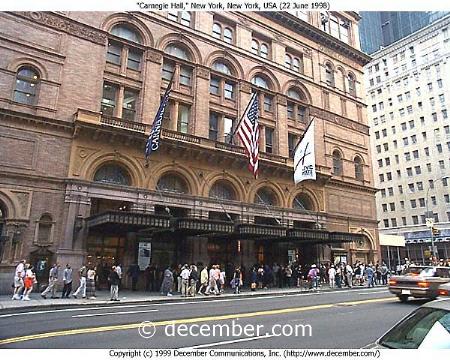
Yesterday at about 12.30 I found myself crossing Delancey. I thought, ‘Hey, I’m crossing Delancey‘. That’s how it is for me in this city. Everywhere I go there’s something charged with meaning. The day before yesterday I was walking up from Times Square towards Central Park and I came to Carnegie Hall. For me Carnegie Hall is – or was, first – this. That’s back in Bulawayo as the 50s were turning into the 60s or thereabouts. The Benny Goodman concert. Above all ‘Sing Sing Sing’; and, within that, a piano solo by Jess Stacey that is two or three minutes of immortality. I went in, to see what was on, and coming up on Sunday (today) at 4.00 was The Thomashefskys: Music and Memories of a Life in the Yiddish Theater. That’s me at the ticket window then. Sold out. Expletive deleted.

Anyway, the whole city is replete with personal and cultural meanings. Take it away you pomos; give out your stuff. Me, I’d prefer to walk the streets of New York – any day of the week.

Why I was crossing at Delancey at 12.30 yesterday was that I’d just been at the Tenement Museum on the Lower East Side and signed up for the ‘Piecing It Together’ tour. This was to see some of the tenements at 97 Orchard Street and to be told about two families who had lived there – and about the garment industry – by our tour guy, J.R. McCarthy, Educator. J.R. is a man of words and of some pazazz in their delivery. By him we were told that between 1865 and 1935 20 million immigrants from Europe had passed through this district, and that if you are Jewish in America there’s an 80% chance that your first ancestor in the country started off living somewhere close by. I was surprised also to learn – though I have not checked this, so can’t vouch for it – that German-Americans constitute the largest single US ethnicity. We were
taken through the lives of Harris and Jenny Levine, who lived in this tenement in 1897, and their children Pauline, Hyman, Max, Eva and Fay. We then moved on to the Rogarshevsky family. J.R. finished in some style.

I headed off to meet a New York city blogger in Greenwich Village, and that involved crossing Delancey.

(All links his.) I hope Geras can forgive me for reprinting his whole post. I just thought it was perfect. If you haven’t been to the Tenement Museum, by the way, it’s really worth the trip—the tours are great and only take an hour, and you learn a whole lot and it’s actually fun.

I’m rereading Here at The New Yorker (Brendan Gill) and About Town (Ben Yagoda), in between something else, so I’ll be quoting now and then. Since I believe in book clubs of only two people, I hope that not too many other people start reading them at the same time—we’ll have to take turns. Or buy them (which I wholeheartedly endorse) and just don’t tell me about it.

Crossing Delancey [Normblog]
[I’d hoped to find a Vonnegut link from The New Yorker, but Google can be trying no matter how much I love it. Oh newyorker.com, why isn’t your archive searchable?]

Categories: , , , , ,