Monthly Archives: January 2006

Unlocking The Complete New Yorker

Having expressed his dismay at some of the more inconvenient features of The Complete New Yorker, Mr. Jalopy at Hooptyrides proves his determination and gives readers the (risky) key to getting around what he says are invasions of user privacy. Caution: Technical frustration and David Remnick at the door with a tire iron may ensue. As Boing Boing reports:

Mr Jalopy has posted a compelling ruminations on the user-license that come with the DVD-based Complete New Yorker set, as well instructions for de-activating the crippling use-restrictions built into it.

As Mark blogged in December, Boing Boing pal Mr Jalopy of the Hooptyrides blog posted a great review of The Complete New Yorker, a collection he’d hotly anticipated as a fan of the magazine. The problem is that the eight-disc set comes with copy-restriction technology that prevents him from loading it onto his hard drive for easy use, which means that if he tries to read the archive out of chronological order (say, through the subject index), he has to constantly swap discs, which is a gigantic pain.

What’s worse is the license agreement, which requires you to waive your privacy rights to allow “the collection of your viewing information during your use of the Software and/or Content. Viewing information may include, without limitation, the time spent viewing specific pages, the order in which pages are viewed, the time of day pages are accessed, IP address and user ID. This viewing information may be linked to personally identifiable information, such as name or address and shared with third parties.” This is a pretty abusive term-of-service for an anthology of magazines: since when does reading a magazine require a waiver of privacy? Continued.

Trapped Radicals: “The Last of Her Kind”

Newsday logo

Trapped Radicals

By Emily Gordon

In Sigrid Nunez’s idiosyncratic, provocative and sublimely confident new novel, “The Last of Her Kind,” history and fiction are intermingled in a fable it would be unwise to ignore. In this precise meditation on race, class, drugs, the haunting power of friends and family members, and the hazards of loyalty and privilege, Nunez takes apart the story of a kind of life in the 1960s like a still-live mine.

The only child of a wealthy Connecticut family, Ann Drayton and her freshman roommate, Georgette George, the book’s narrator, meet at Barnard College in 1968. The undergraduates in “The Last of Her Kind,” mostly upper-middle-class white women and their friends, are radicalized, charged with righteous energy and blinded by misguided envy. Ann joins Students for a Democratic Society, scorns “bourgeois affectations” and fails to understand why the girls at the Barnard Organization of Soul Sisters cafeteria table don’t welcome her joining them. She’s vocal about her regret that she was not born poor and disenfranchised. By the end of the novel, Ann will get her wish. Is that for the best? Nunez gives us the gift of deciding that for ourselves.

In this large-themed novel, Nunez examines not just campus radicals like Ann—only one of the “kinds” referred to in the title—but Georgette’s abusive mother and runaway hippie sister, Solange; Ann’s old-fashioned, anxious parents and her African-American teacher boyfriend; music and publishing big shots, and others. Through meticulously structured narrative, Nunez brings them through the ’70s and ’80s to the immediate present, from which a sober Georgette tells their story.

Many of the characters in “The Last of Her Kind” become trapped in their own myths about liberation. Georgette, whose family really is poor, never quite escapes the abuse and neglect that shaped her. One of the best things about this deeply intelligent novel is its direct confrontation of the truth that family, like trauma, close friendship and overpowering love, never really leaves us—it comes back like a song, endlessly repeating. “A woman in love lies to herself,” Georgette writes, and that phrase can be applied to the novel as a whole. Students in the ’60s loved their causes; Solange loves a crass Mick Jagger; Georgette loves Ann, and they are all disappointed. Ann and Georgette are only in college for the first section of the novel, which documents the friendship and falling out of intense young women wonderfully; the middle section, in which Georgette finds her way in publishing, will recall Mary Cantwell’s memoir “Manhattan, When I Was Young.” The final section takes place in prison.

Were the more tragic consequences of breaking out of conventionality and fear—the murder at Altamont, a character’s sexual assault, bad LSD trips—fate or punishment or martyrdom or something else? Nunez has us consider the culpability of not just the characters here but of Jagger himself, the newspapers, parents, schools, drug dealers, witnesses and observers, and so on. As she looks back on her life, Georgette reflects, “I believe you have to reach a certain age before you understand how much life really is like a novel, with patterns and leitmotifs and turning points, and guns that must go off and people who must return before the ending.” Nunez makes that entirely believable.

Throughout the often very moving story, Nunez has Georgette interrupt her own narrative of Ann’s progress through college-dropoutdom into a perpetually protesting adulthood with quotations, song lyrics and other facts. It makes for a slightly didactic, but surprisingly pleasant effect. Georgette’s own story, which at first seems to be a distraction from Ann’s tale, becomes increasingly central—and increasingly the more interesting one. Nunez is a subtle writer, and there are many flawless observations: “She made me want to hide my hands,” recalls Georgette of Ann’s upper-crust mother. It says a lot about Nunez’s skill as a writer that her evocation of a particularly harrowing LSD trip both serves the story brilliantly and is absolutely imaginable.

What Nunez is aiming at, and achieves, is a document of an era through characters who begin to seem like historical icons whose names we should remember. It’s responsible, feminist, uncompromising and hugely informative but never patronizing. She shows us the crowds and the big ideas, then zeroes in on the individuals within them, conferring on them nobility and intelligence. Nunez has created a book that feels both porous—there is room for our own accounts of these times—and like the discovery of a crucial document, the riveting archive of the lives of the last of all kinds of dreamers.

This review of Nunez’s novel was in Sunday’s Newsday. I don’t know how long it’s been since I’ve read a contemporary novel that was genuinely free of errors—typos, odd spacing, brand names spelled wrong, weird punctuation. Three cheers for FSG for keeping proofreaders off the streets! (For publishing superb books, too.) In the review above, I fixed a phrase in the penultimate sentence that got dropped inadvertently in the editing process. Not a euphemism for “I fought to keep it but I lost,” I swear!

(Published in Newsday, January 8, 2006)

What about BoB?

BoB's big blogs.

Hooray! Emdashes is a finalist in the Best of Blogs awards this year, in the Best Book/Literary Blog category. I can’t think of a better one-year birthday present. Voting ends soon, so look for the form on BoB (I can’t seem to find it, but I’ll link when I do; here it is). Here are the rules:

On January 10 we will publish the finalists, and provide a form for voting online for the fan’s choice.

The fans will vote on a blogger and the resulting vote will count as a percentage of the overall vote to be put forth by the jury panel. Popular vote will only be a small portion of the overall decision making process, but it will allow some participation on behalf of the blog reading public.

All winners will be announced on January 30, 2006. (That’s when voting ends, too.)

I feel so Felicity Huffman right now. In every sense possible.

Later: The other blogs in my category rock. I’ll be happy when any one of them wins, for real. Don’t miss this second-by-second account of the Golden Globes by Sheila of The Sheila Variations; it’s sidesplittingly good. Anyone who puts a Gibson Girl at the top of her blog is OK in my…book.

Eustace Google: The strange, sad case of Brandenn Bremmer

Emily Gordon writes:
I’m interested to see what people are saying about “Prairie Fire,” the Letter From Nebraska by Omaha native Eric Konigsberg in this week’s New Yorker. The piece is about the suicide, last March, of the 14-year-old homeschooled rural Nebraska prodigy Brandenn Bremmer and his heartbroken, perplexed parents, who gave nearly all their material and emotional resources to developing Brandenn’s interests and career. There’s not much talk about the piece yet, since it’s not online and it’ll take a few more days for most people to get the current issue, but just after Bremmer’s death there was plenty of press coverage and internet discussion. Here’s the Blog of Death obituary; I’ve omitted the many links (some expired).

Brandenn E. Bremmer, a 14-year-old musical prodigy from Nebraska, sustained a gunshot wound to the head on March 15. The boy died the following day at Children’s Hospital in Denver. Authorities suspect he committed suicide.

Bremmer taught himself to read when he was 18 months old. He began playing the piano at 3 and was home-schooled from kindergarten on. At 10, Bremmer became the youngest person to graduate through the Independent Study High School conducted by the University of Nebraska-Lincoln. Described by friends and family as a bright young man who smiled often, Bremmer dressed up like Harry Potter — one of his favorite literary characters — for his graduation picture.

Bremmer was only 11 when he began studying piano improvisation at Colorado State University at Fort Collins, Colo. Last year, he released his debut album, “Elements,” and gave concerts in Colorado and Nebraska. The day his body was found, Bremmer had just completed the artwork for the cover of his second CD, which features meditative, New Age piano music.

Like most kids, he loved watching cartoons, playing video games, riding his bike and catching fish. In January, Bremmer enrolled in a biology class at Mid-Plains Community College in North Platte, Neb. He planned to graduate from the University of Nebraska’s medical school by the time he was 21 and become an anesthesiologist.

His mother, mystery writer Patricia Bremmer, said he showed no signs of depression and didn’t leave a suicide note. Bremmer’s kidneys were donated to two people. His liver went to a 22-month-old and his heart to an 11-year-old boy.

The comments are worth reading, too, including one by a 13-year-old named Sydney Lee Smith, who appears to have been a friend of Bremmer’s. (Smith and her mother, Mary, are also quoted in this Lincoln Journal Star piece about the suicide.) More on this soon, and send in any links you find.

Also via Blog of Death: photos of an older Bremmer (he’s seven in the one The New Yorker used), and details about his piano-composition recording Elements, on the Windcall Enterprises page.

“He maybe just kind of ‘crashed’ like computers can,” and other spontaneous theories on the case from back in March, on Common Ground Common Sense.

There’s been a spirited, provocative debate on Wikipedia on the definition of “child prodigy” and which alleged prodigies (including Bremmer, Willie Nelson, and Michael Jackson) to include on the site. In a separate thread, Wikipediaers argue about whether to delete Bremmer’s page on the site, and whether Bremmer should really be considered “notable.” (The page was indeed deleted.) It’s a useful look inside the workings of Wikipedia, too. A user named Stan, a passionate and caustic advocate for deleting Bremmer’s entry, writes:

This is a very strange and sad story of child abuse, in which a boy’s parents tried to live vicariously through him by pushing him beyond his abilities, vanity-publishing his CDs and helping him with high-school homework to get him through at an accelerated pace. He cracked under the pressure and killed himself. Now that he’s dead, those close to him are still trying to live through him, this time by posting and reposting the same wikipedia article about him. I find the situation monstrous. If we have an article about how child prodigies are manipulated and exploited by their parents, we might merge this with that, as a further example, but I don’t know that such an article exists, or if such an article would meet wikipedia standards. It’s also true that many child prodigies go on to do no significant work as adults–many prodigies are simply experiencing an early spurt and turn out to be average-functioning adults. There’s nothing wrong with that, of course, but it highlights the fact that a prodigy is not necessarily notable just for being a prodigy. So I vote to delete this once again.

“Child abuse” is very strong language for what is surely a subtler moral question. The blogger Terrette posted critical comments about the Bremmer family just after Bremmer’s death and got an email from (it seems) the same friend of the family, Mary Smith, who was quoted in the Lincoln Journal Star piece. Terrette defends her position, point by point, and makes it clear that for her the central issue is gun control:

If I may address my displeased reader frankly: I know it must suck to feel that some long-winded East Coast liberal who probably doesn’t even have kids is trying to tell you right from wrong, but please know that I read the newspapers and see the incidents of juvenile suicide and homicide tallied month after month, and the whole thing has made me wonder: What’s going on in this country? However much you’d like to believe that Brandenn Bremmer took that gun in his hands in a quiet little corner of Nebraska — a place with its own rules and customs and that, as such, is radically exceptional to things that take place on the East Coast or in regions where liberals haven’t developed a proper fondness for weapons — the fact is that Brandenn killed himself in a nation where such incidents are common and where laws regulating minors’ unsupervised access to guns are uniformly lax. Moreover, these laws are lax not because of some Constitutional right that the framers of that document set down in law so that all the nation’s children could take up arms against a potential new wave of British Redcoats, or so that seasonal hunting traditions in the Midwest would go undisturbed, but because the National Rifle Association has long targeted our politicians in Washington with its powerful lobby and thereby assured its friends gun-sale profits at the expense of all social, regional, and safety-related considerations. If the NRA could facilitate the sale of semi-automatic rifles to all the teenagers of this nation, believe me, it would. And no amount of killing of and by our children would ever allay the NRA members’ passion for peddling and glorifying weapons. Their short-sighted and self-serving claim will always be: “it’s not the guns that kill, it’s the shooters.”

Update: Hey there, googlers! Don’t be shy; what do you think of what you’ve read about Bremmer’s life and the criticisms above?

Further update: There’s an interesting discussion of Konigsberg’s piece on Gifte
d Exchange
, “the blog about gifted children, schooling, parenting, education news and changing American education for the better.”

Additional note: In the introduction to this post, I’ve made a slight change to my description of Brandenn’s grieving parents. I think, on reflection, that my original tone had an unsympathetic tinge I didn’t intend. It’s often said that the death of a child is the worst pain a person can experience, and I believe it.

And: Well, everyone’s talking about it now, including John Derbyshire in National Review Online:

You know how once in a while you read something that leaves you feeling vaguely disturbed — suddenly unsettled and insecure, as after a minor earth tremor? Well, that’s my current state. The offending text was Eric Konigsberg’s piece “Prairie Fire” in the January 16 issue of The New Yorker.

Obviously he was a very nice kid, the sort you’d want your own kids to mix with. His suicide seems, from Konigsberg’s account, utterly inexplicable.

The suicide of a child is of course one of the major nightmares of parenting. That is one reason I, as a parent, find the Brandenn Bremmer story unsettling. If THIS kid could do it, who might not? Even aside from that, though, there is something about suicide that is deeply disconcerting to all of us. We have all known instances among our acquaintance, or, if we are unlucky, in our own families. An odd thing I have noticed is that a suicide, even of someone we are not strongly connected to, makes us angry…. I suppose this anger is just an acknowledgment of the fact that killing yourself is the most selfish thing you can do — a gross betrayal of your social responsibilities, the first and foremost of which is to exist, so you can carry out all the others. Surely the old dishonoring of a suicide’s corpse — in Christian countries, it could not be buried in consecrated ground — reflects something of this instinctual anger. Continued.

Discussion is ongoing at the New Yorker Forums. Don’t get me wrong—I think the human brain is just as wondrous as it is ridiculous and rigged—but there sure are a lot of people who use the word “gifted” to describe both their children and themselves as kids. I wonder how this plays out across the classes? Who gets to be called “gifted,” and when does the constant reminder of “giftedness” become a burden? It seems like a crude, loaded word that probably causes more problems than it solves. (I speak as a beneficiary of a groovy, ill-planned “talented and gifted” public high school track that rewarded the students who actually showed up to school with countless hours of unstructured hanging out. Fun! American history? We caught up on that later, or didn’t. True believer Mr. Ihle was the exception. Next track after TAG? “Academically Motivated.” God knows what they called the next down from that.) Feel free to argue.

Speaking of arguments, there are posters on the New Yorker Forums who say they’re close to the Bremmers and that Konigsberg misrepresented them, took quotes out of context, knew the story he was going to write before he wrote it, etc., etc. I’m sure people in that community are feeling exposed and sore, but these are familiar complaints; we all know the polls about how little people trust journalists.

[Updated:] As I remember it, Konigsberg expresses open skepticism only once, in a brief aside when listening to the afterlife theories of Hilton Silverman, who’s married to Linda Silverman of the Gifted Development Center. Antidisingenuousmentarianism typed in much of the passage (which I double-checked because I’m fanatical that way):

“Well, I can tell you what the spirits are saying,” [Hilton Silverman] said. “He was an angel.”

[Linda] Silverman turned to face me. “I’m not sure how much you know about my husband. Hilton is a psychic and a healer. He has cured people of cancer.”

“It kind of runs in my family: my grandfather was a kabbalistic rabbi in Brooklyn, and my father used to heal sick babies with kosher salt,” Hilton said. “Brandenn was an angel who came down to experience the physical realm for a short period of time.”

I asked Hilton how he knew this. He paused, and for a moment I wondered if he was pulling my leg and trying to think up something even more outlandish to say next. “I’m talking to him right now,” he said. “He’s become a teacher. He says right now he’s actually being taught how to help these people who experience suicides for much messier reasons. Before Brandenn was born, this was planned. And he did it the way he did so that others would have use for his body. Everything worked out in the end.”

I just started at that “much messier reasons” on rereading—as though the reasons are the tragedy, and the suicide is incidental. I haven’t reread “Prairie Fire,” but except for that “pulling my leg,” I don’t think Konigsberg reveals any feelings about the matter one way or the other.

In any case, all this just continues to demonstrate that the internet is—yes, Eyebeam panel, it is—a pretty effective forum for democratic free speech. I’m glad the rural, homeschooling, non-coastal subjects of New Yorker articles can respond in a widely distributed public place to what’s written about them, even if the integrity of the journalism ultimately prevails.

More discussion at Urban Semiotic.

New and interesting: A journalist tries to contact Linda Silverman about the New Yorker story for Colorado’s New West. Links are theirs.

This week’s New Yorker features a long, and wrenching, profile of Brandenn Bremmer, a prodigiously gifted 14-year-old from western Nebraska who killed himself in his bedroom at his parents’ farm last March. Figuring prominently in the story is Linda Silverman, who runs the Gifted Development Center, a “resource center for developmentally advanced children and their parents” in Denver.

Silverman, who lives in Golden, doesn’t come off particularly well in the story; writer Eric Konigsberg details her tendency to grade smart kids at IQ-levels well off the scale that most child-development experts consider valid, including a 2001 case in which she scored an 8-year-old boy’s IQ at “298-plus.” That boy was later found to have been coached on the exam by his mother. Interviewed after Brandenn Bremmer’s death, Silverman told Konigsberg that the teenager’s parents “had contacts with him after he left his body” and that Brandenn’s “mission to assist others in this lifetime may have been fulfilled by his death” (Bremmer’s organs were donated to several recipients).

Curious about Silverman’s reactions to the New Yorker article, I rang up the Gifted Development Center. Silverman wasn’t available, and a staffer named Lee Ann politely informed me that she would have no comment on the story “because of confidentiality requirements.”

“So,” I said, “I take it Linda is not talking to anyone with the press about this story.”

“We simply can’t,” Lee Ann replied.

I thanked her and hung up, refraining from pointing out that this makes no sense; any confidentiality restrictions between Silverman and Brandenn Brem
mer (who met Silverman as a young boy and attended several GDC events, according to the story) were violated by Silverman’s extensive interviews with Konigsberg, in which she discussed Bremmer at length.

The whole subject of gifted children has become a fraught one, with experts debating what constitutes “giftedness” and disagreeing how such way-above-average kids should be nurtured and taught. The example of Brandenn Bremmer is a cautionary one for all of us who suspect our kids might be brilliant. Unfortunately, Linda Silverman, at least in this instance, doesn’t seem to be shedding much light on the subject.

“I Could Eat a Knob at Night”: Ricky Gervais Dance Remixes

She gave me 20p for the hot chocolate machine

What’s going on here? First cue up the Ricky Gervais podcast, from the beginning, you can. Then read this quick summary of what was to become Pilkingtonmania, from Reuters:

It was during a discussion on the Gervais show about a reality TV show, where contestants were asked to eat an animal’s penis, that Pilkington made Internet history. First he said he could not eat an animal’s penis in the morning because he has a delicate stomach.

He then proclaimed, “I could eat a knob at night.”… After Gervais mused on the show that the soundbite could be used in a dance remix, it took just a few days for the Internet to be awash with songs using the soundbite as a hook.

The latest (at press time) big article, in the NY Times yet, is here. Earlier, there was a Reuters piece about the phenomenon of Karl, the podcast, the knob, and the mashups. Or remixes, as the case may be! I now understand the difference (thanks Nathan). They’re also talking Karl in Australia (an expanded version of the Reuters piece), Chile, and Sweden. Translators welcome. The new series: My first review of the non-free podcast was here, and there have been several more since.
Without further ado–Karl Pilkington dance remixes, the original list. Apologies for any broken links, and updates welcome!

  • The popular and oft-downloaded DJ Reacharound version, from episode six of the podcast. Quite possibly my favorite.
  • Newest! Nathan–“transforming the great into the quite good”–remixes his remix and comes up with something wildly original. Farther out than a chimponaut!
  • Second newest: Matt’s mix, and a good one too. He calls it “an electronica/nuskool version.”
  • Third newest: DJ Ropey’s. I should really set up a voting system.
  • Hop like a kangaroo: Nathan’s uptempo “trancey house mix,” which may be the hippest of them yet. This one deserves a video. Then listen to his truly excellent Gervais-related Free Love Freeway, featuring the vocal stylings of David Brent. Do you think knob cuisine has become popularized as a result of all this? Will Australian PETA need to get involved?
  • Also shiny and new: The band Love2B (“Electronica / Ambient / Experimental”) has a brief but complex version that, laudably, reintroduces the modifier “kangaroo.” Their other songs are funny too.
  • Danceable! Sweet stuff from Confusioning.
  • “Erectioneering”: Fintan Stack’s lyrical contribution, which owes a small debt to Radiohead. He explains himself thusly.
  • Last week’s star: Rohan Lilley, for his very funny take on the, um, knob philosophy. More of Rohan’s mixes and future Gervais riffs here.
  • One of the newest: Aidan O’Halloran calls his version “the ultimate Karl Pilkington ‘i could eat a knob at night’ song.”
  • Cool twist by Mr. Zystem.
  • DJ Frankie Pigeon does his tribute.
  • May be a repeat: a zippy, rhythmically adventurous track with horns.
  • Thanks, Wikipedia! This one’s from Cyn.
  • Andrew Brady, Tom Frost, and Andy (“its very good. Funky house beat”), your audio links hath expired, and that makes everyone sad.

Update: Since this is getting search-engine lovin’ (hello, U.K.!), if you’ve got links to other versions–Ricky said he got at least 70–let me know and I’ll post them here.
NEW: a great rock ‘n’ roll tribute to Karl’s timeless utterance. The newest remix is actually a re-remix by Nathan, who also just revamped his already inspired enhancement of David Brent’s earnestly soulful “Free Love Freeway.” Download it here and you’ll see what I mean. On his MySpace page, he adds modestly, “If you really really like FREE LOVE FREEWAY, theres a totally self indulgent overlong extended mix lasting nearly 9 minutes, here.” I’ve listened–entirely worth it!
knob_night.jpg
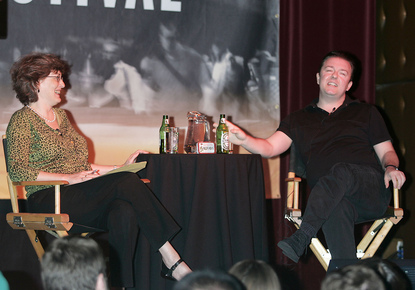
Update again: I’ll need to do some more googlistening, I see, since your desire for Pilkington Man is downright insatiable. Meanwhile, why not read Nancy Franklin on Ricky Gervais? Franklin interviewed Gervais at the New Yorker Festival last year, and it was a delightful event, in part since Franklin is one of the funniest critics around.
gervais_franklin.jpg
Also, via diligent commenter James on the Sydney Morning Herald blog, the trio’s old XFM show. James notes, “It is hilarious (though annoying because you have to download each 5 min file, about 12 per episode – but well worth it).”

Sowerby and Luff's Big Squeeze

Brand-new mashups/remixes added as people send ’em in to me–see below for the list.
LATEST (June ’06): Our favorite Birmingham-dwelling, Office-remixing DJ, Nathan Jay, writes: “I’ve got some new songs–one of ’em [“A Good Day”] might be interesting to you if you watch The Office (US version). I really love the show–as much as, if not more than, the UK version. I made a kind of ‘chilled’ house track, and spruced it up with loads of snippets from Pam the receptionist.” As always, it’s excellent and super-danceable.
Karl Pilkington news: There’s probably not much point in my keeping up with this anymore, since the entire bloggomedia (the gap is quickly closing) is now doing it for me. But in case you’re stopping here first, this is a very funny Karl, Ricky, and Steve animation and a trippy monkey news video, and there’s a forthcoming book by Karl, or something like that. In recent news, there’ve been Karl clocks, badges, shirts on eBay; the end of this post lists other sources for Pilkington paraphernalia.
Are there any British podcasts as funny as Ricky’s? Incredibly, yes! Comedy 365’s ridiculously addictive Big Squeeze with sexy Georgina Sowerby and Brian Luff, the brilliant Chris Skinner’s Simulacrum, and Killer Comedy (or anything else) with the King of Dry, John Dredge. See below for mouth-watering details. And they’re all free!
The only way to survive the long minutes until the next episode is to download as many Big Squeeze (starring Georgina Sowerby and Brian Luff, pictured above) and Simulacrum podcasts–do not miss the interviews with John F. Kennedy, Kate Moss, and Moby-Dick–as you can. Also, John Dredge’s Killer Comedy. See excerpt below for a snippet of Chris Skinner’s revealing interview with the pissed-off whale.

First of all, can I get some things clear about Herman Melville, because that man is a complete son of a bitch. I employed that man as my official biographer. He was set aside to write the great story of my life, exploring the seas, and the things I saw while I was there. And he sold out completely, and turned it into a–horror film. I was this lethal man-killing machine…. I’m quite placid. If you wrong me, I’m bigger than you, I’ll take you out, but not in a dinner way–more in a fighting mean-machine sort of way. I’m not going to do it now, because you’ve been generally quite pleasant.

But is he? Listen to the REST of this shocking Simulacrum show.

Fluffy TV


Have a shameful thing for naughty doctor-bunnies and saucy nursey-lambs? Who doesn’t? Fluffy TV will oodle your noodle. I would say it’ll tickle your fanny, but I know that has an entirely different meaning in the U.K., so that probably won’t do.

Simulacrum from Comedy 365


Wear the knob: Flipporium’s sexy “I Could Eat a Knob at Night” t-shirt (pictured below; “a percentage of Karl proceeds go to buying a goat!”). Link via Wax Elastic. Here are more knob shirts, including “I [Heart] Karl Pilkington.” Need more Pilkington paraphernalia? Get it here. New: a brand-new, stylishly designed t-shirt, and the inevitable Karl quote book.

So What Do You Do to Write a Winning Caption, T. C. Doyle?

82897035_ba18dc6ac2_o.jpg
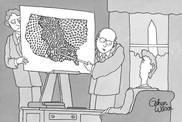
“And in this section it appears that you have not only alienated voters but actually infected them, too.”

Relaxed after a well-earned vacation and back in Park City, Utah, initialed editor and contest champ T. C. Doyle considers Chast, DeLay, hubris, Hemingway, canoes, the “crustacean-like, single-cell-looking objects” and curiously young leader in Gahan Wilson’s drawing, and Doyle’s non-doppelganger, T. C. Boyle, who has also been published in The New Yorker. In the very same issue, actually. Boyle once gave his readers a challenge to write concisely about the year 1970; Doyle dispenses with it in a handy haiku.

First things first: What do your friends and colleagues call you? Is there a nefarious T. Doyle you’d prefer not to be confused with?

It’s T. C. and always has been since day one. Conflicting stories as to why. One is that the TV cartoon show of the day, Top Cat, had a namesake character who was T. C. to his fellow alley cats. Supposedly that appealed to my father, but I wonder. He studied the classics at Princeton in the ’50s and there is nothing cartoonish about him save for occasional phone call from two thousand miles away asking me where “the big screwdriver is.” He does that because he recalls that I was “the last person who used it.” At the time, Reagan was probably running for re-election.

Are there a whole slew of parks in Park City?

Park City does indeed have parks. Officially we are known as the home of the U.S. Ski Team. We hosted several Olympic events in 2002 and have three major ski resorts out our back door. Parks? We got ’em. Including the one behind my house where you can ski jump, luge and bobsled all in the same day.

Is everyone there excited about your caption win?

One woman rang the other night and suggested a connection. Something about common interests and close proximity. Her voice was breathtakingly sexy. Friends have rang and been gracious and generous with praise.

When did you begin reading The New Yorker?

My parents always had a subscription, so I read cartoons as a kid. Later I would pick up the magazine at the airport when I traveled on business. A decade or so ago, my father-in-law gave me a subscription for birthday gift. He’s retired and reads every issue cover to cover. He shares his love of fine things generously. That’s why I will give to him whatever the magazine shares with me.

Who are your favorite New Yorker cartoonists?

I have several favorites, one from another era. That’s Thurber. “The Catbird Seat” is one of my all-time favorite short stories. It’s urban. It’s absurd. And it makes perfect sense to me, a kid from Indiana who once asked Santa for a filing cabinet. I did. When I was a kid, my parents had a cabin in Michigan, in Grayling on the Ausable River. Think pine trees as tall as goalposts, mosquitoes as hungry as stray cats. Supposedly a great place to catch rainbow trout. (I caught only poison ivy.) Inside was a ping-pong table and a record player accompanied by a Trini Lopez album and a Kingston Trio record. And there was Thurber. A whole book of him. I read it over and over while waiting for vacations there to come to an end.

Early in my career, I was introduced to Roz Chast by a co-worker. Actually she introduced me to the work of Chast’s husband, Bill Franzen. She gave me a gift that I have to this day: his book of short stories entitled Hearing From Wayne. Like Thurber’s, his stories are absurd, though more accessible. In one, a guy figures out how to make a buck creating phony “souvenirs” supposedly created by God himself in the aftermath of a tornado. It’s hilarious. When I learned that he was married to Chast, I started looking for her work in The New Yorker. I later bought a copy of one of her books from the 1980s, Mondo Boxo.

Finally, I have become a huge fan of Bruce Eric Kaplan’s work. Small, brutish figures lost in city life? Each with aggressive or callous or senseless points of view? I love that. I recall one often. It is of a man striding purposefully down the street. I think he wears a trench coat or suit jacket and clutches a briefcase in one hand. Outwardly, he appears in command of his world. But the balloon above his head belies his self-assured, confident ways: “Now what is it again I am always thinking?” I hope I got it right. The point is simply this: no matter the exterior, people are often lost, woeful or trapped in circumstances beyond their control, often without their knowledge. It’s just hubris, pocket change and non-striking transit workers that keeps them going.

Did you submit captions to any other contests before this one?

I did. Contest No. 29, the one I won, was my third or fourth attempt.

What’s your favorite non-winning caption so far, either by you or someone else?

My wife, Naomi, had one for Tom Cheney’s recent drawing that I laughed at. His drawing was of the monster truck that somehow found its way on stage and interrupted an orchestral performance. In that one, the lead violinist is addressing the audience. Her quip: “Please excuse me, I am going to have to cut this short. Apparently my date from eharmony.com has arrived.”

On to the strange coincidence of T. C. Doyle and T. C. Boyle appearing in the same issue of The New Yorker. Are you a fan of his writing? Any particular story or novel?

I have not read his work.

Boyle studied 19th-century British literature. Do you have a favorite 19th-century British novel? Or another highly recommended book for 2006?

How about Robert Louis Stevenson’s Treasure Island? One Michigan-free summer I ran afoul of my aforementioned father. Some sin of a broken window or a promise, no doubt—I cannot remember. But I do recall the punishment. He made me write a book report on Treasure Island. I typed it myself on the very manual Royal typewriter he used at Princeton. A few years later, I carried it to the University of Illinois where I banged out a few never-to-be-published short stories. That’s how I taught myself to type. Funny thing, though I write professionally, I still use only three fingers when banging away. And though I have been a journalist for two decades, I still look at the keys.

The same author once challenged readers to write “a story, a memory, a recollection, a re-imagination: 1970 in two-hundred [sic] words or less.” How would you sum up that year in a sentence? Or a haiku?

1970? Hmm… How about this:

Avoid Michigan.
Way too much poison ivy.
Must you? Take Thu
rber.

Boyle drew a comic called “I Dated Jane Austen.” Which author (living or not) would you most like to take a canoe trip with?

God, back to Michigan. Wait. Thinking Big Two-Hearted River. Nick Adams. A gun, I suppose. Surely there was a canoe. Someone in Michigan always has a canoe or at least access to one. So I would pick Hemingway? That’s the author to take on a canoe trip. Wouldn’t matter how well you paddled or how many fish you caught. Rivers there run fast and the currents are strong. After a few bottles of Spanish cava red, which we’d drink while slapping some rods and reels at the water, navigation would be left to chance. Even I’d go back to Michigan for that trip.

Your caption is a deliciously witty commentary on both pollsters and politicos that brings to mind many real-life elected officials. Boyle’s much-anthologized short story “Greasy Lake” begins, “There was a time when courtesy and winning ways went out of style…” Would you say that’s the case in Washington at the moment?

I’m sorry, I was just reading some fine things Tom DeLay had to say about bipartisan cooperation.

Speaking of which, the politician in Wilson’s caption seems awfully young. How do you think he got elected?

He is awfully young. And vulnerable. And that I believe is key to the cartoon. I honestly didn’t see the obvious caricature of the Cheney-like figure delivering the bad news to the shell-shocked President. In retrospect, it clearly is there. But the character is a bit too young and a bit too shocked for our current leader. No, I went with a young, perhaps ambitious, but certainly naive congressman hearing the worst, the absolute worst. So I asked myself, what is the most awful thing you could do to constituents, the thing for which even you, a man of ambition and unshakable belief and self-love would know in an instant would be too much to overcome? Lie to them? Nah. Cheat? Swindle? Nope, gotta be worse. My answer was there in the drawing, in the crustacean-like, single-cell-looking objects that conjured microscopes and test tubes and Petri dishes. And then it hit me: infect them. That would be bad. Way bad. You cannot do worse to voters than infect them. No apology could save you, no rationale could explain your way out of a mess like that. And the spinmeister behind the board in the left hand corner of the cartoon knows it. His certainty of pending doom was the inspiration for my quip.

How his client got elected in the first place, God only knows.

Do you think Alaska and Hawaii were covered in paisley or dots?

See, I didn’t see tie patterns at all. But I only buy a few a year and when I can, I go to Hermès. They do nice ties there. Not many in paisley or on sale.

Boyle writes on his website, “I seek winter this time of year…. I trudged through the woods, accompanied by my canine friend, kept the fire stoked, read, wrote, relaxed.” How about you? Do you prefer to seek winter or banish it?

I live at 7,000 feet next to a ski resort in the shadows an Olympic luge track covered in ice. As I write, part of my lawn is covered in four feet of snow. I won’t see grass until May. I, too, seek the woods this time of year. Only we call them “trees” and you sail through them on titanium boards strapped to your feet. Not exactly trudging. But hey, I’m sure his dog is nice.

I figure winter is best celebrated, not lamented. Better still when forgotten.

Do you think the Washington Monument is one of the more attractive buildings in our nation’s capital?

Is it a building? Really? Can you call a monument a building? I guess so. Buildings have Starbucks in lobbies now. Or tenants of some sort. It’s a nice obelisk. And not cluttered with paisleys or inexplicable symbols.

If you had to wear a tie in the pattern of the East and West coasts in Wilson’s drawing, or the paisley middle, which would you choose?

The costal risottos for sure.

Legal/philosophical note: James Thurber’s “The Catbird Seat” is actually available online, in a crude sort of format. Is it better for Thurber’s estate, and, more to the point, his literary legacy and future fan base, to link to the e-book purchase page above, or to the story itself? What do you think? —Ed.

Also, this is the brilliant Gahan Wilson’s second caption contest drawing. Is he enjoying this? Perhaps we’ll hear from him.

***

Other Emdashes caption-contest interviews:

  • Robert Gray, winner #106 (“Have you considered writing this story in the third monkey rather than the first monkey?”)
  • David Kempler, winner #100 (“Don’t tell Noah about the vasectomy.”)
  • David Wilkner, winner #99 (“I’d like to get your arrow count down.”)
  • Richard Hine, winner #98 (“When you’re finished here, Spencer, we’ll need you on the bridge-to-nowhere project.”)
  • Carl Gable, winner #40 (“Hmm. What rhymes with layoffs?”)
  • Adam Szymkowicz (“Shut up, Bob, everyone knows your parrot’s a clip-on”), winner #27, and cartoonist Drew Dernavich interview each other in three parts: One, Clip-On Parrots and Doppelgangers; Two, Adam and Drew, Pt. Two; Three, Clip-On Parrots’ Revenge
  • Evan Butterfield, winner #15 (“Well, it’s a lovely gesture, but I still think we should start seeing other people.”)
  • Jan Richardson, winner #8 (“He’s the cutest little thing, and when you get tired of him you just flush him down the toilet.”)
  • Roy Futterman, winner #1 (“More important, however, is what I learned about myself.”)

Anthony Lane, you made me laugh!

By all means, we must encourage the funny lines. In his review of Caché (which the magazine insists on referring to as Hidden), Lane writes of the character played by Daniel Auteuil:

Georges is the host of a literary discussion program on French TV. Short of wearing a luminous T-shirt with the word ‘Smug’ picked out in rhinestones, there isn’t much more that he could do to advertise his character.

Funny! And true! Lane also has a moment of beauty here that is so modestly profound I think it, too, should be noted:

On the other hand, you might protest, why lay all this on Georges? He is no [Maurice] Papon, and were all of us to be harassed for our childhood misdemeanors mankind would stalk itself to death.

Incidentally, shame on the Voice‘s David Ng for this: “Indeed, everyone in Cach&eacute may have something to hide, including [Juliette] Binoche’s frigid wife and their son, Pierrot.” That’s not just crashingly old-fashioned, it’s a lazy misreading, too. Really, David, do you know what fucking year it is? Otherwise, his profile of director Michael Haneke is quite interesting. It ends:

Haneke’s obsessions converge in Cach&eacute‘s final scene, a chilling long take that’s the most enigmatic conclusion in recent movie memory. “Using a fixed shot means there’s one less form of manipulation—the manipulation of time,” Haneke says. “I’ve always wanted to create the freedom one has when reading a book, where one has all the possibilities because you create all the images in your head.” Resolutely cryptic, he refuses to decode the scene’s meaning: “About half the viewers see something and the other half don’t, and it works both ways.” He adds, invoking his protagonist’s own mental journey, “We always fill the screen with our own experiences. Ultimately, what we see comes from inside us.”

Grant Residency To Yiyun Li: Hartford Courant

The frustrating case of the Chinese writer who can’t get a break:

The accomplishments of Yiyun Li, a Chinese national now living in California, are extraordinary. Enough to support her bid for permanent residency in the United States and then some. So far, however, Ms. Li’s greatest challenge seems to lie in persuading the federal bureaucracy.

A native of Beijing, Ms. Li, 33, came to this country in pursuit of a graduate degree in immunology. She enrolled at the University of Iowa, where she signed up for an adult-education class in writing.

Something happened. In English, Ms. Li discovered a medium for expressing ideas and emotions inaccessible to her native tongue. Chinese, she said, has become too riddled by habits of repression and secrecy to provide a clear voice.

Ms. Li set aside her goal of a doctorate in immunology. Instead, she enrolled in the prestigious Iowa Writers’ Workshop, where she earned master’s degrees in fiction and creative nonfiction.

Today she teaches at Mills College in Oakland, Calif., where she has accepted a tenure-track position. She has had stories published in The New Yorker and Paris Review. Her first book, “A Thousand Years of Good Prayers,” a collection of short stories, attracted strong critical acclaim. In September, “A Thousand Years of Good Prayers” won the Frank O’Connor International Short Story Award.

Ms. Li holds a temporary visa to live in the United States. She wants to become a permanent resident. Her application to the U.S. Citizenship and Immigration Services in August 2004 had to convince authorities that she was an artist of “extraordinary ability.” She submitted testimonials from some of the world’s most prominent literati, including novelist Salman Rushdie, New Yorker magazine editor David Remnick and novelist Elinor Lipman.

Somehow, immigration authorities weren’t impressed; they rejected Ms. Li’s application, dismissing it as “not persuasive.” She is appealing.

Clearly, she’s an extraordinary candidate.

(Links by me.)

Pekar, piqued

Harvey Pekar

Brian and Matthew Hieggelke at New City Chicago talk to Harvey Pekar about his new book, The Quitter. Peter Schjeldahl’s October 17 story on graphic novels (you know, the one I grumbled about) came up. I’ve provided the second link.

How do you feel about reviews of the book so far?

Well, the reviews have been tremendous. I mean, I’ve gotten eighty or ninety reviews or something, and all but about five of them have been favorable.

Do the bad ones bug you?

Yeah, they bug me, but especially a couple were written that were kind of malicious. Especially, there was one from the New Yorker that was really–this is really funny. I don’t know exactly what the hell happened at the New Yorker, but some guy wrote a piece on graphic novels? In the New Yorker? [Link] And he shit on everybody. Just shit on everybody. So, and he called me–the New Yorker’s a pretty polite magazine, most of the time. This guy, man, he was fucking nasty. It was kind of funny to see it in the New Yorker. He called me, the unintentional inventor of comic minimalism. That’s like, even if I did something right, it had to be accidental, or something like that. So I guess the thing probably made a lot of people mad. I’m assuming, because about a month later, they published another review by somebody else that was favorable about the book. This time it was in a column called Briefly Noted. But this time it was almost like we’re evening up the score here. To find these reviews, I go to up to the public library, `cause I can’t use a computer myself, I’m a fuckup with machines. And my wife won’t help me. So, I go to the library, and these people at the library are sympathetic to me. And they look on Google for the latest reviews. So when the second New Yorker thing came out–if you look on Google, it’ll cite the review and where it’s published and stuff. And then they’ll maybe give you part of the first sentence of the review or something like that. Well in this one, this makeup review, which was a good review of the book, they said something like, `Harvey Pekar is praised!’ You know what I mean; it was weird! It was like, normally they don’t just get this man, hey! Get this man, this guy’s been praised by us! Or something like that, it was really weird. I think you gotta agree that it’s pretty damn strange for a magazine like the New Yorker to review the same book twice within about two months. If I’m talking too much about it, you really start to wonder about me. Maybe you are already, but it was a funny thing.

The NPR website has a few pages from the book and a Terry Gross interview. Publishers Weekly interviewed Pekar and collaborator Dean Haspiel, too.

Pick a peck of Pekar here. And here, cartoonists on the Comics Journal message board jaw about the Cartoon Issue that contained the Briefly Noted in question. Does that make any sense, I wonder?