Monthly Archives: June 2006

Susan Susan Morrison Morrison…

From Jeff Bercovici at WWD:

MORE FOR MORRISON: So much for the speculation that Cathy Horyn might leave The New York Times to replace Michael Roberts at The New Yorker. Susan Morrison, who was already editing the title’s two annual style issues, has been appointed fashion editor, succeeding Roberts, who left in April to join Vanity Fair. Morrison, a veteran of Vogue, Spy and the New York Observer, will continue to serve as articles editor while overseeing the magazine’s fashion and design coverage — such as this week’s story on Cristobal Balenciaga, by Judith Thurman.

Coincidentally, a reader emailed me a few days ago to ask where the heck Thurman had been lately:

Judith Thurman has not written for The New Yorker this year. Do you know why? Her last article for the magazine appeared last fall—an article about tofu in Japan.

You have your answer! And here’s the Balenciaga piece.

“Disobedience” [A.A. Milne; no editorial overtones]
“Disobedience” parody [Am I Right]

Caitlin Flanagan Mystifying

Big news, right? I finally read To Hell With All That this weekend. I’ll be happy to discuss it with whoever asks. And I finally watched her interview with Stephen Colbert here on Salon. It’s very off-putting and perky. Where it will all end…

Because 10 Years Ago Is Basically Now

Google Alerts, which doesn’t always have a bias toward the present (very sensible of it), pointed me to “A Sort of Neighbor Remembers Shawn,” a 1993 letter to the Times following William Shawn’s obituary:

To the Editor:

“William Shawn, 85, Is Dead; New Yorker’s Gentle Despot” (front page, Dec. 9) reminded me of the time in 1972 that I noticed Mr. Shawn’s entry just above mine in Who’s Who.

Quixotically, I submitted a short story directly to him, pointing out that we were neighbors of a sort and hoping he would like my piece, which was based on a military situation I had covered for Life magazine as a young reporter.

On a standard New Yorker rejection slip that came back with my story, Mr. Shawn had scrawled: “Try Shawcross.”

I had no idea what he meant until some months later, when I was proudly showing my Who’s Who entry to my daughter, I noticed that the neighbor just north of William Shawn was Lord Shawcross of Friston, the renowned English barrister and writer, Britain’s chief representative at the Nuremberg war-crimes trials.

However, I refrained from troubling this other distinguished neighbor of mine.

ARTHUR SHAY
Deerfield, Ill., Dec. 10, 1992

If you’ve got a TimesSelect credit to spend, here is the obituary itself. From the story:

Mr. Shawn had long been a fascinated reader of The New Yorker, and in time the Shawns moved to New York. Once there, he began doing reporting assignments for the magazine’s Talk of the Town section.

“I was paid $2 an inch when the piece appeared,” he later said. “It was practically starvation. After a while they let me come into the office and work.”

As time passed, the boyish-looking reporter became known as a prodigy of conscientiousness and organization. In 1935, he turned his hand to editing, although he still wanted to write.

Mr. Shawn worked extremely hard in those days, but he also enjoyed relaxing. “About once a month we’d have a party and about 30 or 40 people would show up,” The New Yorker veteran E. J. Kahn Jr. wrote in his book “About the New Yorker and Me.” “Shawn was our star. He’d be our piano player.”

Why had I never absorbed that before? So let’s review: Shawn played the piano, Lee Lorenz played the trombone (and later the trumpet), and the late Donald Reilly played the trombone as well. How many others were there? Besids the sprightly Dougless Trio, is there now or has there ever been a New Yorker orchestra? I think I’ve got my own question for the column.

Wait a minute—I don’t have my Atlantic subscriber info here to check this, but this turned up on Google:

Sitting In – 98.01
It included mainly New Yorker people — Wally White (piano), Paul Brodeur (clarinet), Donald Reilly (trombone), Warren Miller (trumpet), Lee Lorenz (trumpet) …
www.theatlantic.com/issues/98jan/jazz.htm

Obviously this must be followed up on.

More about the New Column

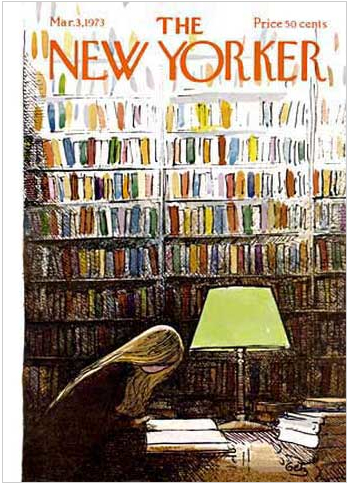
emdashes_getzcover1973.jpg
Wondering who those mystery staffers are? The brand-new monthly column here on Emdashes will be written by two of The New Yorker‘s senior library staff, who’ll be researching and answering your questions. Well, not all of your questions, smartypants! We’re being very picky.

These two know pretty much everything–and what they don’t know, they know who to ask or where to look it up in the vast archive over which they preside. (True fans: It takes your breath away to stand inside it.) They’re the caretakers of the entire history of the magazine, and have awesome knowledge. Tap into it by emailing me your best questions, and you might even make it into the first batch in the column, which will debut next month. I’m excited.

[Arthur Getz cover, above, courtesy of the Cartoon Bank. It’s from March 3, 1973, so it was likely on my parents’ kitchen table the day my sister was born (a day I swear I remember). I also dig this 1957 Getz cover of the cool inside of a bookstore on a sunny day.]

Donald Reilly, 1933-2006


It’s been a busy week, so I’m glad that Blog About Town and The Comics Reporter made mention earlier this week of the sad news that longtime New Yorker cartoonist Donald Reilly has died. The magazine’s website has already put up “The Life of Reilly,” an elegant five-minute slide show about his life and work, engagingly narrated by Reilly’s former editor and fellow jazz horn player Lee Lorenz. It has some great images (photos, cartoons, and covers) along with anecdotes and detail about Reilly’s technique, “tough-minded” sense of humor, and transitions in cartooning methods at the magazine. Looking through the slide show and the Cartoon Bank images, I’m struck by how consistently funny Reilly’s drawings and captions are through the decades, and how even his slyest jokes seem to draw on a genuine sympathy for humanity that isn’t, as we know, a given.

From the Times obituary:

Mr. Reilly, who began drawing for The New Yorker in 1964, did 1,107 cartoons and 16 covers for the magazine. His work also appeared in Playboy, Colliers, Look, The Saturday Evening Post, Mad, Harvard Business Review and elsewhere.

Mr. Reilly’s artwork, typically line drawings with a touch of wash, was known for its directness, said Lee Lorenz, a former art editor of The New Yorker.

“Most artists sketch things out, make preliminary drawings,” Mr. Lorenz said in a telephone interview yesterday. “Don liked his work to be as spontaneous as possible, and he was one of the few artists who would sit down and just do a drawing.”

Together with their captions, which Mr. Reilly wrote himself, the drawings are anthropology in microcosm. Over the years, he wryly dissected the manners and customs of Homo sapiens, among them yuppie tastes (“I’m thirsty,” one tot says to another. “What kind of water does your mother buy?”); mating rituals (“I think we’re getting serious,” a young man confides to his friend. “She’s springing for a credit check and a surveillance on me”); and even euthanasia (“Yes, Oregon’s lovely, but we’re just here for the suicide”).

One well-known drawing, from 1994, depicts a distraught cat on a psychiatrist’s couch. The caption: “To this day, I can hear my mother’s voice — harsh, accusing. ‘Lost your mittens? You naughty kittens! Then you shall have no pie!’ “

Mr. Reilly’s most recent New Yorker cartoon was published on March 13 of this year. It shows one penguin addressing another, who is suavely attired in sunglasses. “Oh, get over yourself,” the first penguin says. “We were all in the movie.”

On at least one occasion, Mr. Reilly’s work influenced public policy, albeit briefly. In 1984, the town council of Garrett Park, Md., voted to install a traffic sign at a troublesome intersection. The sign, taken straight from one of Mr. Reilly’s New Yorker cartoons, read: “At Least Slow Down (formerly STOP).”

It was too good to last. “It’s been gone some time,” Ted Pratt, the town administrator of Garrett Park, said in an interview yesterday. “It got stolen so many times, they gave up.”

Later: Here is the notice placed in the Times by Reilly’s family, which includes memorial contribution information.

Donald Reilly
REILLY-Donald, 72, husband of Kathleen Collins Reilly, died from cancer on June 18, 2006, in Norwalk, CT. A prolific cartoonist and cover artist for “The New Yorker” since the early 1960’s, Donald was also a contributor to publications as diverse as “MAD” magazine and “The Harvard Business Review,” among them “Look,” “Colliers,” “Playboy,” and “The Saturday Review.” As a teenager, Donald got his start at what would become a sideline for most of his life, playing jazz trumpet, trombone, and flugelhorn. Born November 11, 1933, in Scranton, PA, Donald grew up principally in Allentown, PA, and was the son of the late Helen and William F. Reilly. He graduated from Muhlenberg College in 1955 and from the Art School at Cooper Union in 1963. Donald’s survivors, in addition to his wife, are his children, Patricia, Brian, and Michael, as well as Kathleen’s children, Robert, John, and Maura Williams, and their spouses. Donald is also survived by his sister, Helene Fagan. His sister Jane Gallo predeceased him. Donald leaves eight grandchildren: Hanna, Liza, Michael, Henry, Maggie, John, Michael, and Daniel. Family and friends will meet on Saturday, June 24, at 4 PM at the Williams residence, 223 Chestnut Hill Road, Wilton, CT. For information: Harding Funeral Home in Westport, CT, Memorial contributions may be made to The New York Times Neediest Cases Fund, 4 Chase Metrotech Center, 7th Floor East, Lockbox 5193, Brooklyn, New York 11245.

Donald Reilly cartoons [Cartoon Bank]

Eustace Google, Guest Edition


Here’s a woman after my own heart: Sue Blank (great name; hope she’s a crossword fanatic) from the Newtown Advance. She’s saved me the googling I was planning to do for you nice people to uncover the obscure—to us philistines, that is—words in “Burning the Brush Pile,” Galway Kinnell’s lovely recent New Yorker poem about the sad end, or should that be ends, of a snake caught in a brush-pile fire. Here are the lines in question, with boldface for emphasis. Obviously, you need to read the whole poem to get the whole story, along with the rest of his poems, for general gladness.

…stumps, broken boards, vines, crambles.

Suddenly the great loaded shinicle roared
into flames that leapt up sixty, seventy feet,

In the evening, when the fire had faded,
I was raking black clarts out of the smoking dirt,
and a tine of my rake snagged on a large lump.

Then the snake zipped in its tongue
and hirpled away…

Detective Blank writes:

Once I wrote for a trade magazine that limited the length of my sentences to 20 words, the better to avoid challenging the ability of its readers. Many magazines and newspapers limit both vocabulary and sentence complexity to make content easily accessible to the average person. But having been a reader for more than threescore years, I rarely find a word in such magazines or newspapers whose meaning I don’t already know. When I do, I write it down and learn it. Then I keep it in my desk drawer where I can review it frequently until I’m sure I own it.

Thus a poem in the June 19 issue of The New Yorker gladdened my heart with four unfamiliar words: “clart,” “crambles,” “shinicle” and “hirple.” I went looking for definitions. The first word, clart, means to daub, smear or spread with mud, and as a noun, refers to a glob of mud. Shinicle refers to a fire and its light, and hirple means to hobble or limp. “Crambles” did not appear anywhere except in a slang dictionary, and the definition there did not fit. [I looked briefly, too; the sense I found is also “to hobble.”] Still, one can guess from context. The poem spoke of a bonfire built of boughs, stumps, broken boards, vines and crambles. So – perhaps “useless waste or clutter”? “Junk”?

Looking for definitions can easily lead us word freaks far astray, using up an hour or so in random explorations of unfamiliar words. While searching for “crambles,” I serendipitously found “whingle,” to complain, and it reminded me of “whinge,” a word I’ve heard used only by Englishmen to refer to a kind of whining complaint. Surely the two words derive from the same source.

Other useful words, lost, alas, to daily use, include… (cont’d.)

I once consulted on the choice of a single word in one of Galway’s poems while I was his student, and it also ended up in The New Yorker. Alice Quinn does not know of my contribution, since, really, it was so small. But, like the icebox plum, so sweet.

The first person to write in with a plausible (documented) definition of “cramble” as used in “Burning the Brush Pile” gets a prize—any Galway Kinnell collection, your choice.

Dance of the Sugarplum Checkers


Love for the ’80s rages on, and who can blame the younguns who never got to wear plastic triangle earrings the first time? Thus, the Bright Lights, Big City musical is getting another chance in the sun. From Bloomberg:

The infamous “Bolivian Marching Powder” of “Bright Lights, Big City” has marched its way to Philadelphia.

Twenty-two years after Random House published Jay McInerney’s first novel, about a magazine fact-checker whose cocaine-fueled nightclubbing dulls the pain of his failed marriage and mother’s death, a newly revised musical adaptation is playing at Philadelphia’s Prince Music Theater.

The tuneful rock opera aims to be a story of loss and redemption, onstage and off. In 1999, critics clobbered its premiere at the nonprofit New York Theatre Workshop (where the premiere of “Rent” had resulted in a decidedly different outcome). They liked the music, were mixed about the lyrics and lampooned the production, in which its hopeful Scottish composer and lyricist, Paul Scott Goodman, appeared onstage playing guitar and narrating.

Nonetheless, New York’s Sh-K-Boom Records, which specializes in preserving musicals and solo work by Broadway performers, recognized its strengths and produced a 2005 recording. It features the original lead, Patrick Wilson, as well as Christine Ebersole (“Grey Gardens”) and Sherie Rene Scott (“Dirty Rotten Scoundrels”).

Worth Preserving

“Everyone felt there was no reason this should be forgotten,” said Sh-K-Boom President Kurt Deutsch, an actor and musician who is married to Scott and owns the rights to the show. “It has some of the best rock songs ever written for the theater.”

Created with McInerney’s blessing, the musical has less satire and more sentiment than the 182-page novel, which skewered young, striving New Yorkers enjoying the fruits of a nascent stock-market boom. In Philadelphia, Jeremy Kushnier, who resembles a young Jack Lemmon in blue jeans and a three-button brown jacket, plays the protagonist Jamie as a sympathetic roué.

He sings in the frenetic opening number, which like many of the songs quotes from the book: “I am not the kind of guy who should be in a place like this at this time of the morning, Sunday morning 6 a.m. I should have cut my losses about 3 a.m. but I said no, I need more blow to get me on my marching feet again.”

Jamie careens from nightclub to party to his job at “Gotham” magazine, based on the “New Yorker.” His mother appears as a ghost, singing up-tempo remembrances and ballads; his ex-wife, a model, sings a Burt Bacharach-inspired ode to the catwalk.

Cont’d.

Sneak Preview: A New Column Written By…

You. At least, in part. And not by me. I’ll explain.

Like me, you read The New Yorker. With interest. Loyally, actively, critically. Ardently. You love to wrangle with it. Perhaps you’ve just picked it up for the first time. Don’t you wish you could ask it a few questions? To confirm a subtle change that no one else seems to have noticed? To go behind the scenes of the DVD archive with some juicy institutional knowledge? To debunk a hoary myth once and for all? Or a other dozen things? Did you ever have a New Yorker question that could only be answered by someone who’s actually there?

Well, now you can.

Starting soon, two New Yorker staffers (whose identities will remain a secret for now) will answer the best of your questions each month, right here on emdashes. Before that can happen, of course, these wise experts need some good, fun, challenging questions to answer. So what have you always wanted to know? Email me all your queries about New Yorker history, its writers, editors, cartoons, style, subjects, design—anything that’s ever fascinated or confounded you—and I’ll put them into the right hands. Don’t bother inquiring who asked who to the Condé Nast masked ball, but almost everything else goes.

If your question is chosen and I print the (for now) mystery columnists’ answer on emdashes, you’re free to either use your name or initials or remain anonymous, so please indicate in your email which you prefer. Have fun, be specific, don’t hold back, and can’t wait to see what you ask—not to mention the answers.

Update: I’ve gotten some swell entries so far today. Remember, it’s got to be a high-quality question—a real puzzler or a triumph of arcana, or perhaps the soul of elegant simplicity—to be posted and answered here. So keep brainstorming! Quipsters, you make my inbox shake like a bowlful of jelly, but I’m only forwarding the real stuff, so try to use your power for good. So email in those questions. Only questions emailed to me will reach the desk of people who will answer them!

Further update: I’ve revealed more about the columnists here.
(There was a drawing by a young lady named Brooke here, which I’ll fill in later after I’ve transferred the image from blogspot; here are more vibrant body parts.)