Monthly Archives: August 2006

New in New Yorker Technology News: It’s a Hard Drive’s a-Gonna Let You See the Entire Archive Just Like That


First the Complete New Yorker update disk and now this, which I wasn’t expecting at all. From the press release because I am several feet underwater with the puffer fish and the corals, and our internet was down for half the day which has meant much cursing and gnashing of pencils:

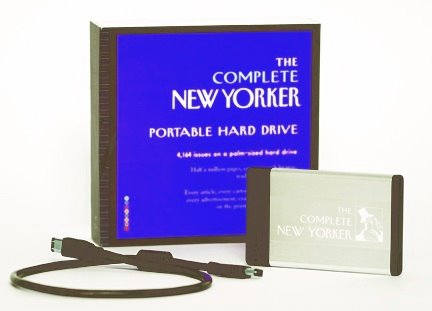
“THE COMPLETE NEW YORKER” ARCHIVE TO BE MADE AVAILABLE ON PORTABLE HARD DRIVE

First Major Editorial Collection Published via a Portable Hard Drive

In one of the first digital publishing initiatives of its kind, The New Yorker will release its comprehensive “The Complete New Yorker” archive on a hand-sized portable hard drive, it was announced today by Pamela Maffei McCarthy, Deputy Editor.

The USB-powered drive, which will retail for $299, represents an evolution of “The Complete New Yorker,” which incorporated the entire archive on eight DVD-ROMs and was released last year. Featuring the same program and design as the DVD collection, the hard drive contains every page of every issue of The New Yorker from February 1925 to April 2006—more than 4,000 issues and 500,000 pages.

The drive is designed to provide easy access to the archive virtually anywhere. It connects to a computer or notebook through a simple USB port, providing instant access to every article, review, poem, illustration, and cartoon, exactly as it originally appeared in the magazine. Users can easily search, browse, read, zoom in, and print any stories, covers, or cartoons they choose. They can bookmark them with notes, or share their reading lists with co-workers, family or friends.

“The Complete New Yorker” hard drive will be available September 18th. Pre-orders are available now at www.thenewyorkerstore.com.

I’m excited. I have a jarring birthday coming up, but since it falls not far from the 18th, I suspect that the trauma may be somewhat alleviated via Tilley microchips. Meanwhile, just in and very much Complete New Yorker-related, the first report from a talented new contributor to Emdashes. But you’re going to have to wait for it, because exciting things are happening in the next month here. As the Addams cartoon says, “It’s a baby!” In this case, the symbolic, brainchild kind. Patience, fortitude.

Related: Additional posts about the DVD archive.

Stop capitalizing “internet”!

Says Jeff Hunt at Here and There, who, in his preoccupation with capitalization, is surely a person after my own heart:

I was reading an article on online journalism in The New Yorker by Columbia University’s Nicholas Lemann, and suddenly all those uppercase Is starting popping off the page, stabbing me in the…nevermind.

It became so, so clear, right there, in a single instance as I boarded my BART train ─ internet should be treated as the internet itself would treat it.

You may thinking such a basis is ridiculous, and that, if carried out to its logical conclusion, the word may end up looking something like “nturnt.”

But really. Why capitalize? The internet is no longer novel or particularly well-revered by its users. Its ubiquity increases worldwide every hour, and even my mom has a web-connected computer at home now.

I cast my vote: it’s time to lowercase the i in internet.

Post-script: I also abandoned capitalizing the w in web, and have never understood why some people want website to be two words.

I would have a few copyediting cavils here if I were being hopelessly petty, and never mind is only one word if you’re Kurt Cobain, God rest ‘im, but that would be foolish, because boy, do I agree. While you’re there, read Hunt’s busy is bullshit post, likely inspired (as a commenter notes) by Alex Williams’s Times story “Pencil It In Under ‘Not Happening.'” [Hunt has since written to let me know it was actually just one of those weird harmonic convergences.] Even better than that, though, is an opinion piece I’ve been quoting since January: Bob Morris’s fantastic prescription for New Yorkers to stop with all the plan-canceling. He writes, but you really have to read all of it because it’s much funnier in context,

First, stop canceling social plans for no good reason. While it’s acceptable to cancel due to severe illness or a transit strike, it is impolite to cancel because you are “stressed” or “overwhelmed.”

We are all stressed and overwhelmed. When is the last time anyone you know in this Type A society admitted to having nothing to do? Canceling devalues the importance of another’s time. It is also the bane of every well-meaning host.

Not long ago Andrew Solomon, the author of “The Noonday Demon: An Atlas of Depression” and a generous host, had seven people cancel for dinner.

“One of them told me she had just gone to the gym and came home depressed,” he said. “I told her, ‘Listen I was so depressed I wrote a book about depression, and unless I was hospitalized with it, I would always show up for dinner parties.’ “

That’s because he has a sense of decorum.

But anyone who has tried to give a New Year’s dinner knows decorum flies out the window with guests who can’t commit — bringing me to another resolution.

Stop treating invitations casually, whether for weddings or country weekends. I can’t stand when friends leave me hanging.

“People don’t R.S.V.P. because they’re hedging their bets,” said Michael Bassett, a lawyer who entertains often. “They leave it up to you to call them, and sometimes they still won’t give you an answer.”

Maybe that’s because they’ve become so used to ignoring voice-mail messages.

And while we’re on the telephone, here’s another resolution for others: Stop picking it up when you can’t talk. It’s an act of aggression, and is the single best reason call-waiting should be discontinued. Cont’d.

I can’t say I’ve stopped doing this altogether, but I’m much more aware of the hideousness of this illness now, and am gradually reforming. Eventually I will stop being a plan-canceler for good. Let’s join the revolution!

Update: I’ve gotten a very long letter about this extremely pressing question (that of capitalizing Internet and Web, that is), which I will publish with the writer’s permission. Also, I hope I’ve conveyed that I agree with Jeff Hunt about not capping internet; after all, I’ve called for one-wording “email.” Sorry about the Kurt quip, Jeff! No hard feelings, I hope.

Related:
Nick Lemann “Not Resisting the Web”
Back to the Future

Ron White, Philosophically

The comic responds to the Blue Collar Comedy Tour story (July 10, not online alas) in an interview with the Austin American-Statesman:

The New Yorker recently came out with a piece that highlighted how White and the other Blue Collar Comedy Tour comics — Jeff “You Might Be a Redneck” Foxworthy, Larry the “Git’er done!” Cable Guy and Bill “Here’s Your Sign” Engvall — get little respect from industry types because Hollywood can’t view blue-collar America, specifically Southern accents, through anything but haughty, elitist glasses.

White and I spoke over the phone. I was in my apartment in lovely South Austin, and he was in his mansion in Atlanta.

Wait. Let’s say we’re playing golf on his gated community’s private course. God, I’m terrible at this game.

Austin American-Statesman: So you read the New Yorker article?

Ron White: Yeah that’s great. Get me real drunk in a bar after I just played for 18,000 people; see what happens next. Cont’d.

Related, kinda: Dana Goodyear’s Profile of Sarah Silverman. “Her arms are long and her center of gravity is low: she is five feet seven, and moves like a vervet monkey…. [Penn Jillette] says, ‘I really think that her sensibility—not her style—and her material and her ability to write and her timing would all work just as well if she looked like Gilbert Gottfried. And yet she doesn’t in any way deny who she is. That’s all you want.’ ”

The Republican Playbook: I Want It


Tall drink of water and good egg (don’t think too hard about that pair of metaphors) Andy Borowitz has a book coming out in October that I’m totally jazzed about—The Republican Playbook (Hyperion, $16.95), a document stolen right from under the nose of President Thimblebrain and published just in time for the fall feudfest. From the PW review: “A Republican-to-English glossary translates ‘personal responsibility’ to ‘welfare cuts’ and ‘My fellow Americans’ to ‘My fellow evangelical Christians.’ More silly, but still amusing, is a ‘Democrat to French conversion chart,’ rendering Joseph Biden as ‘Giscard Boudin.’ ” Pre-order, pronto. Borowitz thinks he might just have time to do a little Emdashes Q & A, so look forward to that.

Related: Ring My Bell [Borowitz Shouts & Murmurs becomes a Fringe Festival play]

Lost Talks Are Going to Topeka City, Topeka City Here They Come

A Kansan ABC affiliate picks as its “hot website” the newly and deservedly touted Silence of the City, where rejected Talks of the Town get a second chance to shimmy in the vaudeville spotlight after they’ve been yanked offstage by the editorial cane with a blat of the tuba. The newsreaders seem a bit baffled by it all (“They probably just get a ton of entries; I know The New Yorker is a popular magazine”), but it’s a nice story with earnest footage of clicking through the blog, which is one of those ever-present, funny old-new media flirtations.

Related: City of the Semi-Silents

Nick Lemann “Not Resisting the Web”

Lemann responds to Jeff Jarvis’ remarks today in the Guardian‘s Comment Is Free. All I’d add to my side note about the original New Yorker story is that it would be smart to hire Bryan Keefer. So, people who hire, get on it!

Speaking of the web and everything, Comment Is Free looks different from the newspaper sites I’m used to reading. They explain:

Comment is free is a major expansion of Guardian comment and analysis on the web. It is a collective group blog, bringing together regular columnists from the Guardian and Observer newspapers with other writers and commentators representing a wide range of experience and interests. The aim is to host an open-ended space for debate, dispute, argument and agreement and to invite users to comment on everything they read.

Huh, I feel the spray of the wave of the future! Or maybe I’m just swayed by the clean, pretty design (I’m fond of red and green, as you can see).

Related: Back to the Future

Sharp as a Pencil

Newly discovered, an endearing and near-giddy interview with David Remnick, undated but I’m assuming from 1998 or thereabouts, when he assumed editorship of the magazine. [The interview is now offline, but still at the Wayback Machine.] Interview by Orville Schell, brother of Jonathan Schell, the nicest visionary I know. Quick quote from the Remnick transcript (with cosmetic punctuation corrections; I hereby volunteer to copyedit the thing for free, Berkeley):

It’s curious, isn’t it, if people come to sort of think that a magazine actually belongs to them in some way.

They do! And I’m glad of it! In a way. I’m glad when they get angry about a change! It shows they are paying attention in some passionate way. When I get these letters: ‘I’ve been a subscriber for 25 years and I think it’s an outrage that you misuse the word X…,’ God love them! I just think that’s fantastic! And I don’t mean it in a patronizing way. I want to not only answer this letter, which I do, but I want to look the address up and go and give them a hug and a big kiss. I mean it! Who could ask for anything more than that?

Malcom Gladwell published a piece about a very strange developmental psychologist who believed that parents don’t matter, that really what matters most is peer groups, and we got hundreds of letters from apoplectic yuppie parents like myself. “What do you mean we don’t matter!” I just thought this was spectacular! And it can be on a grammatical point as well—“Where is that umlaut?” I got one such letter—three pages long. Oh my god, if those two little dots disappear over coördinated, we’re dead in the water!

Later: There are a few more particularly well-spoken bits, for instance Remnick’s description of the editing process at magazines as opposed to newspapers: “You’re talking about a process that can go on for weeks. It’s a conversation. It’s a cajoling. It’s a jujitsu. But finally it is about getting that writer to do the piece that he or she wants.” And on the public visibility of editors: “The magazine is not an esoteric church. It’s not a secret and I’m not a secret.”

Not to mention:

Do you think [Ben Bradlee] had his eye on the market, or do you think he had his eye on…

No. I know time and time again he got all kinds of complaints from advertisers. And without being a jerk about it, without being rude about it, the essential answer for him was, “That’s what we do.”

Has that changed in America now, the ability to say that of some editor?

Not where I stand! I don’t want to speak for anyone else, but clearly it hasn’t. Look, I did not leave writing to pander. Do I hope that we get more and more advertising and that The New Yorker becomes healthier and healthier on the financial side? You bet I do! You bet I do! But not through the easy route. We could do, you know, a market test tomorrow and find out all the obvious things. Drop this, drop that and more of this. Forget it! Forget it! This magazine will publish fiction, it will publish poetry, it will publish foreign reporting! And you and I both know that in the world of focus groups these are not number one on the list. But they will be there in The New Yorker.

And this:

What do you think the legacy of Tina Brown will be?

I think Tina had a lot of guts. And I think that Tina, like any editor, went out and hired a lot of writers that she liked, and that The New Yorker has every reason to be very very proud of her. I also think that it took an outsider, to come in and say, “We can’t do this? Well, yes, I think, we can. I can’t do this? Well let’s just try.” And I think that that attitude went a long way toward shaking the magazine up visually and otherwise, and toward introducing topics that weren’t there before. Again, the topic that always seems to come up is Hollywood. But it’s ridiculous to say it wasn’t there before. Kenneth Tynan, probably one of the best profile writers in the history of the magazine, wrote profiles of Mel Brooks, Louise Brooks, Ralph Richardson and so on.

The look of the magazine is forever changed and I’m glad of it. I’m glad not to have to make the change to photographs myself. Yes, photographs! Cause we took a lot of guff for it, a lot! Such changes take moxie!

You tell ’em, DR!

Related:
Is It Real or Is It Remnorex?
Fly Continental
Casual Friday
Remnick: “There’s a Reason Things Taste Better When They Simmer”
Urban Golf, The Week, and Sex on Legs
Remnick: “I Read Blogs”
New Yorker People in the News
Legacies in the Ether
Last Stand
The Mixed-Up Files of Mr. Basil E. Remnick

Back to the Future


Andrea Batista Schlesinger writes in the Huffington Post:

“Amateur Hour” is what Nicholas Lemann, dean of the Columbia School of Journalism, calls the rise of Internet journalism and the blogosphere in last week’s New Yorker.

I can’t help wondering if Ned Lamont’s primary victory in Connecticut has influenced his thinking.

Since then, I asssume she means, or else Lemann’s reporting would have have had to include time travel; even the Wayback Machine can’t do that!

Anyway, opinions TK. The long and short of it: Lemann has some sound points, and as anyone who knows me knows, I’m an ardent defender of long-established and stringent journalism practices (I work at PRINT, for crying out loud). I also think some of the journalism he cites as mundane or trivial—printable robots, harmless hazing, mountain-dulcimer man—could just as easily be New Yorker pieces if they were properly written. (No one, not even the rain, should begin a story with a dictionary definition.) Along with the new Charles Addams biography, out in September and agreeably juicy, I’m reading a solid ’70s history called Literary New York, which has some detailed passages in it about ’20s magazines that I’m going to type out here. There’s some fluff on the web. There’s society gossip and stuff that dates instantly and bad jokes and pettiness and emerging brilliance. Make what connections you will—I’m sleepy after a delicious dinner and long conversation, but when I can, I’ll reprint it here. If nothing else, it’s good reading.

Later: And of course, Steven Johnson has the last and (for now) best word: Five Things All Sane People Agree On About Blogs And Mainstream Journalism (So Can We Stop Talking About Them Now?) Via Lindsayism, who adds a witty word. Double true.