Monthly Archives: February 2007

Be Careful!

The February 19 & 26 issue of the magazine is so good it’s in danger of exploding.
Unrelated, yet essentially the same:

Ellington was appalled by the very thought that jazz might “develop” to the point where people could no longer dance to it. When he said “jitterbugs are always above you,” he wasn’t really complaining. They might have kept him awake, but he wanted them to be there. He was recalling the sights and sounds of New York life that he got into “Harlem Airshaft,” one of his three-minute symphonies from the early 1940s. If he had put the sounds in literally, one of his most richly textured numbers would have been just a piece of ­literal-­minded program music like Strauss’ Sinfonia Domestica. But Ellington put them in creatively, as a concrete transference from his power of noticing to his power of imagining. Ellington was always a noticer, and in the early 1940s, he had already noticed what was happening to the ­art form that he had helped to invent. He put his doubts and fears into a single funny line. “It don’t mean a thing if it ain’t got that swing.” Characteristically, he set the line to music, and it swung superbly. But under the exultation, there is foreboding. Ellington could see the writing on the wall, in musical notation. His seemingly flippant remark goes to the heart of a long crisis in the arts in the 20th century, and whether or not the crisis was a birth pang is still in dispute.
—Clive James, “The Astonishing Duke Ellington,” Slate

Obvious caption for this week’s contest: “I don’t care if she is the recently sawed cross-section of a tree. I love her.

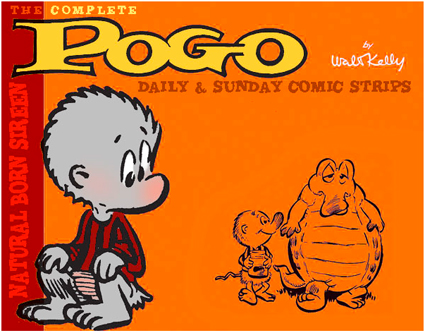
Jes’ Fine: Huge Pogo News From Fantagraphics

From the most exciting press release I’ve seen in months, if not years:

FANTAGRAPHICS TO PUBLISH WALT KELLY’S POGO, DESIGNED BY JEFF SMITH
 
Fantagraphics Books is pleased to announce that it has acquired the rights to publish a comprehensive series comprising Walt Kelly’s classic POGO comic strip. The first volume of Fantagraphics’ POGO will appear in October, 2007, and the series will run approximately 12 volumes.
Each Pogo volume will be designed by Jeff Smith, the award-winning cartoonist and creator of the Bone graphic novel, and a lifelong admirer of Walt Kelly.
Walt Kelly (born Walter Crawford Kelly Jr.) was born in 1913 and started his career at age 13 in Connecticut as a cartoonist and reporter for the Bridgeport Post, his local newspaper. In 1935, he moved to Los Angeles and joined the Walt Disney Studio, where he worked on classic animated films, including ‘Pinocchio,’ ‘Dumbo,’ and ‘Fantasia.’ In the mid 1930s, he drew his first comics work for the future DC Comics. Kelly left Disney in 1941 rather than take sides in their bitter labor strike. He moved back east and began drawing comic books for Western Publishing Company and the Dell line of comics.
It was during this time that Kelly created the character Pogo Possum. The character first appeared in Dell’s Animal Comics as a secondary player in the ‘Albert the Alligator’ feature. It didn’t take long until ‘Pogo’ became the comic’s leading character. After the Second World War, Kelly became artistic director at the New York Star, where he turned Pogo into a daily strip. When the Star folded in 1949, the Hall Syndicate took ‘Pogo’ into syndication, so that the strip soon appeared in hundreds of newspapers. Until his death in 1973, he produced a feature that has become widely cherished among casual readers and aficionados alike as a classic comic strip.
Kelly blended nonsense, poetry, and political and social satire in making POGO an essential contribution to American “intellectual” comics. As the strip progressed, it became a hilarious platform for Kelly’s scathing political views in which he skewered national boogeymen like Joseph McCarthy, J. Edgar Hoover, George Wallace, and Richard Nixon. Kelly was considered a sufficient threat that his phone was tapped and the US Government corresponded with a newspaper reporter who claimed that the eccentric patois Kelly created was a secret Russian code.) Pogo is well known for its elaborate and ornate lettering and for Kelly’s distinctive use of language and lush brushwork. It is one of the few comic strips that succeeded in blending humor and politics into an uncompromising and entertaining whole.
The consecutive run of Pogo has never before been systematically collected into book form. (Fantagraphics published a series of 11 softcover volumes reprinting five-and-a-half years of the strip in the ‘90s.) This will be the definitive series collecting all of his Pogo strips from 1949 to 1973. “Walt Kelly is unquestionably in the pantheon of great newspaper strip cartoonists,” said Gary Groth, President & Publisher of Fantagraphics Books. “Our Pogo books will present Kelly’s work the way it should be published — in a beautifully designed hardcover format, with careful attention paid to reproduction quality, and with knowledgeable introductory material.”
“I am very excited that Fantagraphics has chosen to publish Pogo in such wonderful books,” said Carolyn Kelly, Walt’s daughter. “For many years people have been telling me how much they want to own this series, and I am thrilled that Pogo will now be so carefully compiled and available to us. Ol’ Walt would be proud.”
“This collection has been a long time coming,” said Jeff Smith, “I’ve been waiting for it ever since I was nine. I’m very happy to be helping the Kelly family and Fantagraphics bring this comic strip masterpiece to a new audience.”

Pogo.jpg

Love Conquers All*: Emdashes Readers’ Valentines for The New Yorker

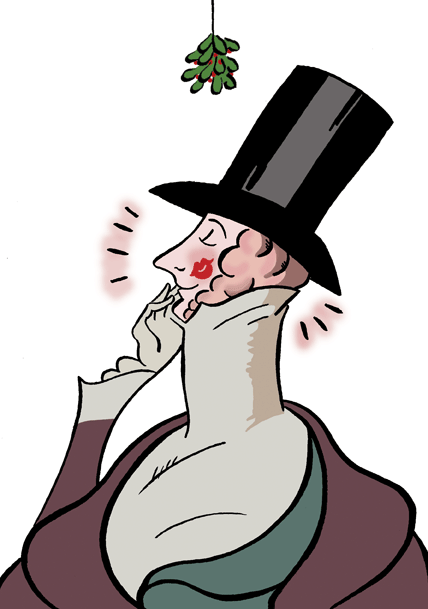
I asked some friends of Emdashes (whose abbreviation is not FOE) if they’d like to send some virtual valentines to a person, thing, or idea at The New Yorker. OK, that’s not completely true—I actually asked them to send a virtual holiday present back in December, but you know how these things go. So whether you hate Valentine’s Day or just sort of hate it, I hope this is a happy diversion, and I personally send kisses (and I’m told they’re quality) to every single one of you. Oh, and you’ll need to skip to the jump for the funny and gorgeous drawings by Patricia Storms; the first, while Christmas-themed, is eerily perfect for this week’s anniversary Tilley cover. Definitely click to enlarge!
Daniel Handler (Adverbs: A Novel, Lemony Snicket’s The End, &c.):
For Malcolm Gladwell: Three poems by Elizabeth Bishop, the first season of Golden Girls, a TRS-80 computer, a jar of dill pickles, and the results of a sociological study from the 1950s, with the expectation that he can find a life-guiding philosophical principle which governs all these specific items.
Mac Montandon (writer for Radar magazine and the author of the nonfiction book Jetpack Dreams, to be published by Da Capo Press in 2008):
1. Weekly assignments for Nick Paumgarten, Mark Singer, and Dana Goodyear.
2. A few more kids for Adam Gopnik—the better to generate story ideas.
3. A standing invitation for Ian Frazier to stop by any time and entertain me and my family with wonderful, witty tales.
4. The opportunity for David Remnick to reconsider that Silence of the City book idea.
5. Comma quotas for all!
Jesse Thorn (host, The Sound of Young America):
I would like to send Roger Angell season tickets to the Red Sox and an elixir of eternal life.
Carolita Johnson (Newyorkette and New Yorker cartoonist):
1. I’d send a beautifully tender, juicy, crackly-skinned, roasted chicken to Gary Shteyngart, with whom I had fun eating and talking about food at the Gin and Books party!
2. To Adam Gopnik, Microsoft Word’s Random Metaphor Check (as soon as it becomes available).
3. And to Orhan Pamuk, I’d send a chill pill after reading “My Father’s Suitcase”! I’ll throw in a self-flagellatory whip (one-time use only, because I do so like him).
A fan who prefers to remain anonymous has $500
for humorist Patricia Marx
.
David Marc Fischer (proprietor of Blog About Town and frequent loser of the Cartoon Caption Contest):
1. To Sasha Frere-Jones: A crate of heart-shaped rockist crackers.
2. To Emily Gordon: The return of Elk Candy. [Yes, please! —Ed.]
3. To Zachary Kanin (gatekeeper of the Cartoon Caption Contest): Whatever he wants, capische?
John Bucher (New Yorker Comment and, if all goes well, brand-new Emdashes intern):
1. Backup batteries for Rik Hertzberg’s common-sense Taser.
2. A ride on an icebreaker ship (or the biggest dump truck in the world) for John McPhee.
3. A spot for Elizabeth Kolbert in the VP’s next shooting party.
4. For Malcolm Gladwell: a Golden Ticket and a tour of the factory.
Patricia Storms (freelance cartoonist and illustrator living in Toronto, who’s illustrating a children’s book for Scholastic Canada and a humor book for Chronicle Books, both out fall 2007; a book of her cartoons about Valentine’s Day will be out in February 2008 from Red Rock Press):
1. This may sound sappy, but I’d love to give Eustace Tilley a big fat kiss as a thank-you for delighting me with such a stellar magazine. I’m feeling especially mushy about The New Yorker this year, because after many years of my reading my mom’s used New Yorker copies, she finally decided to give me a year’s subscription as a Christmas present. What the hell took you so long, ma? (Kidding, I’m kidding.)
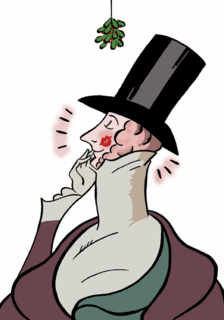
eustace_2.gif

2. And in the spirit of the season, even though I tease poor Franzie mercilessly in my cartoons, I’d like to give good ol’ Jonathan Franzen, contributor to The New Yorker and lover of all things Charlie Brownish, a hug. I think he needs it.

goodol%27franzen_2.gif

 
Love Conquers All is a 1922 book by Robert Benchley that you can read in full here.
A Reader Writes: Can It Be a Coincidence?

Ed O’Connell of Martha’s Vineyard asks this provocative question:
I’m a New Yorker reader of limited tenure with a question that may expose an embarrassing degree of naivete and/or paranoia but, of course, I’m compelled to ask: is there an inside joke at the magazine about using the same unusual word in different articles throughout any one issue? For example, in the 1/29/07 issue, Schjeldahl on the Art World and Denby on Current Cinema both use the fairly unusual word “deracinated.” I have noticed this in past issues from time to time with other unusual words and have wondered if this is the work of a playful editor or merely coincidence. Thanks in advance for any insight.
It goes without saying that no one on the magazine’s staff would ever declare this to be true on the record, even if such twins were planned; after all, word repetitions are one of the things copy departments try to prevent. (In the brief and surreal, though existentially crucial, period in which I freelanced at Lucky, searching for “reps”—multiple instances of “ladylike” and “foxy,” most likely—was one of my oddly enjoyable tasks.)
Still…things like this, bets and dares and japes, have been known to occur in the magazine world. Perhaps there will be an update. Wait and see.
Send letters to the editor to letters@emdashes.com. As always, nothing is published without permission, so rest easy, paranoiacs.

Will the Real Monocle Please Stand Up? (No Slight Intended to E. Tilley.)

Wallpaper* star Tyler Brûlé may be starting something called Monocle (“a new, global, European-based media brand…delivering the most original coverage in global affairs, business, culture and design”), though at press time monocle.com was not live, but in my mind the real Monocle will be the wittily designed, unusually shaped, and culturally astute humor periodical of the ’50s and ’60s, edited by Victor Navasky, Richard Lingeman, et al. From a workshop in which Navasky participated (when?) at the New School, “On The Nation and the Historical Role of the Journal of Opinion”:

VN: The relevance of Monocle to this discussion today is that it taught me that all of the assumptions in the magazine business in the United States of America are dictated by business interests, rather than political, reader or writer interests.
For example, I made a joke about the fact that we were a “leisurely quarterly,” coming out twice a year — and yet the question remains, why should magazines come out every week, or by moon cycles, or every month, or every quarter? Why shouldn’t they come out when they have something to say? The reason they come out this way in this country — and in other countries there are other reasons — is that you can’t get second class mailing privileges from the United States Post Office unless you come out on a regular schedule, and you have to pay a lot more to mail it if you don’t have second class mailing privileges.
The second theory we had at Monocle was: Why should a magazine cost the same every week? One week we have two dollars and fifty-cents worth to say, and the next week we may have 25 cents’ worth to say. They next week we might have five dollars worth to say. So why don’t we charge what it’s worth, rather than the same price every week? Well, the retailer will get confused. It’s a business decision you make not to charge what it’s worth, as you would with books.
Why should a magazine be in the same shape every week, on the same paper? Monocle was long and thin for much of the time, and we called it “as tall as Time and as wide as Reader’s Digest.” We thought that we could sell ads that way, but we didn’t sell any ads.

Later: I just noticed that Steve Heller has a nice long post about this at Design Observer. Read it!

Grafs: What’s The New Yorker’s Munch-munch Ratio?

An experiment in which, instead of writing unfairly hasty sentences when pressed for time, I offer you a fizzy thimbleful of each noteworthy article.

A rough gauge of sophistication as it’s constructed through language, then, can be found in the number of references to Norwegian artist Edvard Munch, painter of The Scream (or other people named Munch), and instances of the word munch, one of the most ungainly, inelegant words in the English language…. When I examined previous New Yorker articles to delve deeper into its Munch-munch ratio (which is 2 since 2000), I found that, in fact, every instance of munch was a quotation of some sort. New Yorker writers had, in fact, a Munch-munch ratio that was undefined. Until Nov. 13.
—Graham Meyer, “Spectral Intrusions,” The Other Tiger

The result is the meta-erroneous belief that The New Yorker has a policy against printing corrections at all—a belief that has made it all the way to the Columbia journalism department. “As I understand it, for many, many years they didn’t even run letters to the editor,” [Nicholas] Lemann said. “It’s fairly recent—I can’t remember when they started—that they run letters. They still, since 1925, have not run corrections.”… In fact, although the weekly “Mail” section is a relatively new addition, the magazine has printed letters since at least 1936.
—Leon Neyfakh, “Off the Record,” New York Observer

It looks like George Packer may finally get the war he’s been asking for. In his 2003 New Yorker essay “War After the War,” which was the basis for the book The Assassin’s Gate and which is one of the single finest pieces of journalism I’ve ever read, Packer made the case that Iraq would be won or lost not in battlefield victories or large-scale campaigns but in tiny human interactions, ground-level points of contact between Iraqis and Americans. His intimate, scene-based reporting became an example of the thing he was advocating, the attentiveness to nuance and context that the military couldn’t get right.
—Gabe Roth, “Right Approach, Wrong Time?,” Roth Brothers

In his interview with Robert Hass to an overflowing crowd at International House, the Columbian artist Fernando Botero mentioned that when reading Seymour Hersh’s article in The New Yorker about American soldiers using torture in the same prison at Abu Ghraib where Saddam Hussein used similar violent tactics, he was deeply shocked…. This, he had not expected of the North Americans. Compelled to respond to this outrage with pencil and brush, he spent the next 14 months creating over a hundred drawings and paintings, based on the photographs which had been published showing the humiliation, abuse, depravity and torture.
—Peter Selz, “The Power of Botero’s Abu Ghraib Images,” The Berkeley Daily Planet (includes one of Botero’s arresting drawings)

Balliett’s page-long, semicolon-laden paragraphs—like Stephen Dixon’s, but more voluptuous—felt like mere transcriptions until, with a decisive snap or a concise, precise image, he would bring us back to the point. Often, it just happened that the point would be a different one—more surprising, less common-sensical, less easily summarized—than the one we thought was being made.
—”Whitney Balliett, 1926-2007,” Quiet Bubble (Another Balliett reflection is here; thanks to Scott McLemee for the tip!)

NYC Event: Thomas Bernhard Jubilee at KGB (Dale Peck, Wayne Koestenbaum, &c.)

Welcome news about an event on Feb. 18 at which you will drink beer and Wayne Koestenbaum, Rhonda Lieberman, Ben Marcus, Geoffrey O’Brien, and Dale Peck will read from and discuss the Austrian novelist, playwright, and poet about whom Ruth Franklin wrote in The New Yorker in December: “The author of eleven novels and more than twenty plays, Bernhard had a well-deserved reputation as the country’s most provocative postwar writer: he spent his career alternately mocking and mourning Austria’s Nazi legacy, which, with typical bluntness, he once represented as a pile of manure on the stage.” From the event announcement:
A reading tribute to Thomas Bernhard
Sunday, February 18, 7:00 p.m.
KGB Bar, 85 E. 4th St. (between Bowery and 2nd Avenue), 2nd Floor
Free
contact: Jonathan Taylor, jonathandouglastaylor@gmail.com
Austrian novelist, playwright and poet Thomas Bernhard (1931–89) is not as widely read in the U.S. as he is throughout Europe, but here too, his influence among innovative writers is outsized. Gleefully embracing his role as Austria’s preeminent Nestbeschmutzer (“nest-fouler”), he embroidered his boundless dissatisfaction with existence into monologues that reach a comic fever pitch through relentless exaggeration, repetition and contradiction.
On Feb. 18 at KGB, a group of New York authors will read selections from Bernhard masterpieces including Old Masters, Correction, Yes and Gathering Evidence, and discuss their encounters with his work:
Wayne Koestenbaum has published five books of poetry, most recently Best-Selling Jewish Porn Films. His next book, Hotel Theory, will be published in spring 2007. He is a Distinguished Professor of English at the CUNY Graduate Center, and currently also a Visiting Professor at the Yale School of Art.
Rhonda Lieberman, the only woman on this panel, is a New York-based writer, a Contributing Editor of Artforum, a Visiting Critic at the Yale School of Art, and a longtime admirer of Bernhard’s super-crabby oeuvre.
Ben Marcus is the author of The Age of Wire and String and Notable American Women. He has published fiction and essays in Harper’s, The Paris Review, Tin House, McSweeney’s, and Conjunctions.
Geoffrey O’Brien is the author of Sonata for Jukebox, The Browser’s Ecstasy, and other books.
Dale Peck is a novelist and critic. His new novel, The Garden of Lost and Found, will be published this fall. His favorite Bernhard novels are Old Masters, Concrete, and Woodcutters, although not always in that order.

Wednesday Guest Post: This Week’s David Heatley Cover

Martin Schneider, our trusty Squib Reporter, writes:
Our friends over at FLOG! (that’s Fantagraphics’ blog) are excited
about David Heatley‘s cover this week. Heatley’s work is very interesting. He had a running series in the Fantagraphics anthology Mome called “Overpeck” (soon to be a full-fledged graphic novel) that was a somewhat surrealistic treatment of childhood and suburbia; it would merit the term (David) Lynchian. Heatley’s contribution to McSweeney’s 13, the vaunted comix issue edited by Chris Ware, was called “Portrait of my Dad”; it was about as unflinching and profoundly moving as contemporary comix get.
Heatley’s Achilles’ heel, if he has one, is that the drawing isn’t always very pretty. When I heard that The New Yorker had commissioned a cover from him, I confess my first thought was to wonder whether, stripped of narrative and the latitude to be so powerfully affecting, Heatley’s work would function well in that setting. Having now seen the cover, I’m happy to see that it’s very good.
A reader adds: Just a few days ago the Poetry Foundation’s website published Heatley’s comic-strip adaptation of a poem by Diane Wakoski, the first in a series inviting cartoonists to adapt poems of their choice from the Foundation’s archives.

Zadie Smith Lecture Finally Online, Hersh Talks, Forks and Hipsters, and “8.”

The news you need, fellow New Yorker obsessives, in one-sentence whitecaps. I’ve had some of these stored up for a bit, but you’re getting your news here a) about, often, things that happened fifty years ago, and b) from a person who once edited a magazine (Wabi) whose entire premise was non-timeliness. You’re welcome to order an issue (#1, unnumbered); it’s $1, and will arrive sometime. It comes with a free (green plastic, but sturdy) fork—a sweet deal, and utilitarian, too.
Zadie Smith’s New Yorker Festival lecture on “failing better” is now online in the Guardian, hooray! (Via The Stranger.)
Here’s a good Times (U.K.) piece about E.B. White and Charlotte’s Web: “The creator of Charlotte’s Web, the bestselling children’s book of all time, as well as an extraordinarily popular manual for writing American English, he was revered by colleagues such as John Updike, James Thurber and Art Buchwald as one of the true masters of American prose. In other words, he is so good that not even professional jealousy could keep writers from praising him.”
Seymour Hersh is speaking at Williams College on Feb. 13; Paul Auster and his musical daughter, Sophie, are performing tonight (that’s Feb. 6) at the Union Square Barnes & Noble in New York.
 
Meredith Goad (excellent name for a reporter) of the Portland Press Herald and Maine Sunday Telegram quotes a Maine resident who’s offended by a New Yorker cartoon, which turns out to be this one by Lee Lorenz.
 
Many people who write about religion online have commented on Rebecca Mead’s Talk about the “Apocalypse Not” conference, and here are three of those posts, with more to come as I see them, if I think they’re interesting.
If you wondered about the puzzling appearance of the number 8 in the middle of a sentence in the last issue (in Jeffrey Toobin’s “Google’s Moon Shot”), so did the linguistics blog Languge Hat.
Once again, The Burg has managed to produce a funny episode. “North Williamsburg is the new regular Williamsburg!” Watch it. You’d be amazed how good this potentially ridiculous show can be.
As James Wolcott has posted, here’s James Marcus on Allen Shawn.
More about the late, great Whitney Balliett, and Lester Young, too (and here’s Nat Hentoff’s Wall St. Journal story, as always, annoyingly inaccessible); and more about the much-missed Molly Ivins in the Voice. Speaking of jazz, and major losses, Philly’s Five Spot has burned down. This is very sad news.
Read this Times story about swing dancing at a Christian college, but for the love of Frankie Manning, do not try any dips or (especially) aerials without months of training and supervision! Dips in dance are fun and romantic, sexy and satisfying. And they can be neck-snapping and partner-alienating if done wrong. Don’t risk it till you know what you’re doing. That said, dance, dance, dance.
At a party recently, I met a guy named Ezra Bookstein whose very interesting-sounding documentary (with Scott Feinstein) about the photographer Milton Rogovin, The Rich Have Their Own Photographers, has been impressing people at a bunch of film festivals, and is showing soon on PBS. If you know when, please let me know.
This writer will be blogging about every short story in the magazine this year.
And belatedly, but eternally, I was moved by this viewer comment on a Denny Doherty clip from YouTube:

“California Dreaming” was the anthem for all us draftees 1968-70. All us Cali guys in the 3rd Infantry Regiment (The Old Guard) at Ft Myer, Va. had C.D. either written inside our lockers or written somewhere on our helmets. Great song & fond memories. Rest easy Denny.