
Continuous reports from the 2007 New Yorker Festival.
The audience who gathered for a reading from these two authors was a human Chex mix: bits and pieces of every group were there to listen to Annie Proulx and Junot Diaz, who write in different styles, have different cultural backgrounds and different styles of writing, and clearly respect each other a great deal as friends and as artists.
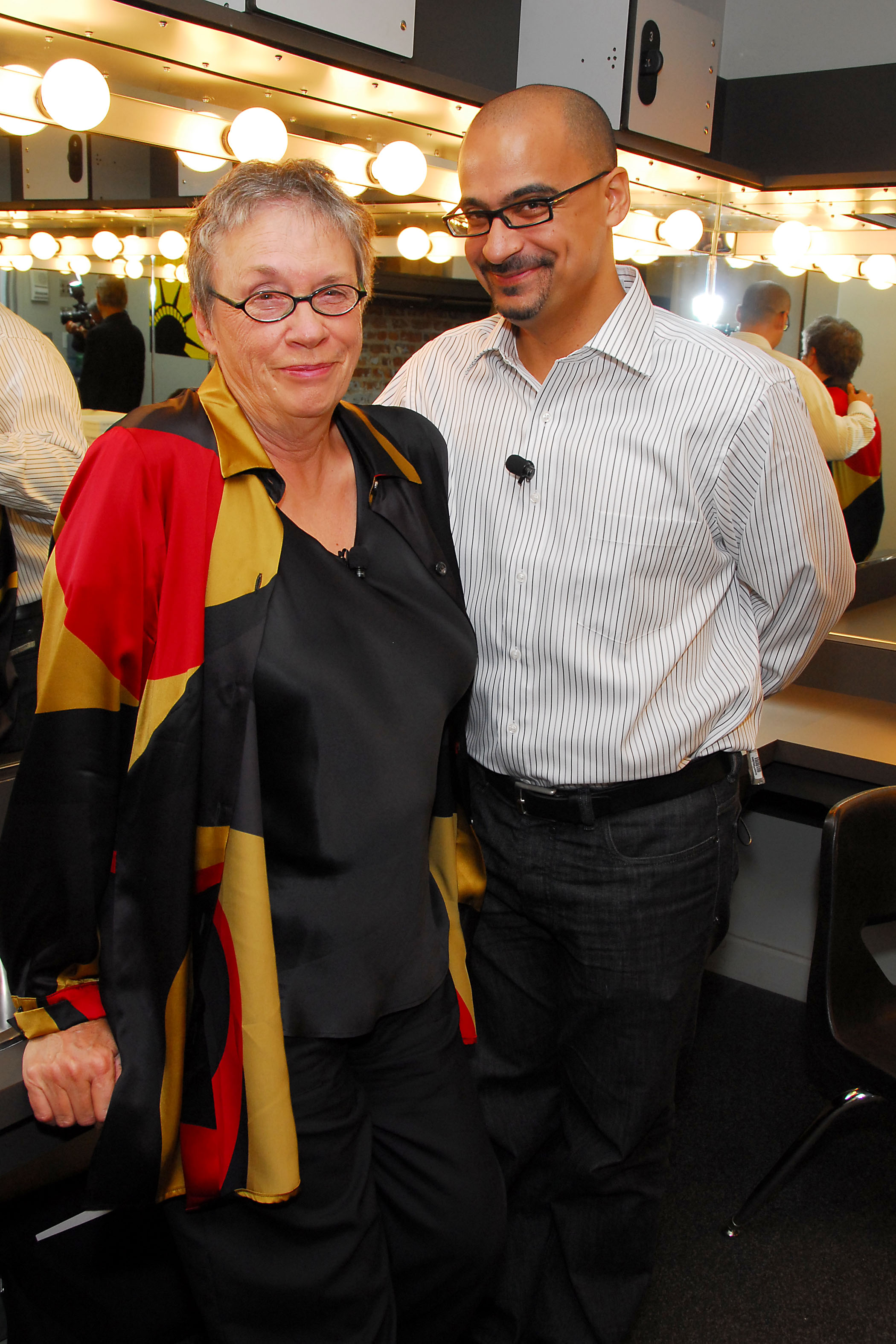
High energy abounded. “It used to Mick Jagger that got me excited,” said the woman next to me. “You know, rocker boys. Now it’s literary women that I drive hours to see.” Junot Diaz read a short paragraph from his novel The Brief and Wondrous Life of Oscar Wao—a paragraph in which, once again, his protagonist was being beaten up. He was self-deprecating as he read, apologetic to the audience, as if we wouldn’t enjoy his beautifully constructed sentences and wordplay. He was mistaken.
He talked about the fact that he continues to write short stories about humans and their failings in relationships. “As long as you keep cheating, I’ll keep writing.” he said. To prove this, he read the story of Alma and her lover; Alma has long arms, beautiful legs, and “an ass that exists beyond the 4th dimension.” Alma is all her lover isn’t, but as much as he loves being with her, he cheats on her, writing it all in his journal—which she finds. It’s not the journal that is his downfall, though, but the lie he tells to explain the contents that end it all with the delectable Alma.
Annie Proulx spoke briefly of the book she’d just finished about Wyoming’s Red Desert. When asked by a friend to write the text in his book of photography on that part of the country, she was surprised to find nothing written about it, and it became her next project to produce a book of short stories set there.
As she was researching the book, someone asked her to fill the chasm in sagebrush stories—less than a dearth, there have been none till now—and that brought about the short story she read next. “The Sagebrush Kid” is about the Sandy Skull stagecoach station, run by Mizpah and Bill Furr. Unable to have children, thwarted by eagles and coyotes not understanding that the piglet and dressed-up chicken were substitute children (you had to be there), Mizpah adopted a special sagebrush, and fed it gravy and bones and, well, that sagebrush grew and grew. While it grew, the station gained a reputation of, shall we say, not a place you wanted to spend the night.
Laced with the wonderful richness of language Proulx uses in all her work, we heard sentences that were spectacular in their music and accuracy: “He would buy cattle for a song, fatten them up, then sell them for an opera.” The story ends years later, with the understanding that the Sagebrush Kid has a cousin somewhere, and her name is Audrey.
The Q. & A. that followed was brisk, with both authors advising other writers to remember that fiction has to be disciplined, very structured and organized. Diaz said he felt that Proulx respects humanity, and that he’s a “self-hating boy,” because Proulx treats both sexes equally in her writing and doesn’t allow her subject matter to be defined by her sex. It was obvious that despite their differences, both writers have a great deal of admiration for each other, and that made for a cozy, stimulating evening.
—Quin Browne (Read more about Quin.)