Well, the first annual (I hope!) New Yorker Festival Debate has come and gone, and to call it anything less than an unmitigated success would be a sham. I was seated up front at the Society for Ethical Culture, by chance nestled among some of The New Yorker‘s more elderly readers; the woman next to me, as an example, wore an expression of pure glee the few times I ventured a peek. If the Member from Gopnik and the Member from Gladwell (as the convention required they call each other) don’t collectively become a 100% Canadian staple of the Festival, then the world just doesn’t make sense. Attention programmers! I want to see these two debate a year from now! Got it? Good.
Gladwell, defending the proposition that we should disband Harvard, Yale, and Princeton (Gopnik frequently questioned this circumscribed definition of “the Ivy League”) and use their endowments to “purchase Canada,” had a difficult task insofar as he was defending an outlandish proposition for which there happens to be a great deal of supporting data. Gopnik, by contrast, could appeal to normalcy and reason without any data at all. However, the tone of high whimsy sustained by both Members was a joy to behold.

I prefer Gladwell’s rational moralism to Gopnik’s intuitive pragmatism, but I give Gopnik credit, though—he is quick. Hardly had Gladwell evoked the French Revolution than Gopnik took the opportunity to enlist the (already sympathetic) chair, Simon Schama, author of Citizens. Our very moderator wrote a freaking book on the Terror, Jack! (Short for Jacobin.)
My favorite bit was when Gladwell shamed the Ivy League’s rank naked elitism by quoting a federal investigation of Ivy League admission practices in the 1980s. (I’d like to see more of the fruits of that investigation—I assume Karabel has the goods.) According to notes found in applications, Harvard admission officials dismissed candidates for being “shy,” “frothy,” and “short with big ears”—and then pointedly implied that the Member from Gopnik must surely take some comfort in Gladwell’s implicit defense of those groups.
Schama took on his role as arbiter in the spirit of a mad uncle or possibly a court jester; he amusingly bristled at his employer Columbia’s exclusion from Gladwell’s “Ivy League First Division” of Crimson, Bulldog, and Tiger (Gopnik’s preferred satirical term was “Axis of Evil”). At one point Schama leapt up from his central table and, using the Member from Gopnik as a sort of meat puppet, contributed a point of fact and called the Member from Gladwell a “dunderhead.” Hardly the cool impartial magistrate such august proceedings demand.
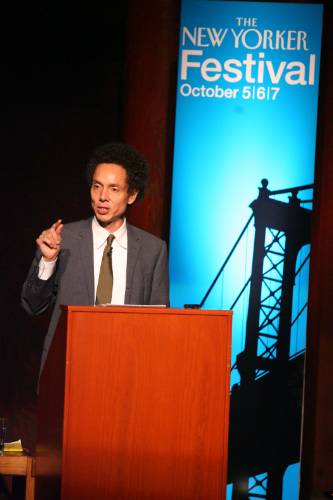
As Gladwell predicted, Gopnik was charming and almost dangerously persuasive—or, I should say, as persuasive as baldfaced appeals to emotion can be. Gopnik used a maximalist strategy wherein any agenda to disband Group X can be assumed to take its most extreme form at all times. Gopnik likened the Member from Gladwell to Pol Pot, a comparison Gladwell confessed he found “flattering.” Gopnik saved perhaps his shrewdest—indeed, possibly difference-making—move for his final statement, enlisting Bill Clinton for his cause and aligning George W. Bush himself with the Member from Gladwell. (Gladwell had to roll his eyes at that one; he might have sensed that defeat was nigh.)
In the end, Schama peered into the audience’s show of hands and pronounced the proposition defeated. Harvard, Yale, and Princeton can rest easy—for now.

—Martin Schneider