
Martin Schneider writes:
Summer began yesterday, and with it began Infinite Summer, a massive book club project (sort of) in which the only book is David Foster Wallace’s Infinite Jest, and readers have until the autumn (September 21) to finish it. The pace is 75 pages a week (not including the associated endnotes), which isn’t very hard, and readers are rewarded with all sorts of commentary and opportunities to discuss! (Here’s the schedule.)
I’m using the Kindle version, which should make it doubly fun (and also make navigating the endnotes a breeze). I read about 300 pages of it when it first came out, and then stopped, and then developed a block about cracking the book ever again. Until now!
I’ll be sure to let you know how it goes!
Author Archives: Martin
What’s in This Week’s New Yorker: 06.29.09
Martin Schneider writes:
A new issue of The New Yorker comes out tomorrow. A preview of its contents, adapted from the magazine’s press release:
In “With the Marchers,” a resident of Tehran reflects on the recent demonstrations and the situation on the ground after the country’s controversial Presidential election. The resident, who decided to write this piece without a byline because of the Iranian authorities’ attempts to curtail the actions of the Western media, writes, “On the afternoon of June 15th, I bumped into my old friend Reza at the huge demonstration on Azadi Street—the march nobody will ever forget.”
In Comment, Laura Secor looks at the difficult situation that Iran finds itself in now that Iran’s supreme leader, Ayatollah Ali Khamenei, has demanded an end to the street protests mounted in favor of the reformist Presidential candidate, Mir-Hossein Mousavi.
In “Angelo’s Ashes,” Connie Bruck offers a behind-the-scenes look at the rise and fall of Countrywide Financial Corporation, once the largest home-mortgage provider in the United States, and chronicles the ambitions of Angelo Mozilo, its “self-regarding chairman and C.E.O.”
In “The Catastrophist,” Elizabeth Kolbert profiles James Hansen, the director of NASA’s Goddard Institute for Space Studies, who is sometimes called “the father of global warming,” and examines his recent efforts to warn the public about the increasing threats to our climate.
Rebecca Mead examines the recently discovered early letters from Edith Wharton to her governess.
Alex Ross visits Marlboro Music, the famed summer institute for aspiring and established musicians.
James Wood reads Censoring an Iranian Love Story, by Shahriar Mandanipour.
Jill Lepore looks at the parenting-advice industry.
Peter Schjeldahl attends the Judith Leyster exhibit at the National Gallery.
David Denby reviews The Hurt Locker and Food, Inc.
Hilton Als reviews David Adjmi’s Stunning.
There is a short story by Stephen O’Connor.
Potentially Controversial Observation Re: Buffalo Sentence
Martin Schneider writes:
Has anyone entertained the notion that perhaps “Buffalo buffalo Buffalo buffalo buffalo buffalo Buffalo buffalo” is not a valid English sentence?
If you are not aware of what I’m talking about, by all means head over to Wikipedia and catch up, it’s a marvel.
(Very quickly, because these things get complicated, if you imagine a (purely optional) comma after the fifth “buffalo,” you might glimpse a valid sentence that means something like, “Those NY-state bison that NY-state bison often bully, they also bully NY-state bison.”)
As far as I know, I believe that anyone who is able to follow the grammar of the sentence accepts the premise that the sentence is valid. That is to say, the set of people who deny its validity is congruent to the set of people who don’t get it. Seeing the argument for its validity is the same thing as accepting its validity.
I’m wondering if that’s really the case. Maybe you can see why it works, but also deny that it counts as a valid sentence. I’m going to throw it out there.
Before we continue, I must invoke the classic sentence devised by Noam Chomsky, “Colorless green ideas sleep furiously,” which serves to establish that a sentence can be grammatical while having a nonsensical semantic meaning (these words are cribbed directly from the Wikipedia entry on the sentence). I think I’m arguing that “Buffalo buffalo Buffalo buffalo buffalo buffalo Buffalo buffalo” might be a grammatical sentence without a valid semantic meaning—if that matters. I’m not sure it does matter, but it might.
In my “comprehensible” rendering of the sentence in the parenthetical above, I’m concerned about the insertion of the word “also,” which is, I think, conceptually necessary to make the sentence work, but also threatens the sentence’s validity. Can a purely tautological sentence be said to be valid?
The trouble is that the activities and entities involved are congruent. So the group of “buffalo from Buffalo” who buffalo “buffalo from Buffalo”—what is it they do, now? Oh yes. They buffalo “buffalo from Buffalo.”
But no: in order to avoid pure tautology, they do not merely “do that.” They also “do that.” It’s always phrased that way in the rendering, they “also” buffalo Buffalo buffalo.
As evidence, citing the Wikipedia page, here are two more ways to explain the sentence:
Bison from Buffalo, New York, who are intimidated by other bison in their community also happen to intimidate other bison in their community.
THE buffalo FROM Buffalo WHO ARE buffaloed BY buffalo FROM Buffalo ALSO buffalo THE buffalo FROM Buffalo.
Note that both examples take pains to include the word “also.” But you can’t “also” move from one activity to the same activity. Can you? Let’s see if it holds up in a different context:
My hamster, who enjoys lettuce, also enjoys lettuce.
Is that a valid sentence? I think it’s not clear.
Moving on. There’s a related problem, which is the absolute congruity of the groups “Buffalo buffalo.” I don’t really know if that set of animals truly can be said to bully … itself.
The sentence works if you think of it as describing a situation in which some Buffalo buffalo do something to some other Buffalo buffalo, as in the first example just cited: “Bison from Buffalo, New York, who are intimidated by other bison in their community also happen to intimidate other bison in their community” (emphasis mine). I’m just not sure that that’s what the words mean. Let’s try a test case:
New Yorkers root for New Yorkers, who in return root for New Yorkers.
Is there really a distinct subject and object there? I’m not sure there is. Is that describing two actions, or one action twice?
Now: it’s possible that the sentence means both things. It means something without semantic coherence, along the lines of my “New Yorkers” example, while also meaning something closer to “some buffalo do things to other buffalo.” Because humans and their brains are complicated and can read identical sentences with varying precision.
And maybe that ambiguity is all one requires to give the sentence semantic heft.
Thank you.
Celebrate Pauline Kael’s 90th Birthday at the Cooler!
Martin Schneider writes:
Pauline Kael was born 90 years ago this Friday, June 19. Jason Bellamy of the Cooler, a website dedicated to “cinema ruminations,” has chosen to dedicate the week to the one critic who probably influenced more movie bloggers than any other (and many other writers and critics too).
All week long, he’ll be posting some of Kael’s more noteworthy reviews and then open the floor to discussion.
The inaugural post features Kael’s review of A Clockwork Orange, and focuses on her thoughts on violence in movies.
I think Kael is one of those people who’s so influential that her name doesn’t even come up that much; it’s like it’s superfluous. Kudos to Jason for bringing her name into view a bit.
As Jason says, the celebration lives or dies on the participation of others, so please, do go over and comment!
What’s in This Week’s New Yorker: 06.22.09
Martin Schneider writes:
A new issue of The New Yorker comes out tomorrow. A preview of its contents, adapted from the magazine’s press release:
In “The Secret History,” Jane Mayer speaks with Leon Panetta, the C.I.A.’s new director, in an exclusive interview about the agency’s legacy of torture, and examines the Obama Administration’s “attempts to restore the rule of law in America’s ï¬ght against terrorism without sacriï¬cing safety or losing the support of conservative Democratic and independent voters.”
In “Don’t Shoot,” John Seabrook looks at the innovative strategies that David Kennedy, a professor in the anthropology department at John Jay College of Criminal Justice, in New York City, has developed to reduce gang-related violent crimes. Employed to great success in Cincinnati, Providence, and several other communities in the U.S., Kennedy’s program, widely known as Ceasefire, imparts a moral component to crime deterrence.
Hendrik Hertzberg, in Comment, examines the impact of President Obama’s recent speech in Cairo on elections in the Middle East.
In the Financial Page, James Surowiecki looks at the effects of rising gas prices on consumer confidence.
In Shouts & Murmurs, Paul Rudnick describes a Utah Mormon’s experience with same-sex marriage on a family trip to Massachusetts.
Jon Lee Anderson explores Spain’s efforts to confront its civil-war past, including a pending exhumation of poet Federico GarcÃa Lorca’s remains.
Lauren Collins profiles romance writer Nora Roberts.
Sasha Frere-Jones listens to Sonic Youth’s latest release, The Eternal.
Kelefa Sanneh examines the recent movement away from the corporate work world and back to small business.
Hilton Als reviews the musical Coraline.
Anthony Lane reviews The Taking of Pelham 1 2 3 and Whatever Works.
There is a short story by Tim Gautreaux.
Anonymous Book Reviewer Nails It: Gawande Infiltrates Halls of Power
Martin Schneider writes:
In 2007 I reviewed Atul Gawande’s book Better for Publishers Weekly. I ended the review with this sentence: “Indeed, one suspects that once we cure the ills of the health care system, we’ll look back and see that Gawande’s writings were part of the story.”
How quickly predictions come to pass. It turns out Gawande does have a well-positioned fan in the White House. According to The New York Times:
President Obama recently summoned aides to the Oval Office to discuss a magazine article investigating why the border town of McAllen, Tex., was the country’s most expensive place for health care. The article became required reading in the White House, with Mr. Obama even citing it at a meeting last week with two dozen Democratic senators.
“He came into the meeting with that article having affected his thinking dramatically,” said Senator Ron Wyden, Democrat of Oregon. “He, in effect, took that article and put it in front of a big group of senators and said, ‘This is what we’ve got to fix.'”
Furthermore, America’s hippest health care wonk, Ezra Klein, called Gawande’s piece possibly “the best article on health care you’ll ever read,” which is even more impressive.
Update: Enjoy Gawande’s University of Chicago commencement speech, delivered this morning.
The Uptown Pearl: End of an Era
Martin Schneider writes:
Last Friday, I saw Vieux Carré by Tennessee Williams at the Pearl Theatre on 8th Street. Hilton Als gave the show a good review in the June 8 issue. I recommend the show, but it’s only playing for a few more days (through June 14), so make haste!
Anyone who has spent much time in the East Village will know the Pearl. It’s located on the old site of the Theatre 80 St. Marks, where I dimly remember seeing a Godard double-feature before it stopped showing classic movies around 1993.
This week marks the last week of the phenomenally fruitful artistic directorship of Shepard Sobel, as well as the last week of performances in the East Village space; they are moving to the New York City Center in midtown. It’s sad news for people who like the good things in life to stay the way they are.
The Pearl is my favorite theater company in New York. It was (and, one expects, will remain) the quintessential repertory theater in New York, mounting well-acted “straight” (that is, interpretation-free) productions of classic plays ranging from Shakespeare to Ionesco and beyond. I saw plays there by worthwhile playwrights of yore you don’t see produced often: Lessing, Calderón de la Barca, Goldoni.
The first play I ever saw there was Shakespeare’s Cymbeline, in 1996. To this day it remains one of the freshest productions of Shakespeare I can recall, a feat accomplished on a small stage with a bare set.
Over the years I saw probably about 25 productions, which gave me a chance to get to know the versatile company. I won’t soon forget names like Joanne Camp, Rachel Botchan, Celeste Ciulla, Carol Schultz, Arnie Burton, Robin Leslie Brown, Hope Chernov (this is a company where the woman seem to get the choicest roles), Arnie Burton, Dan Dailey, Robert Hock, Dominic Cuskern, Sean McNall, John Wylie, Edward Seamon. I’m grateful to all of the above as well as everyone else who helped with the productions, for the pleasures they afforded me over the years.
I’m confident the Pearl will prosper 40 streets north, but I’m still sad that I won’t again see their productions off of St. Marks Place. I’m sure I’ll continue to see their productions (Shaw’s Misalliance next year looks tasty).
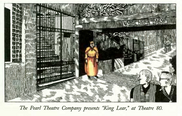
Update: In the lobby of the Pearl hangs a framed drawing cut out from the pages of The New Yorker. It appeared in the September 19, 1994, issue. Here it is (click to enlarge):
Take Part in the Tom Swifties Competition at Schott’s Blog!
Martin Schneider writes:
Yesterday morning Ben Schott kicked off a Tom Swifties competition at the New York Times website. It didn’t take me long to get quite swept up in the fun of composing them (I’d never really tried before), and apparently I’m not alone. A mere 36 hours later and there are nearly two thousand comments to the post.
Here are the ones I contributed (a few are pretty groan-worthy):
“Margaret Thatcher is the blame of this country’s problems,” said Nigel accusatorily.
“I’m going to carve an object out of this branch,” said Tom wittily.
“My favorite architect is from Spain,” said Tony gaudily.
“This list of great albums from the 1980s is missing Centerfold,” said Jay guilelessly.
“It is very important that we complete this dam,” Tom badgered the audience.
“These dumplings are delicious,” said Tom wantonly.
“I don’t really see the need for automobile insurance,” said Tom recklessly.
“Sis boom bah!” shouted Tom cheerfully.
“Which way is the ladies’ room?” asked Tom gently.
“I’d be interested in parting with the Minnesota Twins’ stadium at the right price,” the businessman said seldom.
“How am I going to affix this leaflet to this corkboard?” asked Tom tactlessly.
“I would never be able to find Italy on a map,” said Luigi bootlessly.
If nothing else, the competition may give our fecund Pollux ideas for a few delightful strips.
If you post any, by all means post them here as well!
Celebrate Dorothy Parker This Weekend, at Governor’s Island!
Martin Schneider writes:
The annual Parkerfest (it is the 11th) takes place on June 6 and 7. The always ambitious Kevin Fitzpatrick has much planned. (By the bye, June 7 is also the anniversary of Dorothy Parker’s death, in 1967.)
It will be held on Governors Island. Come attend a huge Roaring Twenties weekend, with vintage clothes, automobiles, live jazz, and outdoor cocktail parties.
The Governors Island Jazz Age Lawn Party is produced by Michael Arenella, who will lead his famous Dreamland Orchestra in “hot-and-sweet” period music. Vintage attire is encouraged, and there is a wide range of fun things to do both days.
All information about the schedule of activities, which runs from 11 AM to 5 PM, can be found the Society’s website.
Sign up for the Society’s newsletter, and you will be constantly up to date on all matters Parker-related.
Mastery of Syntax Fuels Apparent “Michael Jordan of Captioners”
Martin Schneider writes:
I was tickled by Steve Johnson’s post at the Chicago Tribune‘s website on Larry Wood, who has now won the New Yorker Caption Contest for the third time.
Here are Wood’s previous two victories. (Hat tip to David Marc Fischer’s indispensable Blog About Town.)
Reading between the lines, it seems that economical wording is key to the Chicago attorney’s success. Johnson quotes Caption Contest honcho Robert Mankoff that “Wood’s was clearly the best worded of several submissions that went after the same basic joke.”
Also noteworthy is the news that every week, Farley Katz, who administers the contest, “culls through the submissions, catagorizes [sic] them by type of joke.” It hadn’t really occurred to me that so many people would coincide on their jokes every week, but it does make sense.
Even readers with exceptional eidetic memory will probably need reminding that Wood is an Emdashes reader. Congratulations, Lawrence—or may I call you Larry?