
Martin Schneider writes:
New Yorker cover illustrator (and Twitterer) Bob Staake has posted a pictorial tour of his studio. He seems to have designed it with an eye toward convincing intelligent children (or humans of any age) that previous decades were waaaay more fun than today. Staake has a keen eye for old-timey bric-a-brac, which makes it just completely delightful. Go have a look.
Author Archives: Martin
If Pnin is In, Does That Mean Kilgore Trout is Out?
Martin Schneider writes:
Last week we posted the syllabus of Zadie Smith’s fiction seminar at Columbia University. I noticed that one of the books was Vladimir Nabokov’s Pnin. It triggered a memory: last October, on a New Yorker Festival panel with Hari Kunzru and Peter Carey, Gary Shteyngart answered moderator Peter Canby’s request to name a favorite or most influential work by intimating that he reads Pnin “once a month.”
I know the journalistic credo has it that once is an occurrence, twice a coincidence, thrice a trend. I have only the two mentions, yet nevertheless cry “Trend!” My impression is that Pnin is relatively obscure; it doesn’t come up in conversation much, at least not with the people I know. I’ve read four Nabokov novels, and Pnin isn’t one of them. As far as I know, Pnin is noteworthy for being somewhat more autobiographical than most of Nabokov’s work, as it is about a Russian emigre who is working in the United States as a professor.
So much for this focus group of one. Have you been running into Pnin lately?
As it happens, Pnin has a slight familial resonance for me; my father used to tell how impressed he was with the original Pnin stories when they appeared in The New Yorker in the mid-1950s, so it feels like I’ve been aware of it for years. I’m now traveling and have a limited number of books at my disposal, but, triggered by Shteyngart perhaps, elected to bring that one with me. I’ll get to it soon.
New Yorker Blog Roundup: 03.12.09
Martin Schneider writes:
I have the vague impression that the magazine’s newfound interest in its blog section has not penetrated the awareness of its audience, as much as one might hope. There has been a lot of activity over there since about Thanksgiving; there’s terrific writing there every single day, and you should check it out. Hence this recurring feature.
Also: Comments! Some of these blogs accept comments. Steve Coll’s “Think Tank” accepts them, Richard Brody’s “Front Row” accepts them, and George Packer’s “Interesting Times” accepts them. New terrain, indeed!
So go over and make those writers feel good—everyone appreciates a little feedback. And more to the point, make the magazine feel good about its decision to give you a voice!
As always, I’ll be putting this little message in front of the roundup: (This content is taken directly from the left nav bar on the magazine’s website.)
Steve Coll on why energy efficiency matters in a time of war.
Evan Osnos puts himself in Richard Nixon’s shoes.
The Front Row: Danny DeVito will tell the story of “Crazy Eddie.”
Hendrik Hertzberg revisits election results and reaches a conclusion.
News Desk: Grown men, in unfamiliar places, can do strange things.
James Surowiecki asks what it means to bury a bank.
George Packer praises a civil servant helping Iraqi refugees.
Sasha Frere-Jones finds his soulmate.
The Book Bench: Generation twit, is Joan Acocella a vampire?
The Cartoon Lounge: Warren Miller draws man’s best friend, playing dead, one million dogs.
Goings On: U2 disappoints fans, guess the name of Rihanna and Chris Brown’s duet.
Ask the Author: Submit a question to the editor the Style Issue, Susan Morrison.
Thru You, Through the New Yorker Blog, to Most of the Rest of Us
Martin Schneider writes:
A friend sent me a link to Kutiman’s marvelous “Thru You” website, and now I’m all excited about it. After the initial delight had worn off, I thought, “I wonder if Sasha Frere-Jones knows about this?”
Relax, man, his blog was on it way back last week (an eternity in meme propagation terms). Unsurprisingly, what he has to say is well worth a look.
But more to the point, go visit Thru You.
New to the Twittersphere: Richard Brody of “The Front Row”
Martin Schneider writes:
Richard Brody, who covers movies from “The Front Row” in the blogs section of the New Yorker website, has taken up Twitter.
The main New Yorker/Twitter post has been updated accordingly.
Area Twitterer Muses About Literary Magazine in 140 Characters or Fewer
Martin Schneider writes:
You guessed it, more New Yorker mentions from the aether! Let’s dive right in, shall we?
LeonardoZ Reading The New Yorker. Such a well written magazine. Wondering how even good mags can survive, specially in this economy.
cazelk It’s about time the New Yorker coughed up a solid 12,000 words on DFW. What do we pay them for again? Ohhhh right, I get it.
PaigeWiser The cover of the New Yorker magazine features Michelle Obama… with sleeves. Didn’t recognize her.
ericaceous Is there a bookstore in all of New York that carries anything by James Wood? He writes for the New Yorker, fer cripes sake!
judygoldberg I’m a finalists in this week’s New Yrker Caption Contest! I’ll just come right out and ask pls vote 4 me!!! http://tinyurl.com/anban5
mnreads listening to the new David Foster Wallace excerpt in the New Yorker, the read pronounces Edina, Minnesota wrong
nancheney David has the newly arrived New Yorker with the David Foster Wallace article. I had it first. grrrrrr.
alsolikelife: thinks David Denby’s New Yorker mumblecore piece reads like a teacher-parent consultation during PTA week: “Little Joey is making movies…”
wackjack I find it charming that The New Yorker still refers to publicists as press agents.
ErikHagen I like his beard so much that I want to draw pictures of it, and send them to the New Yorker to be published.
samduke left my new yorker at the taqueria only a 1/3 way through that epic DFW profile. 2nd time this week i’ve lost something before finishing it.
Cartoonless Captions Twitter: Inspired by TV on the Radio?
3/18: Catch the Simon Rich and Benjamin Nugent Event in Brooklyn
Martin Schneider writes:
There’s a fun event with two New Yorker luminaries on March 18 at the powerHouse Arena. From the press release:
The powerHouse Arena is pleased to invite you to a talk and reading
“Funny Because It’s True”
with Simon Rich and Benjamin Nugent
Moderated by Ben Greenman
Wednesday, March 18, 2009, 7-9PM
The powerHouse Arena
37 Main Street, Brooklyn
For more information: (718) 666-3049
RSVP: rsvp@powerhousearena.com
The powerHouse Arena invites you to a night of laughs, moderated by Ben Greenman, featuring Simon Rich, author of Free-Range Chickens and Ant Farm and Other Desperate Situations and Benjamin Nugent, author of American Nerd: The Story of My People.
About Free-Range Chickens
Simon Rich is a 24-year-old writer for Saturday Night Live, former president of The Harvard Lampoon, and author of the acclaimed book, Ant Farm (Random House, 2007). In his second book, Free-Range Chickens, Rich returns with another collection of humor pieces that mines more comedy from the absurdities of everyday life in our hopelessly terrifying world.
In short comic vignettes divided into sections such as “Growing Up,” “Going to Work,” “Relationships,” and a topic that has always puzzled him—”God,” Rich examines life’s biggest and smallest questions, from why people check their email every three minutes to God’s master plan for mankind.
In the nostalgic opening chapter, Rich recalls his fear of the Tooth Fairy (“Is there a face fairy?”) and his initial reaction to the “Got-your-nose” game (“Please just kill me. Better to die than to live the rest of my life as a monster”). He goes on to imagine office life as a “Choose Your Adventure Story” and later points out how we could all learn a lot about life and happiness by looking at the world through the eyes of free-range chickens. In his final chapter Rich imagines a conversation with God: Does God really have a plan for us? Yes, it turns out. Now if only He could remember what it was…
About American Nerd: The Story of My People
“American Nerd is very funny and consistently smart, but it’s also mildly controversial—I’m not sure I’ve ever seen these kinds of cogent, intuitively accurate arguments made about any ‘type’ of modern person. Benjamin Nugent is just weird enough to be absolutely right.”
—Chuck Klosterman, author of Sex, Drugs, and Cocoa Puffs
“The coolest book about nerds ever written. Heck, one of the coolest books ever written, period. Benjamin Nugent is the Richard Dawkins of geekdom. Outsiders of the world, this is required reading. Know your roots!” —Paul Feig, creator of Freaks and Geeks
“What everyone should be talking about…funny.”—GQ
Most people know a nerd when they see one but can’t define just what a nerd is. American Nerd: The Story of My People gives us the history of the concept of nerdiness and of the subcultures we consider nerdy. What makes Dr. Frankenstein the archetypal nerd? Where did the modern jock come from? When and how did being a self-described nerd become trendy? As the nerd emerged, vaguely formed, in the nineteenth century, and popped up again and again in college humor journals and sketch comedy, our culture obsessed over the designation.
Mixing research and reportage with autobiography, critically acclaimed writer Benjamin Nugent embarks on a fact-finding mission of the most entertaining variety. He seeks the best definition of nerd and illuminates the common ground between nerd subcultures that might seem unrelated: high-school debate team kids and ham radio enthusiasts, medieval re-enactors and pro-circuit Halo players. Why do the same people who like to work with computers also enjoy playing Dungeons & Dragons? How are those activities similar? This clever, enlightening book will appeal to the nerd (and anti-nerd) that lives inside all of us.
About the author:
Benjamin Nugent has written for The New York Times Magazine, Time, New York, and n+1. His first book, Elliott Smith and the Big Nothing, was published in 2004.
About the moderator:
Ben Greenman is an editor at The New Yorker and the author of several acclaimed books of fiction, including Superbad, Superworse, and A Circle is a Balloon and Compass Both: Stories About Human Love. His fiction, essays, and journalism have appeared in numerous publications, including The New York Times, the Washington Post, the Paris Review, Zoetrope: All Story, McSweeney’s, and Opium, and he has been widely anthologized.
His current projects include Correspondences, a limited edition handcrafted letterpress publication created by Hotel St. George Press and Please Step Back, a novel published by Melville House (due in April 2009). He is also a regular contributor to the music and psychology blog www.moistworks.com.
Best of the 03.09.09 Issue: Masters of the Universe
Martin Schneider writes:
Bob Staake’s takedown of Wall Street CEOs was on the cover. Features included Ian Parker’s report on Iceland’s economic collapse, D.T. Max’s look at the life of David Foster Wallace, and Sasha Frere-Jones’s appreciation of Lily Allen.
A Cheat Sheet for Ian McEwan, Confounding Modern “Master”
Martin Schneider writes:
Daniel Zalewski’s article “The Background Hum” clarified a few things in my mind about Ian McEwan. For the first time I realized that he mixes unlike traits. He’s either an exceptional writer who frequently writes bad books, or a pretty ordinary writer who had an unusually strong middle phase to his career. I favor the latter interpretation, but both will do.
Point being, let’s simplify, he’s a guy who’s written some very good books and some distinctly not-so-good books. This isn’t that unusual, I suppose, but McEwan’s kind of maxed out on his ability to do both things in the same career, which makes him cognitively difficult to get a handle on. He’s really incredibly famous—Britain’s “national author”—and very well-regarded, and he more or less escapes his proper share of abuse for the stinkers.
And by the way, no discredit to Zalewski, who repeatedly signals in the article that he understands this about McEwan, from the frank mention of Saturday‘s awkward contrivances to a friend’s “savage assessment” of McEwan’s prose to the nod to John Banville’s stinging review of Saturday in the New York Review of Books (link is courtesy of Mark Sarvas, a longtime McEwan detractor).*
Let me say now that I identify as a fan, and have for years, more or less. It’s precisely this enthusiastic self-identification that has made me notice how difficult some of his books are to defend.
Thing is, I had the luck to start with the good ones, beginning with his novella Black Dogs, which I liked a lot (even if, in retrospect, the ending is iffy). From there, in order: The Innocent, Amsterdam, Enduring Love, and Atonement, of which Amsterdam is the only true clunker of the bunch. Amsterdam is, I think, a bit scorned among McEwan enthusiasts because it won the Booker Prize, which was simply a mistake, they chose the wrong book, and it had the effect of making it difficult for his next book, Atonement, to get the support it deserved a few years later.
So, where was I? Right: Four winners in five books! I thought. Wow! This guy is the real deal! I was excited. After that, consistent with McEwan’s peculiar status, alluded to in the opening paragraph, came a surprise: the next five books I read (combining the very old and the very new) were close to an unmitigated disaster—and that group contained his best book.
To be precise: I read The Comfort of Strangers and The Cement Garden, earlier books, unremitting and unredeemable in my view. Then two newer ones: Saturday I had no choice but to abandon, and I rather liked the slight On Chesil Beach. And then, most recently, his midcareer masterpiece The Child in Time.
So, without further ado, here’s my scoresheet, ranked from good to bad with spaces to indicate significant differences in level:
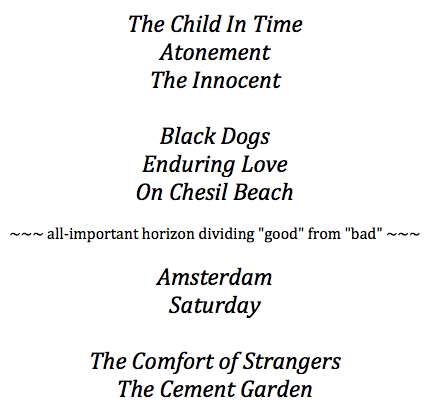
A remark or two: I really liked The Innocent, and I’m surprised it doesn’t get mentioned more often. It’s the book of McEwan’s that rises for lack of obvious flaws. And Enduring Love is justly noted for its exceptional opening section; but the book does not, in truth, deliver on that promise. It’s still one of the good ones; that and On Chesil Beach are the weakest of the good group.
Parenthetically, as I prepared this list, it struck me how much of a problem McEwan has with cute or otherwise inorganic endings, which are often clever, tacked on, tricksy. Many of the books have brief “codas” or some other framing device that jars, intentionally, with the main part of the book. Sometimes it works, and sometimes it doesn’t.
A clue to McEwan’s combination of successes and failures may lie in an impression of mine, at least, that he is especially beloved by a certain kind of reader who hasn’t always read that many top-notch novels; it’s hard to tell. McEwan is a little too good to be the “mere” poster boy for literary striving by the unsophisticated. And yet the people I know who have read really deeply (I am not counting myself in that group) don’t especially care for him.
I have a friend who amply qualifies as a person of that sort, and a few months ago we were discussing big-deal Anglo-American writers: Roth, McEwan, Mailer, D.F. Wallace, Vollmann, Amis, people like that. And at a certain point, apropos of nothing, implicitly addressing my McEwan fandom, she suddenly spat, “I mean—On Chesil Beach—” and I can’t rightly remember if her next utterance was “Ugh!” or “Come on!” but that should suffice to express her intended meaning.
On Chesil Beach? I thought. The thing’s not crap. It’s won awards. It was rather well turned. Small, slight, sure. But certainly pretty good.
And yet, and yet—in the meantime, I’ve come to understand her a little, I think. That business of being Britain’s “national author,” for one thing. Is it possible for a novelist to have a lamer identity? It’s worse than Michael Jackson’s insistence on being called the King of Pop. At this very moment McEwan, having completed a novel “about” 9/11, is off putting on the final touches of his novel about climate change. Saturday had few recognizable human beings, I don’t expect this next one to have any, either, for what I should think are obvious reasons.
Similarly, this business of disdaining literary values for scientific rigor…. it’s a bit much. The irony is that McEwan’s virtues are precisely literary ones, not intellectual ones.
For he does have virtues. His writing on the sentence level can be awfully good. And his reputation for a certain kind of sinister tension is well deserved. He’s got a little in common with Paul Auster, maybe—very good on the sentence level, with a good dose of high seriousness of an almost modernist kind, and with terrific narrative drive.
But he’s got something else. At his best, McEwan excels at a certain sort of wonderfully daring, original, and apt moment that is extraordinarily satisfying. He possesses the imagination to invent, sheerly invent, an audacious and yet very human detail that somehow brackets the artificiality of the rest of the novel and, indeed, of all fiction. The business with the balloon in Enduring Love is an example, but an even better one is the scene late in Black Dogs in which a serious confrontation in a French restaurant is unexpectedly undone by an absurdly misfired utterance. The Innocent and Atonement have something of this quality as well, situations of sufficient potency that they radiate worthiness to every other aspect of the book in question. What makes The Child in Time the best of McEwan’s books is that he was able to spread that effect across so much of the narrative, rather than isolate it to a single scene.
As I said before, McEwan had a helluva hot streak there in middle age. He’s written a short stack of very good books. You should go read those. And the rest? You’re on your own.
*) My memory of McEwan’s reception at The Elegant Variation was in error.