Martin Schneider writes:
I love this picture:
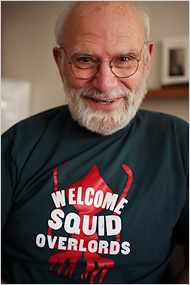
(Photo by Chester Higgins Jr., from “In Praise of Early Adapters,” The New York Times, March 9, 2008.)
Author Archives: Martin
George Packer Successfully Attains Hyphenate-dom
Martin Schneider writes:
It’s difficult to contemplate George Packer’s first play, Betrayed, without using the word authenticity, which aspect does not exhaust its virtues. I went into the performance imagining that it might be something of a chore, but it was far from that. Derived from Packer’s lengthy article of the same name, which ran in the March 26, 2007, issue of The New Yorker, the play is about two Iraqis whose well-nigh bottomless idealism towards the occupying/liberating Americans is put to the test.
Americophiles from way back, Laith, a Shiite, and Adnan, a Sunni, start working as translators in the Green Zone only to find themselves in a remorseless no man’s land, blithely treated as potential suicide bombers by their well-meaning but ultimately apathetic employers and reviled as traitors by their neighbors outside the Green Zone.
Chief among the charms of the evening, play and production alike, is the nuanced portrait of the duo at its heart. Likeable and fundamentally apolitical, Laith and Adnan gamely put up with a welter of indignities from the Americans, most of whom (with one notable exception) are content to do their jobs and not entertain the consequences of the fear-driven system in which they are operating.
The betrayal of the title recalls the myopia we showed in letting Hungary twist in the wind in 1956—not to mention the empty promises of 1991 so vividly portrayed in David O. Russell’s Three Kings, a movie with a somewhat similar agenda to Betrayed. Packer is, of course, first and foremost a reporter, and he lends the material a depth of observational detail that no ordinary playwright can match.
In recent times we have seen Tim Robbins’ play Embedded, Brian DePalma’s movie Redacted, Robert Baer’s movie Uncovered … it’s easy to get mixed up. I hope the conflation of title confusion and outrage fatigue prevents no engaged theater devotee from seeing Betrayed. It runs until April 13, so there’s plenty of time, and tickets are as low as $25 in a small room in which even the last row is a decent seat.
Academia and The New Yorker: The Next Wave
Levi Fox, Gretchen Sund, and Caroline Altman, three enterprising undergraduates from the American Studies Program at the University of Virginia, have put up a stimulating suite investigating the unique status of The New Yorker as a “local” magazine with a decidedly “national” profile.
According to the editor’s introduction, the suite “examines the people who defined New Yorker humor in its early days and drove the magazine’s success” and takes a look at its formerly “elitist advertising policy.” They look at some of the analogues of The New Yorker, both at home (Vanity Fair, Saturday Evening Post, Collier’s) and abroad (Germany’s Simplicissimus, London’s Punch) . They also take a peek at a few memorable wartime covers.
Good work! I hope that all three of them become passionate Emdashes readers—if they aren’t already!
Note: Thanks for The Millions for including a link to this in his most recent “Curiosities” post. Emily kindly reminds me that it’s been sitting in the Rossosphere for ages! I thought it looked familiar.
William F. Buckley, 1925-2008
Martin Schneider writes:
When I pondered William Buckley with reference to The New Yorker, my first thought was that someone so conservative must surely have scorned such a bastion of liberal sentiment. The Complete New Yorker archive shows such a supposition to be hostage to more recent Rove-ian (and not just Rove-ian) categories of political discourse. Buckley was a creature of a no less heated but perhaps a less doctrinaire age; his byline appeared in The New Yorker no fewer than 11 times.
His work for The New Yorker fell into two broad categories: articles about sailing and journal-like accounts of his daily lot. As Buckley in National Review possessed a vessel for his own political opinions, it likely never occurred to him to rail against the welfare state in the pages of The New Yorker.
I confess that to me, Buckley was a figure out of Doonesbury cartoons and Woody Allen movies from the 1970s. I don’t remember Firing Line. I have caught him on old episodes of The Dick Cavett Show, and I can tell that he must have been a delicious object of abhorrence for the East Coast liberals of the day. Next to Rove he looks positively benign; judging from his views on Iraq he was closer to the Upper West Side liberal of today than either side of that dyad ever would have imagined.
Buckley’s first contribution, a two-parter from 1971 billed in the Complete New Yorker as an account of his “activities in November,” looks especially interesting. Go check it out.
Update: On his blog, Hendrik Hertzberg posts this fond reminiscence of his encounter with the preeminent conservative. Elsewhere on the site, Ben Greenman directs us to a YouTube clip of Buckley and Gore Vidal being nasty to one another (these clips of Buckley debating Noam Chomsky are almost as compelling).
Comment Spam Verges On Ern Malley Grandeur
Martin Schneider writes:
Like most blogs’ comments sections, ours is daily inundated with quizzical and nonsensical appeals of indeterminate origin. Just now I came across this, which I think has a daft poetic integrity all its own:
Greetings!..
There was merrily!
The Regard! The Excellent forum! Thank you!
I feel like taking a bow.
Fact: “New” Plus “Jack Handey” Often Equals Laughter
Jack Handey has a book coming out! I just learned this, and it made me happy. Pub date is April 8! The title story, “What I’d Say to the Martians,” might be the funniest thing I’ve read in the past five years; you can read it here. How much “Shouts & Murmurs” stuff has made it to book form? I reckon Woody Allen and Steve Martin have pulled it off. Anyone else?
I love the cover, too:

New York’s Upright Citizens Brigade has been hosting a series of highly entertaining reading events to promote Ben Karlin’s new anthology, Things I’ve Learned From Women Who’ve Dumped Me. I went to the one last Thursday, and fellow “Shouts and Murmurs” alum Paul Simms read part of his very funny chapter.
At one point Brooke Shields showed up and told a great story about dating the not-yet-outed frontman for a very popular 1980s singing duo that must, alas, remain nameless.
Fun fact: Brooke Shields has never written a “Shouts & Murmurs” item!
“First Priest in White House” Encounters Prickly Troublemaker
Martin Schneider writes:
Obama takes Wisconsin, with Hawaii results to come.
In late 2006 a New Yorker podcast of David Remnick interviewing Barack Obama did a fair amount to convince me that Obama was my kind of candidate. There’s nothing like 45 minutes of sustained discourse (at that time, hard to come by) to clarify one’s impression of a person. I’ve supported Obama ever since.
Today, it’s a curio, but perhaps all the more interesting for being more than a year old. Here’s the file itself; here’s a transcript. Terms from the headline are derived from the interview (natch). Enjoy.
MSNBC’s Brian Williams Calls Ryan Lizza “Required Reading”
Martin Schneider writes:
It’s not every day that a major news network dedicates important programming time (Wisconsin and Hawaii today!) to a discussion of in exactly what ways a recent New Yorker article is so awesome, as happened just a few minutes ago (a little before 2 p.m. Eastern). The article in question was Lizza’s look at John McCain in the most recent issue. They even showed a screenshot of the New Yorker website.
Update: They kept Lizza on after the 2 p.m. jump—he’s rather telegenic! I hope to see more of him.
Gladwell Raises New and Troubling Questions About New and Troubling Questions
Martin Schneider writes:
The Adam Baumgold Gallery has been on New Yorker streak lately. In addition to showcasing a number of intriguing works by Saul Steinberg, the gallery is putting on “Chris Ware: Drawings for New York Periodicals,” which features a number of New Yorker covers in the draft stage. Here are a couple of examples:

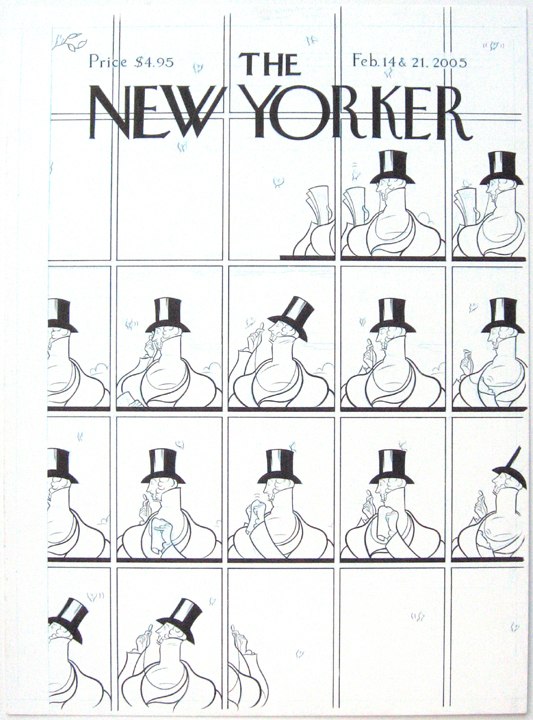
I find these images haunting; I don’t know why. I run a little hot and cold on Ware, but his technique is undeniably staggering. Judging from these images, the show provides a great deal of insight into his way of working.
The gallery is located at 74 East 79th Street, and the show runs through March 13. I can’t wait to check it out.
Meanwhile, in a more aural vein, last week’s episode (#348) of This American Life featured Malcolm Gladwell describing some prankery from his days at The Washington Post. The mp3 is available on TAL‘s website, and you can also get it on iTunes. For those who don’t own iPods or are allergic to podcasts, Gladwell told a version of this story in a 1996 Slate diary.
Eustace Tilley Conquers Austria
Martin Schneider writes:
My mother is the American correspondent for the Austrian newspaper Der Standard. Recently she started a blog on American topics, a mix of quick bursts about the primaries (for now) and clarifications of American expressions or habits that never get explained in the standard resources that a German-speaking audience would consult (“selling the Brooklyn Bridge,” “Dear John letter,” and so on).
The recent Obama/Clinton cover remix prompted her on Monday to introduce her readers to a certain waistcoated dandy. Whether you read German or not, enjoy the Eustace-y goodness.
Update: Confronted with a deluge of requests (well, one), I supply the following quick and dirty translation. I fully await adjustment from my mom, who has me cornered in the German department.
“The New Yorker, yes, The New Yorker” for a long time was the theme of an ad campaign for this esteemed magazine. This statement of confirmation was the answer to the astonishment of an unseen listener in the face of all of the interesting, unexpected, and not-at-all-old-fashioned things that could these days be found in the by no means stodgy New Yorker.
Once again, The New Yorker has surpassed everyone: The following cover [refers to first link below, Clinton/Obama Eustace cover] is a variation on the likeness of a certain Eustace Tilley, a made-up character who every February for decades (indeed, from the very beginning) captured in simultaneously traditional and satirical (“tongue-in-cheek”) fashion the cool detachment of New Yorker readers.
The week of February 5 (it’s the edition of February 11, but it appears much earlier) The New Yorker ran the following cover:
http://www.newyorker.com/images/covers/2008/2008_02_11_p323.gif
I am perhaps also permitted to hark back to the simple, elegant, and endlessly moving New Yorker cover after 9/11:
http://en.wikipedia.org/wiki/Image:Spiegelman-cover.jpg
Hope that helps!
—MCS